What are Conditional statements ?
In any programming language we need a ability to check given conditions whether it is satisfied or not and allows execution of statements accordingly. Such ability is provided by Conditional statements also known as selection control statements.
- Conditional statements is controlled by boolean expressions in it.
- If the boolean expression is satisified i.e., true then it executes all the statements indented in conditional block.
- If the boolean expression is not satisified i.e., false then it ignores the statements inside the conditional block and jumps to the next line in the code.
What is the use of conditional statements ?
- Execute statements selectively based on the condition provided.
- This helps to improve efficiency of code by providing the ability to control of execution of code.
Python language supports different types of conditional statements which are as follows:
- if statement
- if - else statement
- Nested if statement
- Chained conditional statements
- if statement is frequently used in conditional statement.
Syntax of if statement:
if (expression):
statement(s)
-
Expression consists of boolean expressions.
-
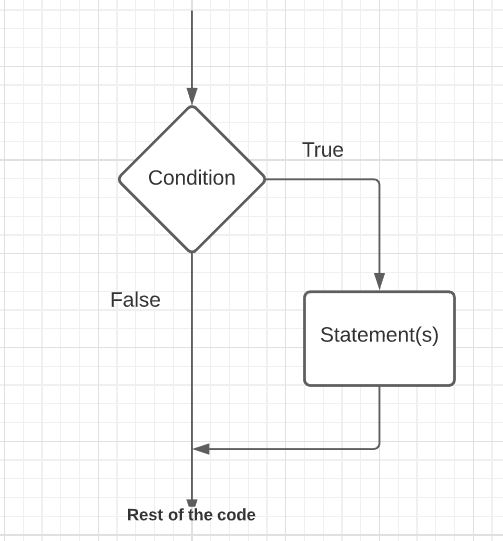
if statement evaluates the boolean expression
- if the expression returns TRUE, then it evaluates block of indented statement(s) present inside the if statement.
- if the expression returns FALSE, then it ignores and executes next statements in the code
-
Points to be remembered:
- Colon (':') is must after if statement, otherwise an error will occur.
- Indentation must be followed after if statement (usually 4 spaces or 1 tab space), otherwise an error will occur.
- It is not necessary to enclose the expression inside any parentheses().
-
Let us take a look at the flow chart for better understanding,
Lets us try to work on few examples:
x = 10 #x is initialised with 10
y = 4 #y is initialised with 4
if x>y: #Boolean Expression
    print("x is greater than y")
x is greater than y
x = 10 #x is initialised with 10
y = 4 #y is initialised with 4
if x>y: #Boolean Expression
print("x is greater than y")#Without indentadtion
File "<ipython-input-6-bff1c9bc8e4f>", line 4
print("x is greater than y")
^
IndentationError: expected an indented block
As indentation is not followed after the if statement an has occured.
if 'PineApple' in ['Mango','Orange','Apple','Kiwi']:
    print("TRUE")
print("FALSE")
False
Here, we can observe that the condition pineapple is not in the given list the if block is not executed and executed the next line prints the FALSE.
if x>y
print(x)
File "<ipython-input-11-65734aeaf3c5>", line 1
if x>y
^
SyntaxError: invalid syntax
Here colon(':') is not used so it generated an syntax error.
- else statement is used for alternative execution.
Syntax of else statement:
if (expression):
statement(s)
else:
statement(s)
-
Expression consists of boolean expressions.
-
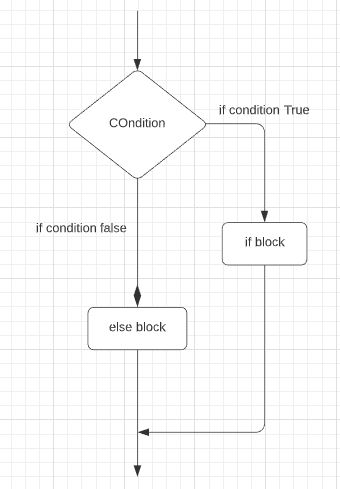
if statement evaluates the boolean expression
- if the expression returns TRUE, then it evaluates block of indented statement(s) present inside the if statement and ignore else block.
- if the the expression returns FALSE, then it ignores if block and executes else block.
-
Points to be remembered:
- Colon (':') is must after if statement and else statement, otherwise an error will occur.
- Indentation must be followed after if statement (usually 4 spaces or 1 tab space), otherwise an error will occur.
- It is not necessary to enclose the expression inside any parentheses().
-
Let us take a look at the flow chart for better understanding,
Lets us try to work on few examples:
x = 9
if x%2 == 0 :
    print('x is even')
else :
    print('x is odd')
x is odd
As the condition is false it executes the else statement and prints x is odd.
x = 14
y = 4
if x<y:
    print("x is less than y")
else:
    print("x is greater than y")
x is greater than y
- Let's take an example from our routine life Question : Students greater than or equal to 9 CGPA are eligible to interview for an XYZ company and remaining are not eligible.
CGPA = float(input("CGPA: "))
if CGPA >= 9:
    print("Congratulations..!! You are eligible for the interview")
else:
    print("Sorry, you aren't eligible")
CGPA: 8.9
Sorry, you aren't eligible
Here, given input is 8.9 which is less than 9 so it ignored "if block" and executed "else block" as the student CGPA is not matching the companies eligibility criteria so it printed Sorry, you aren't eligible
- Let's take another example.
Question: Mr Dev went to market for buying an pine apple. if pine apple is available print stock available otherwise out of stock.
if 'PineApple' in ['Mangoes','Oranges','Apples','Kiwis']:
    print("Stock Available")
else:
    print("Out of stock")
Out of stock
As there are only mangoes, oranges,apples,kiwis in market it printed out of stock
- Nested if statements are used to check whether more than one condition is satisfied.
- Here if statements are placed one inside the other
Syntax of Nested-if statement:
if (expression):
statement(s)
if(expression):
statement(s)
-
Expression consists of boolean expressions.
-
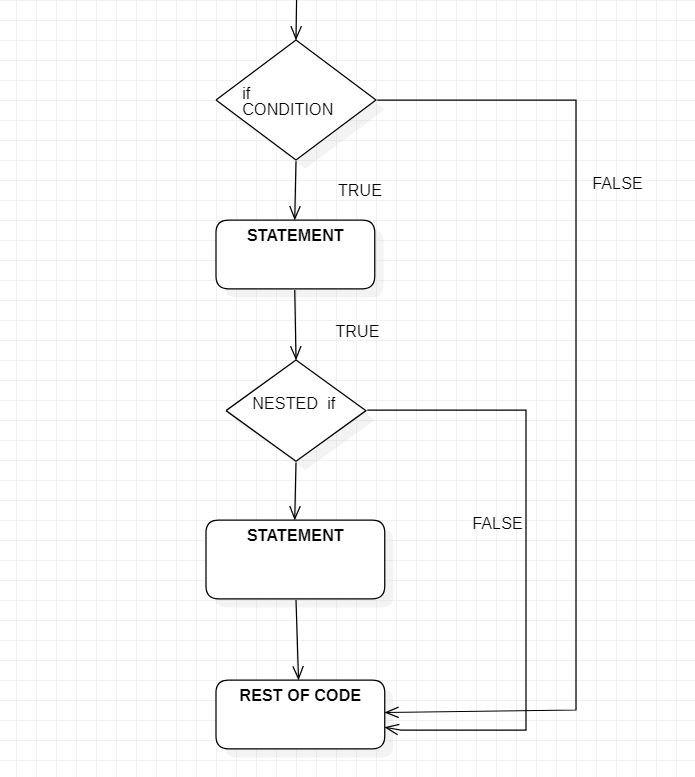
if statement evaluates the boolean expression
- if the expression returns TRUE, then it evaluates block of indented statement(s) present inside the if statement and enters to the nested if statements and executes the block indented statements.
- if the expression returns FALSE, then it ignores if, nexted if blocks and executes next statements in the code
-
Points to be remembered:
- Colon (':') is must after if statement and else statement, otherwise an error will occur.
- Indentation must be followed after if statement (usually 4 spaces or 1 tab space), otherwise an error will occur.
- It is not necessary to enclose the expression inside any parentheses().
-
Let us take a look at the flow chart for better understanding,
Lets us try to work on few examples:
a = 4 #intialised a with 4
if (a>0): #Condition
    print("It is Positive number")
    if (a<5):
        print("Number is less than 5")
It is Positive number
Number is less than 5
- Let's take an example from our routine life
Question : Students greater than or equal to 9 CGPA are eligble for aptitude test, scoring 90 will get opportuinity for interview in XYZ company.
CGPA = 9
Aptitude = 95
if CGPA >= 9:
    print("All the best for aptitude, scoring 90 will help you to get opportunity for interview")
    if Aptitude >=90:
        print("\nCongratulations..!! You are eligible for the interview")
All the best for aptitude, scoring 90 will help you to get opportunity for interview
Congratulations..!! You are eligible for the interview
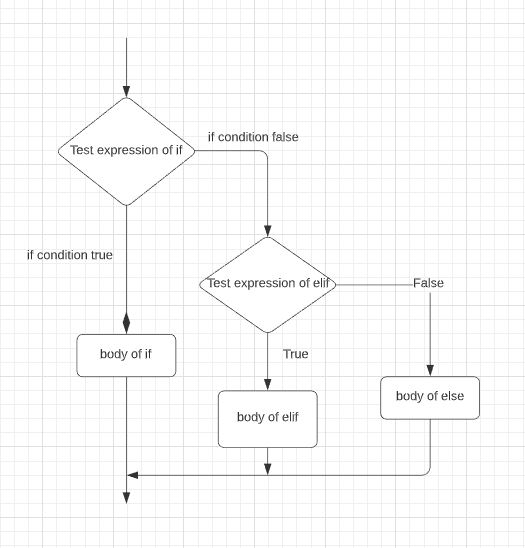
- Chained conditional statements comes into action when we require more than two possibilities.
- Chanined conditional statements consists of if, elif(short for else if), else.
Syntax of Chained conditional statement:
if (expression):
statement(s)
elif(expression):
statement(s)
else:
statement(s)
-
Expression consists of boolean expressions.
-
if statement evaluates the boolean expression
- If that expression returns to TRUE then it goes into if block.
- If it returns to FALSE, then it goes to elif and executes the condition of the elif block.
- If the condition in the elif bock returns TRUE , then the elif block is executed.
- If the condition in elif block returns FALSE , then the code in the else block is executed.
-
Points to be remembered:
- Colon (':') is must after if statement and else statement, otherwise an error will occur.
- Indentation must be followed after if statement (usually 4 spaces or 1 tab space), otherwise an error will occur.
- It is not necessary to enclose the expression inside any parentheses().
-
Let us take a look at the flow chart for better understanding,
Let us try to work on few examples:
Question: To check whether given input is divisible by 2 or 3 or nothing.
a = int(input("number: "))
if a%2==0:
    print("given number is divisible by 2")
elif a%3==0:
    print("given number is divisible by 3")
else:
    print("given number is neither divisible by 2 nor 3")
number:2
given number is divisible by 2
- Let us take an example from our routine life,
Question: XYZ University provides concession in fee based on their marks obtained in entrance test. They are as follows:
| Percentage | Concession |
|---|---|
| 100 | 100% |
| 95 to 99 | 75% |
| 90 to 94 | 50% |
| 80 to 89 | 25% |
| 70 to 79 | 10% |
| 60 to 69 | 5% |
No concession for students who scored below 60 marks.
a = int(input("Marks:"))
if a>100:
    print("Please enter valid Marks")
elif a==100:
    print("Congratulations...!! you got 100% concession")
elif a in range(95,100):
    print("Congratulations...!! you got 75% concession")
elif a in range(90,95):
    print("Congratulations...!! you got 50% concession")
elif a in range(80,90):
    print("Congratulations...!! you got 25% concession")
elif a in range(70,80):
    print("Congratulations...!! you got 10% concession")
elif a in range(60,70):
    print("Congratulations...!! you got 5% concession")
else:
    print("Sorry...!! you aren\'t eligible for concession")
Marks:60
Congratulations...!! you got 5% concession
Summary:
- Conditional statements in python is evaluated using boolean expressions.
- Executes statements selectively based on the condition provided.
- Various types of conditional statements are: if,else,nested-if, if-elif-else
- If a condition is true, the "if" statement executes.
- else statement is executed when "if" statement condition is evaluated as false.
- A nested-if statement is an if statement placed inside another if statement.
- Chained conditional statement is if-elif-else.
- Indentation is white spaces (usually 4 spaces or 1 tab) that indicates the statements belong to same block
- Avoiding colon(":") after if,elif,else will result in syntax error.
- Ignoring indentation in if,elif,else will result in indentation error.
Now let's try implementing all the an example as summary of conditional statements
Code a program using conditional statements
- Take year and month as input
- Find whether entered year is leap year or not
- Find no of days in entered month
Year = int(input ("Year: " ) )
month = int(input("Month: " ) )
if ((Year % 4 ) == 0 and (Year % 100 ) != 0 or (Year % 400 ) == 0 ):
       print("Leap Year")
       if(month == 1 or month == 3 or month == 5 or month == 7 or month == 8 or month == 10 or month == 12):
               print("There are 31 days in this month " )
       elif ( month == 4 or month == 6 or month == 9 or month == 11 ):
           print("There are 30 days in this month " )
       elif ( month == 2 ):
           print("There are 29 days in this month " )
       else:
           print("Invalid month ")
elif ( ( Year % 4 ) != 0 or ( Year % 100 ) != 0 or (Year % 400 ) != 0 ):
    print("Non Leap Year " )
    if ( month == 1 or month == 3 or month == 5 or month == 7 or month == 8 or month == 10 or month == 12 ):
        print("There are 31 days in this month" )
    elif ( month == 4 or month == 6 or month == 9 or month == 11 ):
            print("There are 30 days in this month " )
    elif ( month == 2 ):
            print("There are 28 days in this month ")
    else:
            print("Entered month is not valid" )
else:
       print( " Entered year is not valid" )
Year: 2021
Month: 6
Non Leap Year
There are 30 days in this month
