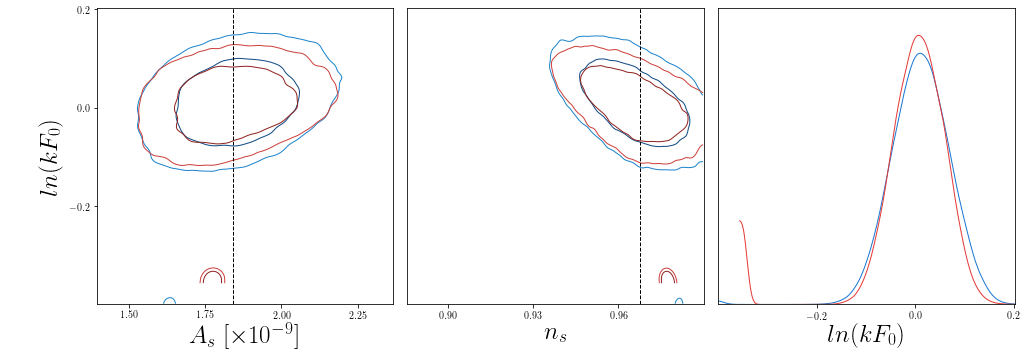
Noticed this morning in a posterior for ln_kF_0 that the posterior doesn't quite reach the edge of the prior volume. This is not a problem with the likelihood class - I can manually get log likelihood evaluations right up to ln_kF_0=-0.4 and the likelihood returns a sensible value, and the parameter limits are set correctly:
with_kf.like.log_prob(values=[0.01,0.01,0.01,0.01,0.01,0.00001])
-220.51340777287453
(kF is the last parameter in the list)
When I look at the chains in unit space:
min(chains_kf[:,4])
0.00622525926085965
vs the lines in blue
min(chains_full[:,4])
2.1792072202320156e-07
So for some reason the sampler is never sampling beyond this value in the case of the red chain, instead the chains are accumlating at what appears to be an artificial peak in the likelihood that I cannot recreate in likelihood scans. Bookkeeping files for each of these are below for reference. I'm unsure whether this points to a broader issue with the sampler.
Blue chain:
info.txt
Red chain:
info.txt


Noticed this morning in a posterior for ln_kF_0 that the posterior doesn't quite reach the edge of the prior volume. This is not a problem with the likelihood class - I can manually get log likelihood evaluations right up to ln_kF_0=-0.4 and the likelihood returns a sensible value, and the parameter limits are set correctly:
(kF is the last parameter in the list)
When I look at the chains in unit space:
vs the lines in blue
So for some reason the sampler is never sampling beyond this value in the case of the red chain, instead the chains are accumlating at what appears to be an artificial peak in the likelihood that I cannot recreate in likelihood scans. Bookkeeping files for each of these are below for reference. I'm unsure whether this points to a broader issue with the sampler.
Blue chain:
info.txt
Red chain:
info.txt