When coding kpno-allsky, I created functionality to correct for fisheye lens distortions:
https://github.com/dylanagreen/kpno-allsky/blob/e6e711b0ddbe4fc8a6beb9f94e73bbd38e54a02c/coordinates.py#L486-L548
It would be beneficial to do the same for the spacewatch camera, and then apply these corrections to the desipoint images. The suggested method is to use Aaron Meisner's bright star catalog and find the differences between the predicted star location and the true star location on the image. An example of the distortion uncorrected image was generated by Anand:
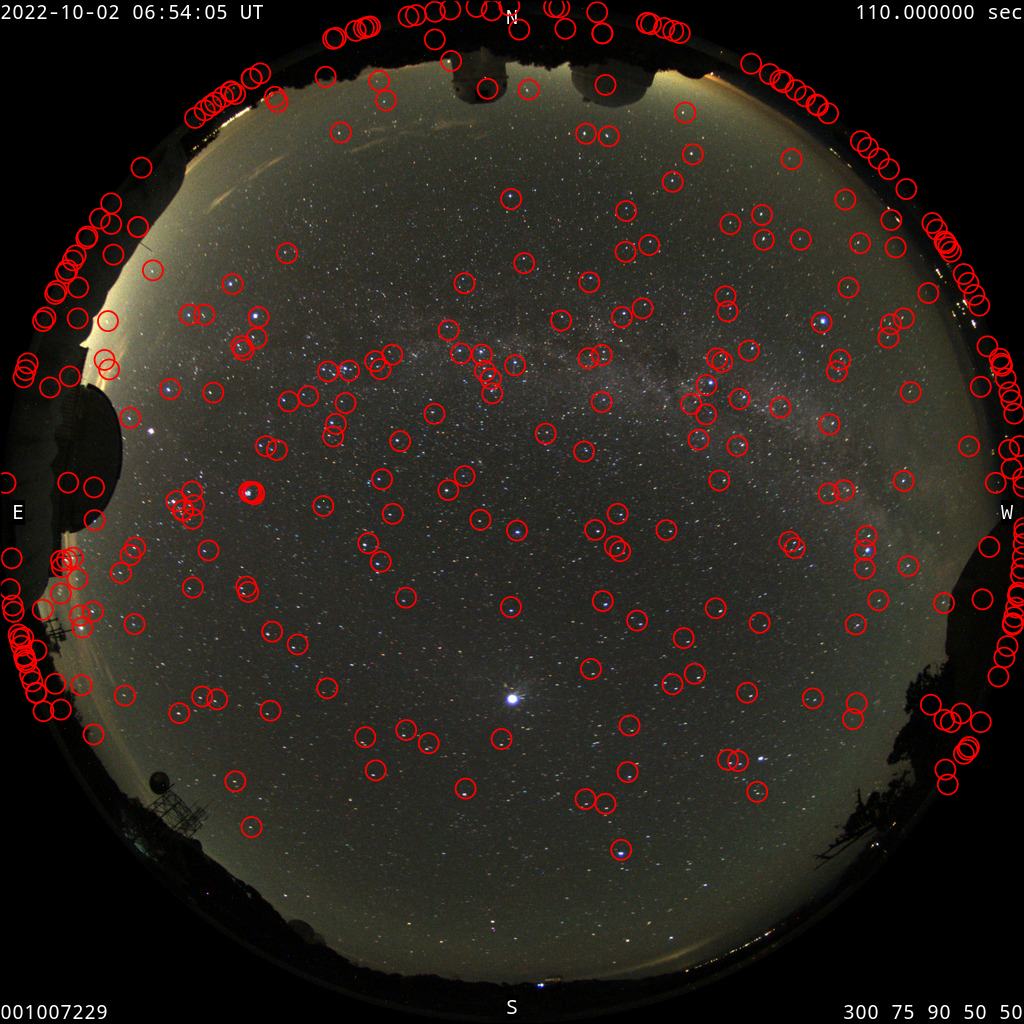
With sufficient year round images we can get good coverage over the entire lens. Code for determining true star position is in kpno-allsky: https://github.com/dylanagreen/kpno-allsky/blob/e6e711b0ddbe4fc8a6beb9f94e73bbd38e54a02c/coordinates.py#L551
David Kirkby has suggested using a Zhao-Burge fit to model the distortion.

When coding kpno-allsky, I created functionality to correct for fisheye lens distortions:
https://github.com/dylanagreen/kpno-allsky/blob/e6e711b0ddbe4fc8a6beb9f94e73bbd38e54a02c/coordinates.py#L486-L548
It would be beneficial to do the same for the spacewatch camera, and then apply these corrections to the desipoint images. The suggested method is to use Aaron Meisner's bright star catalog and find the differences between the predicted star location and the true star location on the image. An example of the distortion uncorrected image was generated by Anand:
With sufficient year round images we can get good coverage over the entire lens. Code for determining true star position is in kpno-allsky: https://github.com/dylanagreen/kpno-allsky/blob/e6e711b0ddbe4fc8a6beb9f94e73bbd38e54a02c/coordinates.py#L551
David Kirkby has suggested using a Zhao-Burge fit to model the distortion.