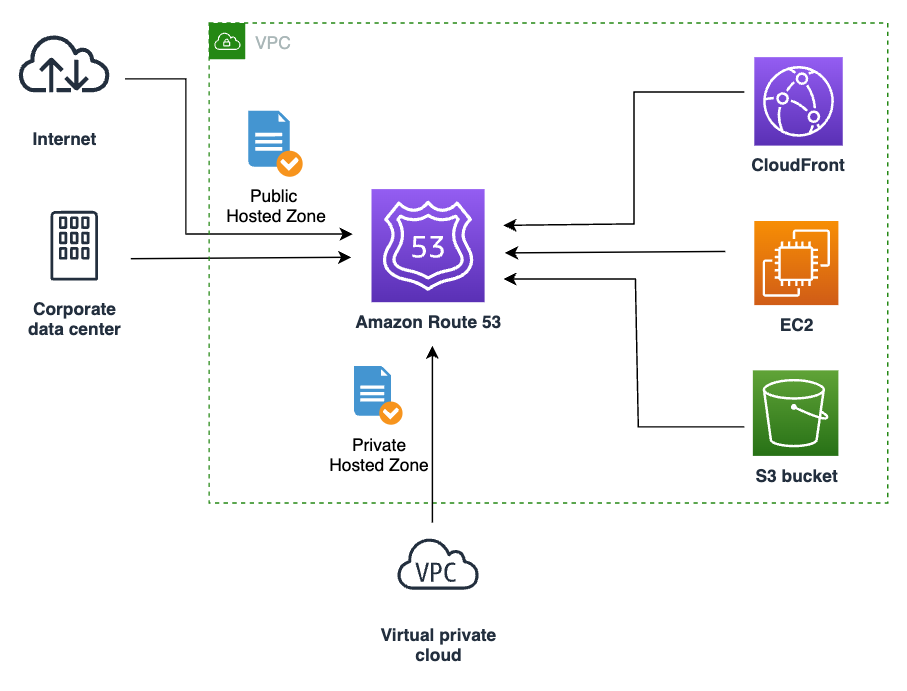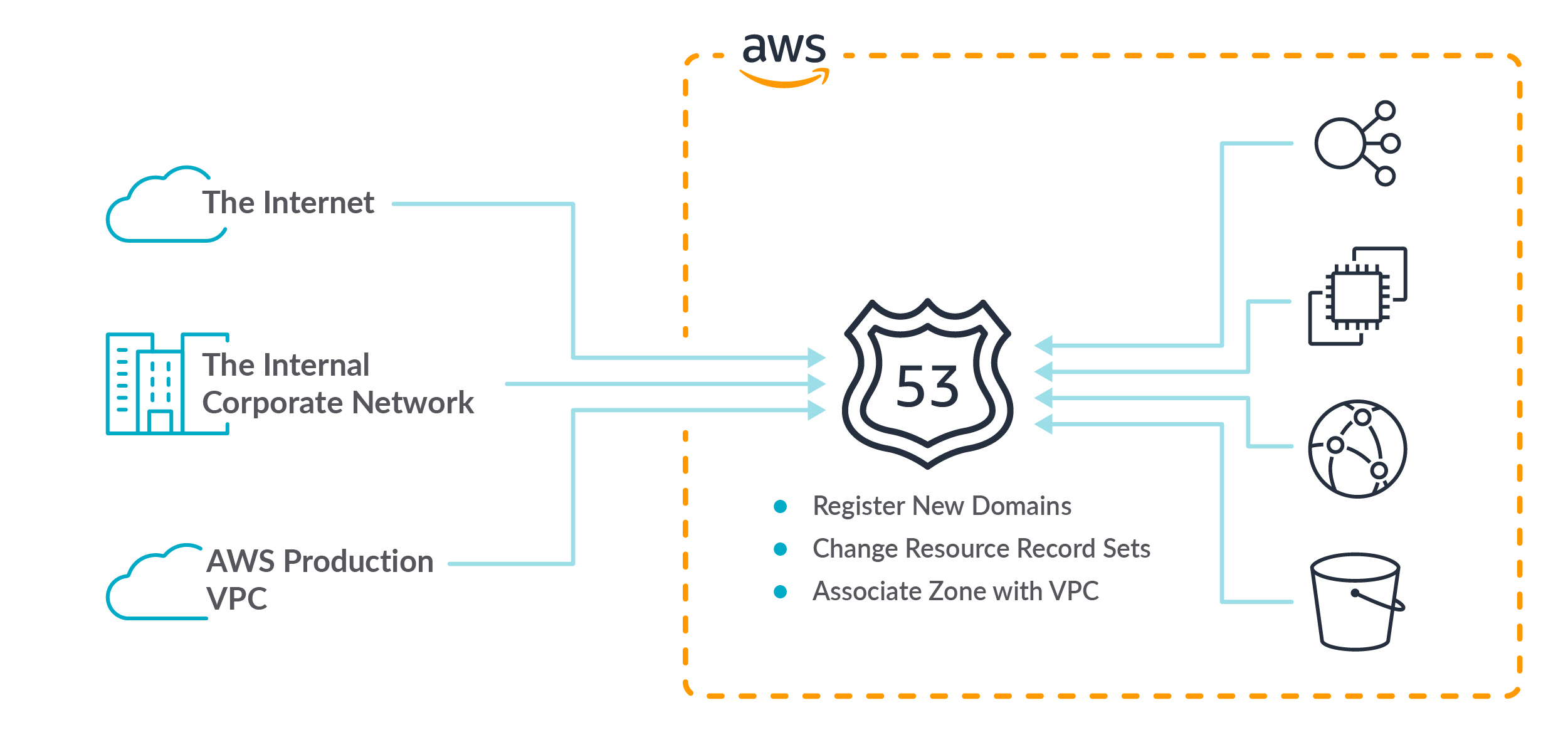
- Managed DNS & Domain Registry: AWS’s highly available and scalable Domain Name System (DNS) service, launched in December 2010. The name refers to DNS’s port (TCP/UDP 53).
- DNS resolution for AWS & external endpoints: Routes users to AWS services (EC2, ELB, S3, CloudFront, API Gateway, WorkMail, Lightsail, VPC endpoints) and non-AWS resources.
- Alias record type: Proprietary server-side equivalent of CNAMEs—resolves at apex domains and supports AWS targets without extra cost.
- CloudTrail: Logs all Route 53 API calls for auditing.
- CloudWatch: Monitors health-check status and metrics like DNS query volume, latency.
- Well-Architected integrations: Use Alias records to point to ELB, CloudFront, S3 static sites, API Gateway, WorkMail, VPC endpoints.
- Route 53 Resolver: Provides recursive DNS within VPCs, plus inbound/outbound endpoints for hybrid (on-prem ⇄ AWS) DNS, forwarding rules, and firewall features.
- Traffic Flow / Application Recovery Controller: Advanced routing (latency-based, geo, geoproximity, weighted, failover) and DNS-level failover and recovery controls.
- Simple: One-to-one mapping—good for straightforward setups.
- Weighted: Distribute traffic (e.g., blue-green, A/B testing).
- Latency-based: Route to lowest-latency region for global apps.
- Geolocation / Geoproximity: Route based on user location or proximity; “bias” allows traffic steering.
- Multi-value Answer: Returns multiple healthy IPs; simple load distribution.
- Failover: Active-passive high availability with health checks.
- IP-based: Route based on client IP ranges—useful for internal vs external traffic logic.
Use Cases:
- Global applications: Improve performance and availability using latency or geo routing.
- Disaster recovery: Failover routing with health checks.
- Testing/deployment: Weighted routing for traffic shifting.
- Hybrid DNS: Use Resolver endpoints for on-premises integration.
- Apex domain support: Alias records for root domain to AWS targets.
-
Within AWS:
- Route 53 Resolver (intra-VPC DNS and hybrid scenarios).
-
External DNS providers:
- Google Cloud DNS, Azure DNS, Cloudflare DNS, Dyn, NS1.
Route 53 has service quotas you can view or request increases via AWS Service Quotas :
Hosted zones:
- Default: 500 per account (increased on request).
- Delegation sets: 100 per reusable set.
Records:
- Max 10,000 records per hosted zone; >10,000 incurs extra charges.
- 400 records per record set; 100 geolocation/weighted/etc. of same name+type.
- Geoproximity: 30 same name/type; CIDR collections limited.
Resolver (Hybrid):
- Endpoints: 4 per region; 6 IPs per endpoint; 1000 rules; 2000 associations.
- UDP QPS: ~10,000 per IP; use multiple ENIs for higher loads.
Costs:
- Resolver endpoints: ~$0.125 per ENI per hour + query charges ($0.40/million up to 1B; $0.20 thereafter).
Exceptions:
- LimitExceededException when quotas are exceeded—handle via optimization or Service Quotas request.
- Use Alias records to AWS targets for cost and flexibility.
- Balance TTL: low TTL = fast changes, high traffic; high TTL = cache efficiency but slower updates.
- Monitor DNS health and metrics via CloudWatch and set alerts.
- Use multi-AZ subnets for Resolver endpoints; avoid routing loops; specify static IPs for resiliency.
- For Resolver, enable capacity utilization metrics and integrate alarms for scaling.
- Not a substitute for ELB: Use multi-value answer only for simple distribution; not load balancing.
- Low QPS at Resolver endpoints: Cheap approach but may cost more; better to use private hosted zone associations if within AWS.
- Complex routing internal only: Avoid if overcomplicating; internal tools or simpler DNS may suffice.
- Using Route 53 where regional DNS or internal corporate DNS is preferred: e.g., for internal-only resolution without VPC/VPC endpoints.
| Topic | Key Points |
|---|---|
| Definition | Managed DNS + Domain registrar; supports AWS & non-AWS |
| Routing | Simple, Weighted, Latency, Geo, Geoproximity, Multi-value, Failover, IP-based |
| Integration | Works with ELB, CloudFront, S3, API GW, VPC, CloudWatch, CloudTrail |
| Limits | Hosted zones, records, Resolver rules/endpoints, QPS, cost quotas |
| Best Practices | Use Alias, monitor metrics, choose TTL wisely, use multiple AZs, capacity metrics |
| Wrong Uses | Not for load balancing, internal DNS only, cost-heavy hybrid usage, over-engineering |