A Python package (battle-tested C++ under the hood) for calculating integrated loudness (LUFS) with the ITU BS.1770 loudness algorithm. Useful for EBU R 128 compliance. Takes NumPy arrays as input (supports mono and stereo/multichannel). Based on libloudness (original implementation by Magnus Bro Kolstø, Nomono).



pip install loudness
import soundfile as sf
import loudness

audio, sr = sf.read("audio.wav", dtype="float32")  # shape (samples, channels)
lufs = loudness.integrated_loudness(audio, sr)
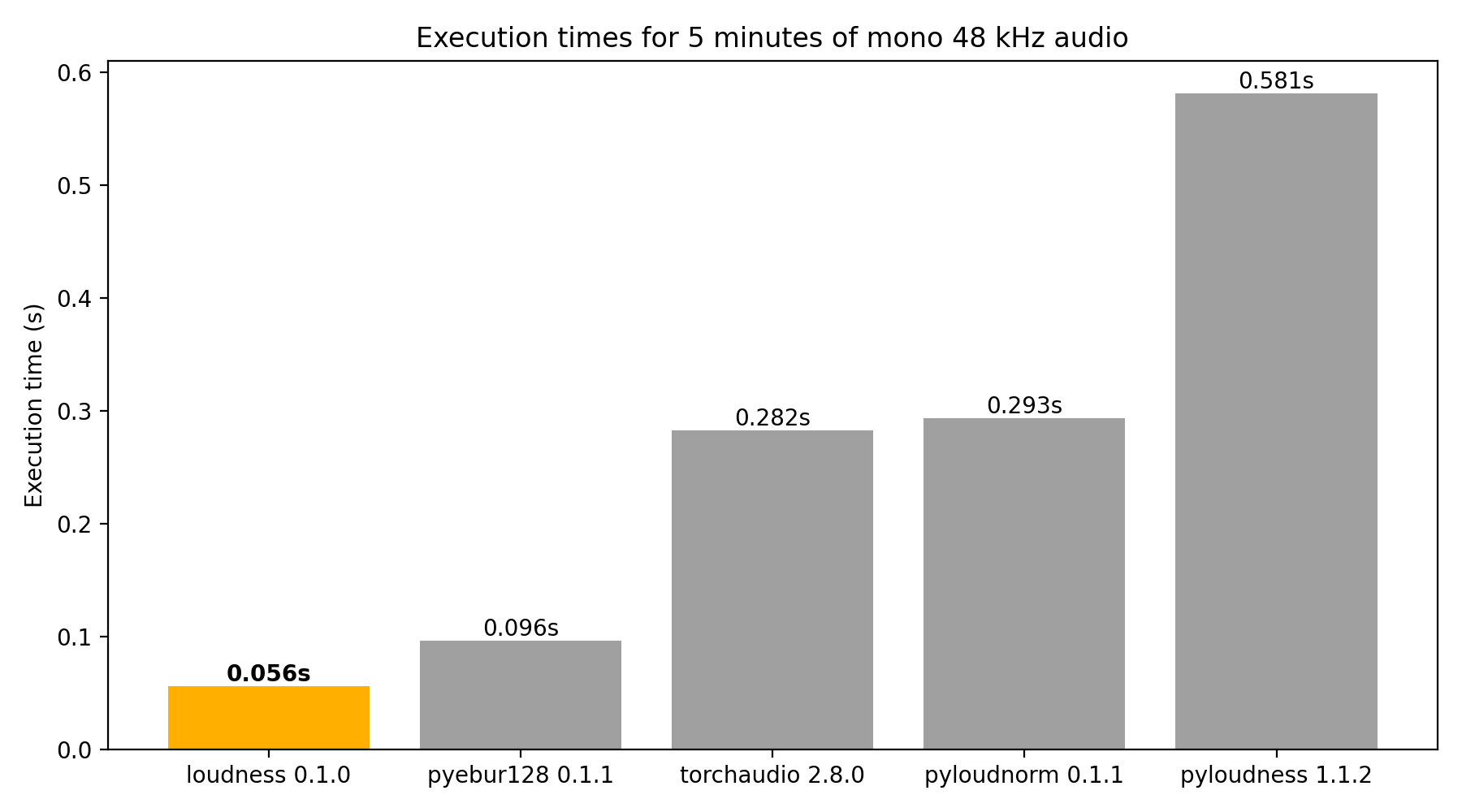
print(f"{lufs:.2f} LUFS")loudness is significantly faster than the alternatives when running on CPU:
- Add support for Python 3.14
- Remove support for Python 3.9
For the complete changelog, go to CHANGELOG.md
- Install CMake and a C++ compiler
pip install numpy pybind11 build scikit-build-corepython -m build --wheel- Install the built wheel
pytest
| Name | Github stars | License | Last commit |
|---|---|---|---|
| jaxloudnorm |  |
 |
 |
| loudness |  |
 |
 |
| PALA |  |
 |
 |
| pyebur128 |  |
 |
 |
| pyloudness |  |
 |
 |
| pyloudnorm |  |
 |
 |
| torchaudio |  |
 |
 |