causaleffect is a Python library for computing conditional and non-conditional causal effects.
Version 0.1.0 requires Python 3.11 or newer:
python -m pip install "causaleffect==0.1.0"For plotGraph, install the plotting extra:
python -m pip install "causaleffect[plot]==0.1.0"For Python 3.7–3.10, install the 0.0.2 release instead:
python -m pip install "causaleffect==0.0.2"Its source is preserved in the 0.0.2 Git tag. Python 3.11+ users can also pin that version.
For plotting with 0.0.2, install pycairo or cairocffi separately.
For local development and checks, see Contributing.
If we want to compute the causal effect P(y|do(X=x)) from the causal diagram shown below,
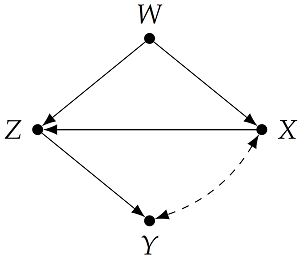
we first create and display the graph:
import causaleffect

G = causaleffect.createGraph(["X<->Y", "Z->Y", "X->Z", "W->X", "W->Z"])
causaleffect.plotGraph(G)
which renders the following image
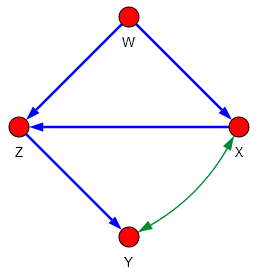
Then we can compute the causal effect by executing:
P = causaleffect.ID({"Y"}, {"X"}, G)
print(P.printLatex())
The code above computes the causal effect, and returns a string encoding the distribution in LaTeX notation:
\sum_{w, z}P(w)P(z|w, x)\left(\sum_{x}P(x|w)P(y|w, x, z)\right)
This string, in LaTeX, is

If the effect is not identifiable, ID returns a Probability with identifiable == False. Its hedge contains the two C-forest graphs; use causaleffect.printGraph(P.hedge[0]) and causaleffect.printGraph(P.hedge[1]) to inspect them.
Start with the quickstart script for identifiable, conditional, and confounded effects.
Other examples from the dissertation:
| Figure number | Example file |
|---|---|
| Figure 3.5 (a) | example_1.py |
| Figure 3.6 (a) | example_2.py |
| Figure 3.6 (b) | example_3.py |
| Figure 3.10 | example_4.py |
| Figure 3.12 | example_5.py |
| Figure 3.13 | example_6.py |
| Figure 3.15 (a) | example_7.py |
| Figure 3.15 (b) | example_8.py |
| Figure 3.16 | example_9.py |
Read the API guide or the generated API reference. The dissertation explains the algorithms.
Run the benchmark with python benchmarks/benchmark.py. Results are local timing measurements, not performance targets.
See the changelog.
If you use causaleffect in research, please cite:
Pedemonte, M., Vitrià, J., & Parafita, Á. (2021). Algorithmic Causal Effect Identification with causaleffect. arXiv. https://doi.org/10.48550/arXiv.2107.04632