Emulation for CPU Stack and simplifying its process . Simplifying x86 Assembly to C language
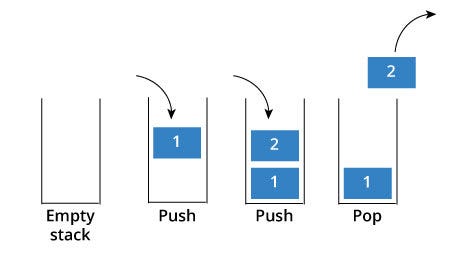
This project is to simplify how the stack works and the process of PUSH/POP
This is the enum of data type , we can add anything we want here , it will be used in the stack initilization later
Here is the core of the stack which will contains a very important members :_
Data :- its the data/elements that will be added/removed (push/pop) in the stack
top :- it represent ESP which will point to the top of the stack.
base :- its represents EBP which will point to the base of the stack.
type:- its the datatype that will be used to be allocated in the heap.
size :- its a custom size that the user will add to be allocated in memory and it will multiplied with the data type size.
Here is the stack initialization , which will take 2 arguments, the data type and size
It will just prepare the required data and the size of the stack
1-)The user is insert the stack pointer, the element that will be pushed/added to the stack , and the size (index of that element).
2-) First it will do a loop to insrt that element in the stack with a notice that element will be added based into its index (size) and it should be auto-increment like the example in the main function (First element should have '1' indext , second element' 2' ...etc)
3- ) Each Last element is added on the stack will point to the top of the stack based in LIFO ordering , and this is how ESP always point to.
4-) Always the base of the stack (EBP) will point to the first element which is index is 0
1-First we are assuming that the stack hold 10 elements
2-We are doing a search for the element And we are doint 3 checks :-
A-) Check if We have found the element and its not the base element (First one)
B-) Check if we have found the element and its the base element .
C-) We didnt found the element
A-) If we have found the element and its not the base element :-
1-) Set the found element to 0
2-) Do a check for the next element (Checking the validation of the Pointer) if its exist or not , if its exist then set it as the Top element (ESP), if its not exist , then set the previous element as the top element.
////////////////////////
B-) if we have found the element and its the base element :-
1-) Set the found element to 0
2-) Do a check for the next element (Checking the validation of the Pointer) if its exist or not , if its exist then set it as the Top element (ESP) and set the Base element as the first element in the stack, if its not exist , then we are at the first element and its the only element in the stack so set that element as the top element and the base element.
** Pros :-
1- ) Its almost like the stack cleaning in CPU
2- ) Simple and help anyone to understand how the pop up operation works
** Cons :-
1-) The stack space is pre-defined (SizeOfTheStack) in the main function, we may need to make it dynmaic.
2-) Using the validation of the next pointer is not a good technique because it will discard all elements after the element we are checking.