



KRAKEN is a guided, wizard-style tool for building advanced search-engine and social-media
dorks — precise site:/intitle:/filetype:-style queries used for OSINT recon, content
discovery, and manual search refinement. Instead of memorizing operator syntax for every
engine and platform, KRAKEN walks you through a few simple questions and generates a full,
categorized set of ready-to-use queries, complete with clickable links.
⚠️ For authorized research and public OSINT use only. KRAKEN only constructs search query strings — it does not scrape, log in, bypass authentication, or access private data on any platform. Every generated query is meant to be run through a normal browser/search engine, and you are responsible for complying with the Terms of Service of whichever engine or platform you search against, and for only researching targets you are authorized to investigate.
- Guided wizard flow — enter a value, tell KRAKEN what type of parameter it is (name, username, email, phone, website, keyword), optionally add a date range, then choose which search engines and/or social platforms to generate dorks for.
- Parameter-type awareness — dorks adapt based on what you're searching for. A username
triggers
@handle/from:/author:-style operators; an email has its local-part extracted as a probable username (clearly labeled as a guess); a website switches everything tosite:/url:-based queries instead of quoted free text. - Multi-engine, multi-platform — generate dorks for several search engines and social platforms at once, or narrow down to just one.
- Modular, self-contained architecture — every search engine and social platform lives in
its own file and owns its entire pipeline: the raw operator syntax and the final
clickable URL. Adding a new one requires zero changes to the main app (see
instructions.txt). - Categorized results — dorks are grouped into tabs (General, Operators, File Mentions, Image, Video/Audio, Email, Password, Intitle, and platform-specific categories like People, Media, Engagement, etc.) instead of one long flat list.
- Direct-to-source links for social platforms — X and Reddit dorks open directly on
x.com/searchandreddit.com/search, not routed through a third-party search engine. - Extra keyword narrowing — when targeting a social platform, optionally add comma-separated keywords that get AND-joined onto every dork generated for that platform.
- Manual Dork Reference page — a separate, persistent page with clickable cards for every supported engine/platform. Each card opens a modal with a static HTML reference (operators, filters, sample dorks, and use cases) for people who want to build dorks by hand.
- Raw export — download every generated dork as a plain
.txtfile (pure query strings, no labels or URLs — ready to paste anywhere).
KRAKEN/
├── app.py                        # Main Streamlit wizard app
├── instructions.txt              # Module contract for adding new engines/platforms
├── requirements.txt
│
├── engines/                      # Search-engine modules (self-contained)
│   ├── __init__.py
│   ├── google.py
│   ├── duckduckgo.py
│   ├── yandex.py
│   ├── yahoo.py
│   ├── bing.py
│   └── startpage.py
│
├── platforms/                    # Social-platform modules (self-contained)
│   ├── __init__.py
│   ├── x.py
│   └── reddit.py
│
└── pages/                        # Streamlit multipage app
    ├── Dork_Reference.py
    └── templates/          # Static HTML reference content per source
        ├── google.html
        ├── duckduckgo.html
        ├── yandex.html
        ├── yahoo.html
        ├── bing.html
        ├── facebook.html
        ├── reddit.html
        └── x.html
- Python 3.9+
- pip
git clone https://github.com/<your-username>/kraken.git
cd kraken
pip install -r requirements.txtstreamlit run app.pyStreamlit will open KRAKEN in your browser (default: http://localhost:8501). The Manual
Dork Reference page is available from the sidebar, or via the link at the bottom of the
main wizard page.
- Enter a value — a name, username, email, phone number, website, or keyword.
- Select the parameter type — this changes how KRAKEN builds queries (e.g. a username
gets
from:/author:treatment; a website getssite:/url:treatment). - (Optional) Add a date range — restricts results where the engine/platform supports it.
- Choose whether to target social platforms — select None, one, several, or All.
- Choose one or more search engines to generate general-web dorks for.
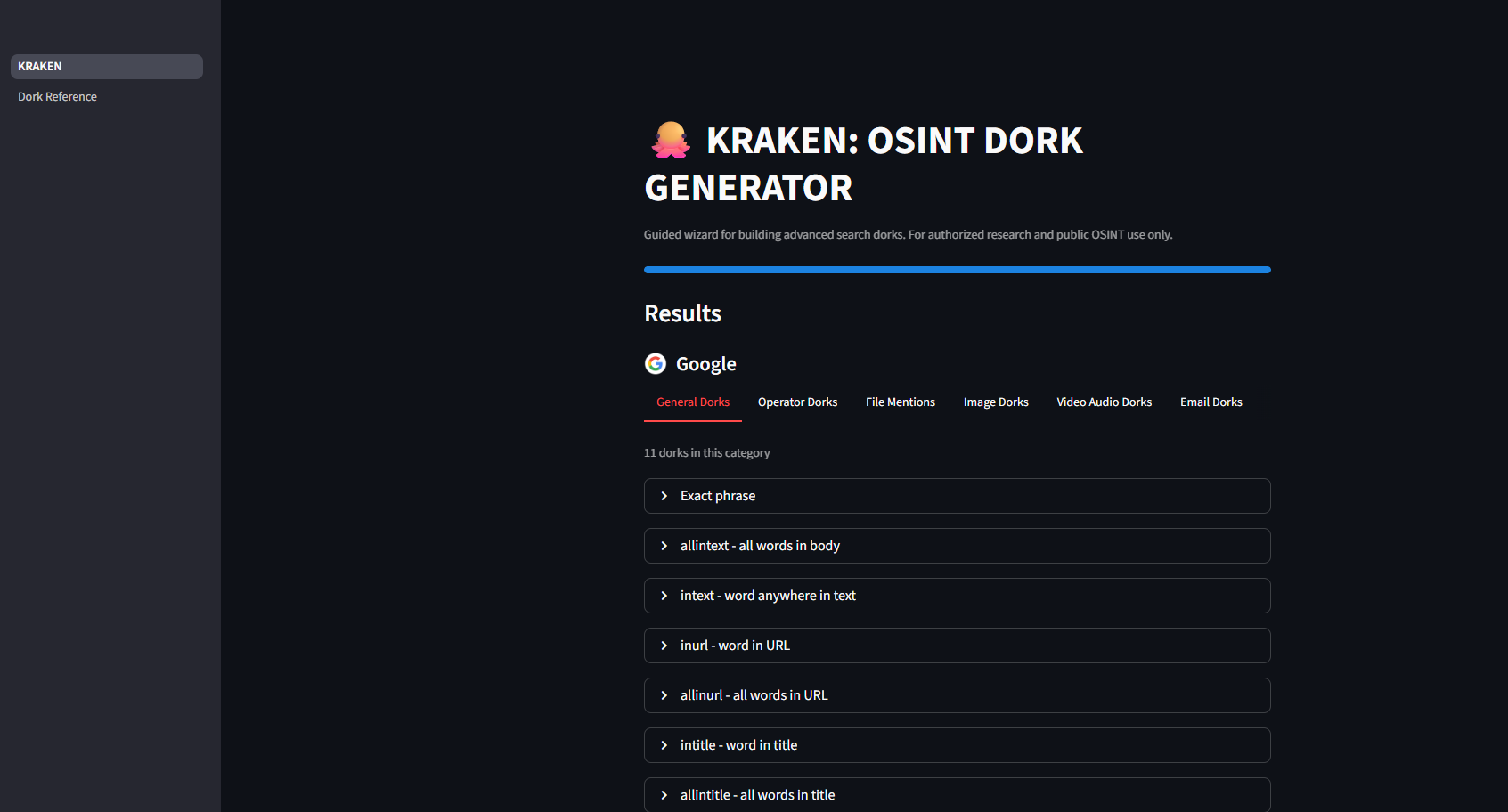
- Review results — grouped into tabs by category, each with the raw dork and a clickable link that opens the search directly.
- Download the raw dork list as a
.txtfile if you want to save or share them.
KRAKEN is built so that adding support for a new search engine (e.g. Brave, Ecosia) or social
platform (e.g. Facebook, Instagram, LinkedIn) doesn't require touching app.py at all — it
auto-discovers every module dropped into engines/ or platforms/.
See instructions.txt for the full contract each module must follow,
including required constants (NAME / DOMAIN, DISPLAY_NAME), the required
generate_dorks(...) function signature, and the expected return shape
(dict[category] -> list[(label, raw_dork, full_url)]).
In short:
# engines/newengine.py
NAME = "NewEngine"

def generate_dorks(value, ptype, date_from=None, date_to=None):
    ...
    return {
        "General-Dorks": [(label, raw_dork, full_url), ...],
        ...
    }
Drop the file in, restart the app, and it appears automatically in the engine/platform selector.
Alongside the generator, KRAKEN ships a static reference page for people who prefer to write
dorks by hand. Each card (Google, DuckDuckGo, Yandex, Yahoo, Bing, Startpage, X, Reddit,
Facebook, Instagram) opens a modal rendering an HTML file from
pages/dork_references/<slug>.html. If a file doesn't exist yet for a given source, a generic
placeholder is shown instead — so you can fill these in one at a time without touching any
Python code.
KRAKEN is a query-construction tool, not a scraper, credential tester, or automation framework. It does not:
- Access, store, or transmit anyone's private data
- Bypass logins, CAPTCHAs, rate limits, or authentication of any kind
- Automate account creation, scraping, or mass requests against any platform
You are responsible for:
- Only using generated dorks against targets you are authorized to research (yourself, consenting clients, or public information within legal and ethical bounds)
- Complying with the Terms of Service of every search engine and platform you query
- Complying with applicable laws in your jurisdiction regarding OSINT and data collection
See Future_Work.txt for planned updates and future work.
---(Add your preferred license here — e.g. MIT, Apache 2.0 — before publishing.)
Contributions that add new engine/platform modules following the instructions.txt contract,
or that expand the Manual Dork Reference HTML content, are welcome. Please open an issue or
pull request describing the addition.