
Our tech stack is ontological:
Hardware — Physics
Software — Mathematics
Our engineering workflow is simple: discover, build, grow, learn & teach
Notice of Proprietary Information
This document outlines foundational concepts and methodologies developed during internal research and development at Apoth3osis. To protect our intellectual property and adhere to client confidentiality agreements, the code, architectural details, and performance metrics presented herein may be simplified, redacted, or presented for illustrative purposes only. This paper is intended to share our conceptual approach and does not represent the full complexity, scope, or performance of our production-level systems. The complete implementation and its derivatives remain proprietary.
Machine-checked proof that confluence and causal invariance are independent properties
Lean 4 formalization of Piskunov's 2020 counterexamples for Wolfram Physics / SetReplace systems
+ a Wolfram Physics Project WM148 causal-invariance case study (fresh-vertex semantics)


"The genome doesn't specify the organism; it offers a set of pointers to regions in the space of all possible forms, relying on the laws of physics and computation to do the heavy lifting." — Michael Levin
Our company operates as a lens for cognitive pointers: identifying established theoretical work and translating it into computationally parsable structures. By turning ideas into formal axioms, and axioms into verifiable code, we create the "Lego blocks" required to build complex systems with confidence.
We humbly thank the collective intelligence of humanity for providing the technology and culture we cherish. We do our best to properly reference the authors of the works utilized herein, though we may occasionally fall short. Our formalization acts as a reciprocal validation—confirming the structural integrity of their original insights while securing the foundation upon which we build. In truth, all creative work is derivative; we stand on the shoulders of those who came before, and our contributions are simply the next link in an unbroken chain of human ingenuity.
Part of the broader HeytingLean formal verification project: https://apoth3osis.io
This repo mechanizes two complementary facts about Wolfram/SetReplace-style rewriting:
- Independence (CE1/CE2): confluence and causal invariance are independent properties.
- WM148 (Wolfram Physics Project): under an explicit fresh-vertex semantics and equivalence up to vertex renaming,
WM148 is causally invariant (in the sense of
SystemFresh.CausalInvariant). - Observable-event (“GC”) causal graphs (bridge abstraction): a coarse-grained causal graph notion that discards
events whose created expressions do not survive to the endpoint; this makes CE1’s “detour step” disappear
(see
HeytingLean.WPP.Wolfram.Counterexamples.CE1.causalGraphGC_iso_short_long).
The point is that the counterexamples rule out “confluence ⇒ causal invariance” under naive matching, while WM148 demonstrates a principled semantics (fresh allocation + α-equivalence) where a concrete WPP model satisfies causal invariance.
Three notions of “causal invariance” used in this repository (be precise when citing):
- SetReplace-style (terminating) causal-graph invariance:
HeytingLean.WPP.Wolfram.Properties.CausalInvariantcomparesSystem.causalGraphOfacross normal-form evolutions. - Observable-event (“GC”) causal-graph invariance:
HeytingLean.WPP.Wolfram.Properties.GCausalInvariantcomparesSystem.causalGraphGCOfacross normal-form evolutions (coarse-graining; not SetReplace’s definition). - Wolfram Physics branch-pair resolution (fresh vertices):
HeytingLean.WPP.Wolfram.SystemFresh.CausalInvariantis joinability-up-to-iso for one-step forks in the fresh-vertex semantics.

CE1 Multiway + Branchial Graph: Confluent but NOT causally invariant
In the Wolfram Physics Project, causal invariance was proposed as the keystone property ensuring observer-independent physics. Many assumed it was equivalent to confluence (unique normal forms).
This formalization proves they are independent:
- Systems can be confluent without being causally invariant
- Systems can be causally invariant without being confluent
Note (why CE1 is subtle): CE1’s two maximal evolutions reach the same normal form but have different lengths.
This breaks SetReplace-style causal-graph invariance, but under the observable-event (“GC”) causal graph abstraction
the two evolutions have isomorphic causal graphs (HeytingLean.WPP.Wolfram.Counterexamples.CE1.causalGraphGC_iso_short_long).

CE1: Confluent ∧ ¬Causal-Invariant All paths converge to same normal form, but causal graphs differ |

CE2: Causal-Invariant ∧ ¬Confluent Multiple normal forms exist, but causal graphs are isomorphic |

CE1 Branchial structure |

CE2 Branchial structure |

WM148 bounded multiway graph (depth 3; deterministic fresh allocator)
- rule:
{{x,y}} → {{x,y},{y,z}}(one fresh vertexz) - semantics: explicit fresh allocation + equivalence up to vertex renaming (
HGraph.Iso) - mechanized theorem:
WM148.causalInvariant : SystemFresh.CausalInvariant (sys := WM148.sys) - executable demo:
lake exe wolfram_wm148_demo(emits bounded multiway JSON; default--maxDepth 6) - import graph (WM148 slice):
RESEARCHER_BUNDLE/artifacts/visuals/wm148_import_graph.svg/RESEARCHER_BUNDLE/artifacts/visuals/wm148_import_graph.html
Explore the proof structure in 2D and 3D:
Click a theorem node in the proof map and use the Artifacts panel to jump directly to the corresponding multiway/hypergraph visualizations and interactive viewer.
- GitHub Pages: https://abraxas1010.github.io/causal-confluence-wolfram-lean/RESEARCHER_BUNDLE/artifacts/visuals/proof_hypergraph_bridge.html
Proof Map (3D preview)
|
Hypergraph/Multiway Artifact (CE1 preview)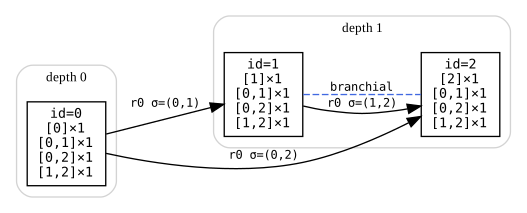
|
Proof Map (3D static fallback)
|
Hypergraph/Multiway Artifact (CE2 preview)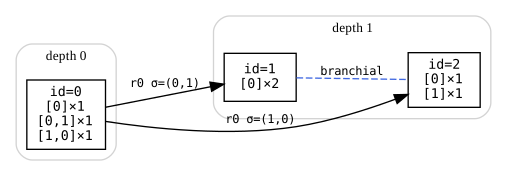
|
Direct deep-links to the interactive multiway viewer:
- CE1: https://abraxas1010.github.io/causal-confluence-wolfram-lean/RESEARCHER_BUNDLE/artifacts/wolfram_viewer.html?demo=ce1
- CE2: https://abraxas1010.github.io/causal-confluence-wolfram-lean/RESEARCHER_BUNDLE/artifacts/wolfram_viewer.html?demo=ce2
- WM148: https://abraxas1010.github.io/causal-confluence-wolfram-lean/RESEARCHER_BUNDLE/artifacts/wolfram_viewer.html?demo=wm148
|
2D Proof Map Pan, zoom, search declarations 
wolfram_2d.html (GitHub Pages) |
3D Proof Map Rotate, zoom, explore clusters
 wolfram_3d.html (GitHub Pages) |
WM148-only proof/declaration map:
|
WM148 2D Proof Map Pan, zoom, search declarations 
wm148_2d.html (GitHub Pages) |
WM148 3D Proof Map Rotate, zoom, explore clusters 
 wm148_3d.html (GitHub Pages) |
Declarations visualized with UMAP embeddings:
- Color-coded by module family (Hypergraph, Rewrite, CausalGraph, Multiway, etc.)
- Click nodes to see theorem details, file location, and code snippets.
- kNN edges show proof similarity neighborhoods.
Interactive multiway viewer (CE1/CE2/WM148-depth3 built-in; or load generated_ce1.json / generated_ce2.json / generated_wm148.json):
- GitHub Pages: https://abraxas1010.github.io/causal-confluence-wolfram-lean/RESEARCHER_BUNDLE/artifacts/wolfram_viewer.html (supports
?demo=ce1|ce2|wm148) - Offline:
RESEARCHER_BUNDLE/wolfram_viewer.html(wrapper; supports?demo=...) orRESEARCHER_BUNDLE/artifacts/wolfram_viewer.html(direct)
UMAP note (interpretation + limitations):
- UMAP is a non-linear projection of high-dimensional feature vectors into 2D/3D; here the features are derived from Lean source text statistics and structural signals.
- Only local neighborhoods are intended to be meaningful; global distances/cluster geometry are not proof-theoretic invariants.
- The layout depends on hyperparameters and a random seed; reruns can rotate/warp the embedding while preserving similar local structure.
- Treat these maps as navigational aids; the formal guarantee is always the Lean kernel check, not the embedding.
- GitHub README pages block embedded iframes/WebGL; the README shows a lightweight preview, while the full interactive 3D viewer is on GitHub Pages.
| Component | Description |
|---|---|
| Hypergraph Model | SetReplace-faithful: Expr V := List V, HGraph V := Multiset (Expr V) |
| Rewrite Semantics | Rules, events, SetReplace-style substitutions (not assumed injective), applicability |
| Fresh-Vertex Semantics | Explicit fresh-name supply + α-equivalence up to vertex renaming |
| Injective-WLOG Lemmas | Under a “simple hypergraph” invariant, applicable matches are forced injective (standard Fin n/finRange LHS shape) |
| Causal Graphs | "Created then destroyed" edges, graph isomorphism |
| GC Causal Graphs | Observable-event (“garbage-collected”) causal graph abstraction + GCausalInvariant |
| Properties | ConfluentNF (unique normal forms), CausalInvariant (isomorphic causal graphs) |
| Counterexamples | CE1: confluent ∧ ¬causal-invariant, CE2: causal-invariant ∧ ¬confluent |
| Main Theorem | confluence_causal_invariance_independent |
| Multiway Infrastructure | Finite enumerators, branchial graphs, WPP bridges |
| WM148 (Wolfram Physics) | {{x,y}} → {{x,y},{y,z}} with explicit fresh vertices + causal invariance proof (branch-pair resolution up to HGraph.Iso) |
cd RESEARCHER_BUNDLE
./scripts/verify_wolfram.sh
This runs strict builds, runs the Wolfram multiway demo, and also emits + checks a small certified
LambdaIR → MiniC → C compilation artifact (see RESEARCHER_BUNDLE/artifacts/compiler/).
cd RESEARCHER_BUNDLE
lake exe wolfram_multiway_demo              # CE1 (default)
lake exe wolfram_multiway_demo -- --sys ce2  # CE2
lake exe wolfram_wm148_demo # WM148 (fresh-vertex semantics; bounded multiway JSON)From the standalone bundle:
cd RESEARCHER_BUNDLE
lake exe wolfram_bundle_demo
cc artifacts/compiler/c/wpp_add1.c -O2 -std=c11 -o artifacts/compiler/bin/wpp_add1
./artifacts/compiler/bin/wpp_add1 # expected output: 42This repo ships a pure Wolfram Language script that reproduces the CE1/CE2 bounded multiway JSON
output of wolfram_multiway_demo, and a small WM148 bounded multiway JSON used to cross-check the
fresh-vertex semantics:
RESEARCHER_BUNDLE/tools/wolfram_ce1_ce2.wl
In Mathematica / Wolfram Engine:
Get["RESEARCHER_BUNDLE/tools/wolfram_ce1_ce2.wl"];
Export["ce1_from_wl.json", CE1JSON[3], "JSON"];
Export["ce2_from_wl.json", CE2JSON[2], "JSON"];
Export["wm148_from_wl.json", WM148JSON[3], "JSON"];
Compare against the Lean-produced files:
RESEARCHER_BUNDLE/artifacts/generated_ce1.jsonRESEARCHER_BUNDLE/artifacts/generated_ce2.jsonRESEARCHER_BUNDLE/artifacts/generated_wm148_wlcheck.json
If you have wolframscript installed, the bundle also provides an automated cross-check:
cd RESEARCHER_BUNDLE
./scripts/verify_wolfram_wl.sh
If you do not have Wolfram Engine installed, the same cross-check can be run with the open-source WL runtime mathics:
python3 -m pip install --user mathics3 packaging
cd RESEARCHER_BUNDLE
./scripts/verify_wolfram_wl.sh
See also the (static) pipeline diagram:
RESEARCHER_BUNDLE/artifacts/visuals/wl_crosscheck_pipeline.svg

-- Main independence result
theorem Counterexamples.confluence_causal_invariance_independent :
  (∃ sys, ConfluentNF sys ∧ ¬CausalInvariant sys) ∧
  (∃ sys, CausalInvariant sys ∧ ¬ConfluentNF sys)

-- CE1: confluent but not causally invariant
theorem Counterexamples.CE1.confluentNF : ConfluentNF Counterexamples.CE1.sys
theorem Counterexamples.CE1.not_causalInvariant : ¬CausalInvariant Counterexamples.CE1.sys
theorem Counterexamples.CE1.causalGraphGC_iso_short_long :
  CausalGraph.Iso (Counterexamples.CE1.sys.causalGraphGCOf [Counterexamples.CE1.e13] Counterexamples.CE1.s2)
    (Counterexamples.CE1.sys.causalGraphGCOf [Counterexamples.CE1.e12, Counterexamples.CE1.e23] Counterexamples.CE1.s2)

-- CE2: causally invariant but not confluent
theorem Counterexamples.CE2.causalInvariant : CausalInvariant Counterexamples.CE2.sys
theorem Counterexamples.CE2.not_confluentNF : ¬ConfluentNF Counterexamples.CE2.sys
theorem Counterexamples.CE2.causalInvariantGC : GCausalInvariant Counterexamples.CE2.sys

-- WM148: causally invariant (fresh-vertex semantics; branch-pair resolution up to renaming)
theorem WM148.causalInvariant : SystemFresh.CausalInvariant (sys := WM148.sys)

-- Bridge: finite enumerator agrees with Step relation
theorem stepStates_iff_step : t ∈ stepStates s ↔ Step s t

-- Fresh-vertex semantics: different fresh allocations are isomorphic (α-equivalence)
theorem SystemFresh.Event.applyWith_iso : HGraph.Iso (e.applyWith τ₁ s) (e.applyWith τ₂ s)

-- Injective-WLOG (under simple-hypergraph invariant)
theorem System.Event.injective_of_applicable_of_finRange_mem_lhs : Function.Injective e.σThe formalization uses only standard Lean kernel axioms:
| Axiom | Purpose |
|---|---|
propext |
Propositional extensionality |
Classical.choice |
Axiom of choice |
Quot.sound |
Quotient soundness |
No project-specific axioms introduced.
| File | Description |
|---|---|
01_Lean_Map.md |
Concept → Lean mapping |
02_Proof_Index.md |
What's proved and where (incl. WM148 causal invariance) |
03_Reproducibility.md |
Build/run commands |
04_Dependencies.md |
Lean/mathlib pins |
05_Technical_Report.md |
Technical summary |
06_Final_Audit.md |
QA status |
TECHNICAL_REPORT_FULL.md |
Full research report |
├── README.md                 # This file
├── .nojekyll                 # GitHub Pages helper
├── index.html                # GitHub Pages landing
├── 0[1-6]_*.md               # Documentation
├── TECHNICAL_REPORT_FULL.md  # Full report
├── artifacts/                # Static artifacts (SVG graphs, etc.)
├── tools/                    # Local tooling for this PaperPack
└── RESEARCHER_BUNDLE/
    ├── README_VERIFY.md              # One-command verification instructions
    ├── lean-toolchain               # Lean pin
    ├── lakefile.lean                # Lake package + pinned deps
    ├── lake-manifest.json           # Locked transitive dependency pins
    ├── HeytingLean/                 # Lean sources (WPP/Wolfram + compiler slice)
    ├── scripts/                     # `verify_wolfram.sh` (+ small helpers)
    ├── artifacts/
    │   ├── visuals/                 # 2D/3D viewers, previews, SVG graphs
    │   └── compiler/                # LambdaIR → MiniC → C outputs (+ `.olean` bundle)
    └── reports/                     # Build transcripts, hashes, portability checks
-
Piskunov, M. (2020). "Confluence and Causal Invariance." Wolfram Physics Bulletins
-
Wolfram, S. (2020). "A Project to Find the Fundamental Theory of Physics." wolframphysics.org
-
Gorard, J. (2020). "Some Relativistic and Gravitational Properties of the Wolfram Model." arXiv:2004.14810
-
SetReplace. "GitHub: maxitg/SetReplace"
Part of the HeytingLean formal verification project
This project is provided under the Apoth3osis License Stack v1.
See LICENSE.md and the files under licenses/.