
A terminal orchestrator for AI coding agents. A background server owns the
terminals your agents run in, so they keep working when you close the UI. The
TUI organises everything as a tree — machines, projects, git branches, agents
and terminals — beside a live view of whatever you select. It is not the only
way in: Conch.app is the same thing in a native Mac
window, and conch web hands it to your phone.
Works with Claude Code, Codex, Gemini CLI, OpenCode, Devin, Copilot CLI, Cline, Qwen Code and Goose — and runs a dozen more, from Kiro and Crush to Mistral Vibe — on your machine or on remote machines over SSH.
It is for running several agents at once and keeping track of them — which one is waiting on you, what each has changed, and getting back to them after your laptop slept. It earns its keep from the third agent, not the first.
It is the wrong shape if you run one agent in one repo (use the agent's own
CLI, with tmux if you want it to survive a dropped ssh session), if you branch
and commit by hand (a plain multiplexer gives you panes without the opinions),
or if review means a conversation with other people — conch reads diffs side
by side, stages hunks, and a note on a line goes to the agent, which answers
it in the thread; Conch.app submits a pull request review (approve, request
changes, comment), but a reply to a colleague's own comment happens on
GitHub, so pair it with gh or your forge for that. It is macOS and Linux;
on Windows, WSL. And it waits for Enter on purpose: nothing the brain
proposes runs until you confirm, so it is not the tool for unattended
swarms.
The longer version, losses included.
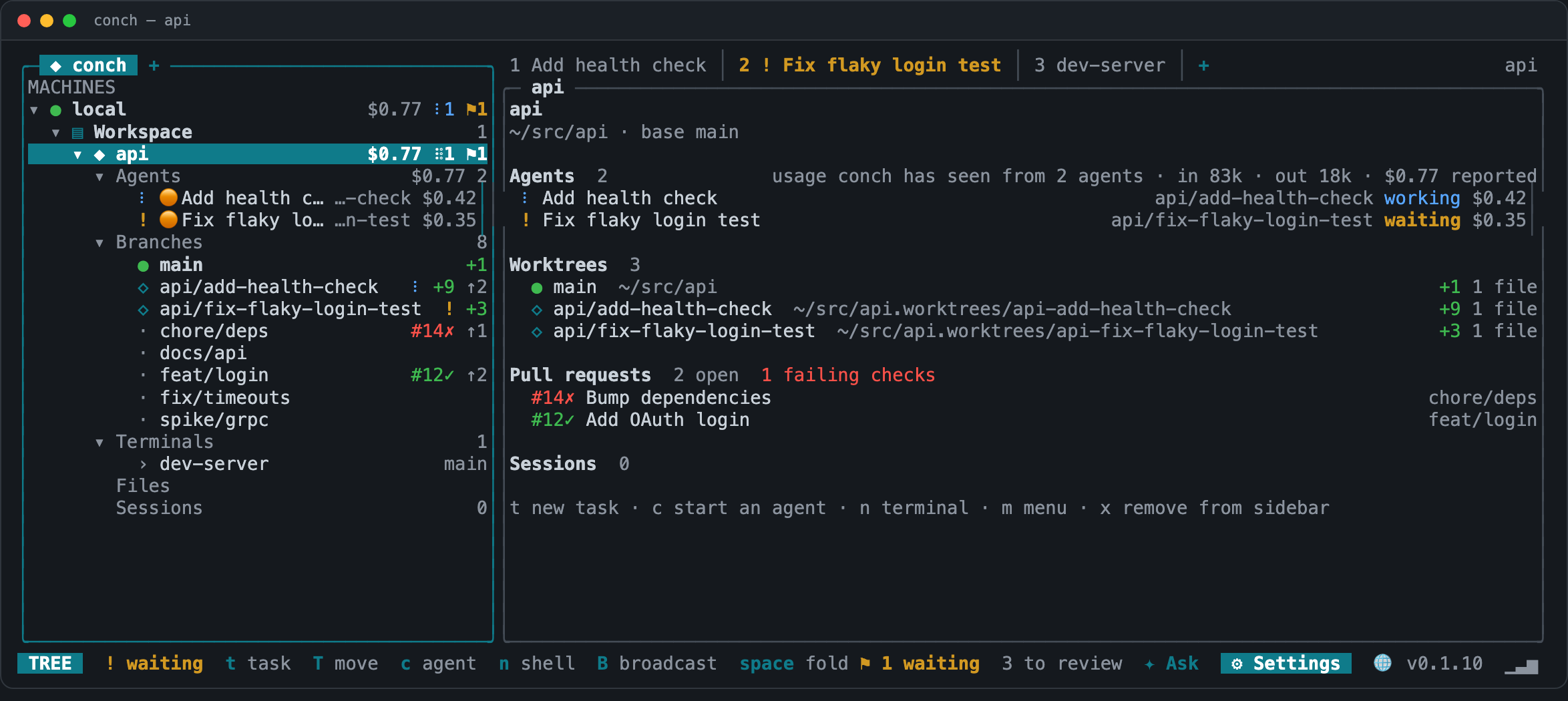
A project expanded into branches, agents and terminals, with a tab per agent — and beside it what the project holds: each worktree, the open pull requests and their checks, and what the agents have spent.
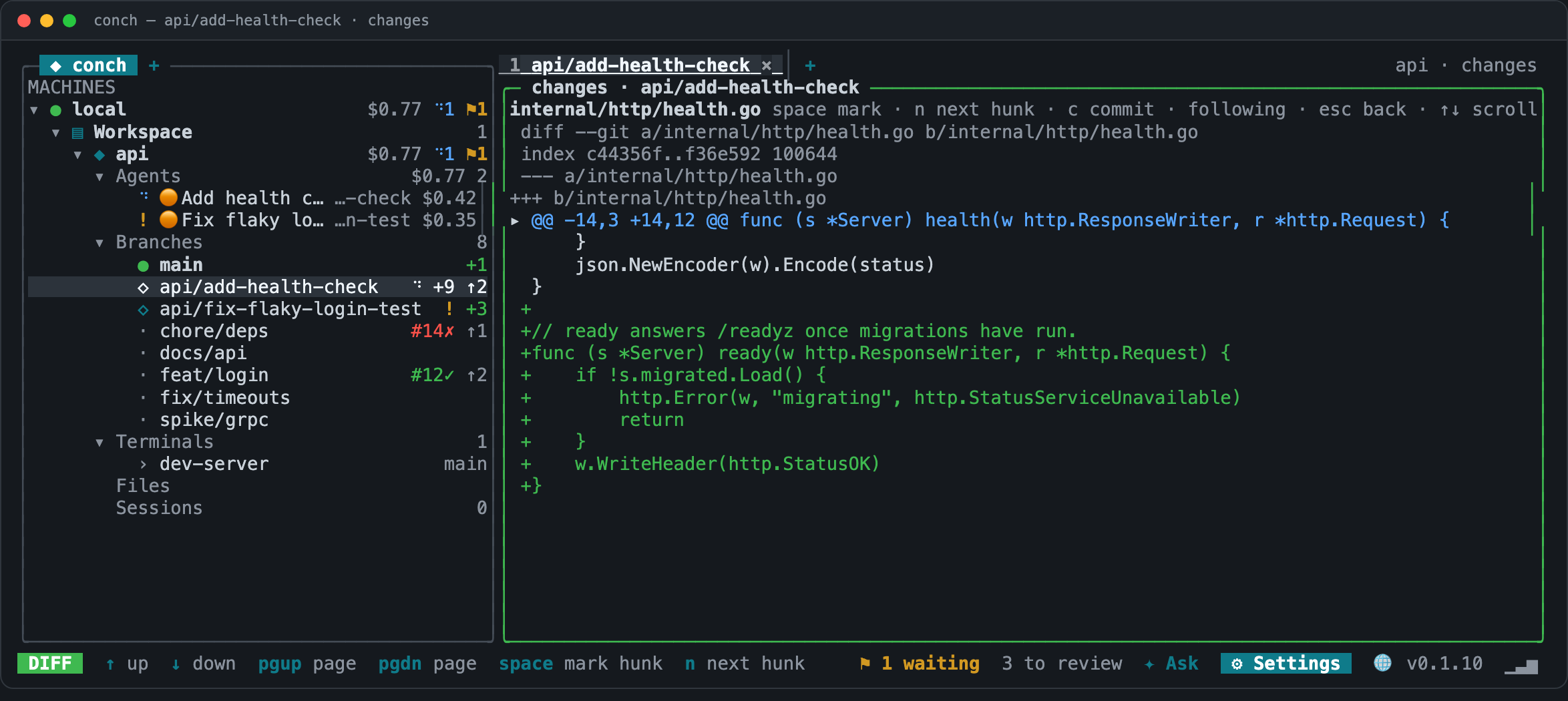
Review an agent's work before it lands: a branch's uncommitted files and
commits ahead, each diff hunk by hunk, and space to stage one.
macOS and Linux (amd64 and arm64):
curl -fsSL https://raw.githubusercontent.com/Amitgb14/conch/master/install.sh | shWith Homebrew, on macOS or Linux:
brew install Amitgb14/conch/conchOr with Go 1.25+: go install github.com/Amitgb14/conch/cmd/conch@latest.
conch update upgrades to the newest release, conch update list shows
what is published and conch update rollback goes back to the version
before it; conch server reload moves the server onto a new build without
stopping your agents. A Homebrew install is updated with brew upgrade conch
instead, and conch then offers to reload onto it.
conch                                   # open the TUI (starts the server)
conch task -cwd ~/src/api "Add a health check endpoint"   # branch + worktree + agent
conch machine add gpu-box               # add a remote machine over ssh
conch project move api -to gpu-box      # branches, worktrees and agents, moved there
conch status                            # panes with agent state
conch read gpu-box:p3                   # a pane's screen, by the ID every view shows
In the TUI: t new task · c start an agent · : ask in plain words ·
B broadcast to a group · ! jump to the next agent waiting for you · ? all keys ·
q detach.
Conch.app is conch in a native macOS window — another client of the same
servers, so it shows the agents the TUI shows and closing it stops none of
them. Panes are drawn by Ghostty; a branch's changes,
its files and the dev server's page sit in tabs beside the agents; ⌘K finds a
pane, a branch or a file. It is in beta:
download it or build it
from macos/.
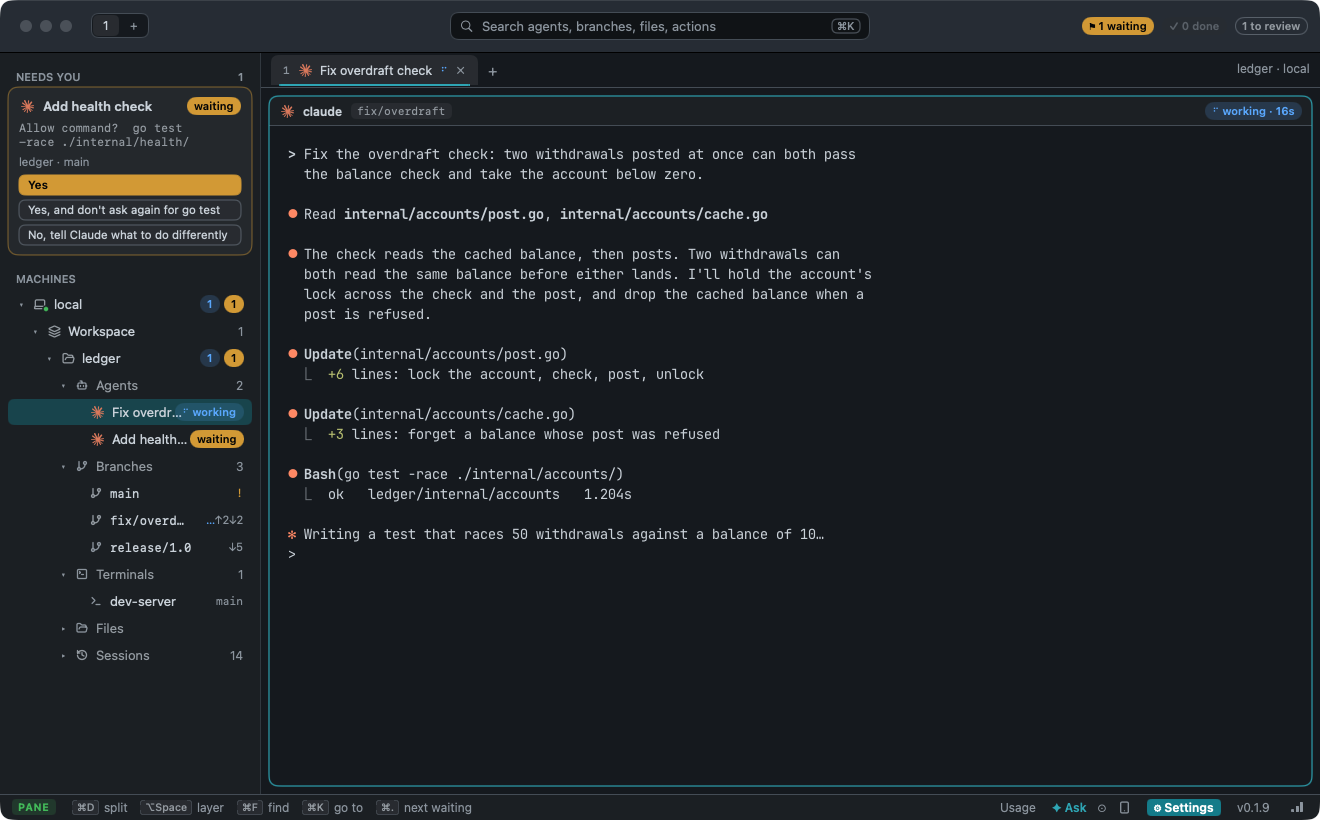
An agent in a Ghostty pane, the tree beside it, and what needs you at the top left: the question a waiting agent asked, with its answers to click.
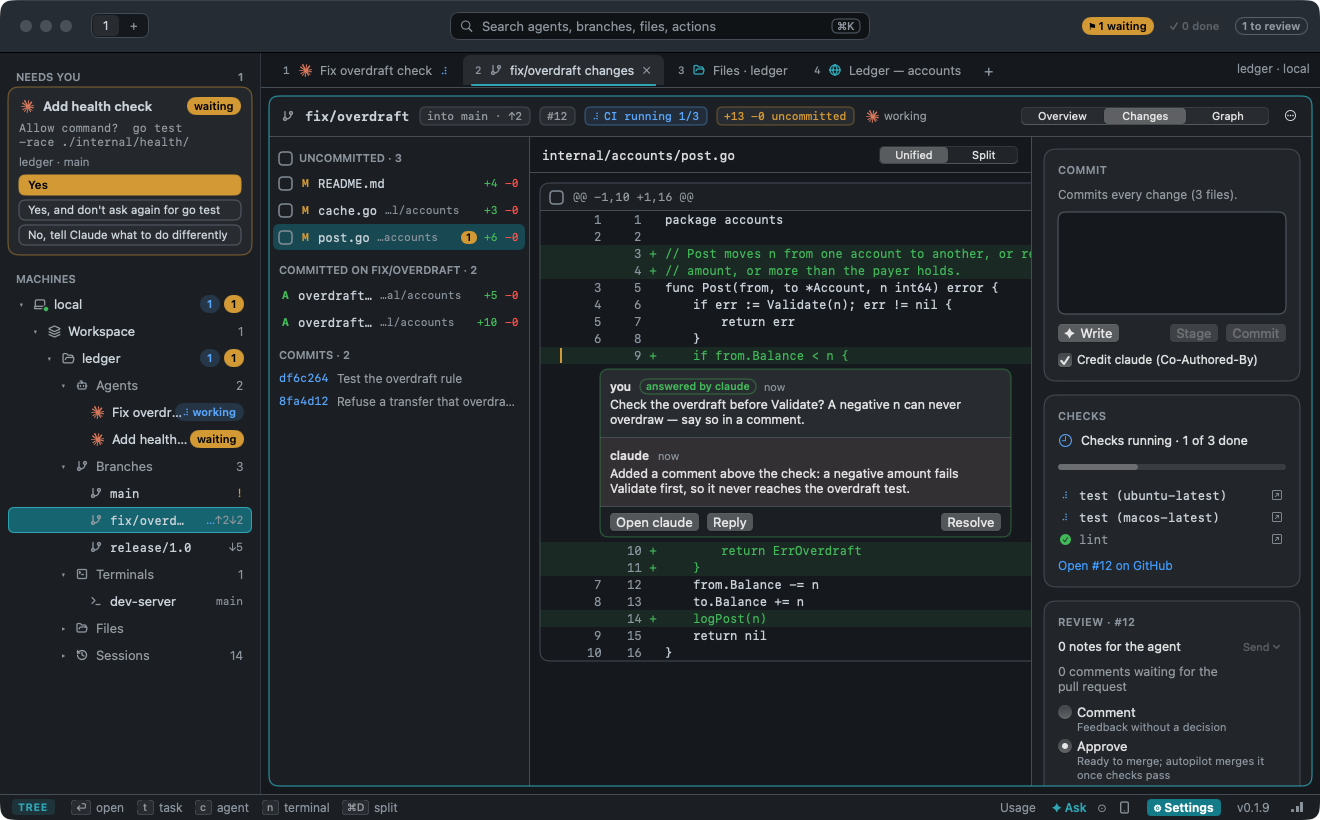
A branch's changes in a tab of their own: stage a hunk, write the commit message, watch the pull request's checks, and leave the agent a note on a line — it answers in the thread.
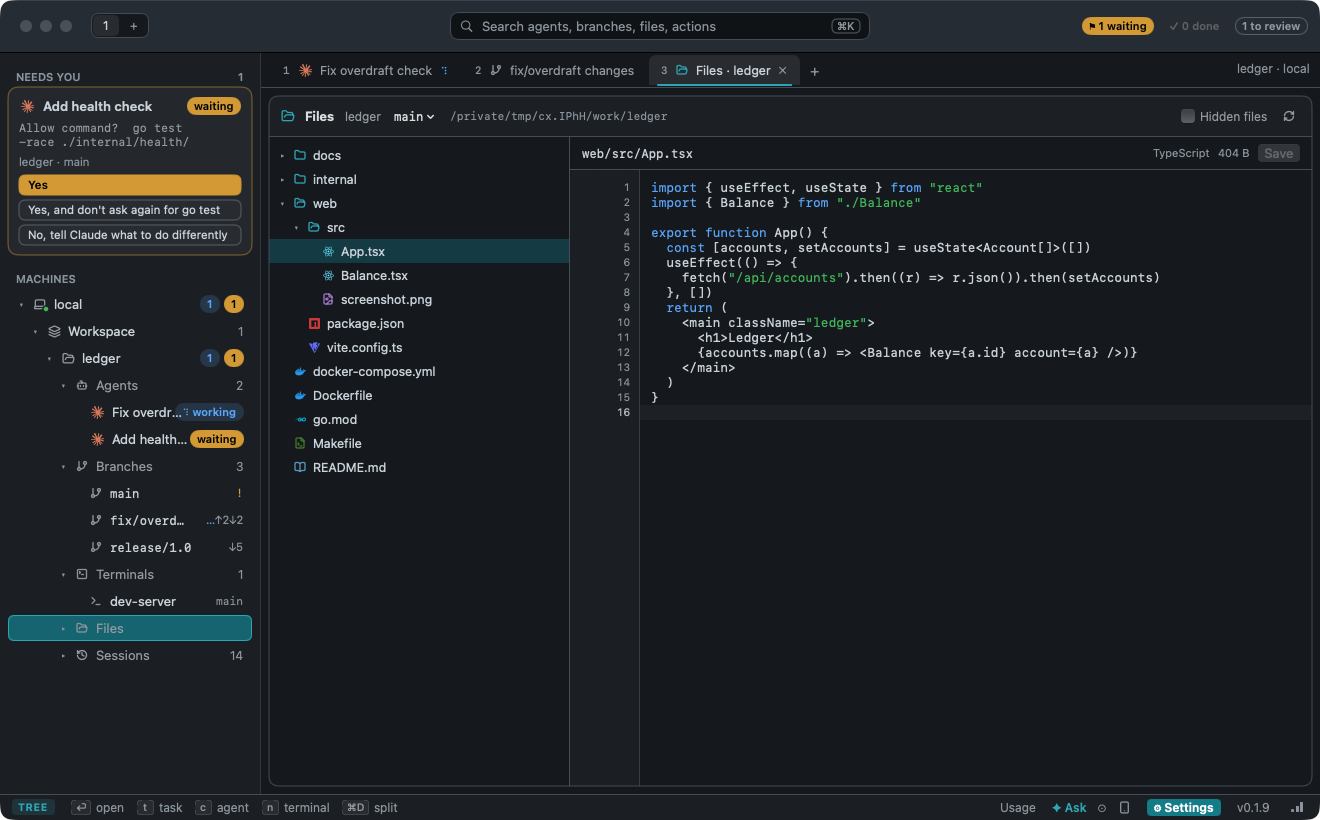
The project's files in a tab too: the tree on the left, the file open with its syntax coloured, and ⌘S to save — checked against what the agents may have written in the meantime.
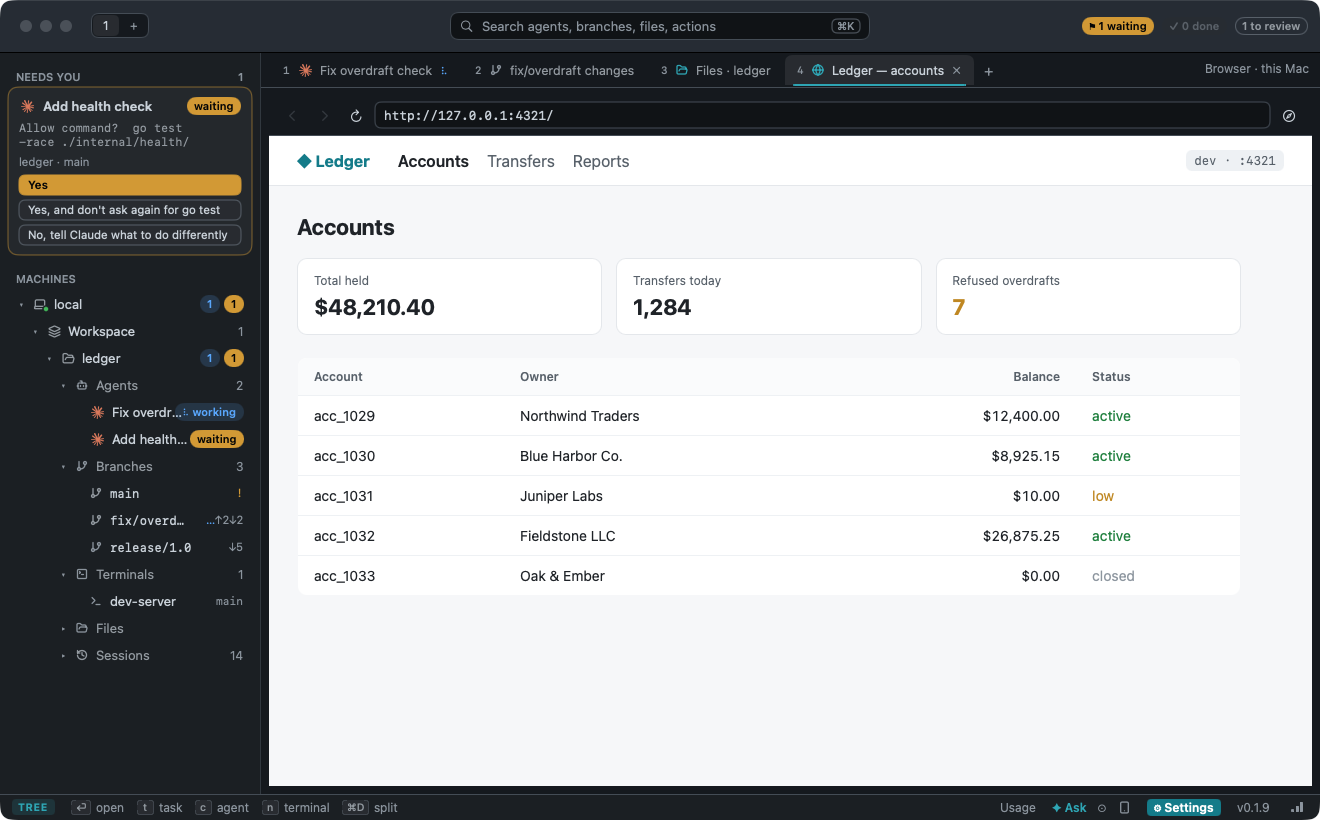
And the dev server's own page in a tab beside them, so what the agent just changed is a glance away rather than another window.
What the window holds, key by key.
conch web serves the same agents to a phone: what each one is doing, the
question it is waiting on with its answers as buttons, every screen at once,
and a keyboard into any terminal. It is a page the gateway serves itself —
nothing to install, and no service of conch's in between.
conch web          # the gateway, in front of the same server
conch web pair     # a QR code and a one-time code for the phone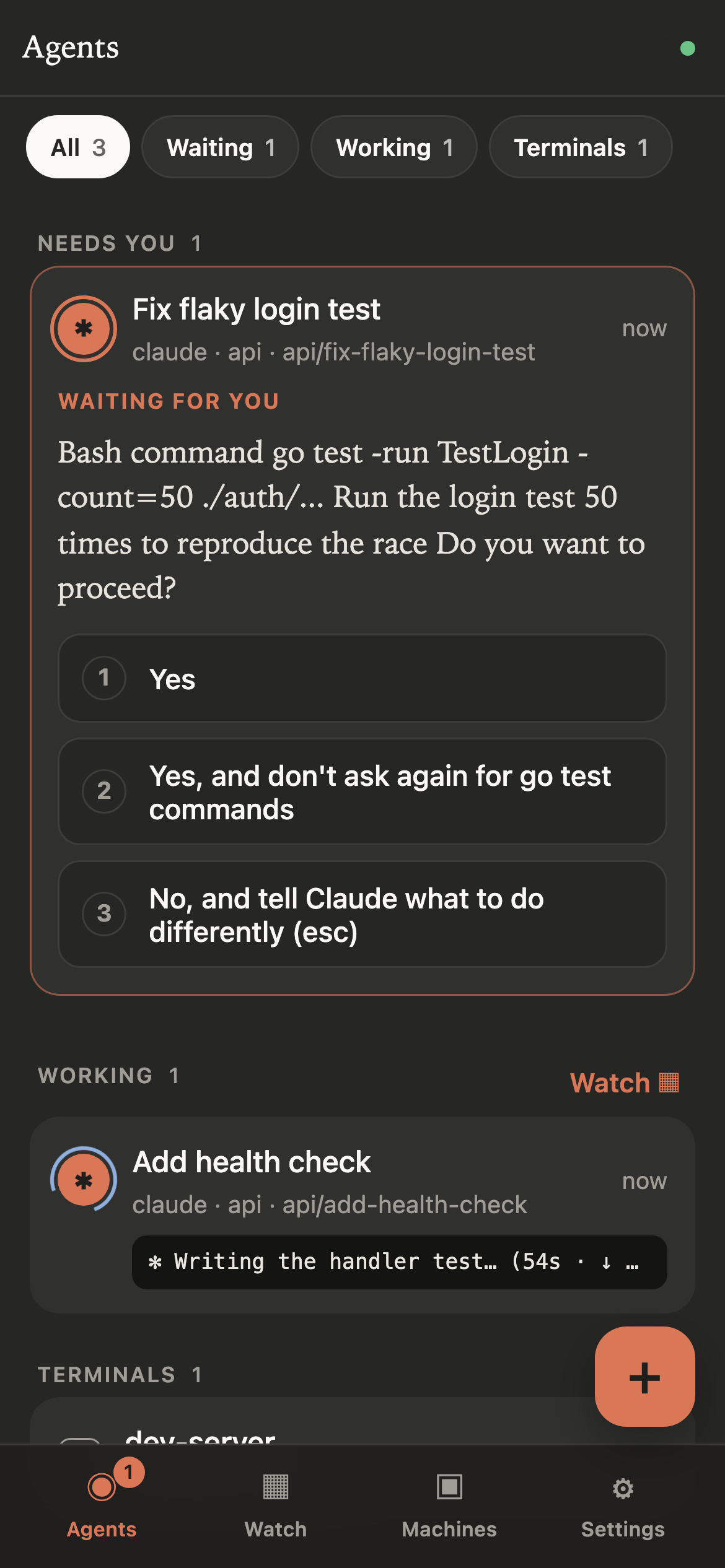
On your own tailnet the phone reaches the laptop directly. From any other
network it goes through a relay you run yourself (conch relay): the
phone and the laptop both connect out to it, and what it carries it cannot
read — they make a Noise session whose key
travels in the QR code, through the camera rather than the network. See
Phone.
conch carries skills that teach an agent to run other agents: start a
helper and read its answer (conch), several at once (conch-team),
review until clean (conch-review), tests to a merged pull request
(conch-ship), a ticket all the way (conch-factory), and the automated
workflow for a project (conch-autopilot). Install them for every agent
— Claude Code, Codex, Gemini CLI, OpenCode, Devin, Copilot CLI, Cline, Qwen Code and Goose:
conch agent skill -applyOr, in Claude Code, as a plugin from this repository:
/plugin marketplace add Amitgb14/conch
/plugin install conch@conch
Then ask an agent in a conch pane: "take issue 123 to a merged pull request", "set up an automated workflow for this project". They act only inside conch. See Agents working together.
make build        # bin/conch
make test         # go test -race -timeout 20m ./...
make lint         # gofmt, go vet, staticcheck — what CI checks first
The tests of the phone app and the settings page run with node and skip
without it. The settings page (internal/configweb/app) is committed as
built; after changing it, run make settings-ui (needs pnpm) and commit
internal/configweb/dist. AGENTS.md has the rules for
contributing, including keeping tests away from your own running conch.
The website and documentation live in web/, a Next.js and
shadcn/ui app (pnpm dev there). Most of its screenshots are regenerated
rather than taken by hand: web/scripts/tui-capture/capture.sh stages a
demo project in a scratch conch and saves the TUI's screens,
web/scripts/phone-capture/capture.sh photographs the phone app in
headless Chrome, and both keep away from your own server and agents.
Conch.app's are taken in the app by hand — a native window is nobody's
script.
Apache License 2.0 — see LICENSE.