
Home · Usage · Build · Architecture · Game testing · Contributing · Conventions · Technical debt · Progress
Tool for porting GDK console executables to Windows PCs, by relinking them against reimplemented system libraries.
No emulation and no separate runtime process. A GDK title is already an x86-64 PE program. The relinker points its imports at AnyBox's own DLLs (core/libs/xdll) and switches the console subsystem to a Windows one. The converted program then runs as an ordinary Windows process.
Early. The relinker, the library build, the run reports and the progress tracking work end to end on a test title. Most system functions are still stubs that stop the title with a report naming the function.

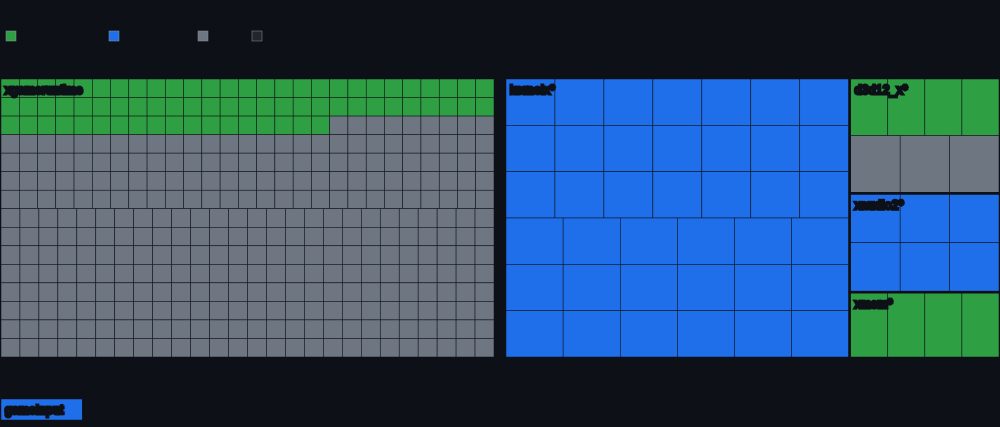
Each tile is a library, sized by its number of functions, and each square in it is one function: implemented (green), forwarded to Windows (blue), stub (grey) or known but not declared yet (dark). A dashed red tile is a DLL that titles import and no AnyBox library serves yet. * marks a library whose full export list is not known yet, so its total grows as titles are audited. Known functions come from the export inventories and title needs records.
The progress page lists every function as implemented, forwarded, stub or not declared, and every DLL with no library. It is regenerated on each push to main by tools/progress.py; the history shows how it grows.
| Library | Serves | State |
|---|---|---|
| xgameruntime | xgameruntime.dll |
XGameRuntime init and options, all of XTaskQueue (composite queues, monitors and waiters included), XAsync, XThread, XGameSave and XGameSaveFiles implemented; XUser, most of XPackage and XSystem stubs. Titles built with the GDK call the runtime through QueryApiImpl method tables rather than named exports: the XAsync and XTaskQueue table is mapped for the methods a bundled GDK module was measured calling (enough for that module's initialization to succeed), and every other table or method stops and names itself |
| d3d12_x | d3d12_x.dll, d3d12_xs.dll |
uses two back ends: root signature serialization is forwarded to the host's d3d12.dll, and everything the device does goes to Vulkan. Built on the Vulkan side: the device, shader store, compute and graphics pipeline state (render state, vertex input, cache first), resource barriers, texture images, views and samplers, bindless descriptors, the buffer window, and fences, queues, resources, command allocators, command lists, descriptor heaps, root signatures and pipeline states (Graphics). Device creation still stops the title until its calls show the device's shape |
| xaudio2 | xaudio2_9.dll |
forwarded to the host's XAudio2 |
| gameinput | gameinput.dll |
forwarded to the host's GameInput |
| kernelx | kernelx.dll |
Win32 subset forwarded to kernel32 |
| xmem | xmem.dll |
XMemAlloc, XMemFree, XMemVirtualQuery and XMemGetWorkingSetStatistics implemented; the allocation attribute word is not decoded yet, so every block is plain read-write memory |
Unsupported or unexpected states stop the process with a run report (anybox-report.json) that names the library and function, the place in the title that reached it and the stack, and with a debugger attached the stop breaks into it (Debugging a stop). Nothing returns a made-up success.
Console shaders ship as native GPU code, not DXIL, so no desktop driver can take them as they are. AnyBox's graphics library (d3d12_x) therefore runs a title's D3D12.X device on Vulkan, with the title's shaders translated to SPIR-V ahead of time by an external translator. The parts of D3D12 that need no GPU, root signature serialization and deserialization, go to the host's own d3d12.dll. The design is on #4 and the pieces are in Architecture.
Built and tested on a GPU without the title's executable (each with its own probe and tests):
- Pipeline state: compute and graphics descriptions resolve their shaders through the store by the hash of each shader container. Blend, rasterizer, depth-stencil, samples, topology and formats become Vulkan state, and the input layout is matched to the vertex shader's inputs. Each pipeline is created once and taken from the pipeline cache first; one that would need too much memory to compile in the title is refused, not compiled.
- Resources: D3D12 resource states become Vulkan barriers, texture descriptions become Vulkan images (typeless, depth and block-compressed formats included), and view and sampler descriptions become Vulkan image views and samplers.
- Commands: clears, buffer copies, uploads and readbacks through placed footprints (block-compressed included), texture copies (depth and stencil planes included), MSAA resolves, draws (viewports, scissors, culling and winding as in D3D12, vertex and index buffers, read-only depth-stencil passes), dispatches and indirect draws and dispatches (
ExecuteIndirectwith plain draw or dispatch signatures, count buffers included) are recorded on Vulkan; GPU tests read every result back and compare it. - D3D12 objects: fences and command queues as COM objects on Vulkan timeline semaphores, with waits held back until their value is signalled so queues never deadlock; committed buffers in the buffer window (mappable, with the GPU addresses the shaders use) and textures in device memory, zero-initialized as in D3D12; command allocators and command lists that record barriers (per subresource), copies, resolves and input-assembler and rasterizer state into Vulkan command buffers, which the queue executes in order with its signals and waits; descriptor heaps (shader-visible ones in the buffer window, at the addresses shaders read descriptors from) holding buffer descriptors, render target and depth-stencil views and samplers, with descriptor copies and render target and depth-stencil clears; root signatures and compute and graphics pipeline states as objects, bound on command lists with their root arguments.
- Root signatures: a title's serialized root signatures are read through the host
d3d12.dllinto parameters, descriptor tables and static samplers (as Vulkan samplers). - Shader resources: the descriptor hash table and bindless set the translated shaders look their images and samplers up in, the buffer descriptors they read their buffers through (constant buffers, raw, structured and typed views), and the buffer window below 4 GB their buffer addresses point into.
Still needing the executable or another source: the device object and its method slots, how root arguments and the heap base reach the translated shaders' push constants (the last step before command lists can draw and dispatch), the console's descriptor sizes and its image and sampler descriptor words, the root signature to shader register mapping, mesh pipelines and presentation.
The shader set is built on your PC from your own copy, into the build folder, like the rest of the project. It is never committed or shared. With a checkout of the translator:
cmake -S . -B build -G Ninja -DCMAKE_BUILD_TYPE=Release -DBUILD_TESTING=ON ^
  -DANYBOX_GAME_PACKAGE=<package folder> -DANYBOX_SHADER_TRANSLATOR=<translator checkout>
cmake --build build
cmake --build build --target shaders            # translate and build the shader store (about an hour)
cmake --build build --target shader_pipelines   # create every pipeline on your GPU (hours; resumes if stopped)
ctest --test-dir build -L shaders --output-on-failure
The settings (worker count, wave64 emulation for 32-wide GPUs, pipeline chunk size, the size limit for modules too large for your PC's memory) and what each test checks are in Building shaders with the project.
Measured on one title's package (26,503 shaders) with an RTX 3070 Ti and 32 GB of RAM:
| Step | State |
|---|---|
| Translate to SPIR-V | ✅ 26,503 of 26,503 (72 minutes) |
| Shader store | ✅ 25,889 modules (614 containers are byte-identical copies), none missing, invalid or conflicting; the C++ store finds all 26,503 containers |
| GPU support | ✅ the GPU supports every feature the modules need |
| Title layout | ✅ every module fits the one descriptor layout and the 144-byte push constants |
| Compute sample through AnyBox's own pipeline code | ✅ 60 of 60, no validation errors |
| Bindless descriptors and buffer access on the GPU | ✅ 3,701 of 3,701 descriptor lookups; buffer windows below 4 GB of up to 2 GiB |
| The title's shaders through AnyBox's pipeline state code | ✅ 12 compute shaders and 8 vertex shaders with vertex inputs become pipelines from their own containers; the largest compute shader is refused in 0.3 s instead of a 75 GB compile; with the offline cache, the pipelines come back without compiling |
| Every pipeline created by the driver | 🔄 in progress, in chunks of 500: 25,000 of 26,503 checked, 24,998 created (9,282 mesh, 11,248 pixel, 2,225 compute, 2,048 vertex and 195 geometry shaders) and none failed. Two compute modules of 43 MiB each need about 75 GB of memory to compile, more than this PC can commit, so they are skipped by size here |
| Shaders running in a title | ❌ needs the title's executable: device creation, command lists, root signatures and presentation follow from its calls |
What is not proven yet: that any translated shader computes the right values inside the title, and how the title binds its resources at run time. Both need the executable.
Per-title status lives in the Game bring-up discussions, one thread per title ID. Start a thread with the bring-up form and paste the line from python tools/run_report_summary.py anybox-report.json.
- Pick the top item on the needs page, which ranks what titles need and AnyBox lacks. Or audit a title you own with
python tools/import_audit.py <package> --needs docs/needs/<TitleId>.jsonand contribute the record so it counts. - Read CONTRIBUTING.md and the XTaskQueue implementation as a worked example.
- Open a pull request with the template. CI runs the conventions check and posts the progress change.
This project is intended for interoperability, research, preservation and compatibility. It does not include, distribute or require copyrighted software, firmware, cryptographic keys or proprietary libraries, and it does not decrypt or unpack protected packages. It works only on executables the user has already obtained in plain form, in accordance with applicable laws and license terms.
AnyBox is an independent project. It is not affiliated with, authorized or endorsed by any platform holder. All trademarks belong to their respective owners.
AnyBox is built to be like AnyPS5, for GDK titles.
GNU General Public License version 2 only. See LICENSE.