"We don't just simulate calls. We measure Grace Under Pressure."


High-stakes verbal skills are currently taught via:
- Passive Theory: Reading manuals (Zero emotional preparation).
- Human Roleplay: Hiring actors is expensive, unscalable, and inconsistent.
The Gap: There is no scalable way to teach people how to think clearly under auditory pressure.
CrisisCall is a browser-based training platform that uses a proprietary Dynamic Escalation Engine to monitor your response time and voice patterns in real-time.
- If you are calm and fast (<2s): The AI de-escalates and provides critical information.
- If you hesitate (>3s): The AI panics, screams, and increases the difficulty.
- The Result: Personalized, high-fidelity stress training that scales infinitely.
We didn't just use Murf Falcon for speed; we used it for Psychological Realism.
In a crisis, silence creates panic. Standard TTS engines introduce a 2-second "robotic silence" that immediately breaks the immersion of a simulation. Murf Falcon's streaming capability eliminates this gap, achieving sub-500ms latency. This makes the simulation indistinguishable from a real life-or-death call.
| Component | Technology | Role |
|---|---|---|
| Voice Generation | Murf Falcon API | Ultra-low latency Streaming TTS |
| Speech Recognition | Deepgram Nova-2 | Real-time ASR (Speech-to-Text) |
| Intelligence | Google Gemini 2.5 Flash | Low-latency Conversational AI |
| Frontend | Next.js 14 | React Framework & UI |
| Styling | TailwindCSS | Professional, dark-mode aesthetics |
| State Management | React Hooks | Custom "Panic" Logic & Audio Visualization |
-
Clone & Install:
git clone https://github.com/Dupahar/crisis-call-murf-agent.git cd crisis-call-murf-agent npm install -
Environment Variables: Create a
.env.localfile in the root directory:MURF_API_KEY=your_murf_key DEEPGRAM_API_KEY=your_deepgram_key GEMINI_API_KEY=your_gemini_key
-
Run Development Server:
npm run dev
Open http://localhost:3000 in your browser.
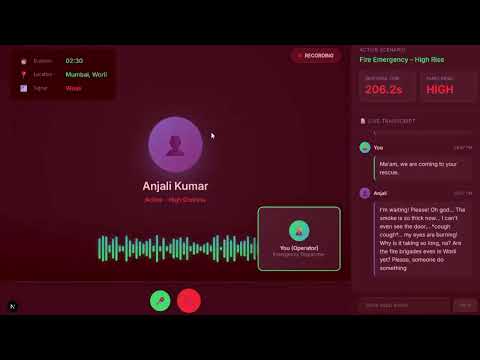
To test the "Panic Mode" yourself:
- Click "Connect to Emergency Channel".
- Say: "112, what is your emergency?"
- Test 1 (Fast Response): Reply immediately.
- Result: Anjali calms down and provides details.
- Test 2 (Hesitation): Wait 10 seconds in silence.
- Result: Anjali screams, begs for help, and the UI pulses RED.
- B2G (Government): 112 Dispatch Training, Hostage Negotiation.
- B2B (Corporate): PR Crisis Management, Cybersecurity Incident Response.
- Healthcare: ER Triage and Telehealth Diagnostics.
MIT