




I build ML systems that survive production — three deployed services (GKE + EKS), measured incidents with documented root causes, and an open-source production template. 14 years of operations leadership behind the engineering.




Three production incidents diagnosed from first principles:

 81% error rate under load  →  uvicorn --workers is anti-pattern under K8s
                                (shared CPU budget = thrashing, not parallelism)
                                Fixed: asyncio + ThreadPoolExecutor, GIL analysis
                                Result: 81% errors → 0%, 2000m CPU → 1000m

 SHAP returning all zeros   →  TreeExplainer incompatible with StackingClassifier
                                Fixed: KernelExplainer in original feature space
                                Evaluated 4 alternatives before deciding

 HPA never scales down      →  Memory-based HPA + fixed ML footprint
                                = mathematically impossible to scale down
                                Fixed: CPU-only HPA, 3→1 pods in 8 minutes
I spent 14 years running business operations — teams, vendors, budgets and customer-facing processes — before moving into ML engineering. That background is why my portfolio looks the way it does: a model is useful only when it can be deployed, monitored, explained, improved, and operated with cost discipline.
I build working ML systems, document trade-offs, measure failures, and turn those lessons into reusable patterns. Seeking my first formal ML/MLOps role; experienced in ownership, pressure and making systems easier for the next person to operate.
Target roles: ML Engineer · MLOps / Production ML · Platform Engineer (ML infra) · ML Platform / Data Engineering with ML workflows — evaluated on evidence, not tenure.
| Strength | How it shows up |
|---|---|
| Operations mindset | I care about reliability, cost, handoffs, and real user impact. |
| Production ML fundamentals | FastAPI, Docker, Kubernetes, MLflow, CI/CD, monitoring, drift detection, and model versioning. |
| Debugging discipline | I document root causes instead of only showing final demos. |
| Business judgment | I connect engineering decisions to cost, risk, and maintainability. |
| Learning velocity | I use open-source projects to turn new tools into working systems. |
Flagship Open-Source — ml-service-template
Is a reusable foundation for teams that want safer defaults when moving machine learning services toward production.
I created it after building my portfolio and seeing the same failure patterns repeat: blocked APIs, fragile deployments, missing monitoring, unclear model promotion rules, weak secrets handling, and documentation that does not match how the system actually behaves.
The template packages those lessons into a reusable starting point:
| Layer | What's encoded |
|---|---|
| 38 anti-patterns (D-01→D-38) | Runtime · Training · Infrastructure · EDA · Security · Closed-loop monitoring · Documentation coherence · Edge protection |
| SLSA L2 supply chain | Gitleaks → Trivy → Syft SBOM → Cosign keyless (OIDC) → Kyverno admission, every CI Action pinned by SHA |
| Closed-loop monitoring | Ground truth ingestion · Sliced performance · Champion/Challenger (McNemar + bootstrap ΔAUC) |
| Native-cloud edge protection | Cloud Armor (GCP) / AWS WAF+Shield by default, Cloudflare opt-in for multi-cloud — never a third-party account forced onto the common single-cloud case |
| Governed AI-assisted development | 27 skills, 19 rules, 20 workflows · agent behavior protocol (AUTO/CONSULT/STOP) · audit trail · eval gates — AI coding made reviewable, not hidden |
| Audit-grade quality guardian | 8 more anti-patterns (Q-01→Q-08) for standards that erode silently — unpinned actions, license drift, evidence-free releases — owned by a recurring 23-domain enterprise audit, not a one-off report |
| Quad-IDE native | Devin · Cursor · Claude Code · Codex — same invariants, native config for each |
| 43 ADRs | Each decision documented with alternatives rejected and revisit triggers |
# Zero to working fraud detection service in one command
git clone https://github.com/DuqueOM/ml-service-template.git
cd ml-service-template && make bootstrap
→ Template repo | QUICK_START.md | 43 ADRs
Sibling Project — agent-local: the same governance, a new domain
The template's philosophy generalized to local, multi-tier LLM agents — not a
fork, a reusable platform (core/ + thin usecases/ domains) that proves the
governance model travels beyond tabular ML serving.
| Layer | What's encoded |
|---|---|
| Deterministic policy gate | Versioned YAML policy checked before a response ships — never model self-judgment |
| Reflection isolated from evidence | A model's self-reflection is structurally unreachable by the policy gate or verifier (ADR-009) |
| Eval-gated autonomy | 11 adversarial sets + an offline gate prove a "successfully fooled" model still can't bypass the policy layer |
| Interop discipline | MCP/A2A evaluated and rejected on a precise technical conflict, with the evidence that would reverse it on record (ADR-010) |
| OWASP LLM Top-10 (2025) | Every category mapped to a concrete control, not a generic security paragraph |
→ agent-local repo | Full write-up
Production Portfolio —ML-MLOps-Portfolio
Shows three end-to-end ML projects built beyond notebooks: model training, APIs, containers, deployment artifacts, monitoring, tests, and documented engineering decisions.
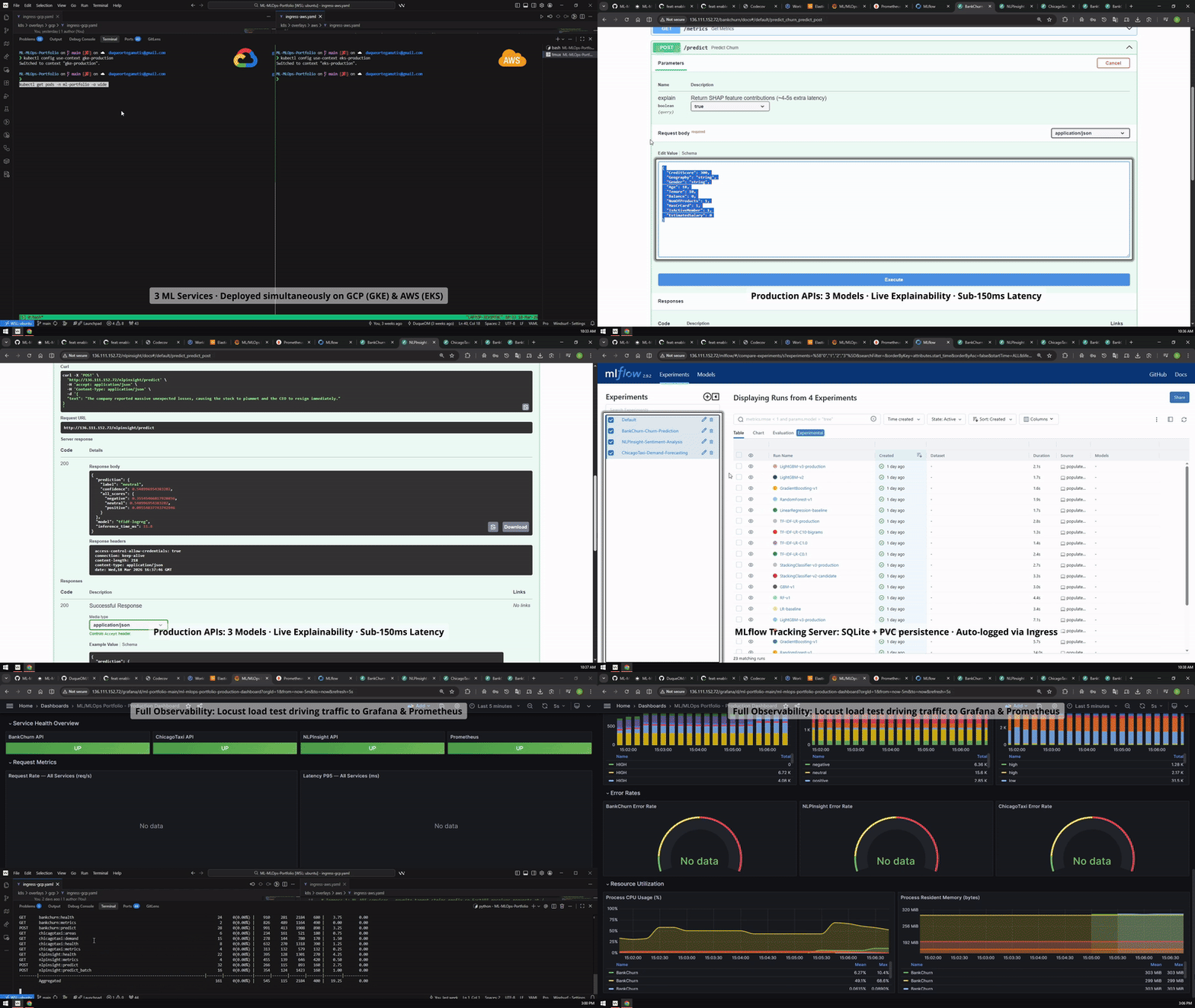
| Project | What it demonstrates | Main result |
|---|---|---|
| BankChurn Predictor | Classification API, SHAP explanations, threshold tuning, model serving. | AUC 0.87, 90% coverage. |
| NLPInsight Analyzer | Financial sentiment API, honest dataset selection, CPU-friendly serving. | 80.6% accuracy, 98% coverage. |
| ChicagoTaxi Pipeline | PySpark ETL, demand forecasting, data leakage correction. | R2 0.96, 6.3M rows processed. |
One example from the portfolio: a load test exposed an 81% error rate in an ML API. I traced the issue to a serving pattern that created CPU contention under Kubernetes, then redesigned the inference path with asynchronous execution and a thread pool. The result dropped the error rate to 0% and reduced CPU needs.
That story matters because it shows the habit I want to bring to an ML/MLOps role: measure the problem, understand the cause, fix it, and document the lesson.
📐 18 ADRs → | 📋 Engineering Highlights → | 📺 3min Demo →
Python scikit-learn XGBoost LightGBM PySpark FastAPI Docker
Kubernetes Terraform GitHub Actions MLflow DVC Prometheus
Grafana SHAP AWS GCP
TripleTen Data Science
14 years operations -> MLOps & Production ML
I use AI-assisted coding tools — and I engineer that workflow instead of hiding it. My production template encodes the governance layer: behavior protocols (AUTO/CONSULT/STOP), path-scoped rules, an append-only audit trail and eval gates that keep AI-generated changes reviewable and bounded. Architecture, trade-off analysis, incident diagnosis, and final technical decisions are my responsibility; the tooling accelerates the rest.
I consider this a core engineering skill for 2026, not a disclaimer.
Open to MLOps, Production ML, Applied AI, and ML Platform roles — evaluated on evidence, not tenure.
Remote preferred - Mexico City (CST)