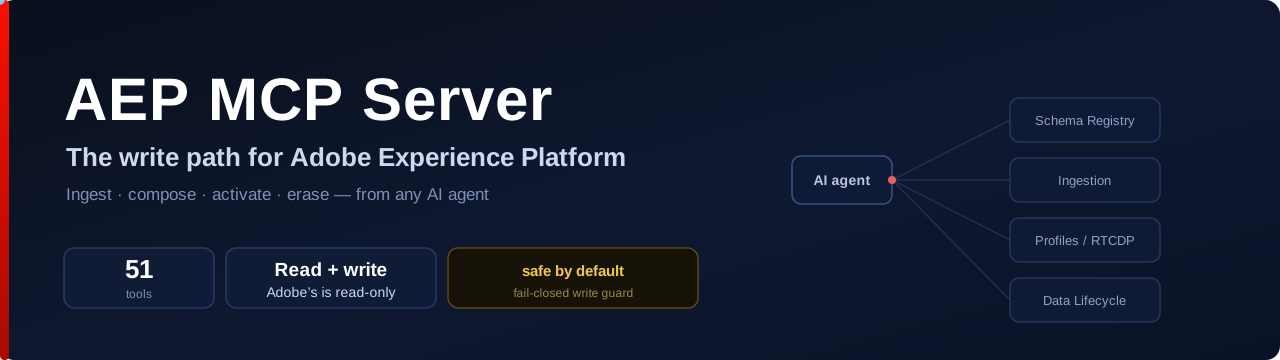






51 tools across 12 categories. Full read AND write. Self-hosted, Apache-2.0, no invitation required. Batch ingestion, schema composition, audience activation, data lifecycle, privacy jobs, query service.
Ingest a batch → compose a schema → activate an audience → honour an erasure. Every mutation gated by a fail-closed write guard that asks Adobe what kind of sandbox it's in.
claude mcp add aep \
  -e AEP_CLIENT_ID=... -e AEP_CLIENT_SECRET=... \
  -e AEP_ORG_ID=...@AdobeOrg -e AEP_SANDBOX_NAME=your-dev-sandbox \
  -- npx -y @focusgts/aep-mcp-server
Then just ask your agent:
"Create a schema with the Demographic Details field group, then a dataset on it." "Ingest this NDJSON file and tell me when the batch lands." "Build an audience of customers who bought twice this quarter and activate it." "Delete every record for this email address — dry run first."
Writes are off until you ask for them, and safe mode only unlocks sandboxes Adobe classifies as development.
flowchart LR
  A["📐 Compose<br/>schema from field groups"] --> B["🗂️ Create<br/>dataset"]
  B --> C["📥 Ingest<br/>batch · upload · complete"]
  C --> D["🎯 Activate<br/>segment → destination"]
  D --> E["🧹 Govern<br/>erasure · expiration · quota"]
  E -. "re-audit the tenant" .-> A
Adobe's first-party gateway can tell you what's in your Experience Platform tenant. It cannot create a dataset, land a batch, activate an audience, or submit an erasure. This does — and does it behind a guard that fails closed.
flowchart LR
  A["AI agent<br/>(Claude · Cursor · Copilot)"] -- MCP / stdio --> B["aep-mcp-server<br/>51 tools"]
  B --> W{{"write guard<br/>fail-closed"}}
  W --> C["Schema Registry<br/>+ Catalog"]
  W --> D["Batch Ingestion"]
  W --> E["Profiles · Segments<br/>Destinations"]
  W --> G["Data Lifecycle<br/>+ Privacy"]
  C --> F["Your AEP sandbox"]
  D --> F
  E --> F
  G --> F
The agent calls tools; the server talks to live Adobe APIs over OAuth Server-to-Server. The write guard sits in the HTTP client, not in each tool, so all 51 inherit it and none can forget it. Blocked calls never reach Adobe.
Three postures. Reads are never restricted in any mode.
AEP_MODE |
Writes permitted | Use it when |
|---|---|---|
read-only |
Never, in any sandbox | Handing the server to someone to explore an environment you don't want touched |
safe (default) |
Only where Adobe classifies the sandbox development |
Evaluating, or letting an agent work without risking production |
production |
Anywhere, including production | You run your own change control and don't want the server second-guessing you |
How
safedecides — and why it's not the sandbox name. A production sandbox can be called anything, and a sandbox calledprodmight not be production. Only Adobe'stypefield from the Sandbox Management API decides.It fails closed. If the type can't be determined — the credential can't read sandbox metadata, the API errors, startup hasn't finished — writes are blocked. A credential must not earn write access by being less capable. An unrecognised
AEP_MODEfalls back tosafe, so a typo can never grant production writes.A sandbox literally named
prodis refused unconditionally, before mode resolution — soAEP_MODE=productiondoes not lift it. Override withAEP_I_UNDERSTAND_THIS_WRITES_TO_PROD=trueonly if that really is your sandbox's name. The inference is deliberately asymmetric: trusting a name to allow a write is unsafe, trusting one to deny a write is safe, because the worst case is a refusal you can override on purpose.Mutations are off entirely unless
AEP_ALLOW_MUTATIONS=true. That is separate fromAEP_MODEon purpose: choosing a write mode should not also mean "yes, you may change my data".
Startup always states the active posture:
SAFE MODE — sandbox is a development sandbox, so writes are ENABLED.
SAFE MODE — sandbox is PRODUCTION, so writes are BLOCKED. Reads work normally.
SAFE MODE — sandbox type could not be confirmed, so writes are BLOCKED (fail-closed).
READ-ONLY MODE — no write, update, or delete will be performed in any sandbox.
PRODUCTION MODE — writes permitted against ANY sandbox, including production.
Writes are not uniformly gated — uniform gating makes an agent useless. Gates sit where an action is irreversible and wide-reaching, and every one is checked before any network call:
| Tool | Gate |
|---|---|
aep_create_record_delete |
dryRun defaults true. Real submission needs confirm: "DELETE RECORDS <datasetId> <identityDigest>" — bound to the dataset and a SHA-256 digest of the exact identity set, so a confirmation can't be reused for a different deletion. ALL and multi-dataset targets are refused. |
aep_delete_segment |
confirm: "DELETE SEGMENT <segmentId>" — segments were create-only until 0.9.1, so every one an agent made was permanent |
aep_delete_dataset |
confirm: "DELETE DATASET <id>", escalating to "DELETE PROFILE-ENABLED DATASET <id>" when the dataset feeds Profile |
aep_complete_batch |
confirm: "COMPLETE BATCH <batchId>" — the point of no return for ingestion |
aep_revert_batch |
confirm: "REVERT BATCH <batchId>" |
aep_create_dataset_expiration |
confirm: "CREATE DATASET EXPIRATION <datasetId>" — unless dryRun: true |
aep_update_dataset_expiration |
confirm: "UPDATE DATASET EXPIRATION <ttlId>" |
aep_cancel_dataset_expiration |
confirm: "CANCEL DATASET EXPIRATION <ttlId>" |
aep_delete_profile |
confirm: "I understand this is irreversible" (deprecated — prefer Data Hygiene) |
Confirmations name their target. A phrase carrying the dataset id — and for record delete, a hash of the identities too — cannot be copied from one call to another. A generic "I understand this is irreversible" approves any deletion once you've typed it once.
Identity values never leave the process.
aep_create_record_deletereturns a count, the namespace names, and a digest — never the email addresses or device IDs you passed it. A record-delete request is by nature a list of real people; a tool that echoes them copies them into every transcript and log sink it touches.Batch creation and file upload are ungated on purpose: those writes are additive and recoverable. An unwanted batch can be left uncompleted, and data that did land can be removed with the Data Hygiene tools.
Every tool ships MCP annotations — readOnlyHint, destructiveHint, idempotentHint, openWorldHint — derived from the same metadata that builds its description, so the two cannot drift.
| Count | |
|---|---|
readOnlyHint: true |
29 |
destructiveHint: true |
8 |
| Un-annotated | 0 |
These are hints for the client, not enforcement — the guards above enforce. Their value is that a client like Claude Desktop uses destructiveHint to decide when to interrupt and ask a human. Without them aep_delete_profile looks identical to aep_list_schemas. A test asserts the destructive list exactly, so a ninth is a deliberate act rather than an oversight.
All prefixed aep_, verb_noun naming. 🔒 changes state · 🔥 destructive.
|
Schemas (4)
Datasets (4)
|
Ingestion (7)
|
Sources (2)
Query Service (3)
|
|
Identities (2)
|
Profiles (4)
|
Segments (5)
Destinations (3)
|
|
Privacy Service (6)
|
Data Hygiene (9)
|
Workflows these unlock
Ingest end to end —
create_schema→create_dataset→create_batch→upload_batch_file→complete_batch→get_batch_statusBuild and activate an audience —
create_segment→estimate_segment_size→list_destinations→create_destination_connection→activate_segmentHonour an erasure request —
get_profile_by_identity→create_record_delete→get_work_order_statusRetire data on a schedule —
create_dataset_expiration→list_dataset_expirations→update_dataset_expiration→cancel_dataset_expiration
What's actually been run against a live tenant is recorded per tool in docs/VALIDATION-MATRIX.md — including the surfaces that are documented-and-mocked but deliberately never executed, and why.
AJO is a separate Adobe product, licensed separately — hence the ajo_ prefix, so an entitlement failure reads as one.
|
Campaigns
|
Campaigns is the only AJO surface reachable on our tenant. Journeys, messages, channel surfaces, content templates, fragments, offers and decisions all return an HTML 404 — the gateway has no such route — so they are deliberately not implemented. |
Writes are absent on purpose. The routes exist, but shipping an unvalidated write path into a product that sends messages to real people is not a trade worth making.
Every MCP server in this space is described by its tool count. That measures surface area, not competence: fifty tools that 404 score higher than ten that work.
bench/ is an agentic benchmark that measures the other thing — given a real task and a live tenant, does the agent finish it, and can you prove it?
npm run bench          # tier 1, read-only, safe on any tenant
npm run bench:write # tier 2, creates and removes what it creates| Assertions run against Adobe | A "create a segment" task is scored by a GET that finds it — never by the create call's own success flag. A write reporting on itself is not evidence. |
| Cleanup is scored | Completing the goal while leaving an orphan is not a pass. A benchmark that dirties the tenant can only run once honestly. |
| Tier 1 is production-safe | GET only. A benchmark nobody dares run measures nothing. |
Current: tier 1 5/5, tier 2 2/2, zero residue. Tier 3 (irreversible) is defined and deliberately empty — its tasks are non-cancellable and can take 30 days, and a benchmark is not a good reason to run one.
We expect to score badly on tasks we haven't built for. That's the intended use.
Adobe ships first-party tools through CX Coworker Gateway. It's a genuinely good product, and if all you need is to ask questions about your tenant, use it.
| Adobe AEP tools (CX Coworker Gateway) | @focusgts/aep-mcp-server | |
|---|---|---|
| Operations | Read-only (search_*) |
Full CRUD (read + write) |
| Tool count | 8 | 51 |
| Access | Invitation-only + org enablement | npm install — any org with API credentials |
| Batch ingestion | Not available | 7 tools |
| Profiles / Identity | Not covered | 6 tools |
| Privacy Service | Not covered | 6 tools |
| Data Lifecycle | Not covered | 9 tools |
| Transport | Adobe-hosted gateway | stdio (local, composes with other MCPs) |
| Data path | Queries traverse Adobe's gateway | Runs entirely in your own VPC |
| License | Proprietary | Apache 2.0 |
| Error responses | — | Structured AEP_{status} codes |
Audiences and destinations do appear, but in a separate Real-Time CDP tool set on the same gateway — and Adobe is explicit that creating, activating, updating, or deleting audiences, destinations, and dataflows isn't supported there either. The read-only boundary holds across the whole gateway.
They're complementary, not competing: pair Adobe's gateway for governed reads with this server for the write path.
Adobe's figures were read from their Experience Platform tools page (last updated 17 July 2026):
search_datasets,search_class_relations,search_data_access,search_data_lake,search_dule,search_query_service,search_audit,search_allowed_ip_ranges. It's a Beta surface and will change — check their docs for the current figure. The read/write split is the durable difference, not the count.
Claude Code — one command
claude mcp add aep \
  -e AEP_CLIENT_ID=... -e AEP_CLIENT_SECRET=... \
  -e AEP_ORG_ID=...@AdobeOrg -e AEP_SANDBOX_NAME=your-dev-sandbox \
  -- npx -y @focusgts/aep-mcp-server
Claude Desktop — claude_desktop_config.json
~/Library/Application Support/Claude/claude_desktop_config.json (macOS) or %APPDATA%\Claude\claude_desktop_config.json (Windows):
{
  "mcpServers": {
    "aep": {
      "command": "npx",
      "args": ["-y", "@focusgts/aep-mcp-server"],
      "env": {
        "AEP_CLIENT_ID": "...",
        "AEP_CLIENT_SECRET": "...",
        "AEP_ORG_ID": "...@AdobeOrg",
        "AEP_SANDBOX_NAME": "your-dev-sandbox"
      }
    }
  }
}
Cursor — .cursor/mcp.json
{
  "mcpServers": {
    "aep": {
      "command": "npx",
      "args": ["-y", "@focusgts/aep-mcp-server"],
      "env": {
        "AEP_CLIENT_ID": "...",
        "AEP_CLIENT_SECRET": "...",
        "AEP_ORG_ID": "...@AdobeOrg",
        "AEP_SANDBOX_NAME": "your-dev-sandbox"
      }
    }
  }
}
VS Code (GitHub Copilot) — .vscode/mcp.json
{
  "servers": {
    "aep": {
      "command": "npx",
      "args": ["-y", "@focusgts/aep-mcp-server"],
      "env": {
        "AEP_CLIENT_ID": "...",
        "AEP_CLIENT_SECRET": "...",
        "AEP_ORG_ID": "...@AdobeOrg",
        "AEP_SANDBOX_NAME": "your-dev-sandbox"
      }
    }
  }
}Get them at developer.adobe.com/console: create a project → add Experience Platform API → OAuth Server-to-Server.
| Variable | Required | Description |
|---|---|---|
AEP_CLIENT_ID |
Yes | Adobe I/O client ID |
AEP_CLIENT_SECRET |
Yes | Adobe I/O client secret |
AEP_ORG_ID |
Yes | IMS org ID — must end @AdobeOrg |
AEP_SANDBOX_NAME |
Yes | Sandbox to scope every call to. No default — see below |
AEP_ALLOW_MUTATIONS |
No | true to permit any write at all. Off by default |
AEP_MODE |
No | read-only · safe (default) · production |
AEP_I_UNDERSTAND_THIS_WRITES_TO_PROD |
No | Only if your sandbox is genuinely named prod |
AEP_LOG_RESPONSE_BODIES |
No | Log raw Adobe error bodies. Off by default — Adobe echoes request context, which can include identity values |
LOG_LEVEL |
No | Pino level (default info) |
AEP_REQUEST_TIMEOUT_MS |
No | Per-request timeout (default 30000) |
AEP_MAX_RETRIES |
No | Retries on 429/5xx (default 3) |
AEP_SANDBOX_NAMEhas no default, deliberately. It used to fall back toprod, which meant a config file missing one line silently pointed every request — reads included — at production, with no warning. There is no safe default: a wrong guess is indistinguishable from a correct one until something is read or written in the wrong environment. Setting it explicitly toprodis allowed; that's a visible, deliberate choice, and mutations there are still refused by the write guard.Sandbox scoping. Every tool sends
x-sandbox-name, and Query Service derives its database as<AEP_SANDBOX_NAME>:all.
Not every Adobe org licenses every AEP product. A tool returning AEP_403 usually means a missing entitlement rather than a bad credential.
| Category | Required entitlement |
|---|---|
| Schemas · Datasets · Ingestion | AEP (base) |
| Identities | AEP (base) + Identity Service |
| Profiles · Segments · Destinations | Real-Time CDP |
| Sources | AEP (base) — connector availability varies by SKU |
| Query Service | AEP Query Service add-on |
| Privacy Service | Adobe Privacy Service (sold separately) |
| Data Hygiene | AEP (base). Adobe documents no Data Distiller gate here — an earlier version of this table wrongly claimed one. A 401 means wrong org, wrong sandbox, or wrong credential profile, in that order |
TypeScript strict end-to-end, @modelcontextprotocol/sdk + zod, stdio transport, stateless per request.
flowchart LR
  C["MCP client<br/>Claude · Cursor<br/>Copilot · ChatGPT"]
  T["aep-mcp-server<br/><b>51 tools</b><br/>12 categories"]
  G{{"write guard<br/>fail-closed"}}
  A1["Schema Registry<br/>· Catalog"]
  A2["Batch Ingestion"]
  A3["UPS · Segmentation<br/>· Destinations"]
  A4["Data Lifecycle<br/>· Privacy"]
  IMS[/"Adobe IMS<br/>OAuth S2S"/]

  C -- "stdio · JSON-RPC 2.0" --> T
  T -- "every call, no exceptions" --> G
  IMS -. "token cache · 401 re-auth" .-> T
  G -- "HTTPS · Bearer · x-sandbox-name" --> A1
  G --> A2
  G --> A3
  G --> A4
OAuth Server-to-Server with a deduped token cache, structured pino logging with PII redaction, exponential-backoff retries, automatic 401 re-auth, working cursor pagination, structured AEP_{status} error codes, and a graceful-shutdown lifecycle. All logs go to stderr — stdout is reserved for the MCP JSON-RPC stream.
git clone https://github.com/Focus-GTS/aep-mcp-server.git
cd aep-mcp-server && npm install && npm run build && npm test
npm run dev # tsx src/server.ts (hot-reload)
npm test # vitest — 440 tests
npm run typecheck # tsc --noEmit
npm run tools # print the registered tool surfacenpm run test:live runs a read-only smoke suite against a real IMS org and sandbox to verify credentials, entitlements, and sandbox scoping end to end. It invokes no destructive tool and requires AEP_SANDBOX_NAME to point at a non-production sandbox.
| eds-mcp-server | MCP server for Adobe Edge Delivery Services — read, audit, fix, publish and undo your site |
| eds-content-ops-skills | AI skills for EDS content ops — first third-party contributor merged into Adobe's official skills repo |
| eds-ops | CLI + GitHub Action for automated site grading and PR gating |
| EDS Score | Free browser-based site health analyzer |
Built by Focus GTS — Adobe Silver Solution Partner · Apache-2.0
Bug reports and PRs welcome at Focus-GTS/aep-mcp-server · dfox@focusgts.com
Not affiliated with or endorsed by Adobe Inc. or Anthropic, PBC.