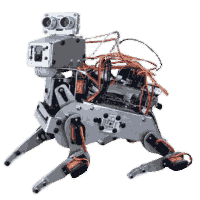


A robot dog. Powered by AI. Consulting living human neurons. Trading memecoins on Solana.
What if the final decision to buy or sell a memecoin wasn't made by an algorithm, a neural network, or even an LLM - but by actual living human neurons?
We're building exactly that.
Our trading robot already runs a sophisticated AI-powered pipeline: real-time token discovery, on-chain analysis, smart wallet tracking, and Grok-4 as the decision engine - all live on stream. It evaluates hundreds of candidates, filters them through hard technical gates, and lets an LLM make the final call.
Now we're adding a new layer: a biological neural network - real human neurons grown on silicon - as a parallel advisor and final gatekeeper in our trading loop.
This isn't science fiction. The hardware exists today. It's called the CL1, built by Cortical Labs, and we're already in active discussions with their team to make it happen. We've applied for early access to the Cortical Cloud infrastructure - our application has been passed through to their CRM pipeline, and we're working directly with a Cortical Labs representative to secure CL1 Cloud access for our use case. The moment it's available, we're plugging neurons into the loop.
In 2022, Cortical Labs published a landmark paper in the journal Neuron demonstrating that ~800,000 brain cells grown on a microelectrode array could learn to play the video game Pong. The system, called DishBrain, showed goal-directed learning within five minutes of real-time gameplay.
The key insight came from theoretical neuroscience - specifically Karl Friston's Free Energy Principle. The idea: biological systems inherently act to minimize surprise and unpredictability in their environment. The DishBrain team leveraged this by:
- Correct action → predictable, structured electrical feedback (neurons "understand" the world)
- Wrong action → random, chaotic electrical noise (the world becomes unpredictable)
Neurons naturally reorganize their firing patterns to avoid the unpredictable state. They don't need explicit reward signals like machine learning models - they self-organize toward predictability. This is fundamentally different from how any artificial neural network learns.
As Cortical Labs' Chief Scientist Brett Kagan explained: "Every time it gets it wrong, it gets information that is different, that can't be predicted. The only thing the system could do would be to change its actions."
The CL1 is the commercialized evolution of DishBrain. Launched in March 2025, it's a self-contained biological computer:
- 200,000 living human neurons (derived from induced pluripotent stem cells) grown on a 59-electrode silicon grid
- Sub-millisecond closed-loop latency - stimulate neurons and read their response in real-time
- 6-12 month neuron lifespan with integrated life support (temperature, gas, filtration)
- Python API (
cl-sdk) for programmatic stimulation, recording, and real-time closed-loop interaction - Under 1 kilowatt per rack - millions of times more energy-efficient than GPU clusters
In early 2026, developer Sean Cole demonstrated CL1 neurons learning to play Doom - navigating corridors and shooting enemies through adaptive real-time goal-directed learning. The CL1 culture operates on reflex and pattern, not planning - which, as it turns out, is exactly what memecoin trading rewards.
Cortical Labs is now scaling their Cortical Cloud - racks of 30 interconnected CL1 modules available as "wetware as a service." This is how we'll connect.
graph LR
    A["Token Discovery<br/><i>scan</i>"] --> B["Hard Filters<br/><i>technical</i>"]
    B --> C["Smart Wallet Enrichment<br/><i>on-chain signals</i>"]
    C --> D["Grok-4 Decision<br/><i>LLM reasoning</i>"]
    D --> E["Execute Trade<br/><i>swap</i>"]

    style A fill:#1a1a2e,stroke:#e94560,color:#fff
    style B fill:#1a1a2e,stroke:#e94560,color:#fff
    style C fill:#1a1a2e,stroke:#e94560,color:#fff
    style D fill:#0f3460,stroke:#e94560,color:#fff
    style E fill:#16213e,stroke:#0f3460,color:#fff
graph TD
    A["Token Discovery"] --> B["Hard Filters"]
    B --> C["Smart Wallet Enrichment"]
    C --> D["Grok-4 LLM<br/><i>reasoning</i>"]
    C --> E["CL1 Organoid<br/><i>biological instinct</i>"]
    D --> F{"Consensus Engine<br/>both agree?"}
    E --> F
    F -->|YES| G["Execute Trade"]
    F -->|NO| H["Veto<br/><i>'The neurons said no.'</i>"]

    style A fill:#1a1a2e,stroke:#e94560,color:#fff
    style B fill:#1a1a2e,stroke:#e94560,color:#fff
    style C fill:#1a1a2e,stroke:#e94560,color:#fff
    style D fill:#0f3460,stroke:#533483,color:#fff
    style E fill:#2d6a4f,stroke:#40916c,color:#fff
    style F fill:#533483,stroke:#e94560,color:#fff
    style G fill:#16213e,stroke:#0f3460,color:#fff
    style H fill:#6a040f,stroke:#e94560,color:#fff
The organoid evaluates in parallel with Grok-4 - not sequentially. Both receive the same candidate data. A consensus mechanism requires agreement before execution, and the organoid holds veto power - if the neurons don't fire in a confident pattern, the trade is killed regardless of what the AI thinks.
The CL1 communicates through electrical pulses - stimulation in, spike patterns out. We need to translate trading signals into something neurons can process.
We map different market metrics to channel groups on the 59-electrode array, and encode magnitude through pulse characteristics:
| Channel Group | Market Signal | Encoding |
|---|---|---|
| Ch 1-12 | Risk Score | Current amplitude (lower risk = stronger signal) |
| Ch 13-24 | Momentum (5m) | Pulse frequency (bullish = high freq, bearish = low) |
| Ch 25-36 | Smart Wallet Confidence | Burst count (more wallets = more bursts) |
| Ch 37-48 | Liquidity / Volume | Amplitude scaling |
| Ch 49-59 | Grok-4 Confidence | Structured pattern if high, sparse if low |
After stimulation, we observe the neural response over a ~200-500ms window:
- High spike rate across multiple channels → excited, coherent response → interpreted as "GO"
- Low / scattered / suppressed activity → incoherent or avoidant response → interpreted as "NO-GO"
- Specific learned patterns (after conditioning) → weighted confidence score
The CL1 API gives us real-time spike detection in closed loops running up to 25kHz. We'll likely run our trading evaluation loop at 100-500 ticks/second - sampling neural response over multiple iterations to build a statistical picture before making the call.
The organoid is unconditioned. It has never seen market data before. Its responses to our stimulation patterns are essentially its naive biological reaction - the neural equivalent of a gut feeling from a brain that has never traded.
This phase is still valuable:
- Establishes baseline response patterns
- Creates immediate, compelling content ("We just asked living neurons if we should buy this coin")
- Provides a control period to measure against later learning
- The neurons' natural tendency to avoid chaotic/high-variance stimuli may accidentally filter out volatile garbage
Implementation: Encode candidate → Stimulate → Read spike response → Binary GO/NO-GO threshold → Veto or pass through to execution.
Now we apply the Free Energy Principle - the same protocol that taught DishBrain to play Pong.
After each trade resolves:
Profitable trade → Predictable reward stimulus
- Structured, rhythmic, low-frequency pulse pattern delivered to the same channels that were active during the "GO" decision
- Reinforces the neural pathways that produced the correct call
- The neurons experience a predictable, "comfortable" signal
Losing trade → Unpredictable punishment stimulus
- Random, chaotic, high-frequency noise across channels
- Disrupts the pathways that produced the bad call
- The neurons experience an unpredictable, "uncomfortable" signal
Over dozens and hundreds of trades, the organoid's response patterns shift. Firing configurations that led to profitable trades get reinforced. Configurations that led to losses get disrupted. The neurons literally learn which market patterns correlate with good outcomes.
This isn't metaphorical. This is the demonstrated mechanism from peer-reviewed neuroscience applied to a new domain.
Implementation: After trade settlement → compute P&L → if profit: deliver structured reward stim to decision-associated channels → if loss: deliver random noise to same channels. Track response pattern evolution over time.
The organoid has now processed hundreds of trades with feedback. Its response patterns carry statistically meaningful signal. At this point:
- Consensus mode fully active: Both Grok-4 and the organoid independently evaluate. Both must agree to buy.
- Tracked performance: We maintain a running scoreboard - organoid accuracy vs. Grok-4 accuracy vs. consensus accuracy
- Adaptive weighting: If the organoid consistently outperforms on certain token profiles (e.g., it's better at detecting rugs), its vote gets weighted higher for those scenarios
- Either can trigger a sell: If the organoid's response to a held position suddenly shifts to avoidance patterns, it can independently trigger a sell signal
The endgame question: can conditioned biological neurons develop a genuine edge in memecoin trading? Even a small statistical edge, demonstrated live on stream with tracked metrics, would be a first-of-its-kind result.
graph LR
    subgraph GR["Grok Robot (TypeScript)"]
        TL["Trading Loop"]
        CE["Consensus Engine"]
        CD["Conditioning<br/><i>post-trade P&L</i>"]
    end

    subgraph CC["Cortical Cloud (Python / CL API)"]
        OS["Organoid Service"]
        EN["Encoder"]
        ST["Stimulator"]
        SR["Spike Reader"]
        CO["Conditioner"]
        OS --- EN
        OS --- ST
        OS --- SR
        OS --- CO
    end

    TL -- "HTTP / WS" --> OS
    OS -- "GO / NO-GO" --> CE
    CD -- "reward / punish" --> CO

    style GR fill:#1a1a2e,stroke:#0f3460,color:#fff
    style CC fill:#1b2a1b,stroke:#2d6a4f,color:#fff
    style TL fill:#0f3460,stroke:#533483,color:#fff
    style CE fill:#0f3460,stroke:#533483,color:#fff
    style CD fill:#0f3460,stroke:#533483,color:#fff
    style OS fill:#2d6a4f,stroke:#40916c,color:#fff
    style EN fill:#2d6a4f,stroke:#40916c,color:#fff
    style ST fill:#2d6a4f,stroke:#40916c,color:#fff
    style SR fill:#2d6a4f,stroke:#40916c,color:#fff
    style CO fill:#2d6a4f,stroke:#40916c,color:#fff
We'll build a Python microservice that wraps the CL1 API and exposes a simple interface to our TypeScript trading bot:
# Simplified concept
import cl
from cl import ChannelSet, StimDesign, BurstDesign

class OrganoidTrader:
    def evaluate_candidate(self, metrics: dict) -> dict:
        """
        Encode trading metrics as neural stimulation,
        read the biological response, return GO/NO-GO.
        """
        with cl.open() as neurons:
            # Encode market data across channel groups
            stim_plan = self.encode_metrics(neurons, metrics)

            # Stimulate and observe
            spike_response = []
            stim_plan.run()

            for tick in neurons.loop(ticks_per_second=500, stop_after_ticks=250):
                spike_response.extend(tick.analysis.spikes)

            # Analyze neural response
            confidence = self.analyze_response(spike_response)

            return {
                "decision": "GO" if confidence > self.threshold else "NO-GO",
                "confidence": confidence,
                "spike_count": len(spike_response),
                "channel_activation": self.get_activation_map(spike_response)
            }

    def deliver_feedback(self, trade_result: dict):
        """
        Post-trade conditioning: reward or punish based on P&L.
        """
        with cl.open() as neurons:
            if trade_result["pnl_percent"] > 0:
                # Predictable, structured reward
                self.deliver_reward_stimulus(neurons)
            else:
                # Random, chaotic punishment
                self.deliver_punishment_stimulus(neurons)
// In the trading bot (TypeScript side)
async function evaluateWithOrganoid(candidate: TokenCandidate): Promise<OrganoidDecision> {
const metrics = {
risk_score: candidate.riskScore,
momentum_5m: candidate.priceChange5m,
wallet_confidence: candidate.smartWalletScore,
liquidity: candidate.liquidity,
holder_count: candidate.holders,
grok_confidence: grokDecision.confidence
};
const response = await fetch(`${ORGANOID_SERVICE_URL}/evaluate`, {
method: 'POST',
body: JSON.stringify(metrics)
});
return response.json();
}
// Consensus check
if (grokDecision.action === 'buy' && organoidDecision.decision === 'GO') {
await executeBuy(candidate);
announce("Grok says buy. The neurons agree. Executing.");
} else if (grokDecision.action === 'buy' && organoidDecision.decision === 'NO-GO') {
announce("Grok wanted to buy, but the neurons vetoed it. Standing down.");
}This is a live experiment. We'll track and publish:
- Organoid response heatmaps: Which channels fire for which types of tokens
- Learning curves: How response patterns evolve over time with conditioning
- Performance scoreboard: Organoid accuracy vs. Grok-4 accuracy vs. consensus
- Veto analysis: How often the organoid vetoes Grok-4, and whether those vetoes were correct
- Conditioning logs: Every reward/punishment stimulus and the resulting neural adaptation
- Live visualization: Real-time spike activity displayed on stream during trade decisions
This isn't just a stunt (though it is a spectacular one).
For biological computing: This would be one of the first real-world applications of biological neural networks outside a laboratory setting - applied to a live, adversarial, high-frequency decision environment.
For trading: If conditioned neurons develop even marginal predictive power, it suggests that biological pattern recognition can extract signal from market noise in ways that statistical models cannot - leveraging millions of years of evolutionary optimization in neural architecture.
For the community: This is something no one has ever done. A robot dog, powered by Grok-4, consulting living human neurons before trading memecoins on Solana - live on stream. Every trade decision visible. Every neural response recorded. The performance tracked publicly.
The neurons might be terrible at trading. They might be surprisingly good. Either outcome is fascinating. But the real question is whether biological intelligence can learn to navigate one of the most chaotic, adversarial, information-rich environments humans have created - the memecoin market.
We're about to find out.
| Phase | Milestone | Status |
|---|---|---|
| Now | Architecture design & encoding protocol. Already in discussions with Cortical Labs - application in their CRM pipeline. | In progress |
| CL1 Cloud Access | Connect to Cortical Cloud, establish API bridge | Queued - working with CL representative |
| Phase 1 | Raw instinct - unconditioned neural evaluation | Ready at cloud launch |
| Phase 2 | Conditioning protocol - reward/punishment feedback loop | After ~100 live trades |
| Phase 3 | Mature consensus - tracked biological edge | Ongoing evolution |
- DishBrain Paper: Kagan, B.J., et al. (2022). "In vitro neurons learn and exhibit sentience when embodied in a simulated game-world." Neuron, 110(23), 3952-3969. PubMed
- CL1 Hardware: Cortical Labs CL1
- CL API Documentation: docs.corticallabs.com
- API Development Guide: GitHub - Cortical-Labs/cl-api-doc
- CL1 Playing Doom: Tom's Hardware - 200,000 living neurons playing Doom
- Chief Scientist Interview: Exclusive Look at CL1 - From DishBrain to CL1
- Free Energy Principle: Friston, K. (2010). "The free-energy principle: a unified brain theory?" Nature Reviews Neuroscience, 11(2), 127-138.
- Brain Cells Learn Faster: EurekAlert - Brain cells learn faster than machine learning