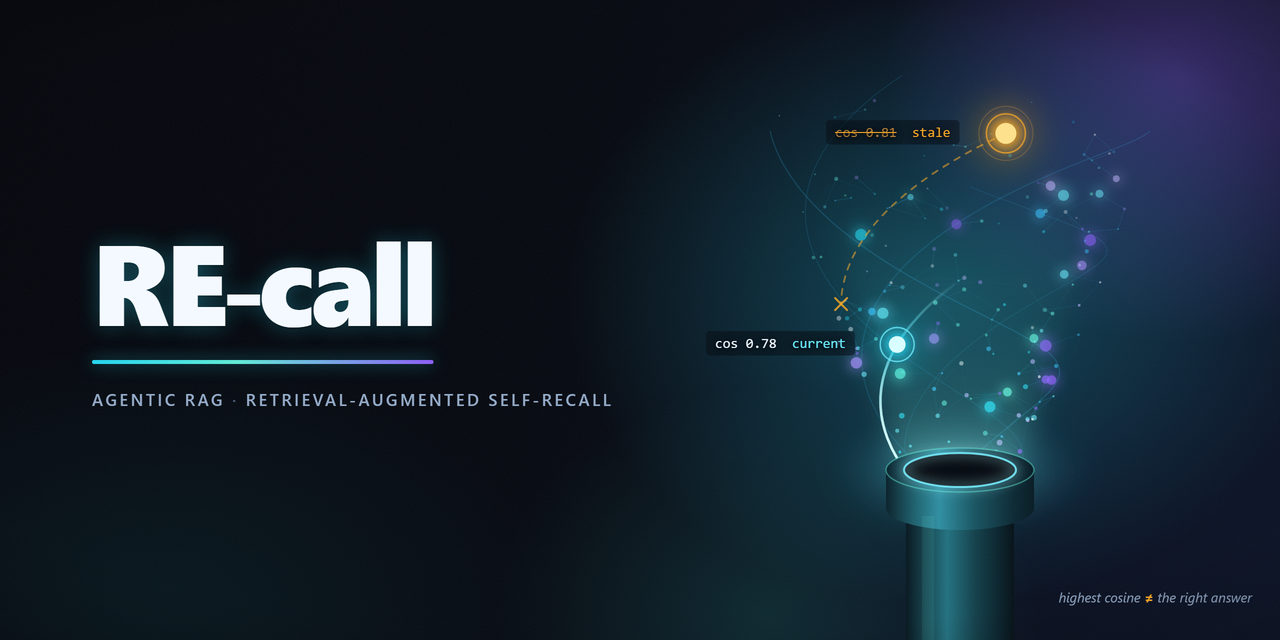
Memory that abstains instead of guessing.
RE-call is agent memory on your own PostgreSQL with pgvector: every hit carries a verdict,
confidence and provenance, a retracted claim comes back marked superseded, and a
question the corpus cannot answer is refused rather than answered from the nearest neighbour.








ATM-Bench Recall@10 92.8924 against 79.09 for the best published row (limits) · second of ten on MTRAG correct refusals (limits) · zero memory-layer LLM calls to build memory, where Mem0 pays one per session (limits)
Why RE-call · Quickstart · How it works · Product surface · Documentation · Evidence
Setup guide: install, configure and run RE-call · Validity Frontmatter: the open spec RE-call implements
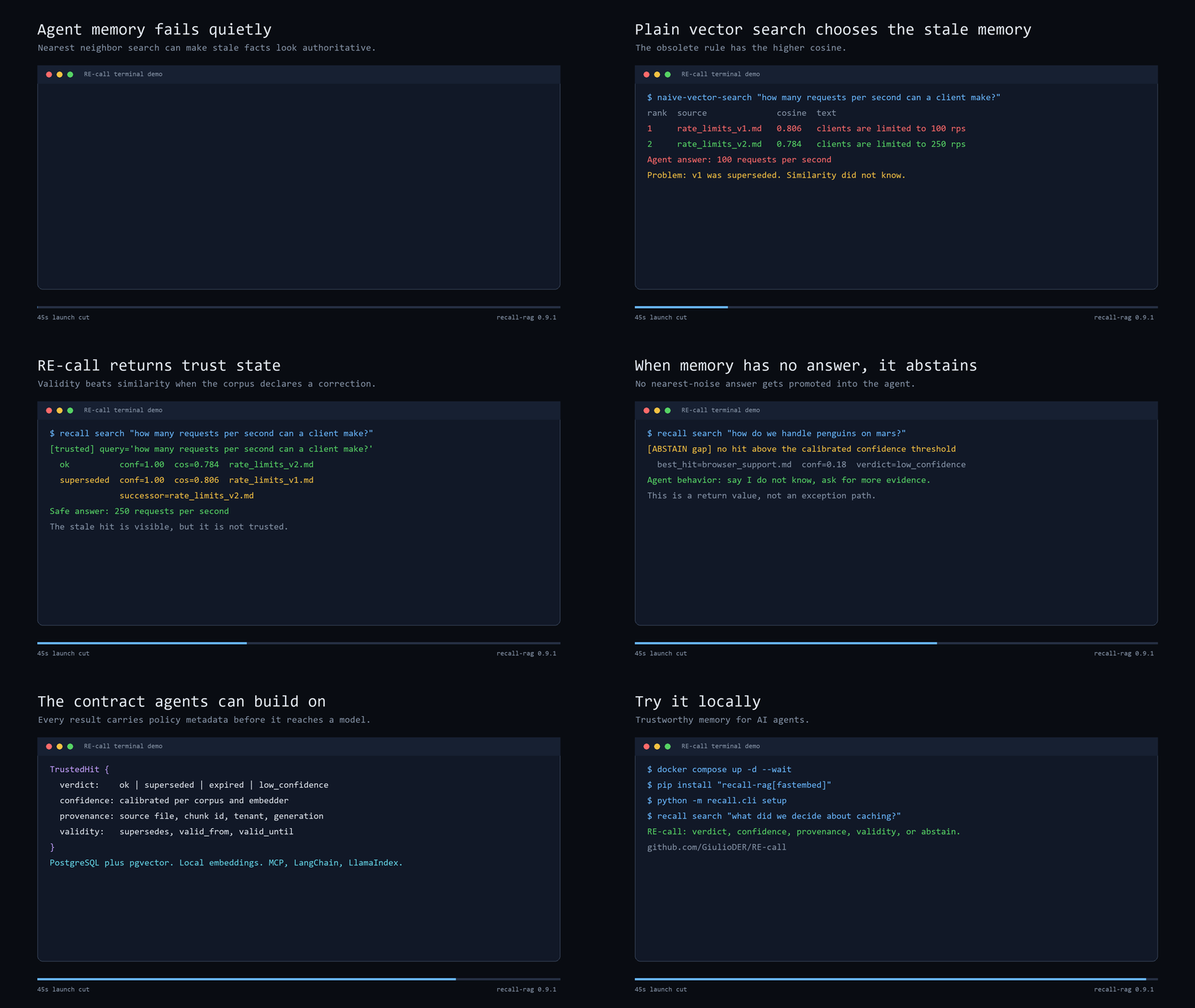
Nearest-match retrieval cannot tell the difference between what is true and what merely reads like it. When a corpus keeps its history, and real agent memory does, the retracted claim and its correction are both retrievable, and the retracted one is often the nearer match. That is not a tuning problem. A ranker with no notion of validity has no way to prefer the correction.
RE-call came out of a production, long-running trading-research agent: months of operation, 792 typed memos, 6,469 chunks, re-indexed daily by a session-end hook (counts from the private corpus behind the case study, so no committed artifact backs them). Every guard in this repository exists because that agent failed a specific way without it. See docs/CASE_STUDY.md.
It is for teams putting agent memory behind real applications, where a stale or unsupported memory is worse than no memory: keep the memory layer local by default, attach policy to every hit, calibrate the refusal threshold on your corpus, and let the application decide what to do with a result that is not trustworthy enough to answer from. Memory that knows what it no longer believes, and says so.
How that compares to the usual choices (feature rows; the only measured column is Mem0, from the paired head-to-head in benchmarks/REVIEW.md):
| RE-call | Mem0 | Zep / hosted memory | Plain pgvector / Chroma | |
|---|---|---|---|---|
| LLM calls to build memory | none | one extraction call per session (measured: 272 calls for the LOCOMO corpus RE-call built at zero) | provider-dependent | none |
| Runs on your own database | yes, PostgreSQL + pgvector | self-host or SaaS | SaaS first | yes |
| Supersession and validity | declared in frontmatter, enforced per hit | no equivalent | no equivalent | none |
| Explicit abstention | calibrated threshold, refusal with a reason | no | no | no, top-k always answers |
| Trust metadata per hit | verdict, confidence, cosine, provenance, tenant | score | score | score |
| License | Apache 2.0 | Apache 2.0 | proprietary SaaS / OSS core | Apache 2.0 / MIT |
The rows for Zep and plain vector stores are feature comparisons, not measurements; nothing here claims a benchmark against them.
The vocabulary that carries that validity, supersedes, valid_from and valid_until in a
document's frontmatter, is published separately as
Validity Frontmatter: MIT licensed, with a
zero-dependency TypeScript implementation beside it. RE-call is its Python implementation, not its
owner. The specification is deliberately licensed more permissively than this repository, so
adopting the vocabulary carries no obligation to adopt the engine.
| Capability | What it means in practice |
|---|---|
| Validity-aware retrieval | Superseded, expired, not-yet-valid, low-confidence, and not-entailed hits are surfaced as verdicts rather than flattened into ordinary search results. |
| Explicit abstention | When no valid result clears the calibrated threshold, callers receive an abstention with a reason instead of a nearest-neighbor guess. |
| Local operation | Ingest and retrieval run on PostgreSQL plus pgvector. Local embeddings are supported, so memory can be built and queried without a memory-layer LLM call. |
| Policy-driven configuration | Embedder, reranker, calibration, trust policy, and retrieval profile are selected to match legal, hardware, latency, quality, and cost requirements. The default is local and offline; higher-quality or hosted options are opt-in. |
| Production boundaries | Tenant IDs, row-level security, token-scoped MCP HTTP transports, erasure, quotas, timeouts, migrations, and observability are part of the shipped surface. |
| Reproducible evidence | Published numbers are tied to committed artifacts, and the claim gate checks them in CI. |
Measured strengths:
| Strength | Evidence boundary |
|---|---|
| Lower memory-layer cost | The LOCOMO head-to-head records no RE-call memory-layer LLM calls, while the comparator pays for extraction calls. See benchmarks/REVIEW.md. |
| External abstention check | On MTRAG, IBM's multi-turn RAG benchmark, RE-call is second on correct refusals among the recomputed systems and stays near the top answer-quality rows. See docs/MTRAG_BENCHMARK.md. |
| Retrieval on a third-party personal-memory benchmark | On ATM-Bench, across 1,013 questions of personal memory QA, the benchmark's own evaluator scores this run at Recall@10 92.8924 and QS 68.4264 . The leaderboard submission was merged 2026-08-23, the answer model is not matched to the published baselines, and the limits are stated in docs/ATM_BENCH.md. |
| Validity beats nearest-match retrieval | Declared supersession makes the current memory win over stale but similar memory. The larger trust study is in results/FINDINGS.md. |
| Stronger than a plain vector store | Returned hits carry verdicts, confidence, provenance, tenant scope, and validity metadata. Plain top-k retrieval returns neighbors and leaves trust to the caller. |
| Clear limits | The evidence states where RE-call works, where it does not, and when a corpus-specific measurement is required. |
The README is the product overview. For evidence behind these claims, start with docs/EVIDENCE.md, then use results/FINDINGS.md for the full interpretation and limits.
Two commands, and the second one starts its own database:
pip install "recall-rag[fastembed]"
recall quickstart
The distribution is recall-rag; the import and the command are recall. The name recall on
PyPI belongs to an unrelated package, so pip install recall gets you something else entirely.
Do not install both into the same environment.
That provisions a throwaway PostgreSQL with pgvector in Docker, indexes a small corpus that ships inside the package, and answers three questions: one it can answer, one whose nearest match is a claim that was later retracted, and one it refuses. The middle one is the point.
Measured 2026-08-22 on one Windows machine with the pgvector image already pulled:
about 50 seconds
cold, and about 22 seconds
on a re-run that reuses the container. A machine without the image also pays for that pull, which
is the largest and most variable part and is not included here. Re-measure with
time recall quickstart.
Nothing is calibrated and nothing is registered with an agent. It prints the next command for each.
recall quickstart --remove # stops the database and destroys its volumeAlready running PostgreSQL with pgvector? recall quickstart --existing-dsn <dsn> skips Docker
entirely.
The quickstart is a demonstration, not an install: it answers questions about a sample corpus with an uncertified threshold, and it leaves your own notes untouched. What follows is the different and longer thing, which points RE-call at your memory, fits a threshold to it, and registers the MCP server with your agent.
RE-call keeps memory in your own PostgreSQL with pgvector, so a database comes first.
Already running PostgreSQL with pgvector? Skip ahead and point the DSN at it.
Want a throwaway one? Save this as docker-compose.yml, then start it:
services:
  db:
    image: pgvector/pgvector:pg18
    environment:
      POSTGRES_USER: recall
      POSTGRES_PASSWORD: recall
      POSTGRES_DB: recall
    volumes:
      - recall_pgdata:/var/lib/postgresql
    ports:
      - "5432:5432"
    healthcheck:
      test: ["CMD-SHELL", "pg_isready -U recall"]
      interval: 2s
      timeout: 3s
      retries: 30

volumes:
  recall_pgdata:
docker compose up -d --waitThen install, create the schema, and run the guided setup wizard. The wizard records the selected embedder, retrieval options, and an optional calibration that is fitted to your labeled queries and your corpus.
pip install "recall-rag[fastembed]"
python -m recall.cli --migration-dsn postgresql://recall:recall@localhost:5432/recall schema --dim 384 apply
python -m recall.cli setup
Those three run unchanged in PowerShell.
The schema command targets the default chunks table deliberately. Global migrations have to be
applied there before any other table, so starting with --table something_else on a fresh database
stops with SchemaTooOld. To add a separate index later, apply the default target first, then pass
--table.
When the wizard asks whether to calibrate, it wants a labeled query file and the corpus those queries refer to. You do not have to build either to try it: both ship inside the installed package, next to each other.
python -c "import recall.eval, pathlib; print(pathlib.Path(recall.eval.__file__).parent)"That prints a directory holding queries.json, a labeled set covering both answerable and
unanswerable questions, and corpus/, the documents those questions are labeled against. Give the
wizard those two paths and calibration runs end to end. Sources:
recall/eval/queries.json
and recall/eval/corpus/.
A calibration fitted that way belongs to that sample, not to your data: it shows the mechanism
working and gives you a labeled file to copy the shape of. What makes a calibration valid, when a
changed corpus needs a new one (recall calibration drift measures that), and what a labeled
file must contain are covered in
docs/FIRST_CALIBRATION.md and
docs/CALIBRATION.md.
Working from a clone:
pip install -e ".[fastembed]"flowchart TB
M["Memo: markdown plus frontmatter"] --> CH["Chunk"]
CH --> EW["Embed locally"]
EW -. "optional" .-> SP["SPLADE encode"]
EW --> DB
SP -. "optional" .-> DB
Q["Query"] --> EQ["Query encoder"]
EQ --> DB[("PostgreSQL plus pgvector")]
DB --> DN["Dense vector search"]
DB --> SL["Postgres full-text search"]
DB -. "optional" .-> LS["Learned sparse search"]
DN --> F["Reciprocal Rank Fusion"]
SL --> F
LS -. "optional" .-> F
F -. "optional" .-> RR["Cross-encoder rerank"]
RR --> GP
F --> GP{"Gap check: calibrated threshold"}
GP --> TR{"Trust layer: supersession, validity, confidence"}
CAL["Calibration: fitted per embedder and corpus"] --> TR
TR -. "optional" .-> EJ{"Entailment judge"}
EJ --> OUT
TR --> OUT["Verdict, confidence, provenance, or ABSTAIN"]
TR -. "explicit opt-in" .-> RG["Reasoning graph projection"]
DB -. "generation-bound" .-> RG
RG --> IP["Inference proposals: review candidates"]
RG -. "optional semantic branch" .-> SG["Evidence Graph V1:<br/>entities, mentions, authored relations"]
TR -. "graph_expansion=one_hop" .-> SG
SG -. "bounded one hop" .-> EC["Neighbor evidence candidates"]
EC --> GT["Normal trust evaluation again"]
GT -. "accepted evidence" .-> RP
TR --> RP["Reasoning policy plus budget"]
IP --> RP
RP --> RV{"Citation and trust validation"}
RV --> ROUT["Cited answer, needs review, clarification, or ABSTAIN"]
| Area | Ships today |
|---|---|
| Retrieval | Dense, sparse, hybrid RRF, optional SPLADE, optional cross-encoder reranking, calibrated confidence, provenance, and trust verdicts. |
| Configuration | Guided setup, local and hosted embedder choices, retrieval cost profiles, optional reranking, strict or development trust policy, and per-corpus calibration. |
| Storage | PostgreSQL with pgvector, ordered SQL migration path, immutable generations, incremental indexing, pruning, and source-scoped erasure. |
| Agent integration | CLI, MCP server, LangChain retriever, LlamaIndex retriever, and injectable search seams for tests. |
| Reasoning | Explicit opt-in reasoning API, CLI, and MCP tools over trusted retrieval, generation-bound authored and semantic Evidence Graph V1 projections , proposal inspection, budgets, and citation validation. |
| Security | Tenant isolation, row-level security checks, serving and migration DSNs, bearer-token HTTP transports, scopes, quotas, and unsafe-DSN refusal. |
| Operations | Timeouts, reconnect policy, structured logging, counters, latency percentiles, and MCP stats. |
| Quality gates | Real pgvector integration tests, type checking, linting, dependency audit, claim-artifact checks, and regression fixtures for known failure modes. |
Deliberately out of scope: an end-user dashboard, entity synthesis, high availability orchestration, automatic truth extraction from prose, and corpus rewrites from inference proposals. Reasoning is opt in, citation constrained, and review aware.
The ordered SQL migration path is versioned now, pre-tenancy tables are migrated in place, and runtime
CREATE TABLE IF NOT EXISTS remains bootstrap only.
Use something else if you need managed hosting, per-chunk ACLs, automatic truth extraction from prose, or a memory system that rewrites facts for you. RE-call is a retrieval library over your PostgreSQL database, not a hosted memory platform.
RE-call is a retrieval library with an opt-in reasoning layer, not a general reasoning system. It does not infer every missing supersession edge, prove that an on-topic memory answers a near-miss question, promote proposals into corpus truth, or replace database operations with a managed service. It returns the trust signals the caller needs, and it refuses to pretend that a nearest match is always usable evidence.
For an ad hoc local markdown folder, create a table for that index, index the corpus, and search it.
If you did not calibrate during setup, use development mode only for local evaluation.
Replace ./notes with your memo folder.
python -m recall.cli --table recall_notes \
  --migration-dsn postgresql://recall:recall@localhost:5432/recall \
  schema --dim 384 apply
RECALL_TRUST_MODE=development python -m recall.cli --table recall_notes index ./notes
RECALL_TRUST_MODE=development python -m recall.cli --table recall_notes search "what did we decide about caching?"
python -m recall.cli lint ./notes
python -m recall.cli check ./notes/new-memo.md --strict
PowerShell uses the same commands, but set development mode first when you are running an uncalibrated local evaluation:
$env:RECALL_TRUST_MODE = "development"For production generation mode, build, validate, calibrate, and promote an immutable generation. Then query the tenant's active generation:
from recall.embeddings import FastEmbedEmbedder
from recall.generation_store import GenerationStore
from recall.trust import trusted_search

emb = FastEmbedEmbedder()
with GenerationStore(DSN, dim=emb.dim, tenant="acme", pool_size=8) as store:
    store.check_schema()
    result = trusted_search(store, emb, "what is the rate limit?")
    if result.abstained:
        ...  # say you do not know
    for hit in result.hits:
        hit.verdict
        hit.confidence
        hit.validity.superseded_by
Set RECALL_SERVING_DSN for application traffic and RECALL_MIGRATION_DSN only in the migration
job. RECALL_DSN remains a deprecated development fallback for the serving DSN. See
docs/MIGRATIONS.md.
Configuration modes are summarized in
docs/OPERATING_MODES.md.
Operational safety notes:
| Topic | Rule |
|---|---|
| Test database | The test suite drops tables. It uses RECALL_TEST_DSN, never RECALL_DSN. |
| Default credentials | The MCP server refuses a non-local built-in recall:recall DSN unless RECALL_ALLOW_INSECURE_DSN=1 is set deliberately. |
| Tenancy | Set RECALL_TENANT or PgVectorStore(tenant=...). Use an unprivileged database role, because PostgreSQL superusers bypass RLS. |
On Claude Code, the plugin does all of this for you, including the hooks and a skill that teaches Claude when to search:
/plugin marketplace add GiulioDER/RE-call
/plugin install recall@re-call
It asks for a DSN, a tenant and a trust mode, and keeps the DSN in your OS keychain rather than in
settings.json. You still need a database first, which is what recall quickstart above is for.
See plugin/README.md.
For every other MCP client, the manual wiring (schema, server block, trust mode) is in
docs/USING_WITH_CLAUDE.md.
Core tools include recall_search, recall_evidence, recall_index, recall_forget and
recall_stats; the authoritative list of all tools is
docs/API.md.
Authentication and tenancy: docs/AUTH.md.
pip install "recall-rag[langchain]"
pip install "recall-rag[llamaindex]"
from recall.integrations.langchain import RecallRetriever
retriever = RecallRetriever.from_store(store, emb, k=5)
docs = retriever.invoke("what is the rate limit?")When the trust layer abstains, the adapters return no document by default. Returned documents carry trust metadata, including verdict, confidence, cosine, and supersession details.
Start with docs/README.md.
Core documents:
| Document | Purpose |
|---|---|
| docs/WRITEUP.md | Architecture and design rationale. |
| docs/API.md | Supported Python, CLI, and MCP surface. |
| docs/REPOSITORY_MAP.md | What is product, evidence, benchmark support, and archive. |
| docs/REASONING_GRAPH.md | Authored reasoning projection and deterministic Evidence Graph V1 semantics . |
| docs/REASONING_OPERATIONS.md | Opt-in reasoning tools, graph expansion, traces, review policy, and operational behavior. |
| docs/AUTH.md | Authentication, scopes, and tenant isolation. |
| docs/MIGRATIONS.md | Migration roles, serving DSNs, and schema operations. |
| docs/OPERATING_MODES.md | Local, production, quality, hosted, and evaluation deployment modes. |
| docs/FIRST_CALIBRATION.md | Walkthrough from an indexed folder to a trusted, certified corpus, with the traps named where you hit them. |
| docs/CALIBRATION.md | Calibration workflow and generation-aware serving. |
| docs/CASE_STUDY.md | Where the system came from and what is public versus private. |
| docs/RESEARCH_PROTOCOL.md | How benchmark runs are controlled and audited. |
| benchmarks/PREREGISTRATION-evidence-graph-v1.md | Preregistered Evidence Graph V1 quality evaluation and relation controls . |
Release notes and upgrade warnings live in CHANGELOG.md.
Start with benchmarks/README.md. The results directory has its own map at results/README.md.
The short version:
| Question | Current evidence |
|---|---|
| Does declared supersession beat plain similarity search? | Yes, on the authored-edge cases measured in the trust and scale studies. |
| Can abstention be trusted everywhere? | No. It works on far gaps and fails on near-misses unless a stronger answerability layer is added. |
| Is retrieval quality universal? | No. Corpus shape dominates, and the measured recommendation is to benchmark your corpus before choosing an embedder. |
| Is the Mem0 comparison apples-to-apples? | The published head-to-head uses the same LOCOMO questions, generator, judge, and paired tests, with reader-tier limits stated in the benchmark review. |
| What does MTRAG add? | A third-party multi-turn benchmark with an official judge that gives full credit for correct refusal. RE-call does not top the benchmark, and that boundary is stated in docs/MTRAG_BENCHMARK.md. |
| What does ATM-Bench add? | A third-party personal-memory QA benchmark over eleven thousand email, image and video items, scored by its own evaluator, where half the questions are graded deterministically rather than by a judge. RE-call's retrieval leads the published board by a wide margin; the answer score is not answer-model-matched and the submission has not been accepted yet. Both limits are stated in docs/ATM_BENCH.md. |
Important benchmark documents:
| Document | Purpose |
|---|---|
| results/FINDINGS.md | Interpretation, limits, and negative results. |
| results/RESULTS.md | Complete result tables. |
| results/ARTIFACTS.md | Checksum and artifact map for readers auditing a claim. |
| docs/MTRAG_BENCHMARK.md | MTRAG setup, results, and scope boundaries. |
| docs/ATM_BENCH.md | ATM-Bench official results, comparability boundaries, and where the remaining loss is. |
| benchmarks/REVIEW.md | Adversarial review of the LOCOMO comparison. |
| benchmarks/PREREGISTRATION.md | Pre-registered rules for the main memory benchmark. |
| benchmarks/archive/preregistrations/README.md | Archived preregistrations for follow-up benchmark arms. |
From a git clone (the eval harness is repo-only; it is not shipped in the recall-rag wheel):
make eval
python -m recall.eval.scale --embedder hashing --filler 50000
Cloud rows require the relevant API keys. Local rows run key-free.
If you describe RE-call in a paper, post, talk, or README of your own, cite the project and credit Giulio D'Erme. Use CITATION.cff as the canonical citation source.
Apache 2.0 license. See LICENSE, and keep NOTICE with redistributed derivative works.
