Sidebar is a real-time AI legal co-pilot that listens to live courtroom testimony and whispers actionable intelligence to the lawyer — hands-free, eyes-forward, no phone required.
The lawyer wears a pair of Meta Ray-Ban glasses, which is what makes this work in a real courtroom — the audio stays private in the lawyer's ear, and the video stream Sidebar analyzes comes straight from the glasses' point of view, so the lawyer is literally looking at the witness while the agent reads the same scene. (We've left the glasses POV stream out of the demo video for time, but it's the centerpiece of the live demo.)
The lawyer loads a case brief before the hearing. During testimony, Sidebar continuously monitors everything said, automatically fact-checks claims against real-world data, cross-references testimony against the brief, analyzes witness facial expressions for stress signals, and speaks findings directly to the lawyer as short sharp whispers — without being asked.
The demo moment: A defendant claims he was at Macy's at 1am. Sidebar searches in real time, finds Macy's closes at 9pm, and immediately tells the lawyer: "Challenge the alibi, Macy's closes at 9." The lawyer never touches a phone. The lawyer never breaks eye contact. Sidebar handles the intelligence layer.
This reframes what voice agents are for. Not outbound calls. Not customer service. A real-time human lifeline in the highest-stakes moments people face.
Built in one day at the YC Voice Agents Hackathon, May 30 2026. Shortlisted as Top 7 Projects!!
Pipecat Sidebar is built entirely on Pipecat as the voice orchestration layer. The pipeline runs: NVIDIA Nemotron ASR → Nemotron 3 Super 120B LLM → Gradium TTS, wired through Pipecat's SmallWebRTC transport for low-latency real-time audio. We use Pipecat's frame processor architecture to hook into transcript events and trigger our autonomous claim monitor without blocking the main voice pipeline. The event handler system (on_user_turn_stopped, on_bot_started_speaking) gave us clean hooks to build the interruption buffer and silence monitor on top of.
NVIDIA Nemotron We use Nemotron 3 Super 120B as the primary legal reasoning LLM and NVIDIA Nemotron ASR for speech-to-text. The 120B model holds the full case brief in context, tracks the running transcript, and decides when to intervene. Nemotron ASR was genuinely impressive — fast, accurate, handles legal vocabulary and proper nouns cleanly, and the latency was low enough to feel real-time in a live conversation.
The main challenge we hit: Nemotron was sometimes reluctant to call tools proactively. It would hear a clear verifiable claim and return a silent acknowledgment instead of firing fact_check. We worked around this by building a parallel GPT-4o-mini claim detector that runs on every transcript and force-triggers fact_check when a verifiable claim is detected — bypassing the LLM's hesitation. This hybrid approach (Nemotron for reasoning, GPT-4o-mini for trigger detection) ended up being more reliable than either alone.
Cekura We used Cekura to evaluate Sidebar across adversarial courtroom scenarios — simulating hostile witnesses, prepared alibis, and procedural objections. Crucially, Cekura tested the deployed agent, not a local mock: it placed real WebRTC calls into our live Pipecat Cloud deployment (see section 4) and scored the actual production pipeline end-to-end. The eval runs surfaced two key failure modes we then fixed: the agent was intervening too often on non-actionable statements, and it was sometimes narrating its own actions out loud instead of just delivering the verdict. We iterated on the system prompt using Cekura transcripts as ground truth until the agent reliably stayed silent when nothing was actionable and spoke only when it had something the lawyer could use. The transcript scoring was particularly useful — seeing exactly where the agent broke character helped us write much tighter behavioral rules than we would have caught through manual testing alone.
We didn't want Sidebar to only run on a laptop on the demo table, so we
deployed the whole agent to Pipecat Cloud and ran it as a real hosted
service. We containerized bot-courtline.py on top of dailyco/pipecat-base,
locked our dependencies with uv sync --locked for reproducible builds, and
shipped it with a one-line pcc deploy using this config:
# pcc-deploy.toml
agent_name    = "courtline"
secret_set    = "courtline-secrets"
agent_profile = "agent-1x"

[scaling]
min_agents = 1   # one warm agent always ready — no cold start mid-hearing
We kept one agent always warm (min_agents = 1) so there's no cold start in
the middle of a hearing, and we inject the Nemotron, OpenAI, and Gradium keys
at runtime through the courtline-secrets secret set instead of baking them
into the image. Because the agent is registered as courtline, Pipecat Cloud
gives us a public endpoint to start a session:
POST https://api.pipecat.daily.co/v1/public/courtline/start
Every call to it spins up an isolated agent, provisions a WebRTC room, and hands back connection credentials. The nice part is that both our React frontend and our tests hit the exact same endpoint — so what we test is exactly what we ship.
That's what let us actually use Cekura properly. Instead of one of us
role-playing a hostile witness over and over, we pointed Cekura straight at
https://api.pipecat.daily.co/v1/public/courtline/start and let it run
adversarial courtroom scenarios against the live agent — rehearsed alibis with
planted factual errors, rapid-fire objections, and long quiet stretches where
the right move is to say nothing. It would drive full WebRTC sessions into the
deployed courtline agent, record every turn, and score the transcripts so we
could see exactly where it spoke at the wrong time or narrated its own tool
calls. We'd fix the system prompt, redeploy, and re-run the same suite to make
sure the fix stuck. That loop is how we caught the over-intervention and the
"I'll check that for you" self-narration — failure modes we'd almost certainly
have missed by hand, but obvious once we could run the same hostile scenario
against the real deployment a dozen times in a row.
A test that actually fixed the agent. One of our most useful runs was a
scenario we called "Alibi, Contract Claim, Address" — and the thing that made
it valuable is that it wasn't a quick ping. Cekura ran a full 7:42 (~8 minute)
cross-examination end-to-end against the live courtline agent, with a
testing-agent witness who threw three different things at us across the whole
conversation: a gym alibi, a legal claim about a contract, and a home address.
A real cross-examination drags on, the claims pile up, and the agent has to stay
sharp the entire time — eight straight minutes is what surfaced the bug a
30-second test never would.

Sidebar handled most of it. It pressed hard on the alibi and kept challenging the timeline (00:13, 01:57, 02:46), and it correctly noted the witness's stated address at 5 Wall Street (01:24, 01:40). But buried in the middle of a long answer, the witness slipped in a legal claim:
Testing Agent (00:30): "...the signed contract does not legally cover any actions taken outside of business hours."
That directly contradicted the case brief — and the agent let it go by without challenging it. Cekura flagged the run as a Failure (3 of 7 rubric checks failed): the agent never pushed back on the contract claim, and it also went silent for more than ten seconds at a few points deep in the call (02:13, 03:15, 04:49), with average latency around 2995ms. The lesson was specific: our claim monitor was tuned to catch location and time alibis but was effectively blind to legal/contractual assertions, and the longer the conversation ran, the more likely it was to stall. We broadened the claim detector to treat contradicts-the-brief legal statements as first-class verifiable claims, tightened the silence handling, redeployed, and re-ran the same eight-minute scenario until it passed clean.
Everything. Built from scratch on May 30 2026:
- Full Pipecat voice pipeline: Nemotron ASR + Nemotron 120B LLM + Gradium TTS
- Autonomous claim monitor — GPT-4o-mini runs on every transcript to detect verifiable claims and force-trigger fact_check without waiting for the LLM to decide
- Real-time fact_check tool using OpenAI web search — checks alibis, business hours, locations, dates against live web data
- Evidence contradiction detector — cross-references live testimony against the loaded case brief and flags inconsistencies immediately
- Facial expression analysis — FER library runs continuous local emotion detection on the witness, GPT-4o interprets signals in legal context, agent speaks up when stress indicators spike during key claims
- Silence monitor — if 15 seconds pass with no intervention, agent proactively suggests the most damaging unused question from the brief
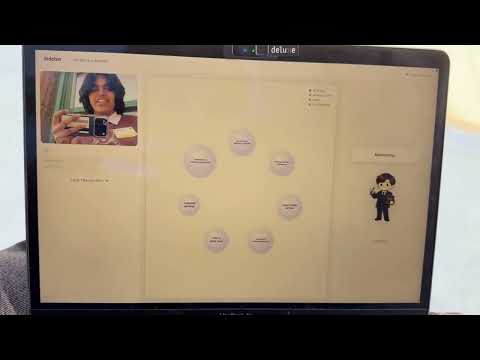
- Evidence connection graph — live SVG visualization that builds in real time showing how testimony connects to brief facts, with color-coded contradiction and match nodes
- 3-step React web app: case intake → brief upload (PDF/text) → live session
- Animated lawyer character that displays agent speech in real time
- Interruption buffer — prevents the agent from cutting itself off mid-sentence when new transcript arrives while it is speaking
NVIDIA Nemotron ASR: genuinely strong. Fast, accurate on legal vocabulary, low latency — exactly what a real-time use case needs. No complaints.
LLM: strong at legal reasoning and holding long context. The main gap is proactive tool-calling. For an autonomous agent that is supposed to act without being asked, Nemotron was too conservative — it would correctly identify a claim but choose not to call the tool. This forced us to build a workaround. If Nemotron's tool-calling behavior could be tuned to be more aggressive in agentic contexts (separate from conversational contexts where conservative is correct), it would be a much stronger fit for autonomous agent use cases. A system-prompt-level flag like "tool-calling-mode: aggressive" would be valuable.
Cekura Scenario generation was the standout feature — it created adversarial test cases we hadn't thought of. The Pipecat integration was smooth.
One piece of feedback: the scoring rubric rewards response quality but has no clean way to reward correct silence. For our use case, staying silent when nothing is actionable is the right behavior — but it scores the same as a wrong response. A "silence was correct here" label in the eval UI would make the platform much more useful for agents that are designed to be selective rather than always-on.
No bugs found, but the dashboard could surface which specific transcript moments triggered a low score more directly — right now you have to read the full transcript to find the failure point.
Pipecat Solid framework. The frame processor architecture is well designed and composable. SmallWebRTC worked reliably throughout the day.
Documentation gap: injecting messages into an active pipeline from outside the frame processor chain (e.g. from an async background task) is not well documented. We figured it out but it took time. A clear example of "how to trigger an LLM response from outside the pipeline" would save future builders significant debugging time.
| Layer | Technology |
|---|---|
| Orchestration | Pipecat |
| STT | NVIDIA Nemotron ASR |
| LLM | NVIDIA Nemotron 3 Super 120B |
| TTS | Gradium |
| Claim detection | GPT-4o-mini |
| Vision / demeanor | FER (local) + GPT-4o |
| Fact checking | OpenAI web search tool |
| Frontend | React |
| Backend | FastAPI + Python |
| Transport | SmallWebRTC |
| Deployment | Pipecat Cloud (courtline agent, start endpoint api.pipecat.daily.co/v1/public/courtline/start) |
| Evaluation | Cekura adversarial scenario testing against the live deployment |