Local-first visual workbench for parallel git-worktree work.
Stop juggling git worktree add, lsof -i, and four terminal tabs. Manage every task,
branch, worktree, port, and dev server from one dashboard on your machine.


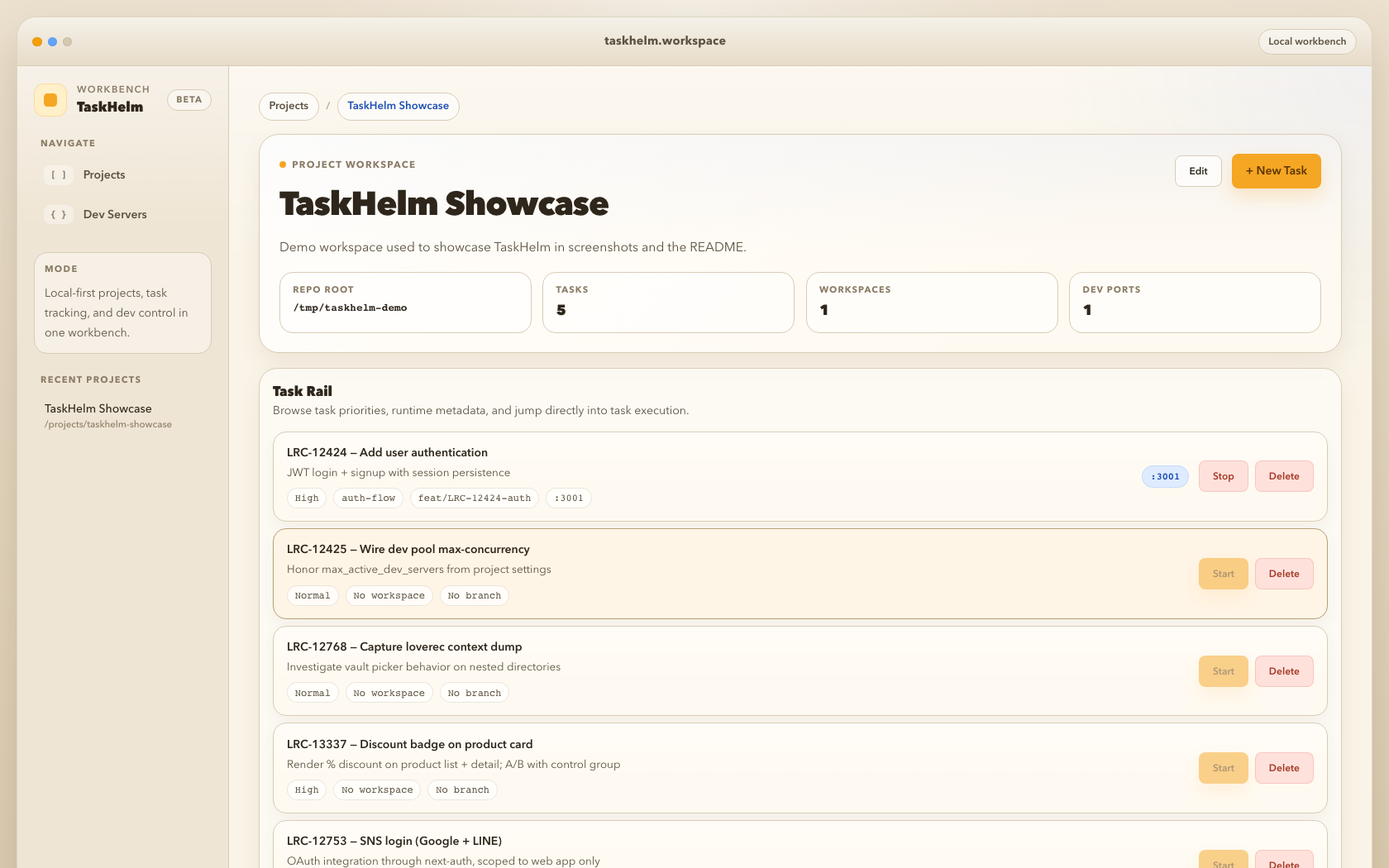
The git-worktree workflow is the right answer for running multiple branches in parallel — but the existing tooling is all CLI. You memorize commands, juggle terminals, and keep a private mental map of which branch lives at which path on which port. As soon as you have four or five tasks in flight, the coordination layer becomes a person. You.
TaskHelm replaces that mental map with a UI. It's the local control plane for parallel-worktree development:
| Without TaskHelm | With TaskHelm |
|---|---|
git worktree add ../foo feat/foo, cd ../foo, pnpm i, lsof -i :3001, … repeat per task |
One click creates branch + worktree + port for a task |
| Which task is on which branch? Which worktree is at which path? Which port? | All visible in a single dashboard, sortable per project |
| Dev servers eat all your laptop's RAM | Pooled with max concurrency — warm vs sleeping, kill external port squatters from the UI |
External process squatting your port? kill -9 $(lsof -ti :3001) |
Modal shows PID / command / user / cwd, one-click Kill & Start |
| Plans and notes live in chat sessions and die with them | Each task owns a Markdown folder on disk that survives crashes, restarts, and tool resets |
TaskHelm is built for single operators running many things at once — solo CTOs, technical founders, staff engineers acting as their own manager. Open source, MIT, works entirely offline against your local filesystem.
Read
docs/01-product-vision.mdfor the full design rationale.
Install the workbench (CLI + dashboard):
npm i -g taskhelm
taskhelm
# → boots the dashboard at http://127.0.0.1:4100 and opens your browser
CLI only (no dashboard auto-launch):
npm i -g @taskhelm/cli
taskhelm-cli project list
Requires Node.js ≥ 22.14. State lives at ~/.taskhelm/taskhelm.db (override with TASKHELM_DB),
runtime cache at ~/.taskhelm/runtime/<version> (override with TASKHELM_HOME), default port 4100
(override with TASKHELM_PORT or PORT).
On first run the launcher prepares the local Next.js standalone runtime from assets shipped inside the npm tarball — about 60–90 seconds, then cached for subsequent boots. No external services, no telemetry.
|
Per project, every task shows its branch, worktree path, and allocated port at a glance. Sortable, searchable, and the source of truth for "what's running where". |
Per-task branch + worktree + allocated port, created from the dashboard or CLI. Subrepos detected automatically. Existing unassigned worktrees can be attached instead of recreated. |
|
|
Max concurrency per project, warm vs sleeping states, health checks, and graceful shutdown. When an external process is squatting your port, the dashboard pops a modal showing PID / command / user / cwd with a one-click Kill & Start. |
Link any folder into a task and TaskHelm renders Markdown notes inline
with embedded images, videos, and diagrams. |
Every dashboard action is also a CLI command — |
A drop-in skill pack that teaches Claude Code, Cursor, Copilot CLI, Codex, and other AI coding agents
how to drive TaskHelm — the mental model, the identifier-resolution rules, the failure-mode catalog.
Without it, agents will fall back to raw git worktree add and miss the whole point of TaskHelm.
# Claude Code
mkdir -p ~/.claude/skills/taskhelm
curl -fsSL https://raw.githubusercontent.com/vantienkhai/TaskHelm/main/skills/taskhelm/SKILL.md \
  -o ~/.claude/skills/taskhelm/SKILL.md
For Cursor / Copilot CLI / generic agents, see skills/.
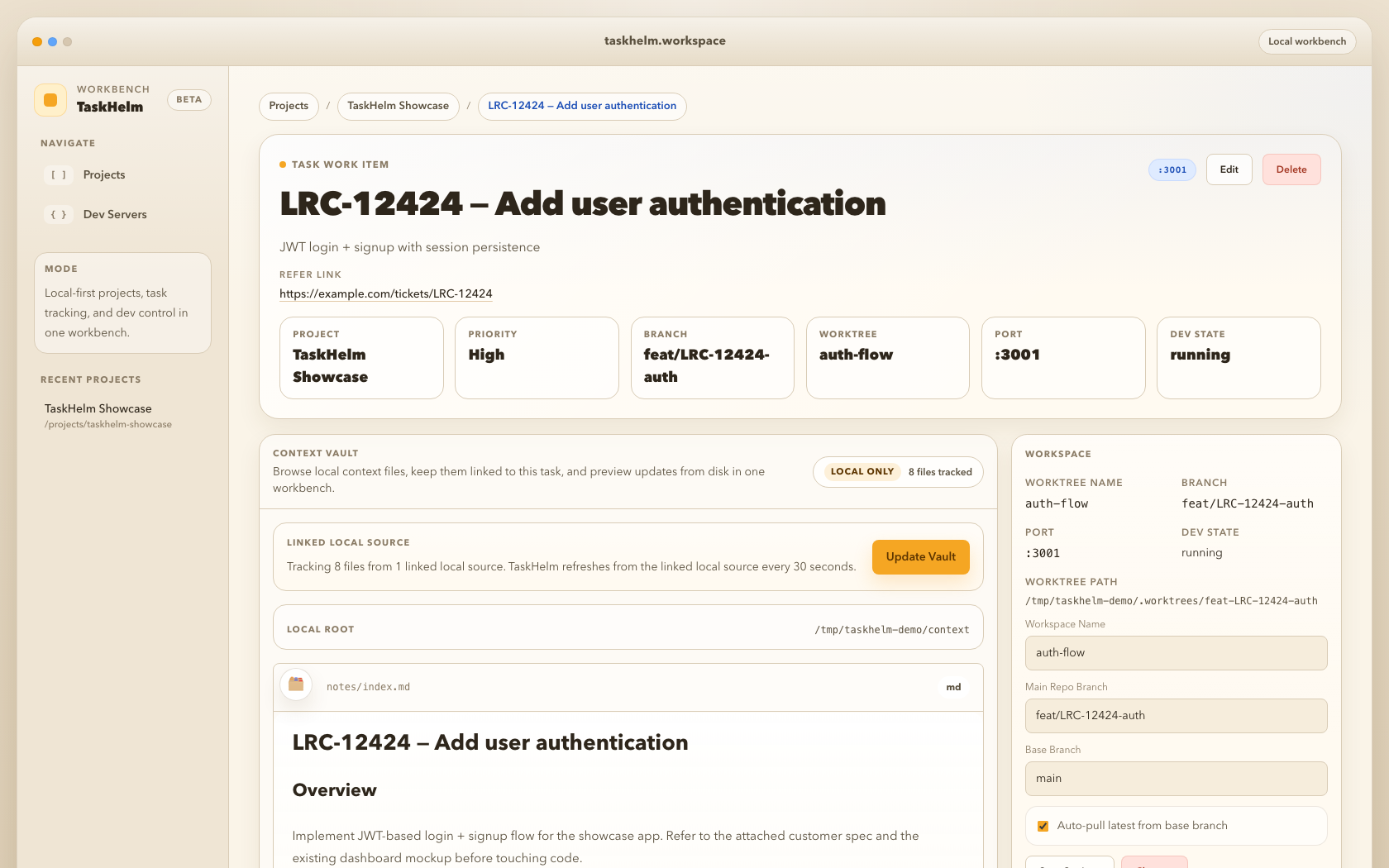
Task cockpit — refer link, branch, worktree, port, dev state in one hero |
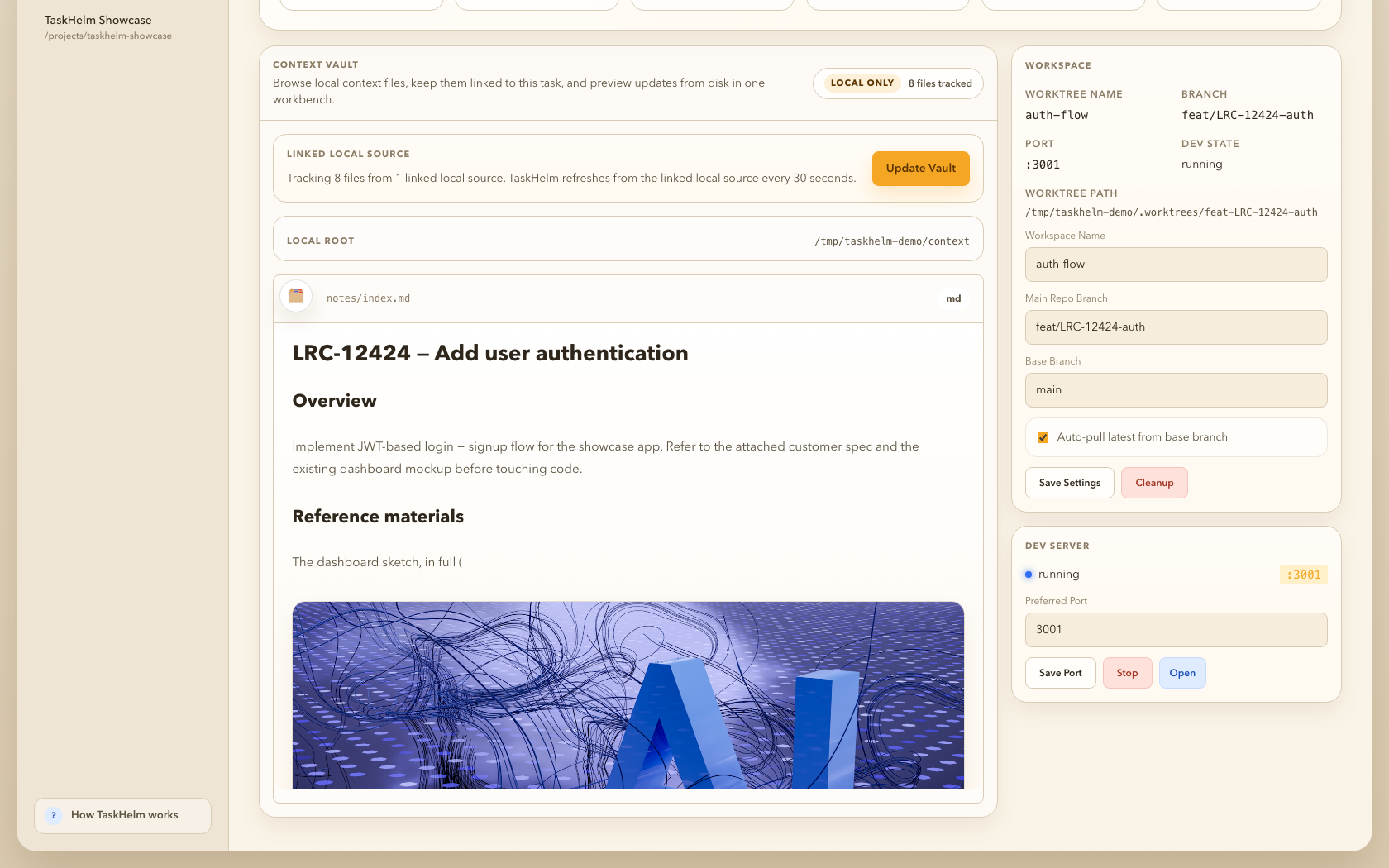
Context vault — link any folder, preview markdown + assets inline |
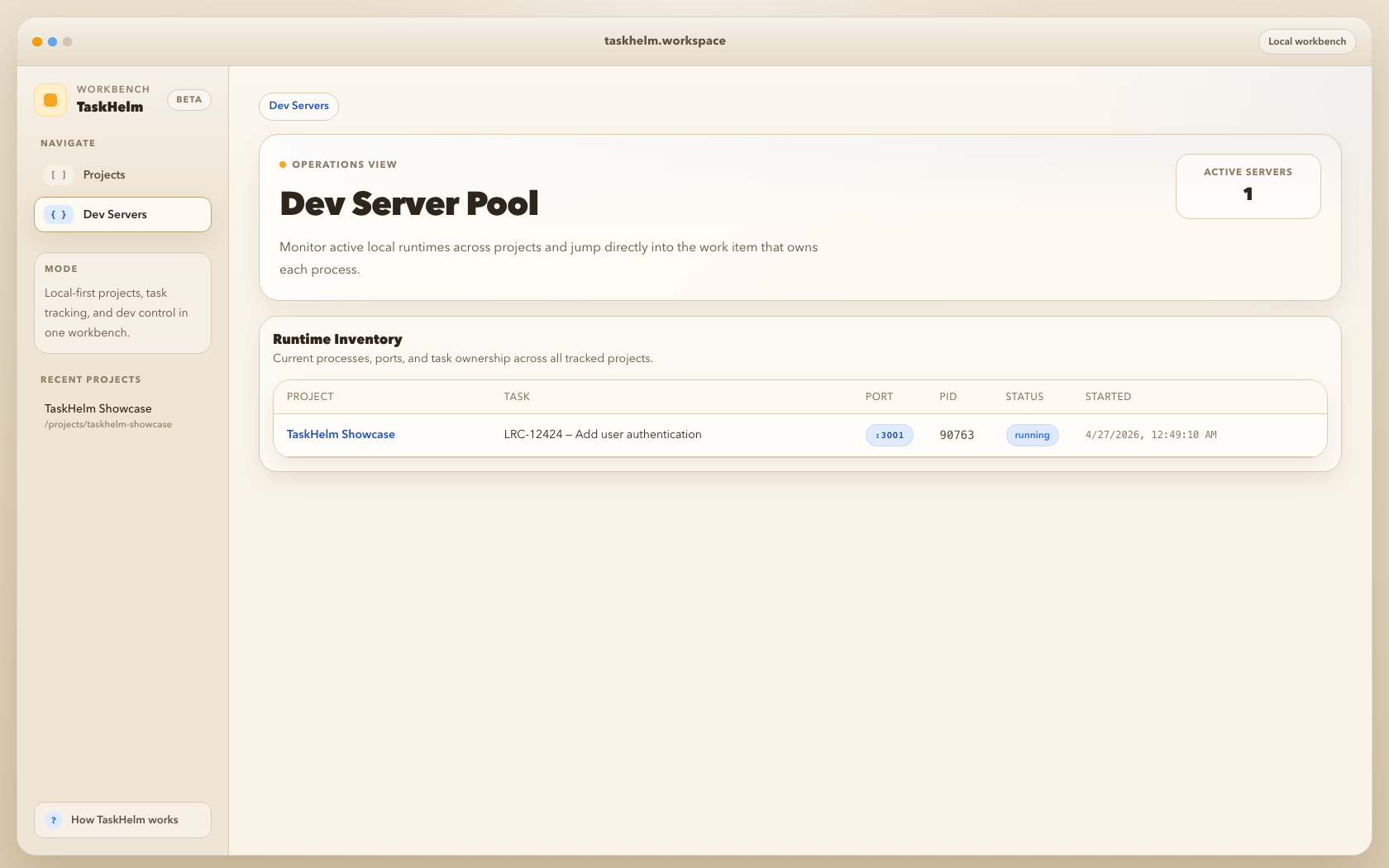
Dev pool — runtime inventory across all projects, jump straight to owner task |
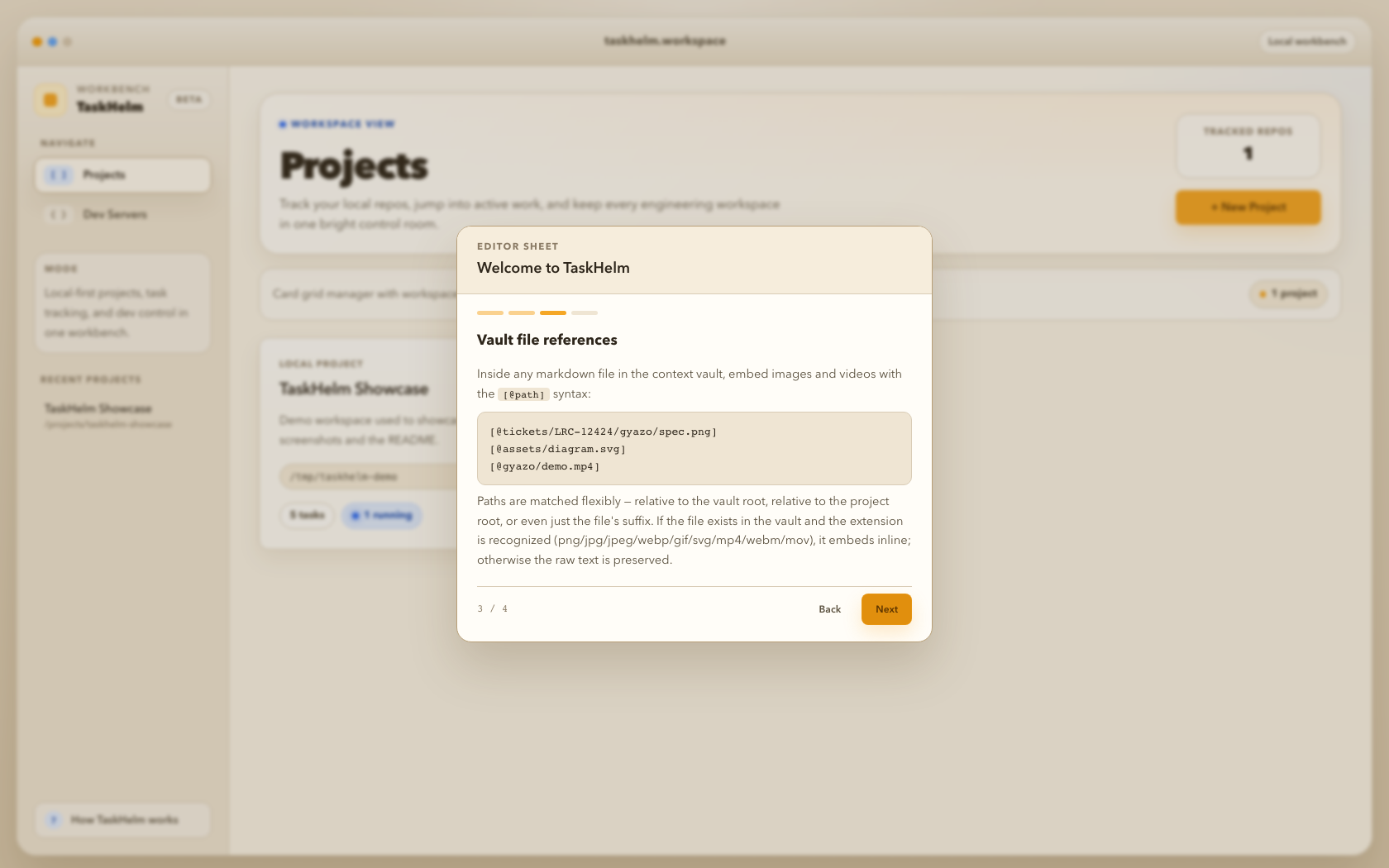
In-app onboarding — 4-step guide auto-shown on first run; reopen anytime from sidebar |
┌──────────┐  ┌───────────────┐
│   CLI    │  │   Dashboard   │   equal first-class surfaces
└────┬─────┘  └───────┬───────┘
     │                │
     └────────┬───────┘
              ▼
      ┌──────────────┐
      │  SQLite (WAL)│   runtime state — projects, tasks,
      └──────────────┘   dev_servers, locks, events, notifications
State lives entirely in a single SQLite file at ~/.taskhelm/taskhelm.db — TaskHelm does not write
anything into your project repos. Per-task notes can be linked from the Context Vault (any folder
of Markdown files on disk, indexed but not owned by TaskHelm).
| Package | npm | Role |
|---|---|---|
taskhelm |
 |
Launcher — preps runtime, opens dashboard |
@taskhelm/cli |
 |
Commander CLI (project, task, workspace, dev) |
@taskhelm/core |
 |
Domain model, SQLite repos, migrations, workspace utils |
@taskhelm/supervisor |
 |
Dev-server pool + crash recovery |
Stack: Next.js 15 + React 19 (dashboard) · Commander (CLI) · better-sqlite3 (state, WAL) · TypeScript 5.7 strict · pnpm + Turborepo · Vitest + Playwright (tests).
| Allowed by default | Not allowed by default |
|---|---|
| Create branch / worktree | Push branches |
| Allocate ports & start dev servers | Merge or rebase shared branches |
| Edit code inside worktrees | Open / close PRs |
| Run local dev / test commands | Mutate external ticket systems |
| Update task records in the local SQLite DB | Anything that touches a remote you didn't explicitly authorize |
The line is intentional. TaskHelm is built so you'd trust running it unattended on your laptop, not so it can ship to prod for you.
git clone https://github.com/Kaka-123-D/TaskHelm.git
cd TaskHelm
pnpm install
pnpm run typecheck   # tsc --noEmit across all packages
pnpm run test        # Vitest in every package
pnpm run build       # core → supervisor → cli → web (sequenced)
pnpm --filter @taskhelm/web run dev   # dashboard at :4100
See CONTRIBUTING.md for the full guide and CLAUDE.md for the
architectural conventions agents must follow when editing this repo.
| Doc | What it covers |
|---|---|
docs/01-product-vision.md |
Why this exists, success criteria, non-goals |
docs/02-v1-architecture.md |
System layers and boundaries |
docs/06-domain-model.md |
Entities and state machines |
docs/07-sqlite-schema.md |
All runtime tables |
docs/10-cli-spec.md |
CLI command groups |
docs/11-web-dashboard-spec.md |
Dashboard screens |
docs/04-init-roadmap.md |
Phased implementation plan |
TaskHelm is in active early development — building toward a stable v1 cut. The runtime, dashboard, CLI, dev pool, and context vault are functional today. APIs may change between minor versions until v1.0.0.
What's next: richer worktree visualization (graph view), better stale-worktree cleanup, multi-repo
projects, and a "switch task" command palette. See docs/04-init-roadmap.md.
If TaskHelm helps you, a star is the cheapest way to say so — and it makes the project visible to the next person fighting the same coordination problem.
Issues, ideas, and PRs are all welcome. Especially valuable:
- Bug reports with a
~/.taskhelm/taskhelm.dbpath and the steps that reproduced - UX improvements to the worktree task list and dev-pool views
- Better stale-worktree detection / cleanup heuristics
- Multi-repo / monorepo subrepo handling
Start with CONTRIBUTING.md. For larger changes, open an issue first so we can align on shape before you build.
MIT © TaskHelm contributors.