
Production-Grade Autonomous Agents with Deep Multilingual Intelligence
Kazma is the reliable multi-agent framework built for real deployment. Cryptographic skill signing, triple-wired human-in-the-loop safety, durable execution, and native Arabic dialect support — all in one full-stack system with live Web UI, TUI, CLI, and multi-platform gateways.



| Lines of code | Tests | Commits | Contributors |
|---|---|---|---|
| ~159K | 4,360 | 1,200+ | Solo |
Kazma (كاظمة) was an ancient coastal oasis in Kuwait — a network of wells and a gateway for trade between civilizations. It was also the site of the legendary Battle of Chains (ذات السلاسل, 633 CE): the Persian army chained its soldiers into a single, rigid wall, yet Khalid ibn al-Walid shattered it through precise, decentralized maneuvering — and won.
We engineered Kazma on those same pillars — not as metaphor, but as architecture:
- 🏜️ The Wells — Deep memory that holds context across sessions. The agent draws from it when it needs to remember, like caravans drawing from oasis wells.
- 🚪 The Gateway — One supervisor brain routed to Telegram, Discord, Slack, Web, and TUI — the way ancient Kazma routed trade between civilizations.
- ⚔️ Breaking the Chains — The chains in that battle were rigidity — and rigidity is what makes monolithic agent pipelines fragile. Kazma runs decentralized swarm patterns and self-healing circuit breakers instead, adapting and recovering where rigid chains would snap.
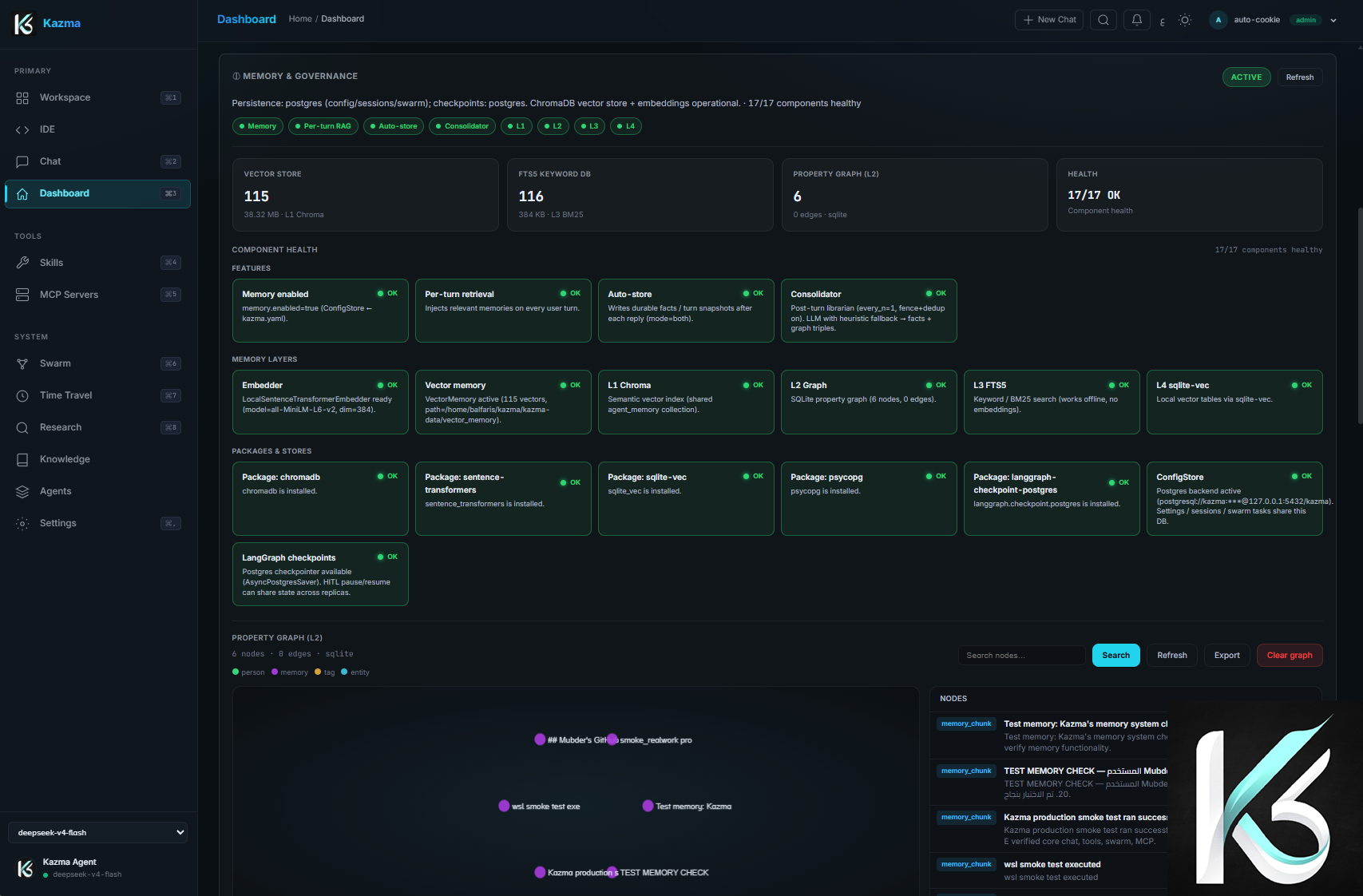
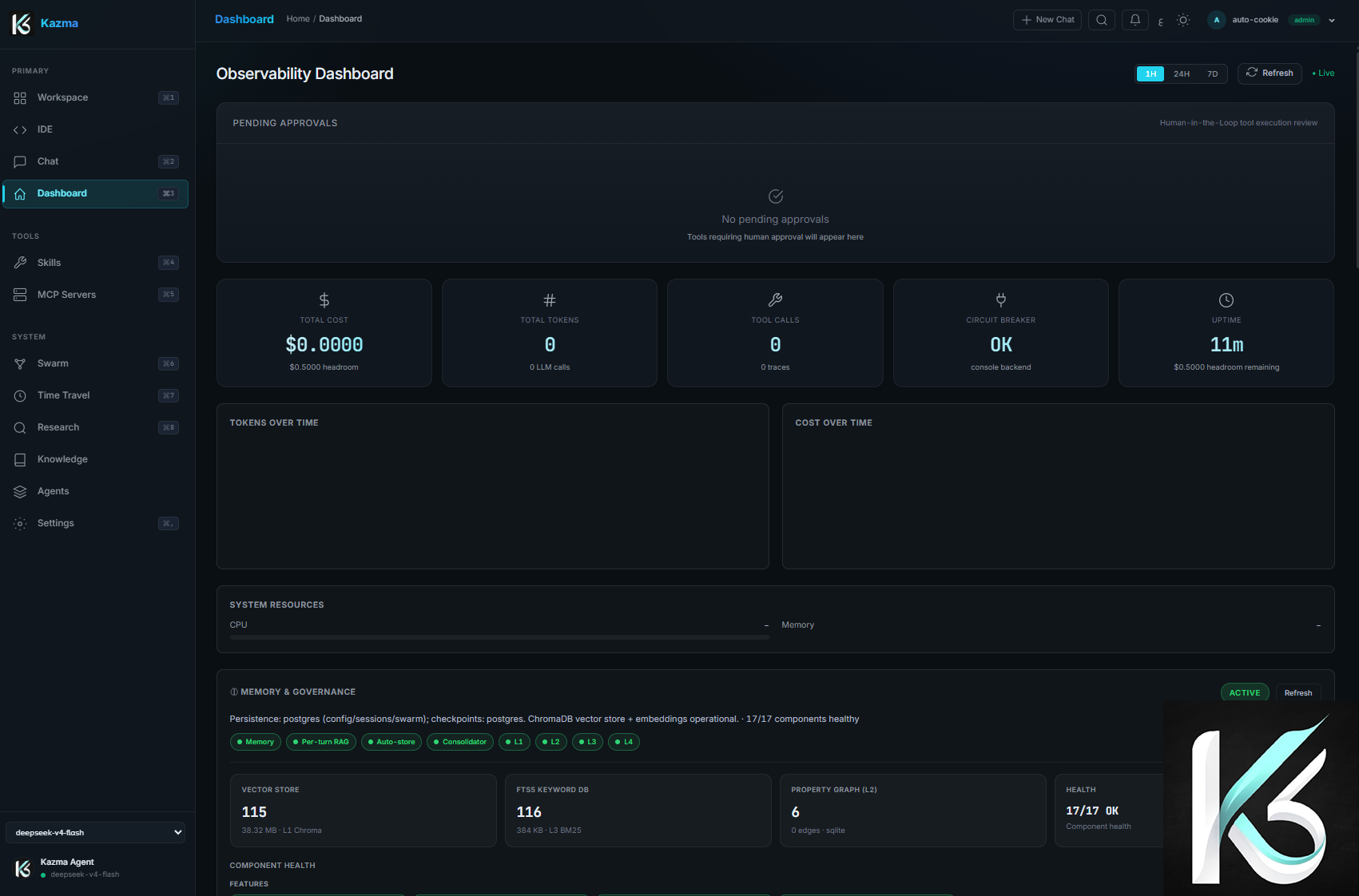
LangGraph supervisor with a ReAct loop, tool calling, durable checkpointing, 80% context compaction, and Pure V2 Cognitive Memory — bi-temporal belief tracking (valid_from / valid_until), Local Ego-Graph Personalized PageRank (PPR), hybrid FTS + vector episode retrieval, and prompt-fenced per-turn context injection. Knowledge Library stays a separate store but can inject into chat (labeled) with federated search. Optional Neo4j dual-write and Postgres/Qdrant adapters — SQLite remains the zero-config default.
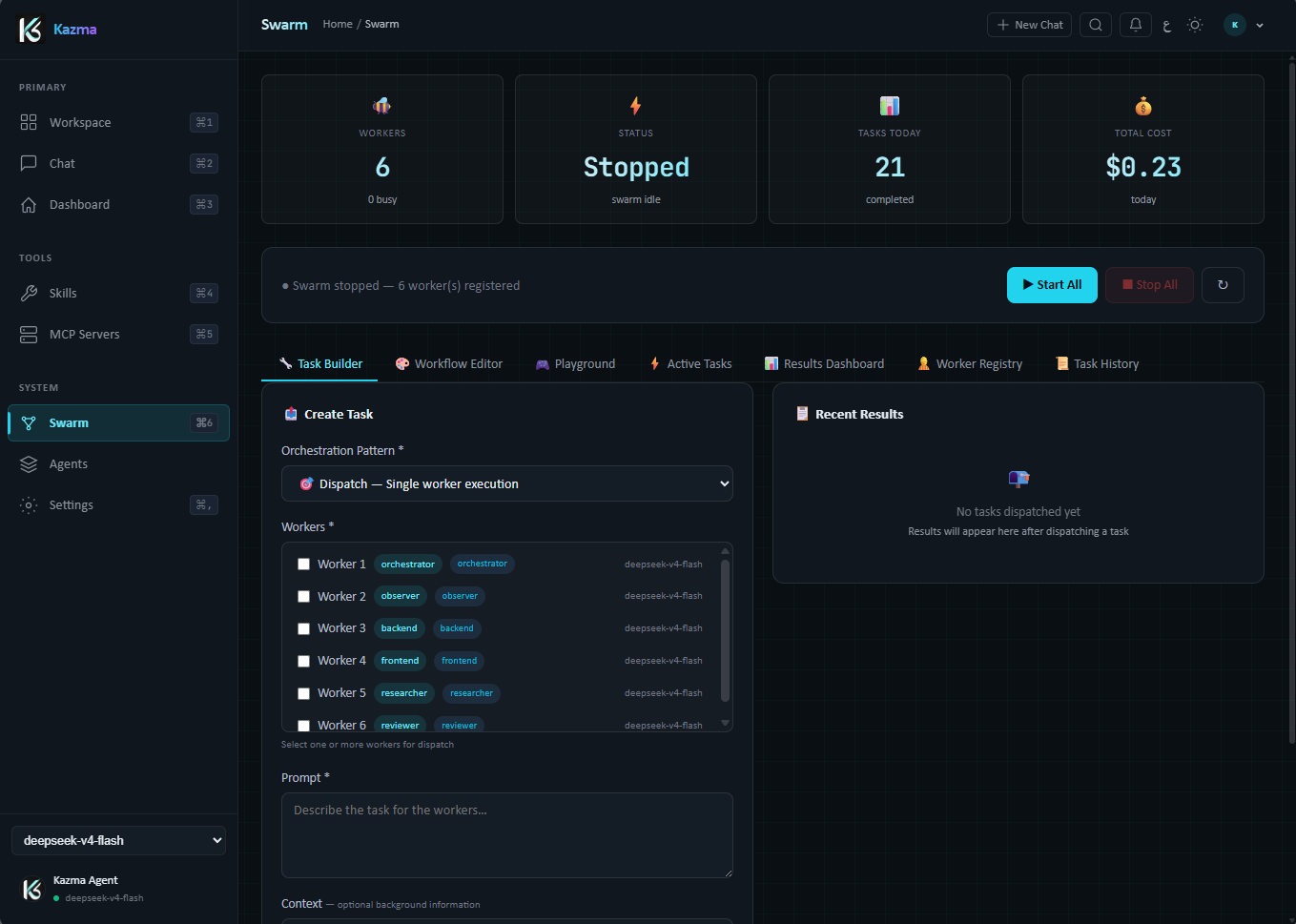
Six dispatch patterns (broadcast, pipeline, fan-out, consult, conditional, dispatch) with a Dynamic Swarm Autoscaler that auto-spawns specialist workers from templates (coder, researcher, generalist) with automatic best-model-per-task routing (coding, reasoning, vision).
Three independent HITL gates — graph interrupt, swarm bus, and pipeline checkpoints — ensure dangerous tools never execute without human approval. Downloaded Agent Skills are integrity-verified (HMAC-SHA256) at load, and Soul evolution deltas are injected behind an untrusted-data prompt fence (<kazma:data untrusted>).
Telegram, Discord, Slack, Web UI, and TUI — all powered by a single LangGraph supervisor. Platform IDs never enter LangGraph state.
Custom Arabic tokenizer, RTL UI, Kuwaiti-dialect support, and the Majlis cultural protocol. Built in Kuwait, for the world.
- Any LLM — OpenAI, Anthropic, Gemini, DeepSeek, xAI, Ollama, and 15+ more via plain HTTP with Vision Capability Routing
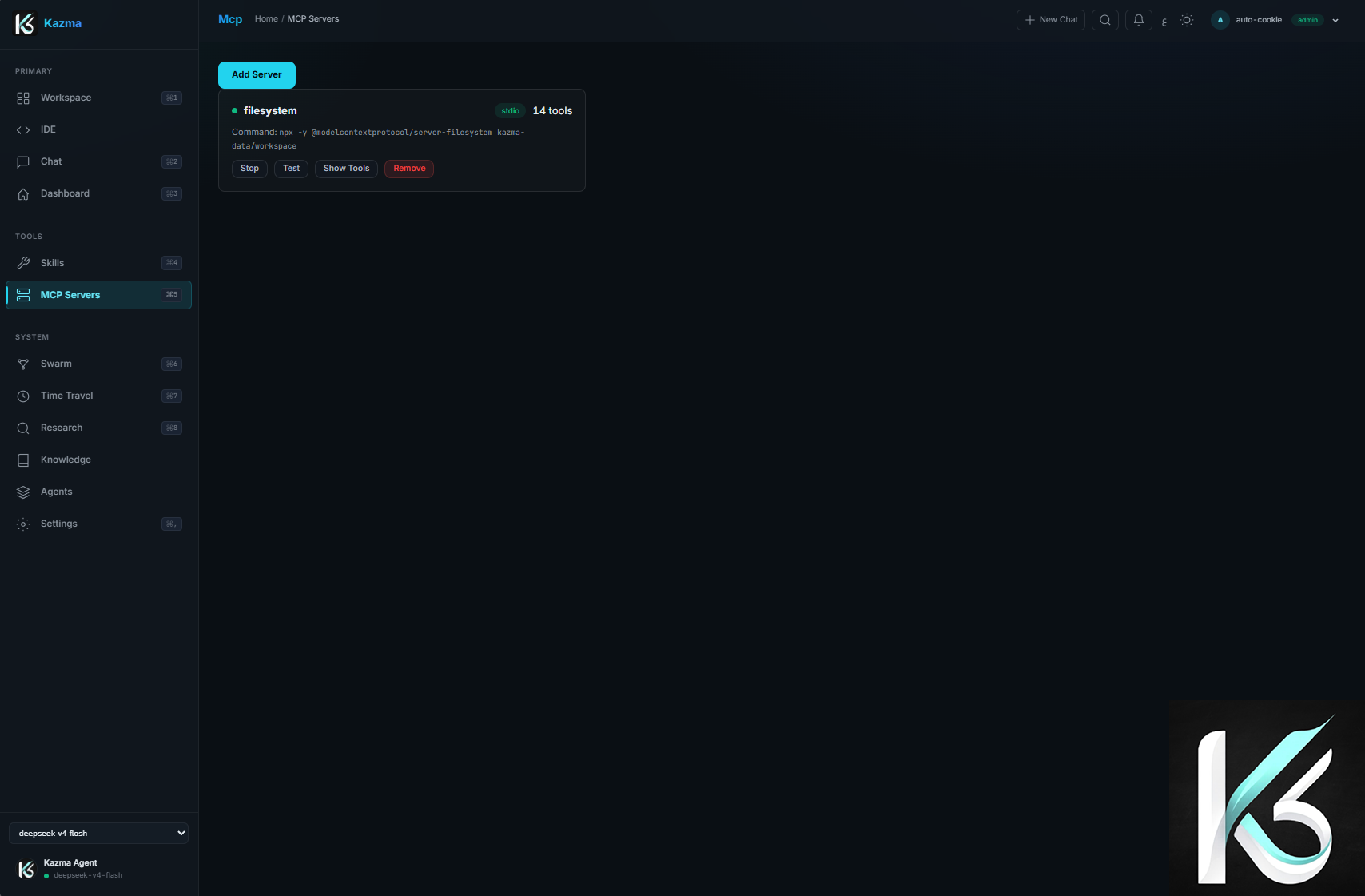
- MCP Marketplace — One-click install from 85+ preset MCP servers with namespaced tools
- Pluggable Scraping Proxy — Rotating residential/mobile proxy provider (
anyip.io) with automatic 429/403 backoff retries and user-agent rotation - Knowledge Library — Ingest entire documentation sites into searchable RAG corpora with cited sources
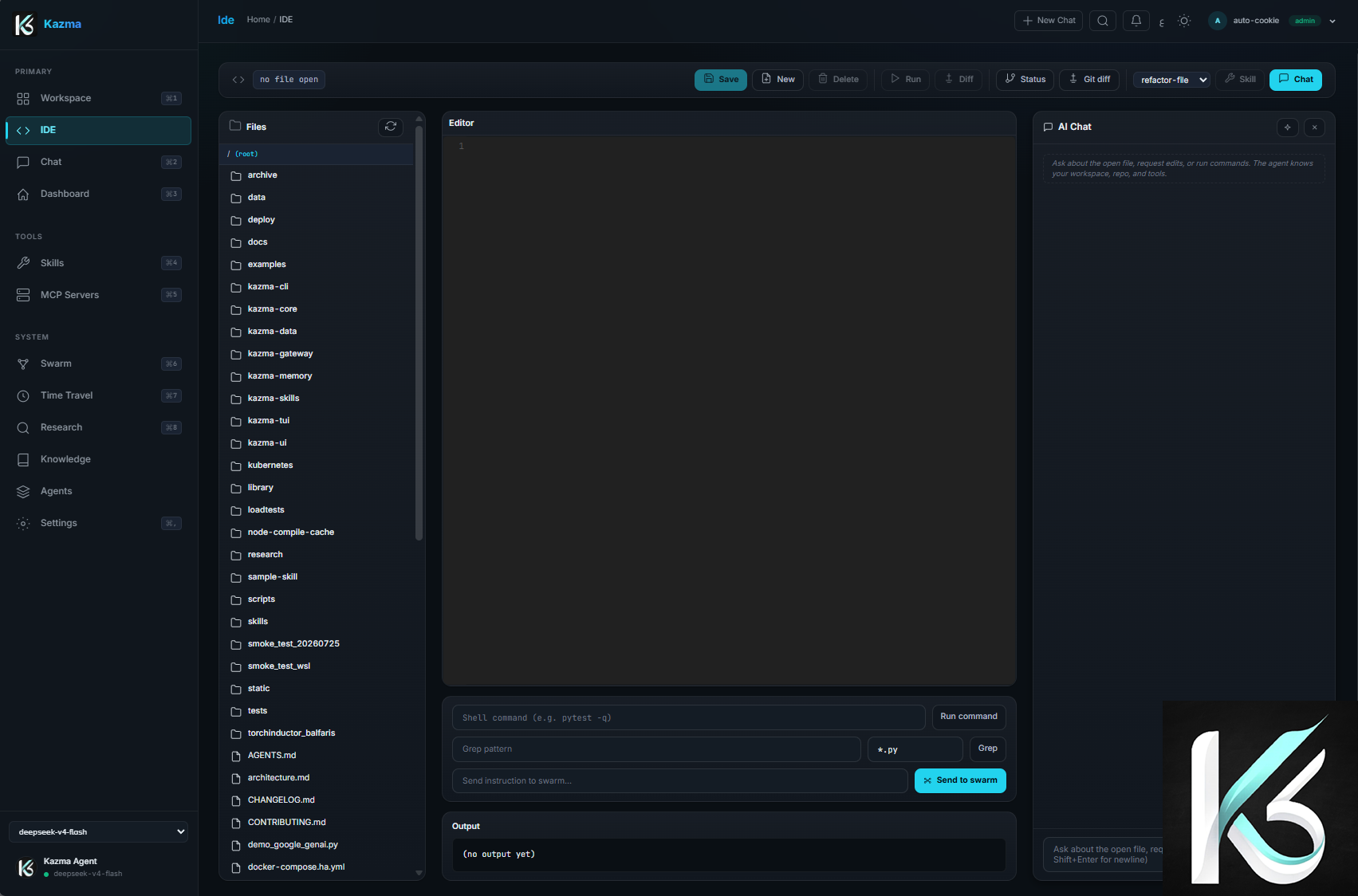
- IDE Subsystem — Transport-agnostic coding backend: multi-tab editor, file-aware AI chat,
/idecommands across all platforms - Time-Travel Replay & Branching — Snapshot every iteration to SQLite WAL (
snapshots.db); restore in-place (/replay), fork threads (/fork), and compare paths - Encrypted Vault — AES-256-GCM storage for API keys and credentials
- Browser, Calendar & Documents — Playwright automation, Google/Outlook calendar, PDF/DOCX/XLSX generation
- Deep Research — Multi-query web search → parallel acquire → digest → LLM synthesis with DOCX export
| Feature | Kazma | LangChain | CrewAI | AutoGPT | n8n |
|---|---|---|---|---|---|
| Self-hosted, MIT | ✅ | ✅ | ✅ | ✅ | |
| Arabic-native | ✅ | ❌ | ❌ | ❌ | ❌ |
| HITL safety gates | ✅ 3 layers | ❌ | ❌ | ❌ | |
| Swarm orchestration | ✅ 6 patterns | ✅ | ❌ | ❌ | |
| Built-in IDE | ✅ Web+TUI | ❌ | ❌ | ❌ | ❌ |
| Encrypted vault | ✅ AES-256 | ❌ | ❌ | ❌ | ❌ |
| MCP marketplace | ✅ 85+ servers | ❌ | ❌ | ❌ | ❌ |
| Time-travel replay | ✅ | ❌ | ❌ | ❌ | ❌ |
| Skill integrity | ✅ HMAC-SHA256 | ❌ | ❌ | ❌ | ❌ |
| Web UI included | ✅ | ❌ | ❌ | ❌ | ✅ |
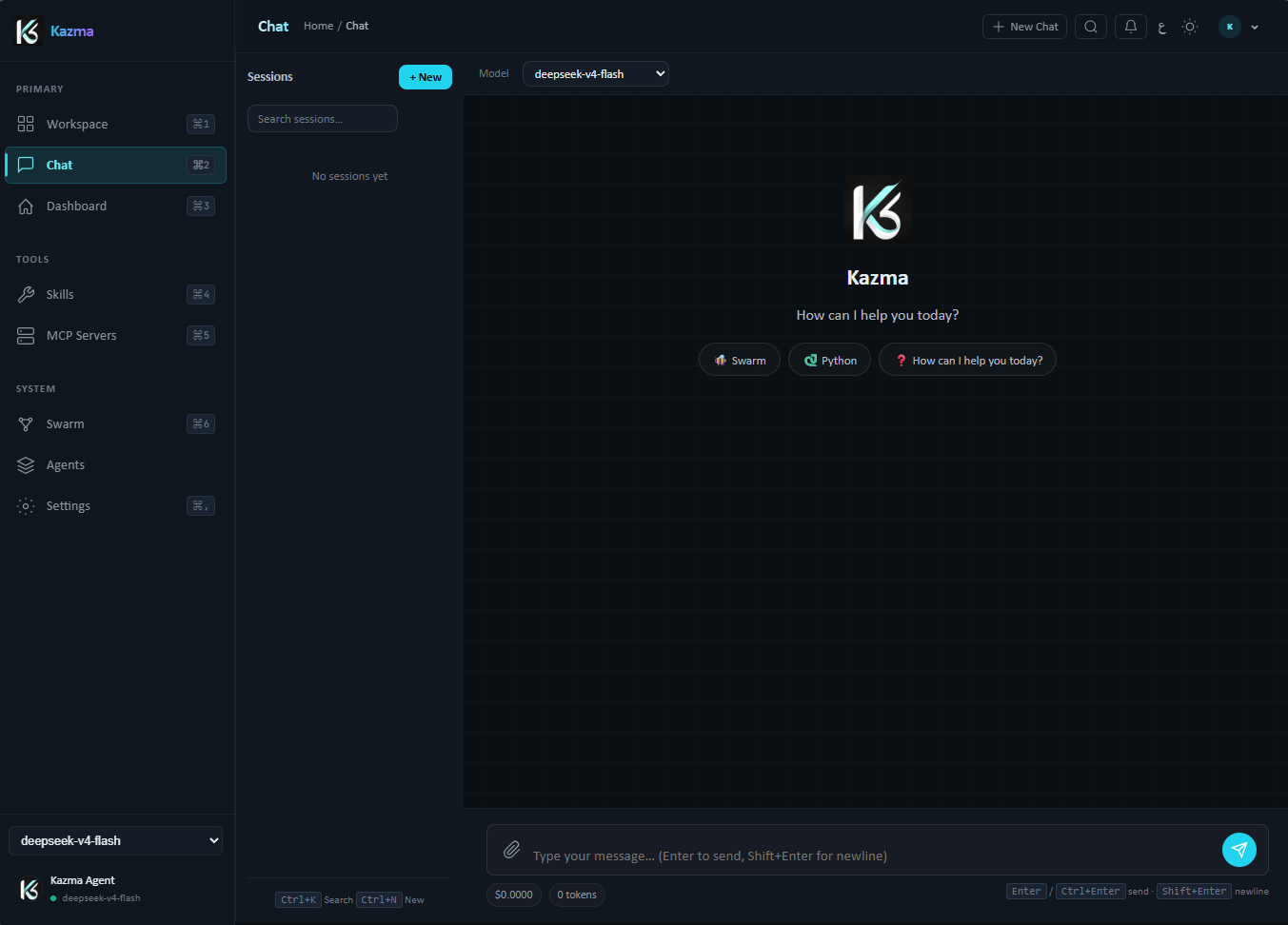
| Dashboard | Web IDE | Chat with HITL |
|---|---|---|
 |
 |
 |
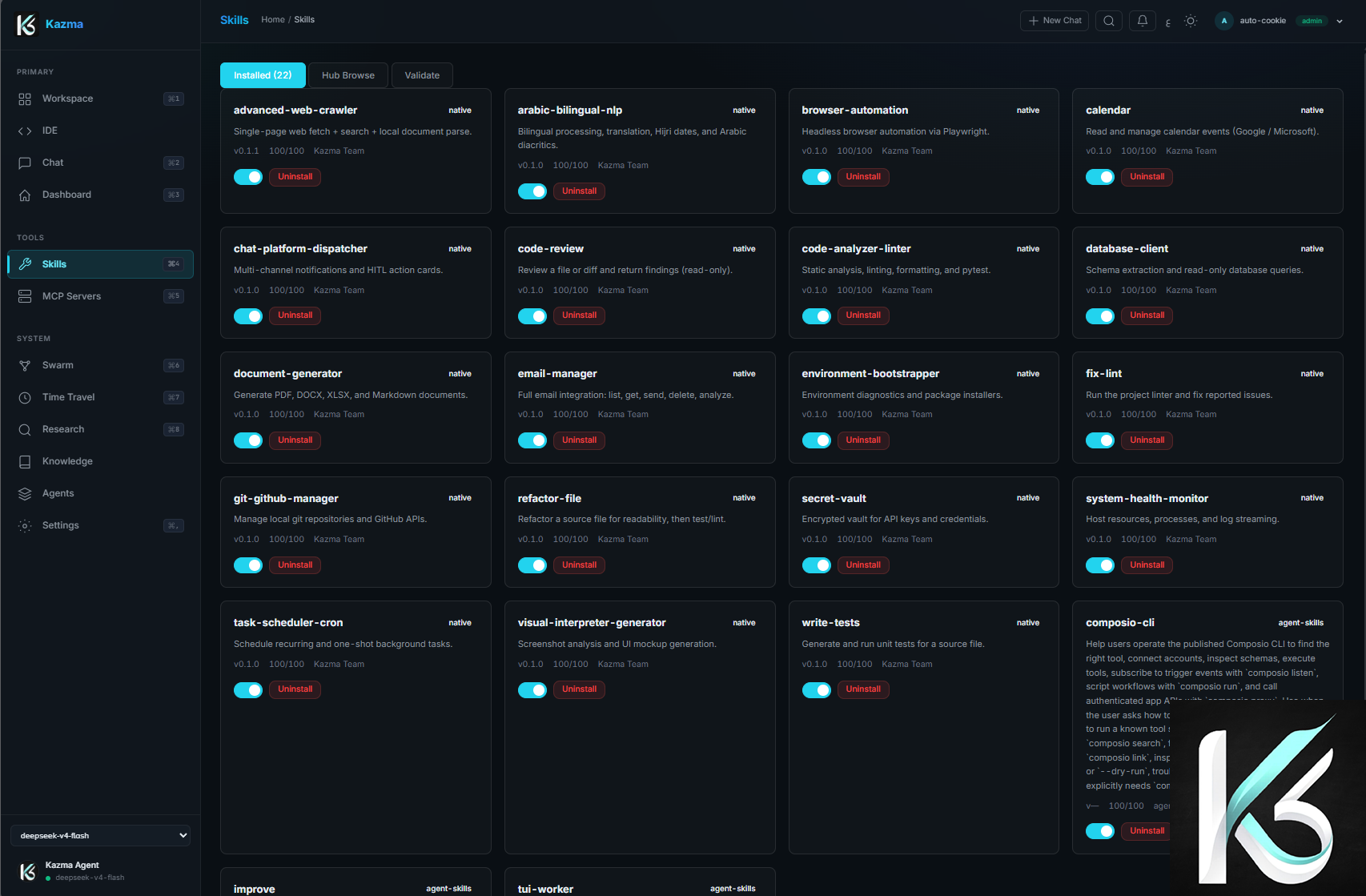
| Swarm Task Builder | Skills | MCP Servers |
|---|---|---|
 |
 |
 |
Requires Python 3.11+ (3.12–3.13 recommended).
git clone https://github.com/Mubder/kazma.git
cd kazma
Option A — uv (recommended):
uv venv --python 3.13
uv sync --all-extras
Option B — pip + venv:
# Linux / macOS / WSL
python3 -m venv .venv
source .venv/bin/activate
pip install -e ".[rag,dev]"

# Windows (PowerShell)
py -3.13 -m venv .venv
.venv\Scripts\Activate.ps1
pip install -e ".[rag,dev]"
Extras:
rag= vector memory;dev= tests/lint;web= Playwright;document= PDF/DOCX/XLSX;database= Postgres/MySQL/Mongo. Install everything withpip install -e ".[all]"oruv sync --all-extras.
# Linux / macOS / WSL
cp .env.example .env

# Windows (PowerShell)
Copy-Item .env.example .env
Edit .env — set at least one LLM key:
OPENAI_API_KEY=sk-...# Web UI (default: http://127.0.0.1:9090)
kazma serve
# Terminal UI
kazma-tuiFull guides: Quickstart · Configuration · Troubleshooting
User (Telegram/Discord/Slack/Web/TUI)
    ↓
Platform Adapter (isolates platform IDs)
    ↓
Supervisor Graph (LangGraph ReAct loop)
    ├── ContextAuthority (80% compaction + per-turn RAG retrieval)
    ├── UnifiedToolExecutor (LocalToolRegistry + native skills + MCP)
    ├── IdeService (workspace-scoped file/exec/git)
    ├── HITL Gate (interrupt before danger tools)
    └── LLM Provider (any OpenAI-compatible endpoint)
    ↓
SwarmEngine (when multi-agent is needed)
    ├── 6 dispatch patterns
    ├── Reliability layer (circuit breaker, retry, timeout)
    ├── Self-improvement (auto-learning feedback loop)
    └── V2 Cognitive Engine (bi-temporal beliefs + PPR recall)
Built on: LangGraph · FastAPI · SQLite (WAL) · Postgres · Docker · sentence-transformers · sqlite-vec
Full diagrams: Architecture · System Map
Kazma operates on a V2 Cognitive Engine for personal memory (single SoT for chat recall) plus an optional Knowledge Library product merge — unified in chat, not merged into one schema table:
| Component | Architecture | Role |
|---|---|---|
| Bi-Temporal Beliefs | SQLite SoT | Functional / set / state beliefs with temporal scrubbing; Dashboard topology paints from SQLite |
| Episode Retrieval | FTS5 + sqlite-vec |
Sparse + dense fusion for “what we said” |
| Associative PPR | Local Ego-Graph | Multi-hop weight expansion over the belief graph |
| Knowledge Library | Separate store | Docs + citations; inject / federated search (MEM / KB labels) |
| Optional Neo4j | Dual-write | Belief triples when configured; never required for install |
| Procedural Memory | Parametric Action DAGs | Tool skills with confidence smoothing and quarantine |
- Per-Turn Prompt-Fenced RAG — Beliefs/episodes (and optional KB) wrapped in
<kazma:data untrusted>fences. - Settings → Memory — Isolation, KB inject toggles, backends, Neo4j Test/Sync, and embedder in one tab.
- Durable Task Queue (
memory_ops.db) — Post-turn extraction, micro-consolidation, partitioned reconsolidation for large corpora. - Automated Nightly Backups & Exports — Native
sqlite3.backup()plus JSONL / GraphML on a 24h scheduler. - Prompt-Fenced Soul Engine — Self-improvement deltas via
ConfigStore+ untrusted fence.
Deep dive: Memory & RAG · Memory best path
Three independent gates. All fail-closed by default.
- Graph interrupt — pauses before
file_write,shell_exec,vault_retrieve, and all danger-tier tools - Swarm bus —
/swarmdispatches require HITL approval for dangerous operations - Pipeline checkpoints — multi-stage pipelines pause at configured steps
Multi-platform approvals: interactive sliding cards in Web, inline buttons on Telegram/Discord/Slack.
See: Security & Safety
# Add workers
kazma swarm worker add researcher --model deepseek-chat --provider deepseek

# Run a pipeline
kazma swarm pipeline --workers researcher,builder,validator "Build a CLI tool"

# Fan out and vote
kazma swarm fanout --workers a,b,c --aggregation vote "Best approach?"

# Check results
kazma swarm history
kazma swarm metrics
Workers automatically learn from outcomes via the self-improvement engine — success patterns are reinforced, failure patterns are corrected in the worker's system prompt.
Full guide: Swarm Orchestration
kazma-core/       Agent runner, LLM provider, swarm engine, memory/RAG, IDE, safety
kazma-gateway/    Telegram/Discord/Slack adapters, slash commands
kazma-ui/         FastAPI web app, IDE page, SSE chat, dashboard
kazma-tui/        Textual terminal dashboard + IDE editor
kazma-memory/     Arabic tokenizer + FTS5 search backend
kazma-skills/     Native skills (vault, database, crawler, coding, …)
kazma-cli/        The `kazma` command surface
| Document | What's inside |
|---|---|
| Docs home | Full documentation map |
| Quickstart | Install paths, minimal config, first message |
| Architecture | Engine internals, data-flow diagrams |
| Configuration | kazma.yaml, ConfigStore, providers |
| Environment variables | Every important env var |
| Tools catalog | Built-in + native skill tools |
| CLI Reference | Complete command tree |
| Swarm | Patterns, reliability, checkpoints |
| IDE | Web/TUI/chat coding backend |
| Security & Safety | Three HITL gates, vault, skill signing |
| Production checklist | Go-live checklist |
| System map | Full monorepo engineering map |
These projects grew up next to Kazma — each one taught us something about agents, trust, and real interfaces that shaped the framework.
| Project | Description | Status |
|---|---|---|
| IndexArc | Portable personal vault for secrets, API keys, and notes. Offline (Ollama) or cloud. | Open Source |
| ShipX | AI delivery platform via WhatsApp — text or voice in Khaleeji Arabic. | In Development |
| KCA | Institutional Intelligence System — Genesis, OS, Guardian, Network, Evolution. | In Development |
4,300+ tests passing across 5 suites.
uv sync --all-extras
pytest                          # All 5 test suites
ruff check kazma-core/          # Lint
mypy kazma-core/                # Type check
See: Development · CONTRIBUTING.md
- Indie developers who want a self-hosted agent that doesn't phone home
- Arabic-speaking teams who need native RTL and dialect support
- Startups & enterprises evaluating production-grade multi-agent orchestration
- Contributors looking for a well-tested, well-documented AI framework to build on
MIT-licensed, production-tested, 1,200+ commits. Built solo in Kuwait with full-stack execution.
🌐 kazma.ai · 🐙 GitHub · 💬 Try the live demo · 📧 Pilots & partnerships
MIT — see LICENSE.