
Models based on data in: Weiler N, Wood L, Yu J, Solla SA, Shepherd GM (2008) Top-down laminar organization of the excitatory network in motor cortex. Nat Neurosci 11:360-6
So far a version of the original model file in MATLAB has been converted to Python, for ease of integration with other Python scripts being developed to use the data from the Weiler et al., 2008 paper.
This can be run with (after installing Numpy):
cd Python
python laminarWsimulation.py
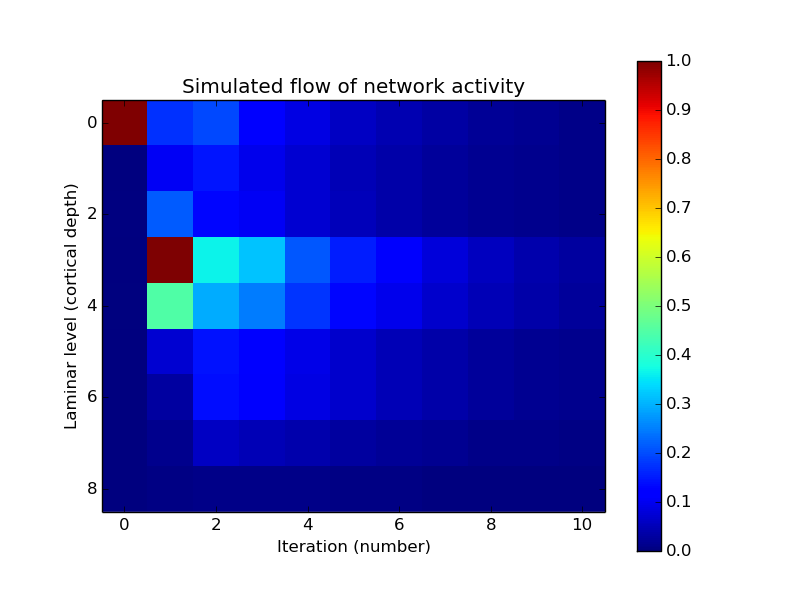
The y axis bins 0-8 represent normalised cortical depth (yfract). Bin 0 represents a normalized cortical depth between 0.1 and 0.2; bin 1 between 0.2 and 0.3; and so on. Each bin represents ~140um of cortical depth, and does not correspond to classical layer boundaries.
A set of scripts has been created to enable generation of simple (integrate & fire or single compartment HH cell model) cortical networks using this connectivity data.
See GenerateLayeredNetwork.py for example, which uses libNeuroML to generate NeuroML 2 descriptions of the populations & projections in the network. See generated example here.
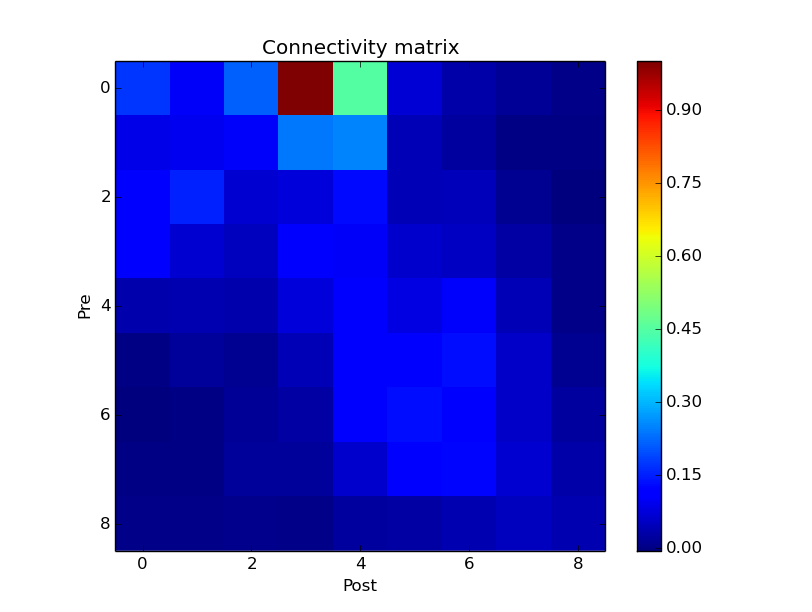
The data used is the connectivity matrix from the above Python code (based on the original Matlab file). It is visualised below:
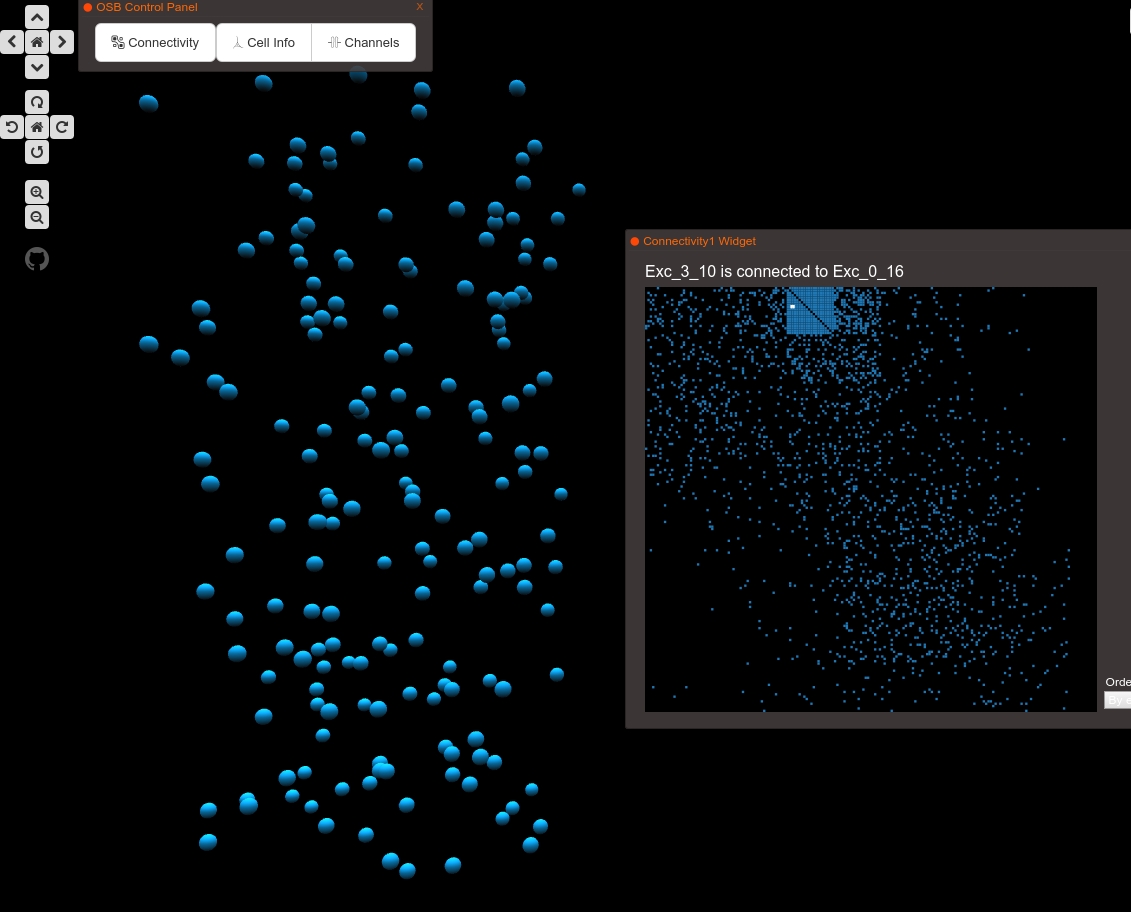
The network can be visualised in OSB (see here)
Clicking on individual cells highlights the connectivity of that cell, e.g. for cells in bin 0 (top of column) there are many connections, particularly to cells in bin 3:
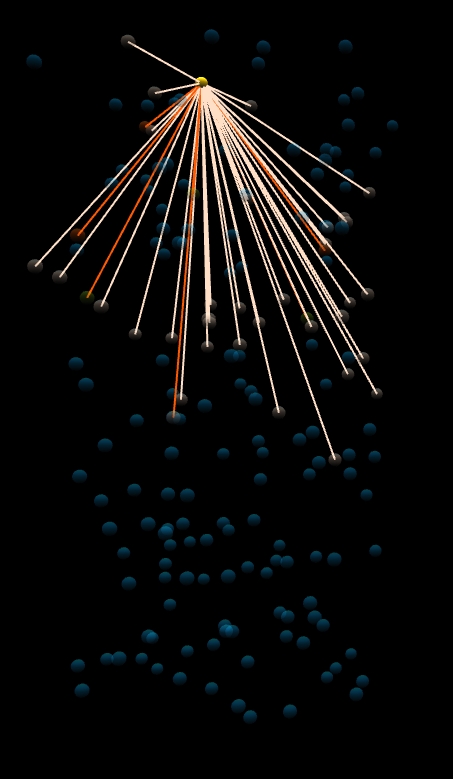
but fewer connections from a cell in lower bins:
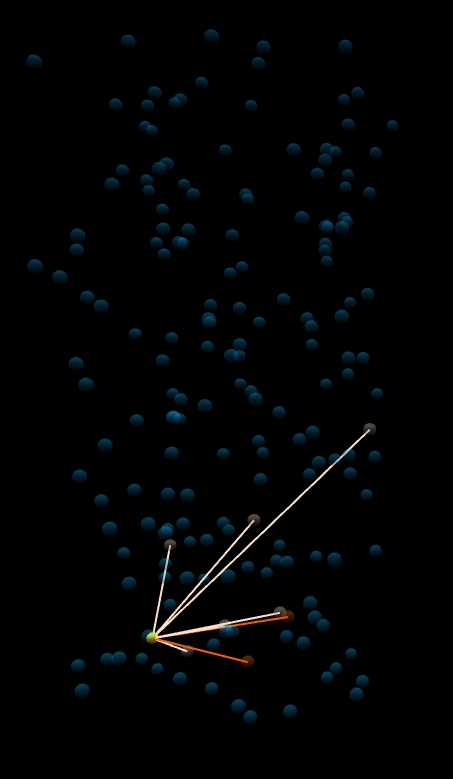
This network has connetivity, but no spiking activity yet. Another python script produces a spiking network model (which can be run with jNeuroML).
The layered network will soon be updated with inputs and then propagation of inputs focussed on individual laminar layers to the rest of the network can be examined.