







A terminal UI for managing and connecting to SSH hosts. Combines your ~/.ssh/config with a built-in host database, tunnels, key management, and an audit log -- all in one keyboard-driven interface.
⚠️ This project is ~98.5% vibe-coded slop — see Model credits for the ever-growing pack of LLMs responsible — the other ~1.5% is real humans (see Contributors). It has — and will keep having — stupid bugs LLMs can't see. Use at your own risk.

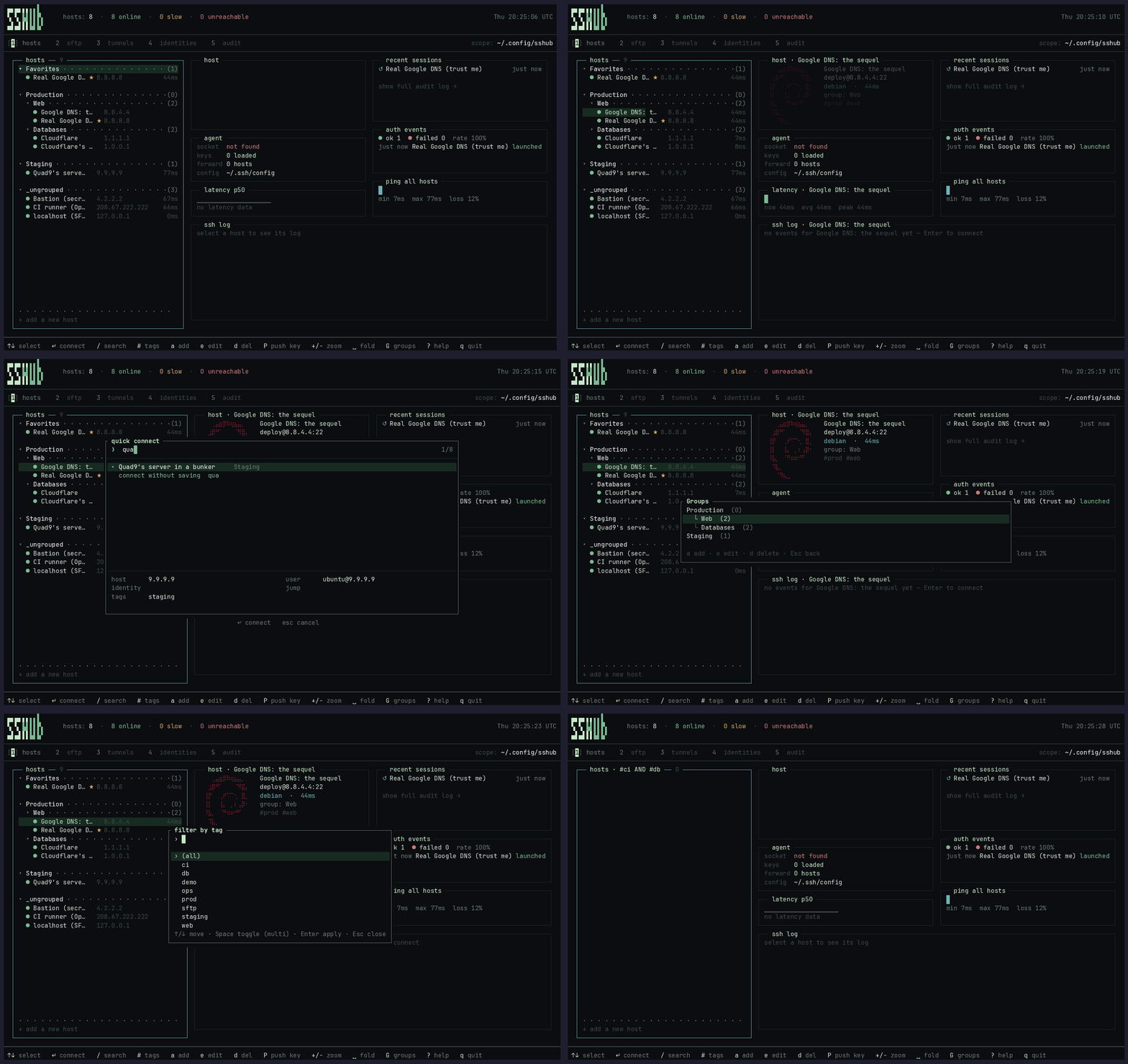
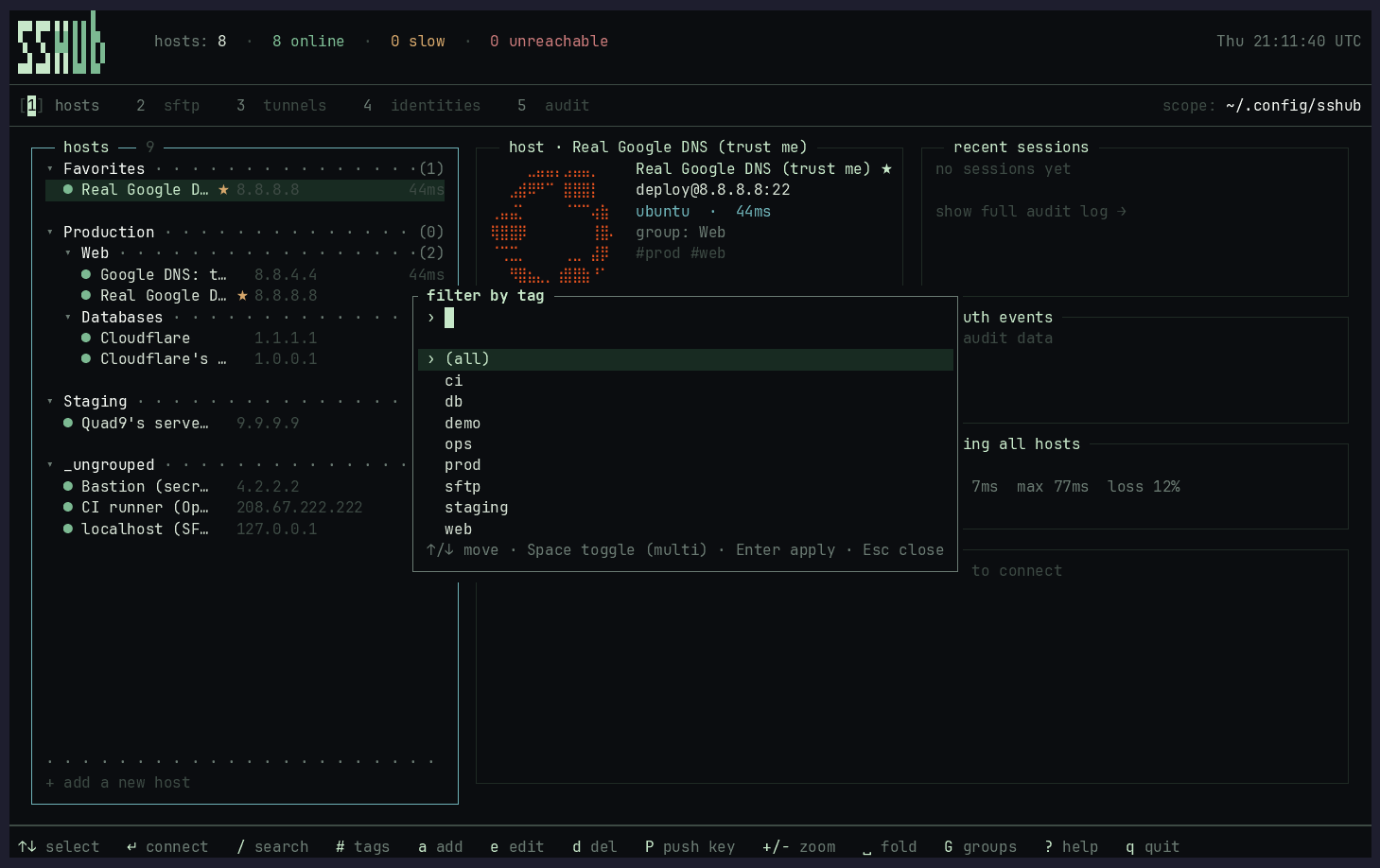
Navigating the dashboard: nested host groups, the fuzzy palette (/), the group manager (Shift+G), and the multi-tag filter (#):
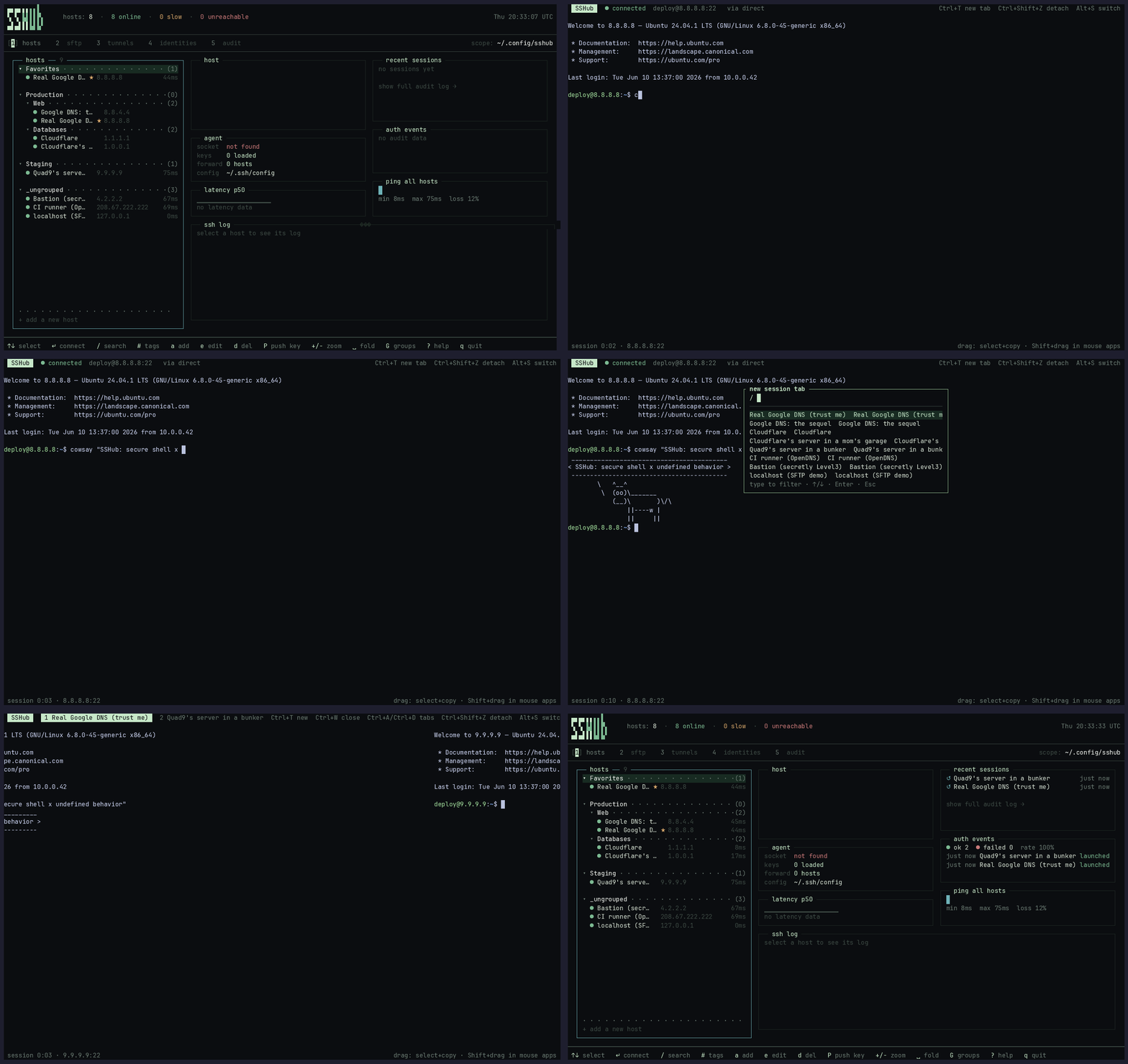
Connecting to a host: the session runs in an embedded PTY right inside the TUI. Ctrl+D detaches, Ctrl+T opens a second session tab, and Alt+S finds a running session by name:
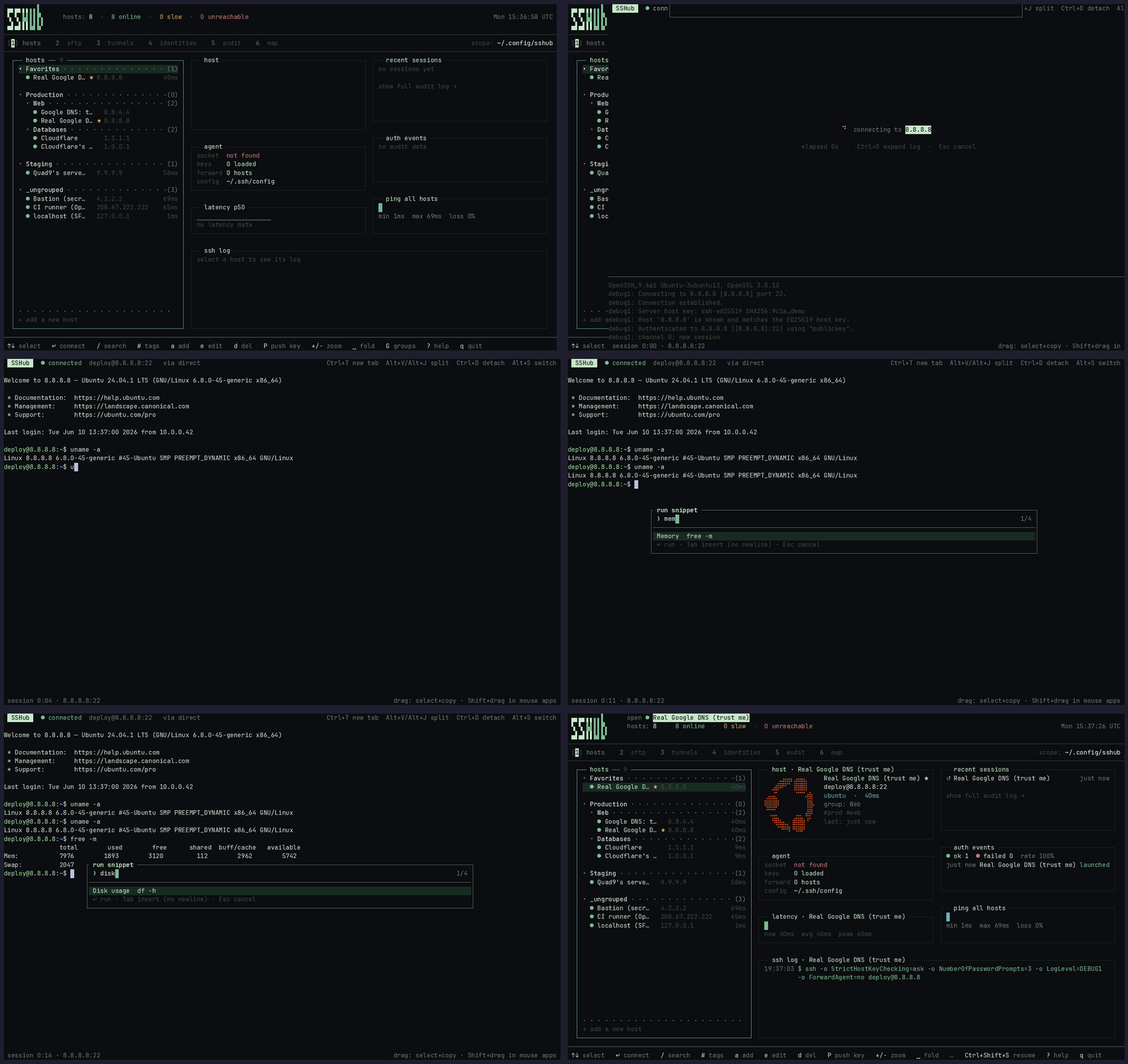
Inside a session: a command you ran comes back as a dim inline suggestion (Tab takes it), and Ctrl+N opens the snippet library (Enter runs a snippet, Tab types it for editing first):
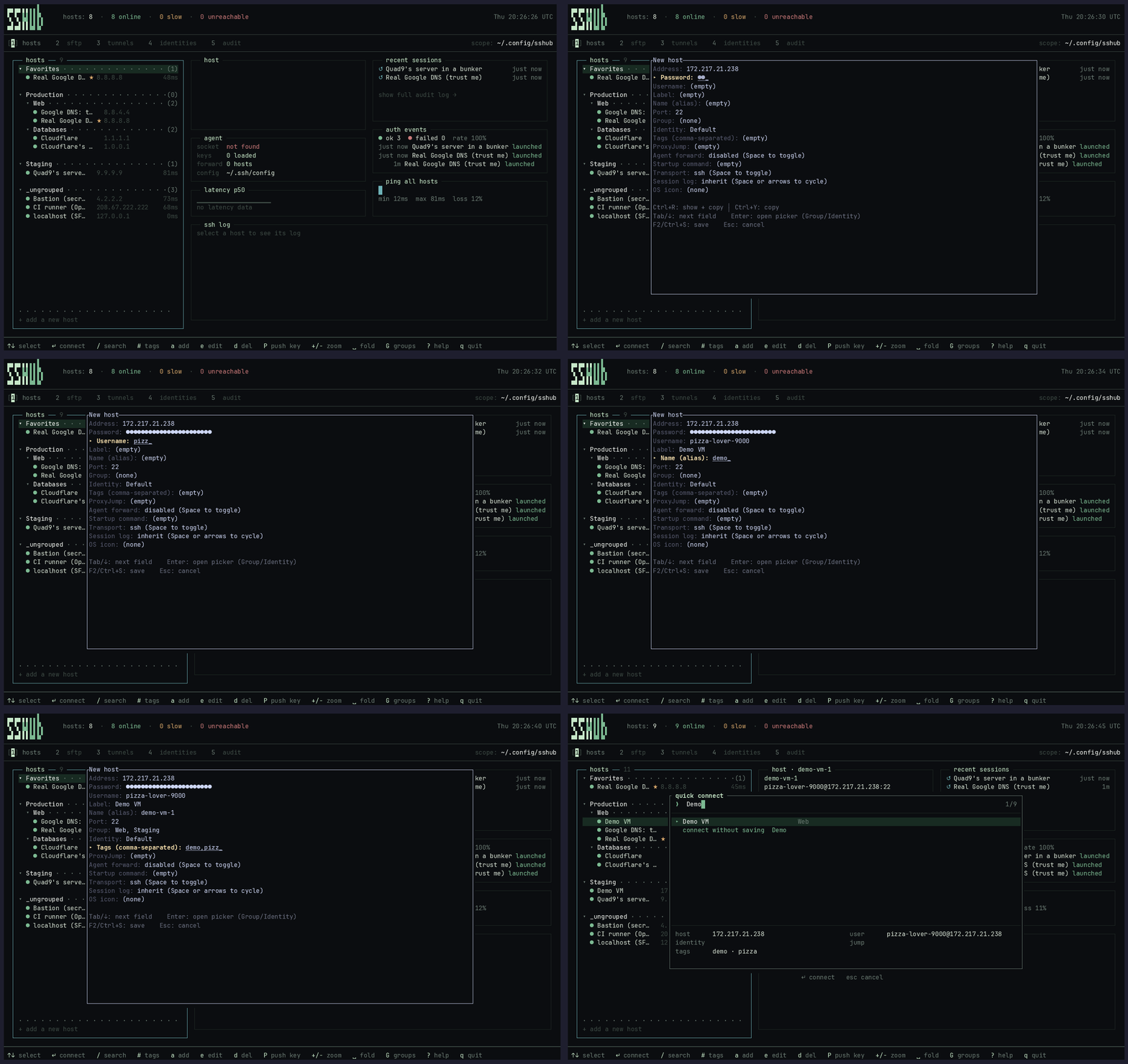
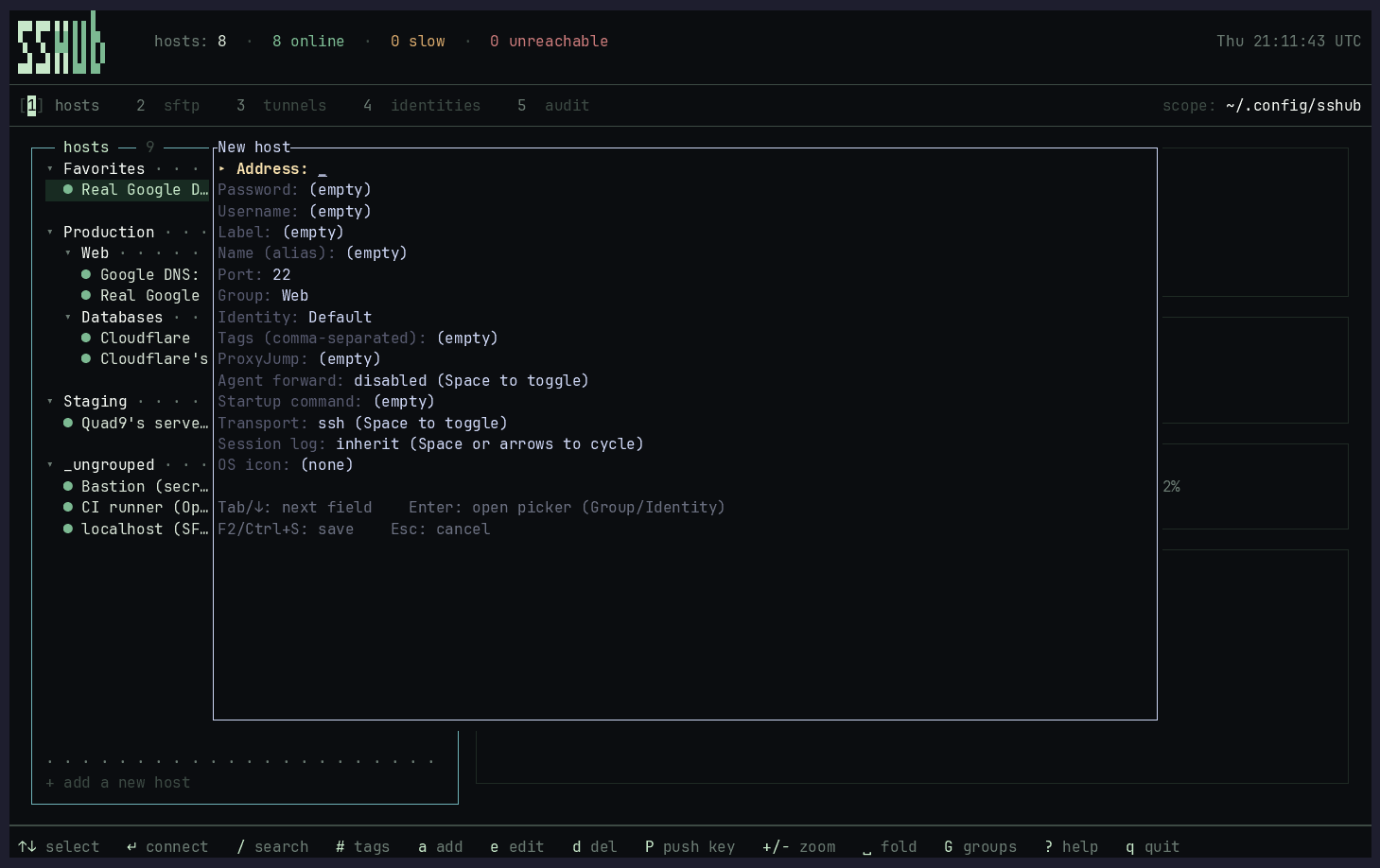
Adding a managed host: address, password, username, label, two groups and tags, saved with Ctrl+S:
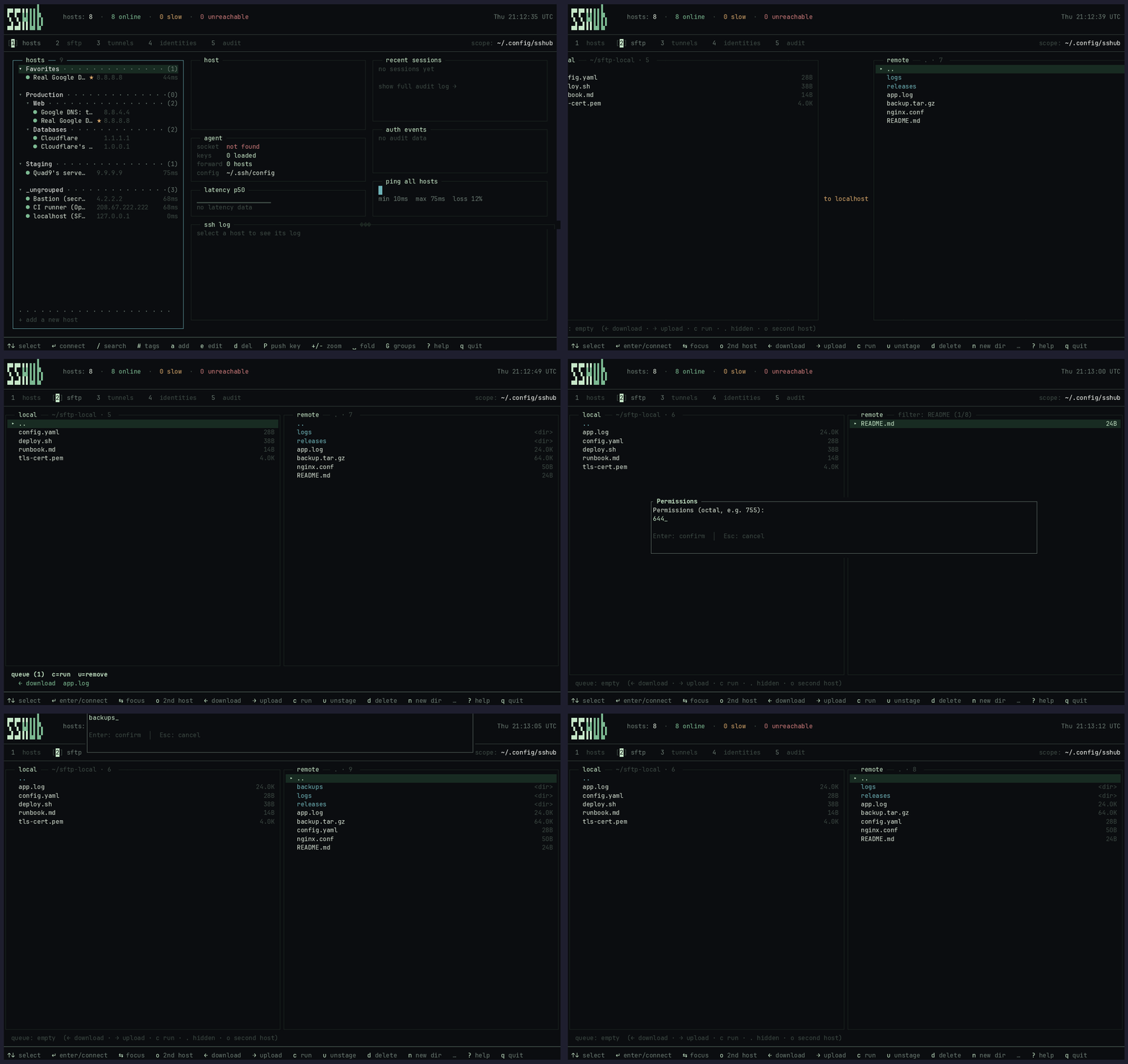
Transferring files over SFTP: a dual-pane browser (local / remote) with a staged transfer queue, plus chmod, new folder and delete in place:
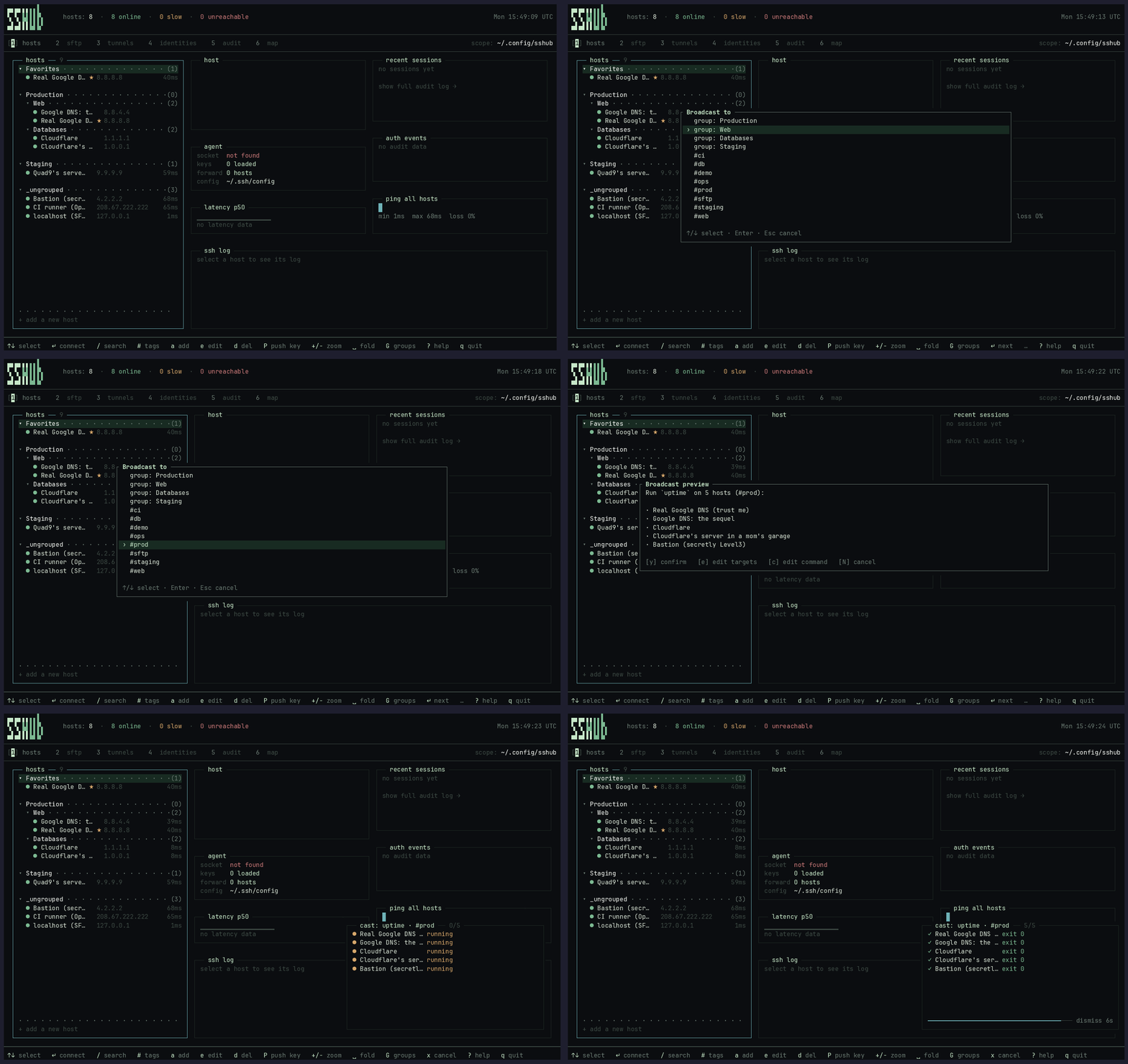
Broadcast (b): one command on every host of a group or tag, with a preview of the hosts before it runs and a live results panel:
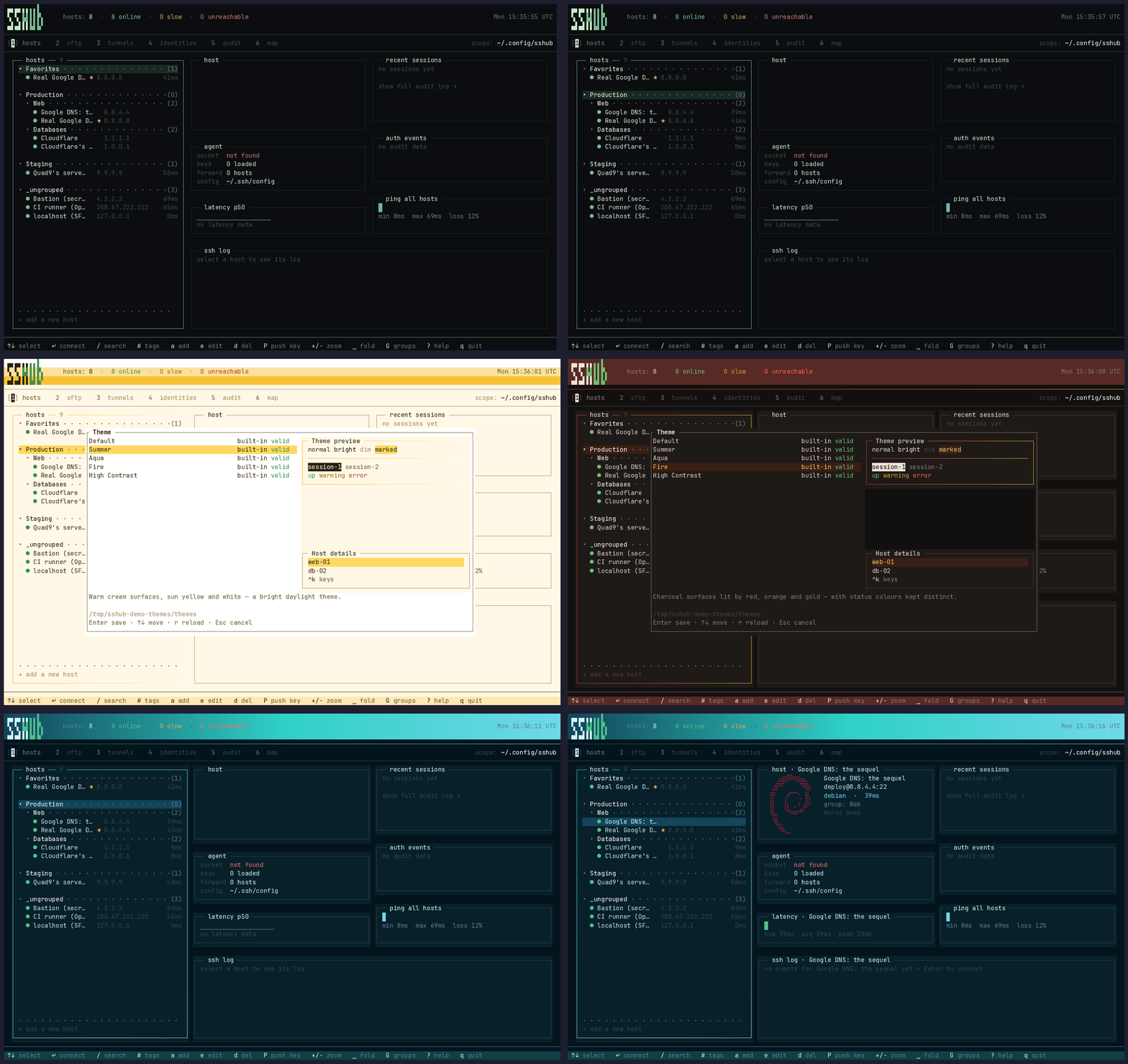
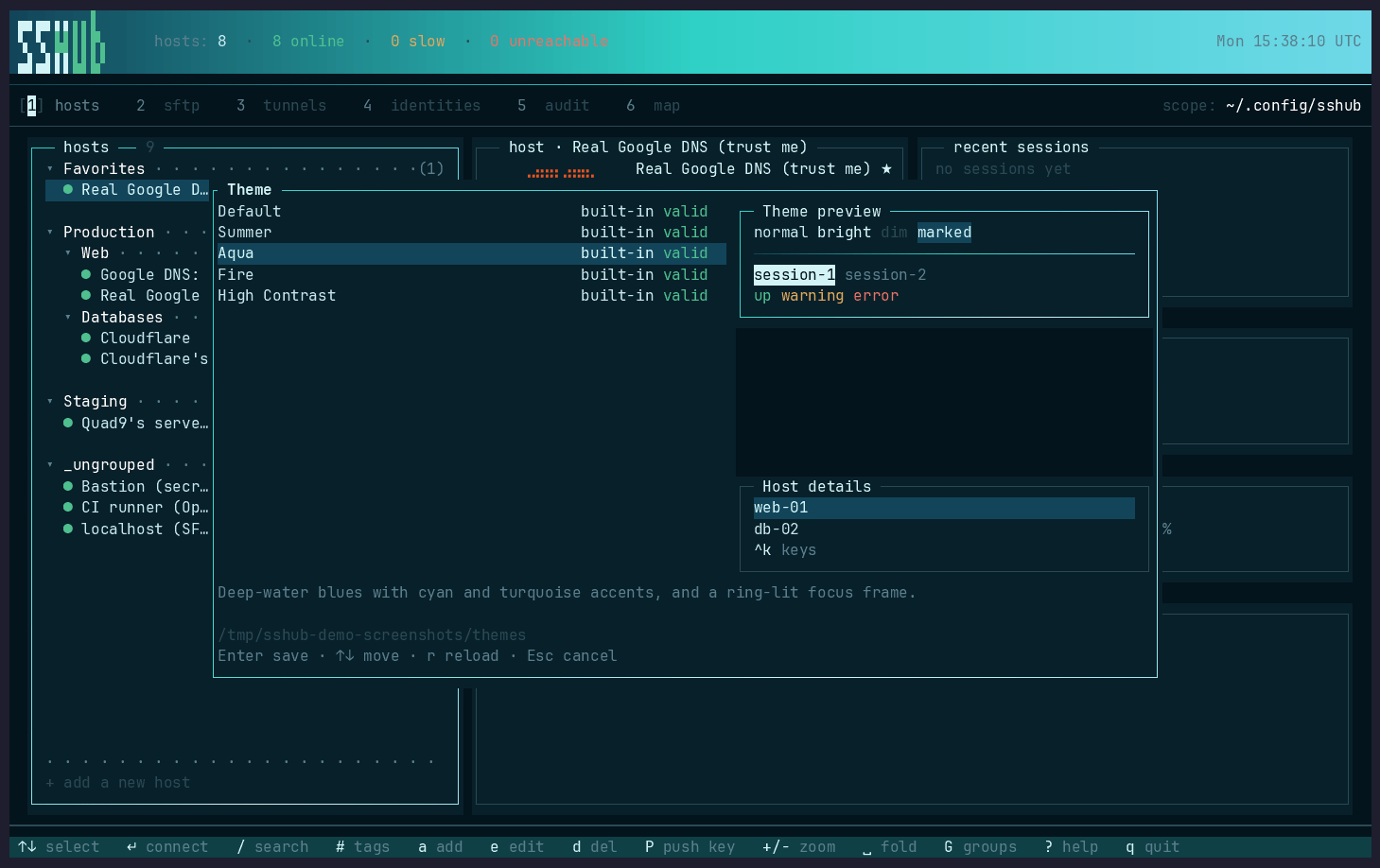
Themes: Settings (Ctrl+H), then Theme.... Every step in the picker previews that theme on the whole interface; Enter keeps it, Esc puts the old one back:
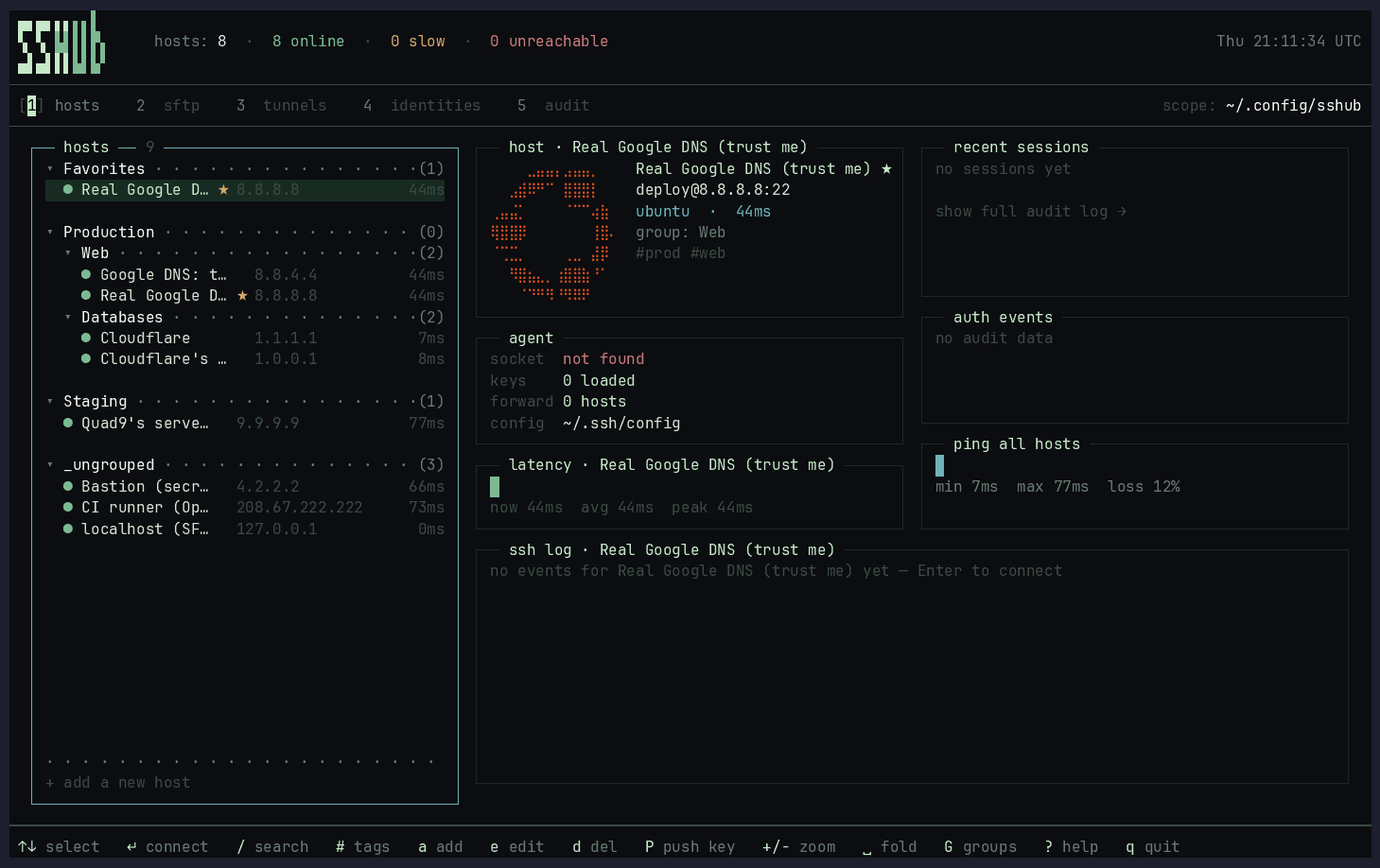
The hosts dashboard: nested groups on the left; the selected host's card shows its auto-detected OS logo, fact sheet, and per-host latency, with live agent / ping panels alongside:
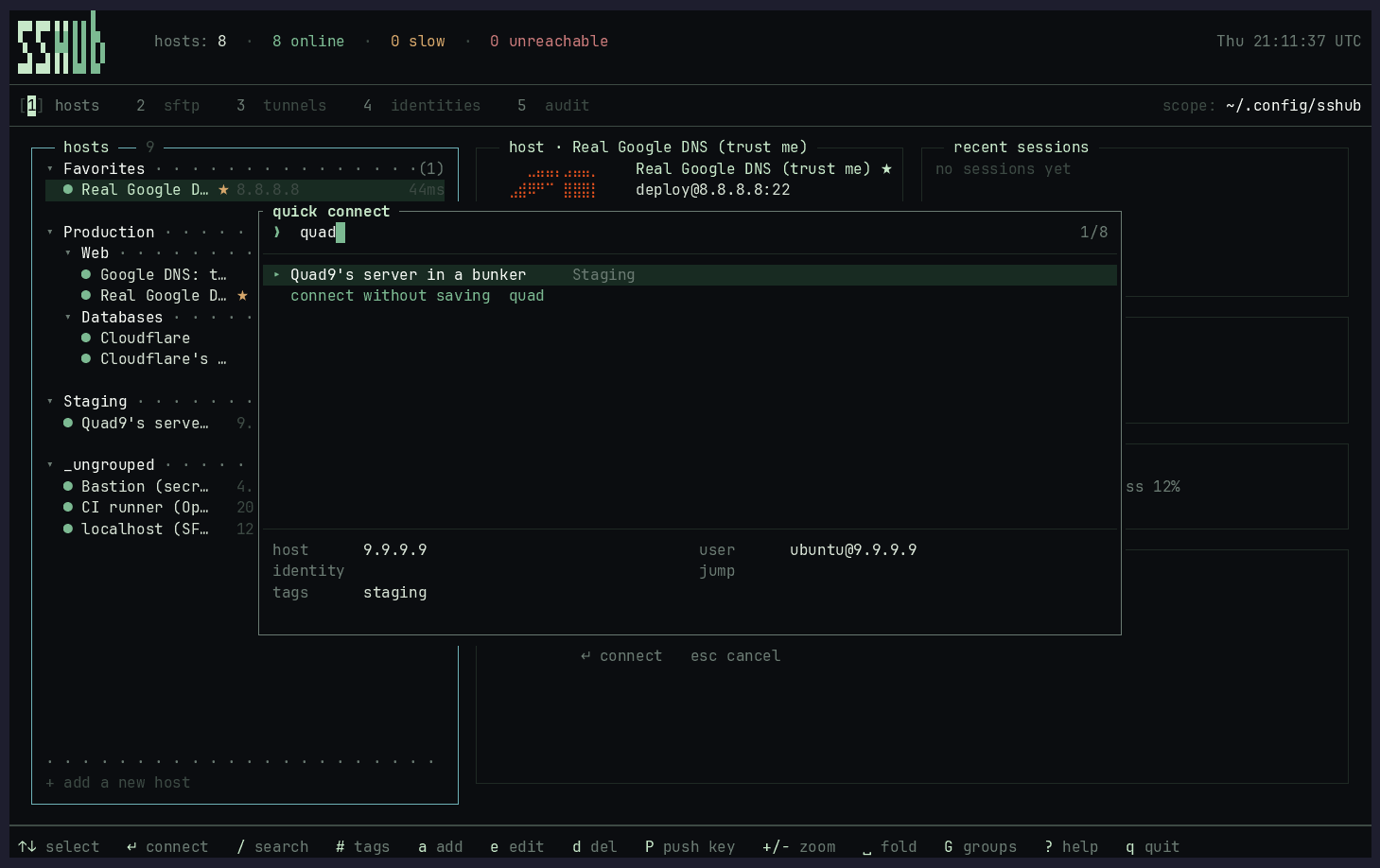
Fuzzy quick-connect palette (/) and the multi-tag filter (#):
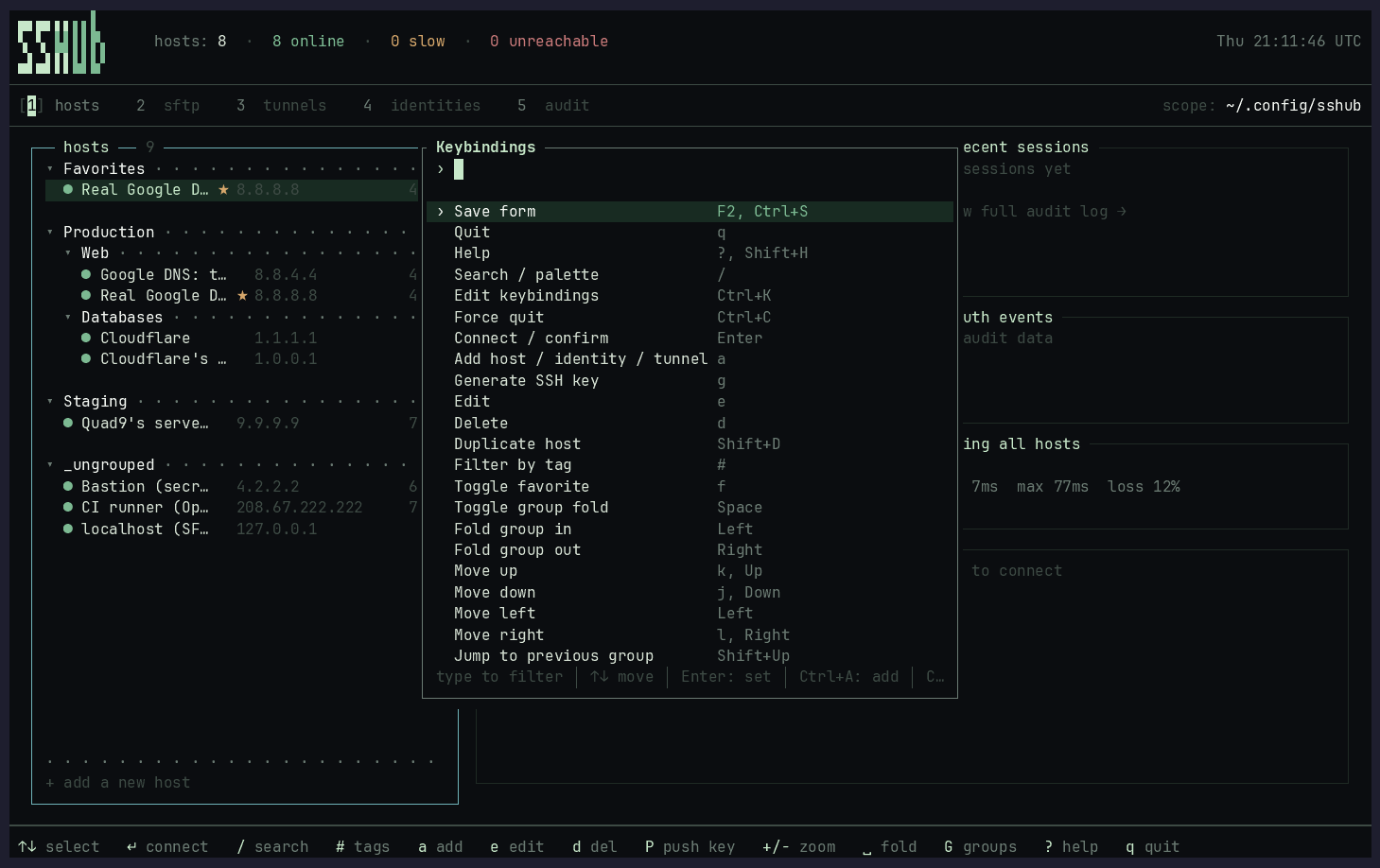
Add/edit host form, the rebindable keybindings editor (Ctrl+K), and the scrollable help overlay (?):
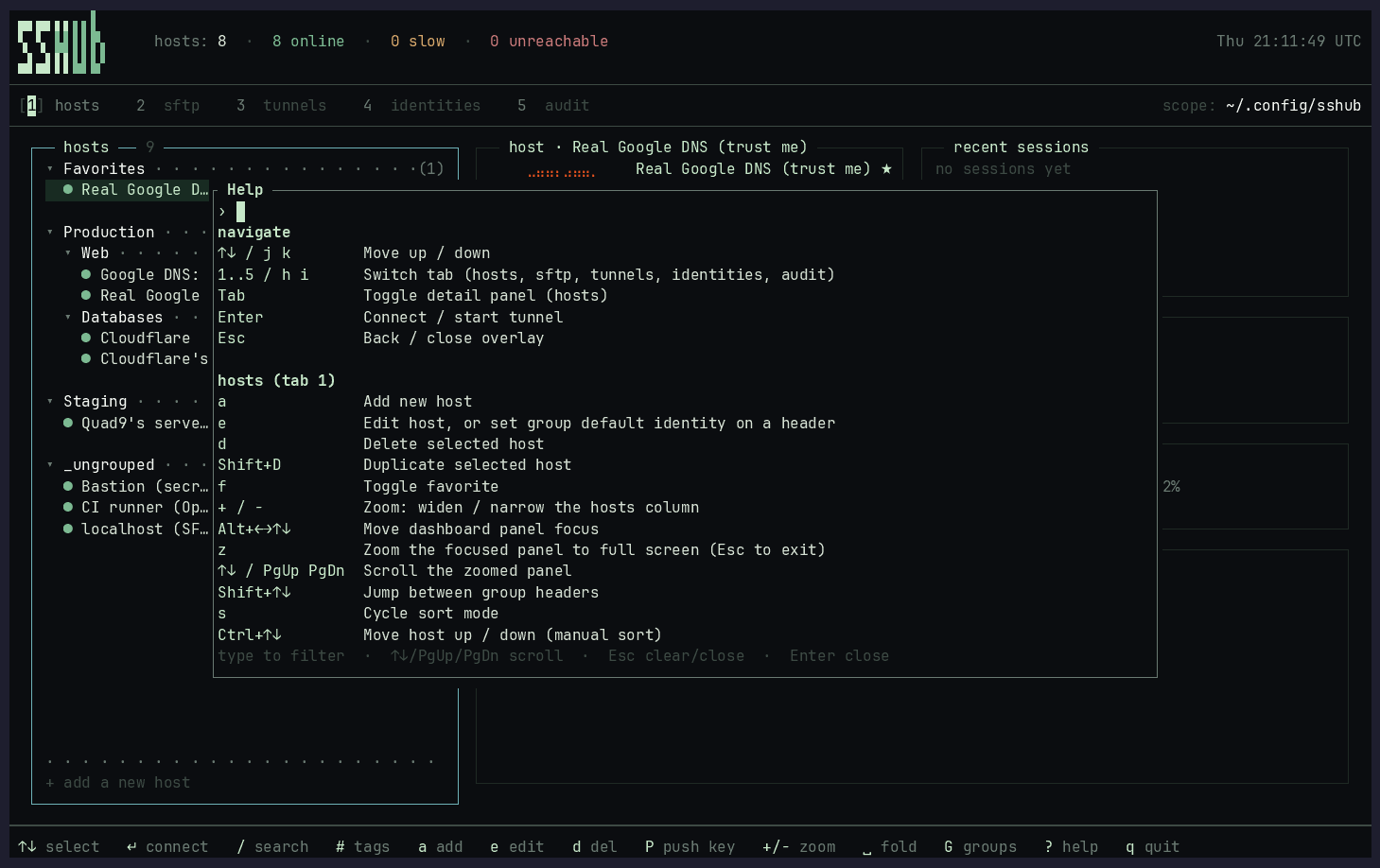
The settings overlay (Ctrl+H): the theme, transparency for SSHub's own surfaces or the remote grid, ping, the update check, profiles, OS logos, quit confirmation, the startup animation and session command history:
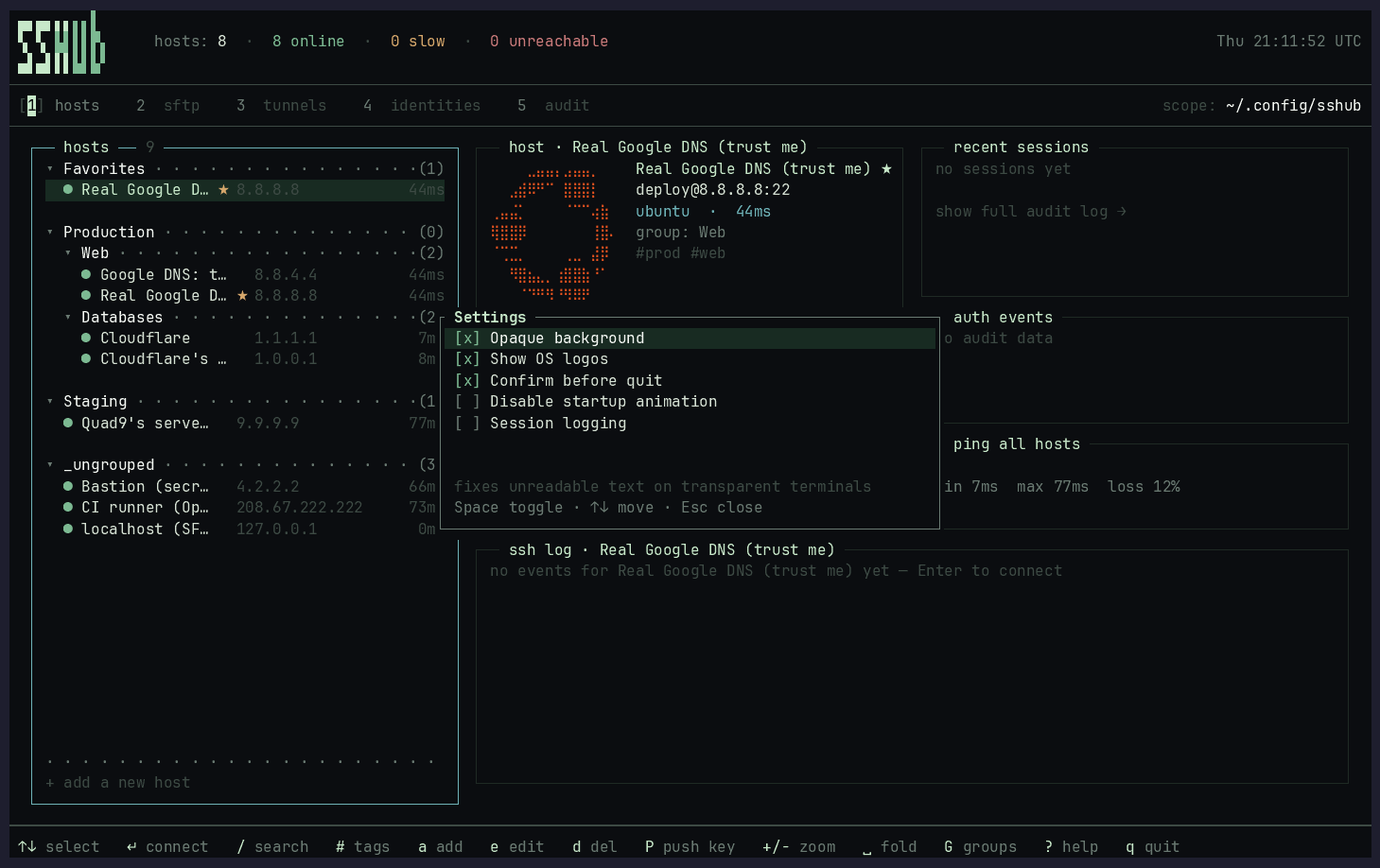
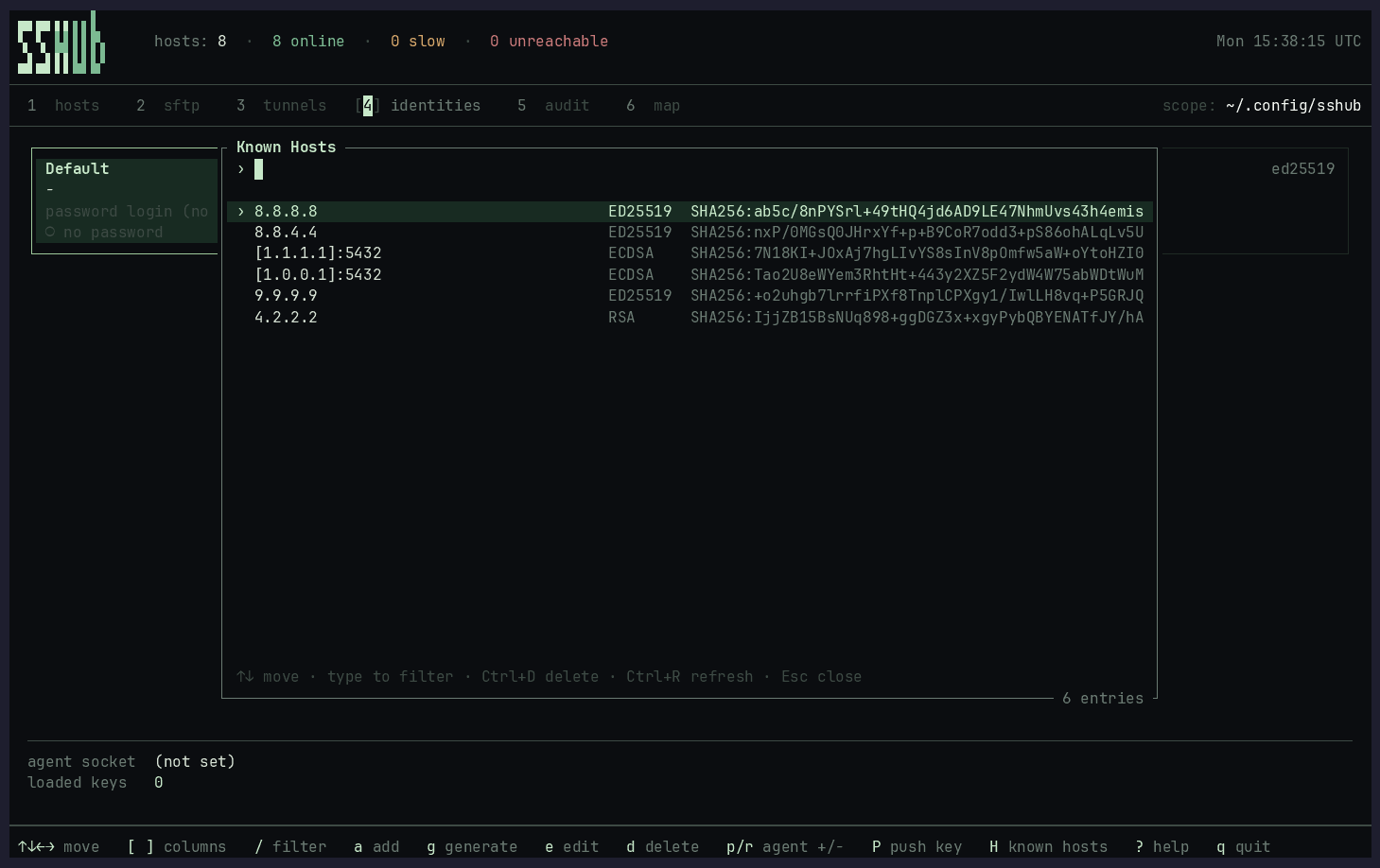
The theme picker, with its detail preview next to the list, and the known hosts manager (H on the identities tab):
- Embedded SSH sessions: connect opens an in-TUI PTY; detach with
Ctrl+Dand return to the dashboard while SSH keeps running; multiple session tabs, andAlt+Sswitches between open sessions with a searchable picker - Interactive SSH authentication: masked password, passphrase and one-time-code modals. Eligible managed credentials get a remember option that starts clear and is saved only after SSH confirms authentication; generic challenges are never saved.
Entersubmits,Tabselects remember,Spacetoggles it, andEsc(orCtrl+C) cancels. New host keys require explicityacceptance; changed keys require uppercaseAto remove the identified stale entry and reconnect for confirmation. Fingerprints are shown unchanged;PgUp/PgDnscroll long prompts. A ProxyJump hop that asks for a password is answered with that hop host's own stored secret, never the destination's, and the modal names the hop. OpenSSH may record accepted keys in its configured known_hosts file. Tunnels, headless commands and Mosh keep their existing authentication paths. - Share this machine's network:
Alt+Shift+Ninside an ssh session (orsshub connect <host> --share-net) gives the host a SOCKS5 proxy on its own127.0.0.1through ssh reverse dynamic forwarding (-R 127.0.0.1:0), so a host with no DNS or way out can reach the world through this machine:apt -o Acquire::http::Proxy=socks5h://127.0.0.1:PORT -o Acquire::https::Proxy=socks5h://127.0.0.1:PORT install ...orcurl -x socks5h://127.0.0.1:PORT .... In the TUI the proxy rides a second ssh connection to the same host that carries nothing else, so the session itself is never touched; the same key stops it, and closing the session or quitting SSHub ends it (on Linux also when SSHub is killed; elsewhere only a SIGKILL can leave it running). It starts once the session is connected. That connection must log in without prompts (a key or a stored password), and a mosh or local shell tab cannot share. It is opt in, never saved on the host, never rides a ControlMaster of yours, and limited to destination ports 80 and 443. The bottom bar shows⇄ net :PORTand the host's SSH log gets the ready-to-paste lines; a host that forbids forwarding shows⇄ net failedand the session goes on. Security: while it is on, any user on the host can use the proxy to reach whatever this machine reaches on ports 80 and 443, internal web services behind its VPNs included. The local ssh client must knowPermitRemoteOpen(OpenSSH 8.5); an older one refuses to start with "Bad configuration option". - Hosts — browse, search, and connect. Fuzzy search with
/, multi-tag AND filter with#, favorites, nested groups, manual sort order - SFTP file transfer — a dual-pane browser with a staged transfer queue: navigate both sides, queue uploads and downloads (files or whole folders, transferred recursively), and run them with a progress bar. Files can be staged while the queue runs. Jump straight to a directory by typing its path with
g(/home/me,../other,~/.ssh;Tabcompletes the last segment). The left pane is your local filesystem by default, or point it at a second server witho(Osends it back to local) to move files between two hosts — relayed through a local temp file, since SSH has no server-to-server copy. Manage files in place too: delete (d), new folder (n), rename/move (R), and change permissions (M, octal chmod) - OS auto-detection — on first connect a background probe detects the remote distro and the host card renders its logo (Braille art in brand colors), just like Termius
- Multiple groups & Favorites — a host can belong to several groups at once; a reserved Favorites group and a ★ marker in the list, toggled with
f - Tunnels — define and manage SSH tunnels (local/remote/dynamic SOCKS). Start, stop, and monitor from the TUI. Per-tunnel keep alive auto-starts on launch and reconnects dropped forwards with exponential backoff (configurable in
config.toml). - Identities: key or user+password identities with ssh-agent integration: add (
p) or remove (r) a key from the agent and see its loaded status, generate an ed25519 or rsa-4096 key pair (g), push a public key to a host (Shift+P), and manage~/.ssh/known_hosts(H: type to filter,Ctrl+Ddeletes a host's keys,Ctrl+Rreloads) - Group connection defaults: a group can set a default identity, username, port, ProxyJump, transport and agent forwarding; a host inherits every field it leaves empty. Edit them with
Ctrl+G(oreon a group header) in the TUI, orsshub group edit --set-default-*headless - Network map (tab
6): the jump hosts as a tree, left to right, with every host as a status glyph behind its last hop and a Σ column counting what depends on each hop. Only real jumps are drawn (a host's own ProxyJump, a group default, an ssh_configProxyJump); groups and tags never add an edge.Bshows a hop's blast radius (and broadcasts to it),othe tunnels riding on it,ttests the path hop by hop withssh -J,umakes a hop the jump of another host,/filters (group:tag:via:!name). A jump loop is flagged and not connectable; a ProxyCommand shows as an opaqueproxy cmdhop.sshub map --dotprints the same graph for Graphviz. In the host form the ProxyJump field is a hop list with a fuzzy picker (reuse a route, add a host, add a raw hop), a cycle guard, and a per-hop test connect; the stored value is still the plain comma separated ProxyJump string - Broadcast (
bon the hosts tab): run one command on every managed host in a group or with a tag. Pick the target, type the command, then review the host list in a preview (ethenSpaceincludes or excludes a host,cgoes back to the command) and pressyto run. Results land in a docked panel and each host gets an audit row;xcancels a running broadcast or clears its error toasts. Your command replaces the host's stored remote command, mosh hosts broadcast over ssh, and output is capped at 1 MiB per host - Passwords from KeePassXC (Linux) - a host's
Secret lookupfield (sshub host add --secret-lookup,host edit --set-secret-lookup) names one Secret Service entry by an exact attribute match, such asURL=ssh://root@10.0.0.5:22,Title=db-01or KeePassXC'sUuid=…, and its password is used instead of one stored in SSHub. In KeePassXC, enable Secret Service integration and expose the entry's group. The lookup must match exactly one entry, and a jump host never receives it - Ad-hoc connect - in the fuzzy palette (
/), typing an unknown[user@]host[:port](IPv6 in brackets supported) that matches no saved host offers a "connect without saving" row; Enter opens an embedded ssh session to it. Input is validated and injection-safe (no leading-dash hosts; destination passed after--) - Local shell tab -
Ctrl+Shift+Topens a session tab running your login shell ($SHELL, else/bin/sh) with the same detach/close semantics as ssh tabs - Command snippets — a library of reusable commands (name, command, optional description and tags). Manage them from the dashboard with
Shift+S(add/edit/delete); inside a live sessionCtrl+Nopens a fuzzy picker whereEnterruns the selected command in the PTY andTabinserts it without a trailing newline so you can edit before running - Session command suggestions — as you type in a live session, the rest of a matching
previously recorded command appears inline as a dim suffix after the cursor.
Tab(orCtrl+F) accepts it,Escdismisses it for that line. Suggestions come from this session's in-memory history (always on, last 100 commands), your snippet library, and — only if you opt in under Settings (Ctrl+H) — a per-managed-host command history stored in the owner-only launcher database. Persistence is off by default. Credential filtering and prompt detection are best-effort, not a guarantee: unfamiliar secrets may survive, so enable disk history only if that risk is acceptable. Flagged commands and multiline pastes are never indexed; paste bytes still reach the PTY unchanged. Remote hosts are never probed for suggestions, and history stays local-only, outside host sync. Clear history per session, per host or globally from Settings. Disabling persistence stops reads and writes but does not delete existing rows. Browse and run snippets separately withCtrl+N(Enterruns,Tabinserts for editing). There is no suggestion picker and noCtrl+Spacechord. - Audit: log of all connection events with filtering by status (all / ok / fail) and time range (all / 24h / week / month); session connect events record the path to the session log when logging is enabled
- Session logging — opt-in capture of PTY session output to
~/.local/share/sshub/profiles/<name>/logs/<host-dir>/(managed hosts use{name}-{id}; pure~/.ssh/configaliases without a launcher row may share a directory when sanitized names collide). Enable globally in Settings (Ctrl+H) or override per host (inherit/on/off). Logs capture everything echoed to the terminal, including passwords if they appear on screen. - Session log browser (
Shift+L): read those session logs inside the TUI. Pick a host, pick a rotated segment, and view it with terminal escape codes stripped so the transcript reads as plain text. In the viewer,/searches (case-insensitive),n/Nstep through matches, andbbookmarks the current line by name.mlists a host's bookmarks to jump straight back to a saved line. Reads are capped so a large transcript is never loaded whole. - Mosh transport — per-host
Transportfield in the host form (sshormosh). Embedded sessions usemoshwhen selected; tunnels and SFTP stay ssh-only. - Startup command: a host's
Startup command(--remote-commandheadless) runs when you log in, in a remote terminal, and the session goes on in your login shell:cd /srv/appstarts you in that directory,cd / && sudo su rootin a root shell in/(exit it and you are back in your own shell). Start the command withexecto make it the whole session, as inexec tmux new -A -s main: the session then ends when it does. This is the ssh transport; an ssh_config host'sRemoteCommandand a mosh host's command keep their own behaviour - Settings overlay (
Ctrl+H): pick the theme, let your terminal show through SSHub's own surfaces or through the remote grid (two separate switches, both off by default), toggle OS logos, quit confirmation, the startup animation, session logging, ping probes and the start-up update check, open the profile manager, and control session command history (persist it, the per-host limit of 1 to 2000 commands, and clearing it per session, per host or globally) - Headless CLI — the whole inventory without the TUI: hosts, groups, identities, tunnels, one-shot SFTP, the audit log and themes, plus
sshub exec <host> -- <command>to run a single command on a saved host and get its output and exit code back (with the stored identity, credential and ProxyJump applied).--format jsonon any listing, stable exit codes, completions for bash/zsh/fish — see Headless CLI - Hybrid sources — hosts from
~/.ssh/config(read-only) and launcher-managed (full CRUD) merge without duplicates - Import/Export: import from
~/.ssh/config, Termius backups, PuTTY (a Windows regedit.regexport or a Unix~/.putty/sessionsdirectory), or mRemoteNG (confCons.xml); export managed hosts back to ssh config format (the export stops with an error naming the host if a name, address, user or ProxyJump could not be written safely). Only SSH sessions are imported (RDP/VNC/telnet entries are skipped), and encrypted mRemoteNG passwords are not decrypted (imported hosts carry no stored secret) - Hot reload — edits to
~/.ssh/configupdate the host list live via file watcher - Configurable keybindings: rebind any action via
Ctrl+K; stored inconfig.tomlunder[keybinds] - Profiles: isolated workspaces, each with its own databases, config, themes, logs and keyring namespace (see Usage). In the profile manager (
Alt+P),ttransfers a host, group, identity or tunnel to another profile, ormafter the destination opens an SFTP-style dual-pane screen to stage hosts for pushing (→) and pulling (←) between the two profiles, followed by their groups, tunnels, identities and audit logs step by step; headless,sshub host|group|identity|tunnel transfer --to PROFILEdoes the same for one entity - Update notice (
Shift+U): on start SSHub asks GitHub for the latest release, and a newer one shows next to the version in the tab bar.Shift+Uon the hosts tab installs it the way SSHub was installed (npm install -g sshub-tui@<version>,cargo install sshub --version <version>, or, for a release tarball, an in-place swap of the binary after checking it runs), then asks you to restart. While it installs, quitting always asks first. With no update known,Shift+Uchecks on demand. Needscurl(andtarfor the tarball swap);Check for updatesin Settings (Ctrl+H), or[updates] check = false, turns the start-up check off. - What's new (
Shift+W): whenShift+Ufinishes an install, a popup shows the changelog of every version it brings (fetched from that release'sCHANGELOG.md).Shift+Won the hosts tab reopens it until the restart, and otherwise shows the running version's notes. - Mouse support: click tabs, rows and hosts-tab panels, scroll lists, double-click to connect, start a tunnel or open an SFTP folder; on the SFTP tab a click picks a host or a pane's entry; in forms, dialogs and pickers a click focuses the field (cursor where you clicked) or highlights the row; a drag anywhere selects text and copies it on release
From npm, prebuilt, no toolchain required:
npx sshub-tui              # run it without installing
npm install -g sshub-tui   # then just: sshub
The installed command is sshub; the package is sshub-tui because npm rejects
the bare sshub name as too close to the existing ssh2 and sshpk.
Prebuilt for Linux x64, macOS arm64 and macOS x64. The binary arrives as a platform-specific optional dependency, so nothing is compiled and nothing is fetched from outside the registry. Any other platform builds from source below.
From crates.io:
cargo install sshubRequires a Rust toolchain (edition 2021) and ssh in PATH.
On Linux, building also needs the D-Bus client library for the keyring (Secret Service) backend that stores host passwords and key passphrases:
# Debian/Ubuntu
sudo apt-get install -y libdbus-1-dev pkg-config
# Fedora
sudo dnf install -y dbus-devel pkgconf-pkg-config
# Arch
sudo pacman -S --needed dbus
Prebuilt binaries for Linux and macOS are attached to each GitHub release.
From the Nix flake (Linux x86_64 and aarch64), no toolchain required:
nix run github:Petyok/SSHub               # run it without installing
nix profile install github:Petyok/SSHub   # then just: sshub
On NixOS, add it as a flake input, install the package system-wide, and import the module that points Nix at the prebuilt binaries:
# flake.nix
inputs.sshub.url = "github:Petyok/SSHub";

# configuration.nix (pass `inputs` to your modules, e.g. via specialArgs)
imports = [ inputs.sshub.nixosModules.binaryCache ];
environment.systemPackages = [
  inputs.sshub.packages.${pkgs.stdenv.hostPlatform.system}.default
];
Prebuilt binaries come from the sshub.cachix.org cache, so
nothing is compiled. nixosModules.binaryCache only sets nix.settings.substituters and
nix.settings.trusted-public-keys; skip it and set them yourself if you prefer:
nix.settings.substituters = [ "https://sshub.cachix.org" ];
nix.settings.trusted-public-keys = [
  "sshub.cachix.org-1:yniNe6K3gkRhTgoJL6Rh2Kvqjfaw7ZjTYEFTwIpYjKA="
];
For nix run and nix profile install the flake declares the cache itself, and Nix asks
whether to trust it the first time (answer y, or pass --accept-flake-config). That
declaration is ignored when the flake is an input of another flake, hence the module. On a
multi-user install a user who is not in trusted-users has the flake's cache ignored: add
it to trusted-substituters (with the key above in trusted-public-keys) or add the user
to trusted-users.
The cache holds the build for the nixpkgs this flake pins. Overriding that with
inputs.sshub.inputs.nixpkgs.follows changes the store path, so Nix compiles locally,
and an older channel can also fail on an older Rust toolchain. The flake follows the
default branch (main), so it tracks releases. The package links nixpkgs' OpenSSL, puts
openssh on the end of PATH (your own ssh still wins), and installs the man page,
icon and desktop entry. Shell completions are not packaged: they embed your host names,
so generate them yourself as described under Headless CLI
(sshub completions <shell> works the same for a Nix install).
At runtime, a Secret Service provider (gnome-keyring, KWallet, …) is preferred for secure credential storage. If one is not running or unlocked (e.g. in WSL, Docker, or headless SSH sessions), SSHub will fallback to storing credentials in a local owner-only restricted file (credentials.json), notifying you in the status bar.
git clone https://github.com/Petyok/SSHub.git
cd SSHub
just install    # builds release binary + desktop entry + ~/.local/bin/sshub
Or build only:
just build
cp target/release/sshub ~/.local/bin/sshub # launch TUI
sshub --version # print version
sshub --dry-run # exit immediately (CI / scripts)
sshub --help # show options
sshub --profile work # launch named profile
sshub --manage-profiles # open profile picker# Wipe the launcher database — managed hosts, groups, identities, tunnels and
# the audit log. Irreversible, so it refuses unless you confirm. Your
# ~/.ssh/config (and the hosts imported from it) are left untouched.
sshub db purge --yes-i-am-stupid
# Target a profile from the TUI or any headless command.
sshub --profile work host list
sshub --profile personal audit list
sshub --profile work db purge --yes-i-am-stupidSSHUB keeps profile-owned data isolated. Each profile can select its own SSH
config source with [ssh].config_path; the default remains shared
~/.ssh/config. With one profile, startup remains silent;
with multiple profiles, the picker appears after the splash. From the dashboard,
press Alt+P (remappable) or open Settings (Ctrl+H) → Add profile /
Manage profiles to create, rename, delete, or switch workspaces without
restarting SSHub. The footer shows the current profile and shortcut. With one
profile, the action opens creation directly; Esc returns to your workspace.
The active profile cannot be renamed or deleted. Switching requires closing SSH
and local shell sessions, disconnecting SFTP and transfers, dismissing broadcasts,
and stopping tunnels (including pending reconnects). A failed load leaves your
current workspace open and displays the error in the manager.
--profile NAME bypasses the startup picker. --manage-profiles opens it even
when only one profile exists. Press Esc in the startup picker to cancel startup.
Headless commands without --profile use the last-used profile and never open
the interactive picker.
Beyond the TUI, sshub exposes a full command-line interface for scripting and
automation: hosts, groups, identities, tunnels, SFTP, and the audit log, no
terminal UI required. sshub exec <host> -- <command> runs a single command on
a saved host and hands back its output and exit code, so a script gets the
stored identity, credential and ProxyJump without rebuilding the ssh command
line by hand. Add --format json to any listing or show command for
machine-readable output (plain text is the default). Exit codes are stable:
0 success, 1 operational failure, 2 usage or bad flags, and 124 when
exec --timeout kills the run (as timeout(1) does). Destructive commands
refuse to run without --yes.
# Hosts
sshub list                                  # list hosts (alias for `host list`)
sshub connect prod-web                       # open an SSH session to a host
sshub host show prod-web --format json       # host details as JSON
sshub host search web                        # fuzzy search
sshub host add --name prod-web --address 10.0.0.5 --port 22 \
    --username deploy --group prod --tags web,prod
sshub host delete --name prod-web --yes      # destructive: needs --yes

# Run a command on a host (scripted; exit code is the remote command's)
sshub exec prod-web -- systemctl is-active nginx
sshub exec prod-web -- 'tail -n 200 /var/log/nginx/error.log' > errors.log
echo "$payload" | sshub exec db-01 -- 'psql -f -'
sshub exec prod-web --timeout 30 --format json -- uptime
sshub exec prod-web -- 'ls && uptime'        # quote it: bare `&&` runs locally
sshub exec prod-web --tty -- top             # full-screen commands need a PTY

# Groups and identities
sshub groups                                 # list host groups
sshub group add --name prod
sshub identity add --name work --username alice --private-key ~/.ssh/id_ed25519
sshub identity agent-remove --name work      # ssh-add -d for the identity's key

# Group connection defaults (issue #74): everything under prod/ goes via the
# bastion as deploy. Resolution per field: host value → best default on any
# group the host belongs to (nearest chain wins; ties break toward the deeper
# group, then the primary group's chain) → global default (port 22, ssh,
# forwarding off). Clearing a host field restores inheritance; tags and
# favorites never inherit.
sshub group edit --name prod --set-default-username deploy \
    --set-default-proxy-jump bastion --set-default-port 2222
sshub group edit --name prod --clear-default-port   # drop one default
sshub host edit --name db-01 --clear-port           # re-inherit the group port

# Copy items to another profile (--move deletes the originals afterwards).
# The plan is printed first; without --yes it asks y/N.
sshub host transfer --name prod-web --to work
sshub group transfer --name prod --to work --with-hosts --yes
sshub identity transfer --name deploy --to work --move
sshub tunnel transfer 3 --to work               # id, label or local port

# Tunnels
sshub tunnel list
sshub tunnel create --host prod-web --type local --local-port 8080 \
    --remote-host localhost --remote-port 80
sshub tunnel start 3                          # start detached (by id, label, or port)
sshub tunnel start 3 --foreground             # run in the foreground with keep-alive
sshub tunnel stop 3

# SFTP (one-shot, over a direct host)
sshub sftp ls prod-web /var/log
sshub sftp get prod-web /var/log/app.log ./app.log
sshub sftp put prod-web ./deploy.tar.gz /tmp/deploy.tar.gz
sshub sftp rm prod-web /tmp/deploy.tar.gz --yes

# Themes (see "Theming" below)
sshub theme list
sshub theme show aqua
sshub theme check ~/.config/sshub/themes/mine.toml

# Audit log
sshub audit list --status fail --days 7
sshub audit stats --days 7

# The jump-host map as a Graphviz graph
sshub map --dot | dot -Tsvg -o map.svg

# Inventory sync with ~/.ssh/config
sshub import                                  # import hosts from ssh config (--from ssh)
sshub import --from termius ./termius-export  # import a Termius export dir (L00t.csv)
sshub import --from putty                      # import PuTTY sessions (~/.putty/sessions)
sshub import --from putty ./sessions.reg       # or a Windows regedit .reg export
sshub import --from mremoteng ./confCons.xml   # import an mRemoteNG confCons.xml
sshub import --from putty --dry-run             # preview parsed hosts without writing
sshub sync                                    # refresh ssh_config rows
sshub export --stdout                         # print an ssh_config snippet

# Shell completions
sshub completions zsh > ~/.zsh/completions/_sshub
sshub completions bash
sshub completions fish
Run sshub <command> --help for a per-command usage block, or man sshub
after just install (preview the page without installing with just man). See
openwiki/workflows/cli.md for the full command tree.
Shell completions are installed automatically by just install (bash and fish
drop into auto-loaded dirs; zsh gets a sourced line appended to ~/.zshrc).
Run just install-completions to (re)install only the completions, or generate
one yourself with sshub completions bash|zsh|fish.
| Resource | Default path |
|---|---|
| Config | ~/.local/share/sshub/profiles/<name>/config.toml |
| Themes | ~/.local/share/sshub/profiles/<name>/themes/*.toml |
| Databases | ~/.local/share/sshub/profiles/<name>/{launcher,metadata}.db |
| Logs | ~/.local/share/sshub/profiles/<name>/logs/ |
| Tunnels | ~/.local/share/sshub/profiles/<name>/tunnels/ |
| State | ~/.local/share/sshub/state.toml |
| Credentials | ~/.local/share/sshub/profiles/<name>/credentials.json (only when no Secret Service is available) |
| SSH config | ~/.ssh/config, or the profile's [ssh] config_path |
Override via environment variables: SSHUB_CONFIG_DIR, SSHUB_DATA_DIR,
SSHUB_SSH_CONFIG. Setting SSHUB_CONFIG_DIR or SSHUB_DATA_DIR selects
compatibility mode, using those directories verbatim and disabling profile
discovery. Legacy SSH_LAUNCHER_* variables remain supported.
Defaults below. Rebind any action with Ctrl+K (saved to config.toml). Press ? in-app for the full list.
| Key | Action |
|---|---|
1..6, h / i |
Switch tab (hosts/sftp/tunnels/identities/audit/map); h is hosts, i identities |
Esc |
Back / close overlay |
Ctrl+H |
Settings (theme, transparency, logging, ping, updates, profiles, command history); fixed, not rebindable |
Ctrl+K |
Keybind editor |
Alt+P |
Add / manage profiles (not in compatibility mode) |
Shift+L |
Browse session logs |
Shift+S |
Manage command snippets |
Ctrl+Shift+T |
Open a local shell tab |
? |
Help screen (type to filter) |
q / Ctrl+C |
Quit (asks first unless confirm_quit is off; a second Ctrl+C forces it) |
| Key | Action |
|---|---|
Ctrl+T |
New session tab (host picker) |
Ctrl+Shift+T |
Local shell tab |
Ctrl+W |
Close session tab |
Ctrl+D |
Detach to dashboard (SSH keeps running) |
Ctrl+[ / Ctrl+], Ctrl+PgUp / Ctrl+PgDn |
Previous / next session tab |
Ctrl+Shift+F |
Open SFTP for this host (the session keeps running) |
Alt+Shift+N |
Share this machine's network with the host, or stop sharing (ssh sessions only) |
Ctrl+N |
Run a command snippet (Enter runs, Tab inserts without a newline) |
Tab / Ctrl+F |
Accept the inline command suggestion; Esc dismisses it |
Esc / Ctrl+O |
While connecting: cancel / show or hide the ssh -v debug log |
Ctrl+Shift+S |
Focus session from dashboard |
Alt+S |
Switch to an open session (searchable) |
Alt+V / Alt+J |
Split view: add a pane side by side / below (up to 4 panes) |
Alt+O |
Split view: focus the next pane (or click a pane) |
Alt+M |
Split view: zoom the focused pane |
Alt+K / Alt+I |
Split view: close the focused pane / back to one pane |
Alt+E |
Workspaces: save this layout under a name, reopen or delete one |
PgUp/PgDn, wheel |
Scroll session history; both go to the remote app while it holds the alternate screen (tmux, vim, less), where the wheel becomes arrow keys |
| drag | Select terminal text, copied on release; Shift inverts it when the remote app owns the mouse |
With sessions running in the background, Ctrl+T, Ctrl+W, the tab-cycling
keys and Ctrl+Shift+F also work from every dashboard tab.
Ctrl+W closes a session tab, but inside a form it kills the word before the
cursor (Ctrl+U kills everything before it): the host, identity and tunnel
forms and the SSH authentication prompt take readline's editing chords.
On the dashboard and in forms, dialogs and pickers the mouse works too:
drag over anything on screen to copy it on release, click a field to focus
it with the cursor where you clicked, and click a picker row to highlight it
(Enter still chooses).
Ctrl+Y copies the focused field's exact value (the stored secret on a
password field), with no label or border. Hold Shift to hand the mouse to
your terminal for its own selection and middle-click paste.
The wheel inside tmux reaches tmux's own scrollback only with
set -g mouse on; without it tmux never asks for the mouse, so the notch
arrives as arrow keys, exactly as in a real terminal.
| Key | Action |
|---|---|
j/k or arrows |
Navigate |
Enter |
Connect to host (on a group header: fold / unfold) |
Tab |
Toggle detail panel |
a |
Add host |
e |
Edit host; on a group header, edit the group |
d |
Delete host |
Shift+D |
Duplicate host |
f |
Toggle favorite |
s |
Cycle sort mode |
Ctrl+↑ / Ctrl+↓ |
Move host up / down (manual sort) |
Space, ← / → |
Fold / unfold the selected group |
Shift+↑ / Shift+↓ |
Jump to the previous / next group header |
Shift+Z |
Collapse / expand all groups |
+ / - |
Widen / narrow the hosts column |
Alt+arrows |
Move dashboard panel focus |
z / Alt+Enter |
Zoom focused panel (Esc to exit) |
c / y |
Clear / copy the SSH log |
/ |
Fuzzy search |
/ + [user@]host |
Ad-hoc connect (unknown host, no save) |
# |
Filter by tags (AND) |
Shift+G |
Manage groups (nested) |
Ctrl+G / Ctrl+Shift+G |
Edit / delete the selected group |
Shift+I |
Import from ssh config |
Shift+E |
Export to ssh config |
Shift+T |
Import from Termius |
Shift+P |
Push public key to host |
b |
Broadcast a command to a group or tag |
x |
Cancel a running broadcast / clear its error toasts |
Shift+U |
Install the sshub update, or check for one |
Shift+W |
What's new: release notes of this version or the installed update |
| Key | Action |
|---|---|
Enter |
Connect to host · enter directory (.. walks up) |
Tab |
Switch focus between the panes |
Backspace |
Up one directory |
g |
Go to a typed path (Tab completes) |
← / → |
Stage the focused pane's selection toward the other |
c / u |
Run the queue / unstage the last transfer |
o / O |
Left pane to a second server / back to local files |
. |
Show / hide dotfiles in both panes (remembered) |
d |
Delete (recursive) |
n / R / M |
New folder / rename / chmod |
r |
Refresh both panes |
s |
Open an SSH session to this host |
/ |
Filter the focused pane |
Esc |
Disconnect, back to the picker |
| Key | Action |
|---|---|
/ |
Fuzzy filter (label, host, ports, type; words may match different fields; Enter keeps, Esc clears) |
a |
Add tunnel |
e |
Edit tunnel |
d |
Delete tunnel |
Enter |
Start / stop / cancel reconnect |
R |
Reconnect settings (+/- adjust, * resets the row) |
x |
Kill tunnel process |
| Key | Action |
|---|---|
arrows / l |
Move through the grid |
[ / ] |
Fewer / more columns (saved) |
/ |
Fuzzy filter (name, user, key path; words may match different fields; Enter keeps, Esc clears) |
a |
Add identity |
e |
Edit identity |
d |
Delete identity |
g |
Generate SSH key pair |
p |
Add key to agent |
r |
Remove key from agent |
Shift+P |
Push public key to host |
H |
Known hosts manager (type to filter, Ctrl+D delete, Ctrl+R refresh) |
| Key | Action |
|---|---|
f |
Cycle filter (all / ok / fail) |
r |
Cycle range (all / 24h / week / month) |
| Key | Action |
|---|---|
↑ / ↓, ← / → |
Previous / next row; walk along the row (hop by hop, then its host glyphs) |
Enter |
Connect to the hop or host through the normal connect path (a raw hop: ad-hoc; a cluster: open / fold) |
e |
Edit the host under the cursor |
/, # |
Filter (group: tag: via: !name, or fuzzy name); tag picker. Enter keeps the filter and opens the clusters holding a match, Esc clears |
B |
Blast radius of the hop; n / N step through the dependents, b broadcasts to them |
o, x |
Tunnel lens; start / stop the tunnel of the host under the cursor |
u |
Use the hop as the jump of another host (Tab: replace or append) |
t |
Test the path with ssh -J, hop by hop, stopping at the first failure (Esc cancels). After a failure: H known hosts, P push a key to the failed hop, l its ssh log |
y, a, z |
Copy the ssh -J command; save a raw hop as a host; zoom the map (Esc unzooms) |
| click | Select a hop or glyph; double-click connects; the wheel moves the cursor |
Space, Shift+Z |
Fold a cluster / reveal 20 more hops / expand direct-only; fold every cluster |
Shift+G, H |
Manage groups; known hosts manager (both work any time on the map) |
Esc |
Cancel a test, then unzoom, then clear the lens, then the filter |
Under 80x24 the map becomes an outline (one hop per row); under 40x12 it asks for a bigger terminal.
In the host form, the ProxyJump field is the hop editor: a add a saved host, r a raw hop, Enter replace, d remove, Ctrl+↑ / Ctrl+↓ move, n direct (stores none, overriding a group jump), X clear (inherit), t test the chain. ssh_config hosts stay read-only.
SSHub's colours live in TOML theme files you can copy, edit and switch at
runtime. Five themes ship built into the binary — default, summer,
aqua, fire and high-contrast — and your own go in the
selected profile's themes/*.toml directory (or ~/.config/sshub/themes/ in
compatibility mode), where the file name is the theme's ID.
mkdir -p ~/.local/share/sshub/profiles/<name>/themes
sshub theme show aqua > ~/.local/share/sshub/profiles/<name>/themes/mine.toml
$EDITOR ~/.local/share/sshub/profiles/<name>/themes/mine.toml
sshub theme check ~/.local/share/sshub/profiles/<name>/themes/mine.toml
Select it in the TUI with Ctrl+H → Theme… → Enter: moving through the list
previews each theme on the whole interface, Esc rolls back, and Enter saves
appearance.active_theme to config.toml. Nothing else is written.
A theme sets any of three layers — your own [palette], the fixed 25-slot
[semantic] core, and per-role [components] overrides — plus named static
[gradients]. Everything you leave out is inherited from default, so
changing one semantic slot recolours everything that uses it. True Color
terminals get the colours as written. The embedded remote session keeps every
colour the remote chose itself; a theme only supplies the ground and the default
foreground the remote left unset.
Three headless commands, all without a TUI or a database:
| Command | What it does |
|---|---|
sshub theme list |
Every built-in and user theme with its state |
sshub theme show <id> [--resolved] |
The theme's source, or a fully resolved standalone export |
sshub theme check <file> |
Strict validation with file:line:column diagnostics |
theme list and theme show read the user themes of the profile --profile
names, else the last used one (the config directory in compatibility mode).
theme check takes any file path.
Full guide: docs/theme-system.md — the file format,
colour values and simulated opacity, inheritance and "auto", gradient
directions and the perimeter rule, the complete role catalogue, every picker
key, the CLI exit codes, and two copy-pasteable example themes.
~/.local/share/sshub/profiles/<name>/config.toml in profile mode
(~/.config/sshub/config.toml in compatibility mode):
[appearance]
active_theme = "default"    # set by the theme picker (Ctrl+H, Theme...)
transparent_sshub_background = false    # let the terminal show through SSHub's surfaces
transparent_session_background = false  # ...and through the remote session grid
os_logo = true              # distro logo in the host card
confirm_quit = true         # ask before q / Ctrl+C
disable_animation = false   # skip the intro splash and UI motion
identity_columns = 0        # identities grid columns, 0 = auto ([ / ] adjust it)

[session_logging]
enabled = false
max_file_bytes = 10485760   # rotate at 10 MiB
retention_files = 50        # keep newest 50 logs per host

[tunnel_reconnect]
max_attempts = 12           # 0 = unlimited retries
initial_delay_ms = 1000     # 1 s (R overlay edits delays in seconds)
max_delay_ms = 60000        # 60 s
stable_secs = 5             # uptime before a spawn counts as up
jitter_ratio = 0.25

[clipboard]
relay_from_pty = true       # let apps inside a session copy to your clipboard

[ping]
enabled = true              # ICMP status probes (Ctrl+H); hosts override it in their form

[updates]
check = true                # ask GitHub for the latest release on start (Ctrl+H; Shift+U checks on demand)

[command_history]
enabled = false             # persist session commands per managed host (Ctrl+H)
max_entries_per_host = 200  # Settings adjusts it between 1 and 2000

[ssh]
config_path = "~/.ssh/config"   # this profile's ssh_config source (profile mode only; SSHUB_SSH_CONFIG wins)

[keybinds]
profiles_manage = ["Alt+P"] # every action is a list of key specs; Ctrl+K edits themjust build # release binary
just test # all tests (unit + smoke + e2e + config)
cargo run -- --dry-run # quick sanity check| Level | Command | What it checks |
|---|---|---|
| Unit | cargo test |
Logic, parsers, fixtures -- no TTY |
| Smoke | cargo test --test smoke |
Binary starts, --help, --dry-run |
| E2E | cargo test --test e2e |
TUI scenarios via TestBackend |
| Config | cargo test --test config_load |
Config file creation and loading |
| Variable | Purpose |
|---|---|
SSHUB_CONFIG_DIR |
Override config directory |
SSHUB_DATA_DIR |
Override data/SQLite directory |
SSHUB_SSH_CONFIG |
Override SSH config file path |
SSHUB_DRY_RUN |
Exit immediately without TUI |
SSHUB_AUTO_QUIT |
1 = quit after first draw, q = send quit key |
SSHUB_VERSION_LABEL |
Replace the tab-bar version label; set but empty hides it (demo recordings) |
SSHUB_INSTALL_CHANNEL |
Declare how sshub was installed (npm, cargo, source, ...); picks the Shift+U update route and the tab-bar suffix (the npm shim sets npm) |
Rust with ratatui + crossterm for the TUI, rusqlite (bundled SQLite) for storage, nucleo for fuzzy search, notify for file watching. No async runtime -- synchronous event loop with 50ms polling.
Made with dynamic workflows + adversarial-multimodel-reviews + cross-model-reviews. Models with commits, reviews, or blocked merges to their name, in order of appearance:
- Opus 4.8
- Opus 5
- Fable 5
- Composer 2.5
- Grok 4.5
- Qwen 3.8 Max
- GPT-5.6 Luna
SSHub is free and AGPL-licensed. If it saves you time, you can throw coins at it:
| Coin | Network | Address |
|---|---|---|
| BTC | Bitcoin (on-chain) | bc1qvuprwm3r0twn03aej9yv0vjkqj3fkskyq7c3pc |
| USDT | Tron (TRC20) | TRnxCkzKD1Wunhvy1XitCrhLCHNs5U3XRf |
Send USDT only on the network listed above -- coins sent over another chain are unrecoverable.
AGPL-3.0-or-later — a copyleft license: forks and derivatives must stay open under the same terms. (Versions ≤ 0.3.1 were released under MIT.)
See CHANGELOG.md.