A simple and extensible Rust library implementing Rapidly-Exploring Random Trees for robot motion planning.
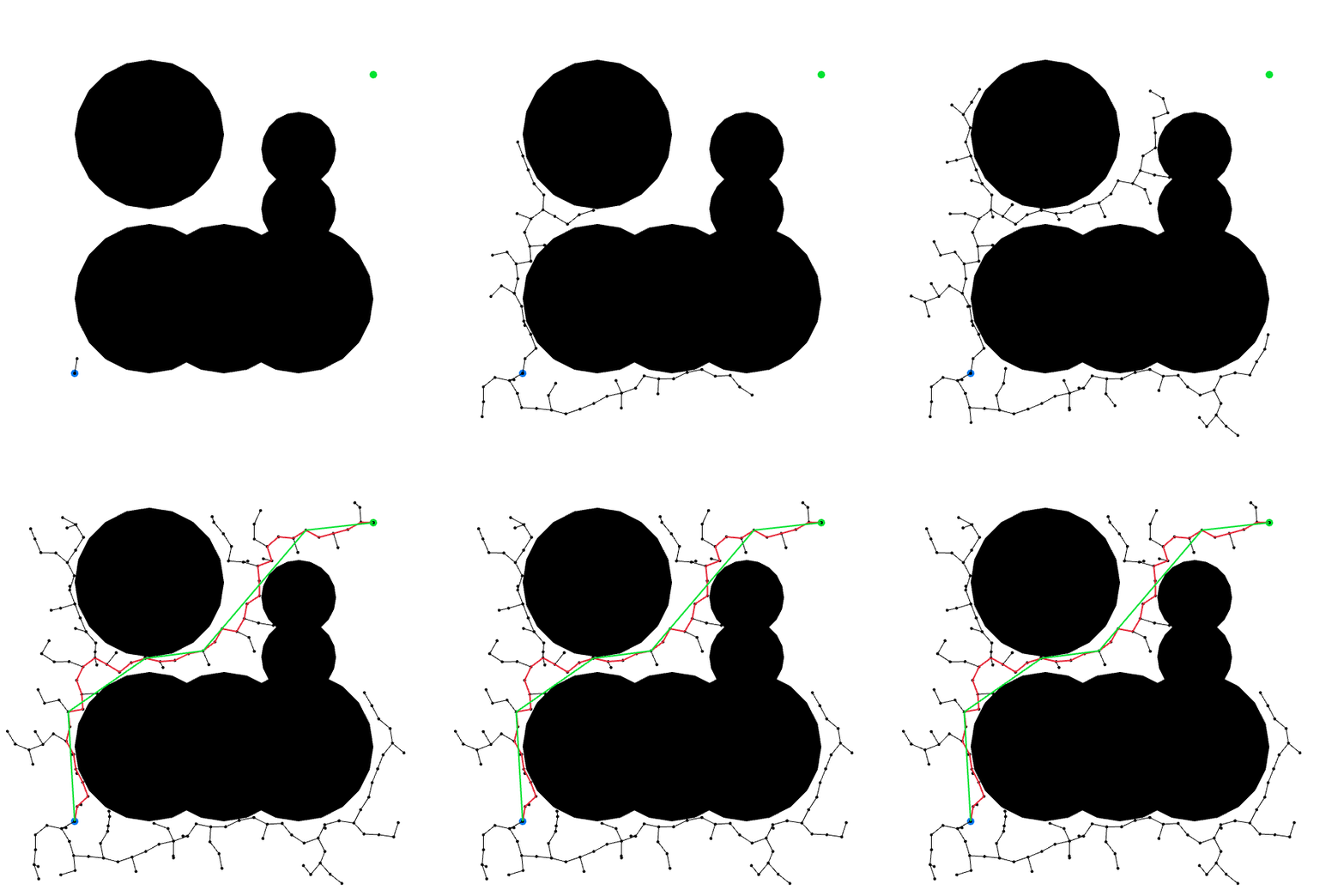
The GIF above is generated by examples/rrt2d.rs.
It uses a point robot, spherical obstacles, a uniform sampling distribution with 5% goal bias and a straight line steering mechanism.
The red path shows the path found by RRT. The green path is after applying shortcutting with rrt::smoothing::fast_shortcutting.
The RRT library is designed to be applicable to a wide variety of robots. Therefore, we use generic parameters. To use an RRT you will need to implement and specify the following generics.
- F (
num_traits::Float) : the floating point type (implements num_traits::Float) - N (
usize) : the number of dimensions in the state space - VC (
rrt::ValidityChecker) : provides functions to check if points and edges in state space are valid (not in collision)- Your implementation should consider the geometry of your robot and the environment
- If you are planning in joint space for a serial manipulator, this will need to perform forward kinematics for collision checking
- Your implementation should consider the geometry of your robot and the environment
- SD (
rrt::SamplingDistribution) : provides a function to sample points from the state space- For most applications,
rrt::GoalBiasedUniformDistributionis sufficient
- For most applications,
- ST (
rrt::Steering) : provides a function to generate a new point by steering from one point towards the direction of another- For applications in which you do not care about robot dynamics,
rrt::EuclideanSteeringis sufficient
- For applications in which you do not care about robot dynamics,
- NN: (
rrt::NearestNeighbors) : data structure for efficient nearest neighbors- For most applications,
rrt::KdTreeNearestNeighborsis sufficient (implemented usingkiddolibrary)
- For most applications,