



Agentboard turns an AI agent from something you operate, into someone you delegate to. You bring context and decisions, it brings the work, and the board always shows whose move it is.

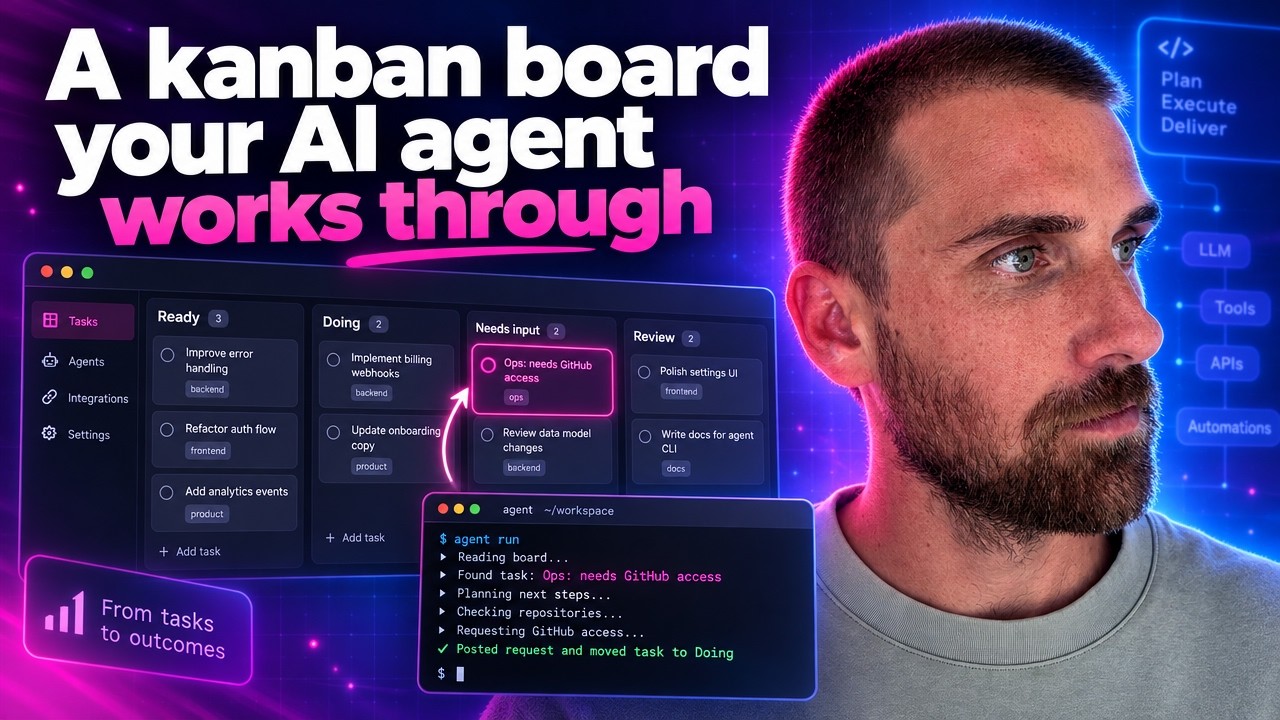
Watch the walkthrough: the board, ops cards, and the agent taking a real issue from ready to pull request.
Chat works for one task. It breaks down when the work is your whole week.
- Cards, not sessions. Every job is one card with its own conversation, files and history. You never dig through old chats again.
- Work while you're away. The agent picks up cards on a schedule. When it needs something, the card comes back to you. Not before.
- One glance in the morning. "Needs me" is your inbox: cards waiting for your answer or your approval. Reply, add context, hand back. The agent continues.
- One agent, all your work. No agent per task type. One agent that reads your context tree handles everything. Tasks stay isolated, your context does not.
- A history you can trust. Every status change and every action is logged with a timestamp. You see what got done, when, and why.
- It asks for what it lacks. Missing a login, a connection, a writing style? The agent creates an ops card for you and moves on. Fill it in when it suits you; the task resurfaces by itself.

- 08:30 You open the board on your phone. Two cards need you. You answer one, paste a login into the other, hand both back.
- 10:40 The agent hits a missing connection. It creates an ops card, parks the task, and moves on to the next card.
- 16:00 Three cards in review. You read, approve, done. The timeline shows what happened while you were out.

inbox → ready → doing → needs_input → review → done
- inbox yours. Only you move a card to ready.
- ready the agent may start.
- doing the agent has claimed it.
- needs_input your turn: a question, a login, a decision.
- review the agent is done, you approve.
- done only you can put a card here. Never the agent.
- A web board and a CLI. Your cards, context and secrets stay on your machine.
- A context tree in markdown + git: who you are, your clients, your connections. The agent reads it, you own it.
- A secrets vault. You paste a value once, the agent uses it, and nothing can ever read it back into the browser.
- Routines: recurring work on a schedule, approved once.
- An agent log: every session, every step. Live while it runs.
- Works with any agent that has a CLI. Claude Code is the default.

Needs Node 22 or newer and an agent CLI. Claude Code is the default.
git clone https://github.com/Robbertvermeulen/agentboard
cd agentboard && npm install && npm run build && npm link
agentboard init
agentboard serve        # board at http://localhost:4666
Create a card on the board, move it to ready, then run one session:
export AGENTBOARD_SESSION_CMD="claude -p --output-format stream-json --verbose --dangerously-skip-permissions"
agentboard runner
Without AGENTBOARD_ORIGIN the board listens on localhost only, no login needed. Exposing it is in docs/reference.md.
Scheduler, secrets, backups, other agents: docs/reference.md.
- Reference: data layout, every command, the runner, backups.
- Deploy on Fly: one machine, one volume, phone login.
- AGENT.md: the rules the agent works by.
- Design: the Claude Design canvas the UI was built from.
- Specs and plans: how it was built. Partly in Dutch.
v0.1. One machine, one agent session at a time, no auth. In daily use by its author.
Functional Source License 1.1. Use it, change it, run it for yourself or your company. Each version becomes Apache 2.0 two years after release. See LICENSE.