

Diverse Dexterous Piano-Playing Challenges for Standard, Robust, Safe, and Multi-Agent RL







OmniPiano is a benchmark for dexterous, multi-hand piano playing built on RoboPianist and MuJoCo. RoboPianist uses two Shadow Hands; OmniPiano supports one to five hands, with up to 111 continuous action dimensions. It offers four benchmark tracks that share the same piano, the same MIDI objective and the same evaluation metrics:
| Track | What changes | Interface | Task settings* | Baselines* |
|---|---|---|---|---|
| 🎼 Standard RL | Repertoire and hand morphology: 1–5 hands, either unrestricted (fully mobile) or restricted (each hand clamped to its own register); annotation or optimal-transport (OT) fingering | Gymnasium | 72 | 10 |
| 🌪️ Robust RL | Noise on the action, observation, reward, gravity, fingertip–key friction or initial hand pose, drawn from a Gaussian, uniform or constant-shift distribution; channels can be combined | Gymnasium | 216 | 4 |
| 🛡️ Safe RL | Musical reward and physical safety cost are separate signals: joint range, actuator power, injured finger, hand collision × Event / Fraction / Excess cost | Gymnasium (CMDP) | 480 | 14 |
| 🤝 Multi-Agent RL | Hands are split across decentralized agents that share one team reward. Four cooperation axes (SCHO): Scalability, Coupling, Heterogeneity, Observability | PettingZoo ParallelEnv |
144 | 8 |
* Counts from the paper, which evaluates 912 task settings with 36 RL baselines plus 4 LLM-based agents in total.
Each track changes one factor of the shared piano task. A difference in performance can therefore be attributed to that single design choice.
- Demos
- Installation
- Quick start
- Tasks
- Training baselines
- Evaluation protocol and metrics
- Repository layout
- Contributing
- Acknowledgements
Click any clip to open the full-length video. More rollouts are on the project website.
 One hand, unrestricted Für Elise |
 Two hands, unrestricted Für Elise |
 Three hands, restricted Pictures at an Exhibition (Great Kiev) |
 Four hands, restricted Winter Wind |
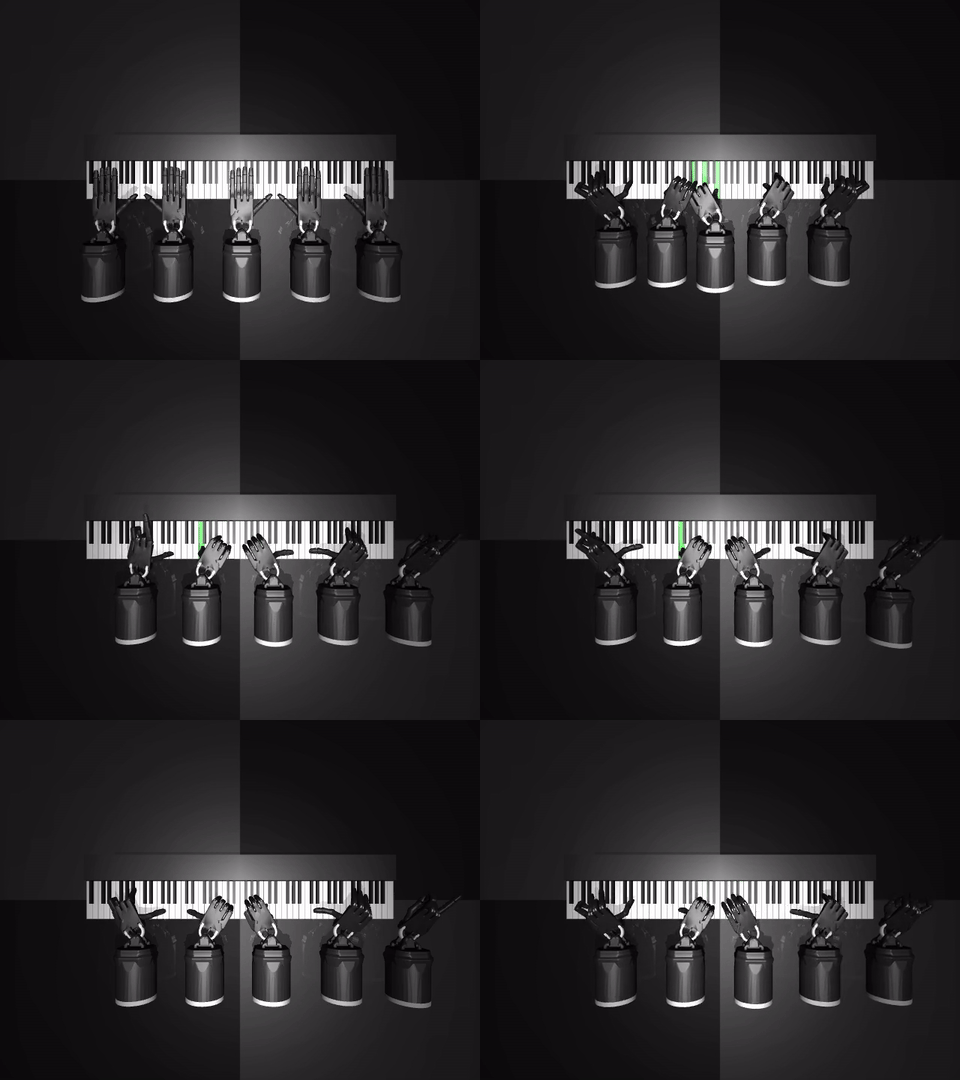 Five hands, restricted Each hand confined to its own keyboard region |
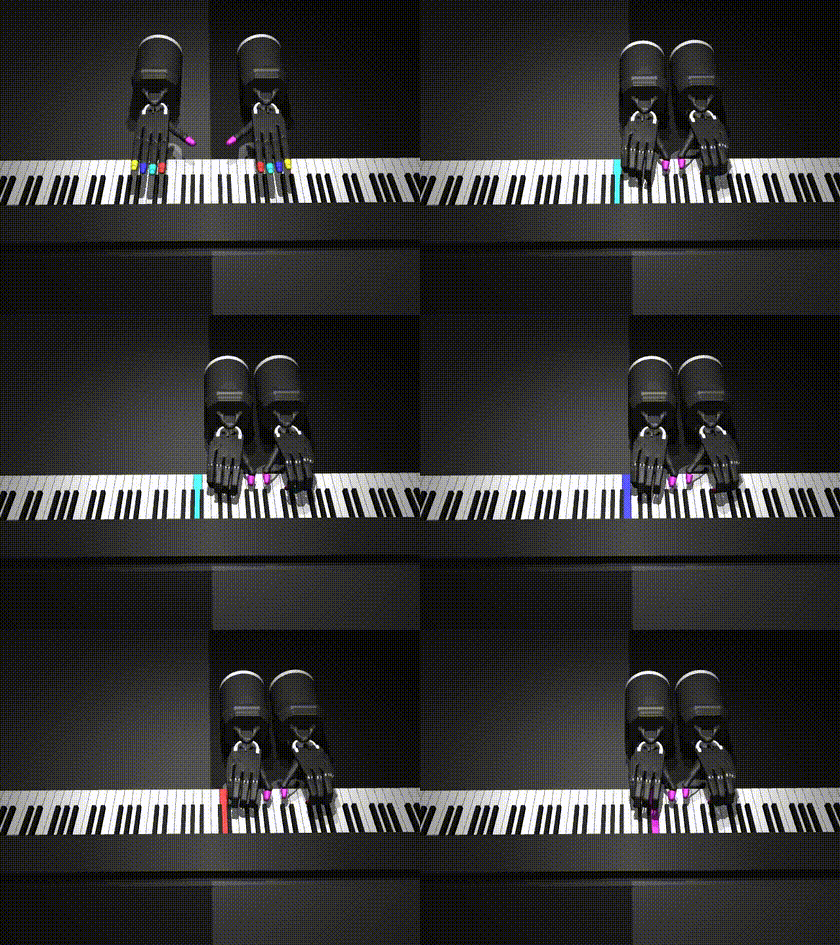 Safe RL: hand collision Limiting contact between neighboring hands |
 Two hands, action noise Clair de Lune |
 Three hands, observation + action noise Für Elise |
 Five hands, observation noise Für Elise |
 Two agents, four hands Winter Wind · Base setting |
 One hand vs. three hands Winter Wind · Heterogeneity setting |
 Four agents, one hand each Winter Wind · Scalability setting |
OmniPiano runs on Linux with Python ≥ 3.10. Windows users can use WSL2.
Unlike the original RoboPianist, the Shadow Hand models and the default
soundfont (TimGM6mb.sf2) are bundled with the repository, so you do not
need git submodule or install_deps.sh.
1. System packages
sudo apt-get update
sudo apt-get install -y build-essential fluidsynth libfluidsynth-dev portaudio19-dev ffmpeg libegl1 libgl1
2. Python environment and package
conda create -n pianist python=3.10 -y
conda activate pianist

git clone https://github.com/SAIL-Research-Lab/omnipiano.git
cd omnipiano
pip install -e .                 # core: Gymnasium + PettingZoo envs, SB3 baselines
Optional extras for particular tracks:
| Extra | Installs | Used by |
|---|---|---|
pip install -e '.[torchrl]' |
torch 2.10, torchrl 0.13, tensordict 0.13 |
Robust-RL baselines (PPO, SAC, EPPO, A2P-SAC, SCPO, OMPO) |
pip install -e '.[marl]' |
ray[rllib]==2.55.1, wandb |
Multi-agent baselines (IPPO, MAPPO, HAPPO, A2PO, FACMAC, centralized PPO) |
| separate env, see Safe RL | omnisafe==0.5.0, safety-gymnasium==0.4.1 |
Safe-RL baselines (32 OmniSafe algorithms) |
Important
Put the Safe-RL stack (OmniSafe) in its own conda environment. It pins
older Gymnasium, NumPy and SciPy versions. Follow
omnipiano/safety/QUICKSTART.md.
3. Piano Fingering Dataset (PIG)
Benchmark pieces come from the
PIG dataset.
Its license does not allow redistribution, so you must download it yourself.
Download PianoFingeringDataset_v1.2.zip (free registration), unzip it, then run:
robopianist preprocess --dataset-dir /PATH/TO/PianoFingeringDataset_v1.2
robopianist --check-pig-exists        # -> "PIG dataset is ready to use!"
4. Verify
export MUJOCO_GL=egl   # headless rendering; use "glfw" on a desktop with a display
python -c "import omnipiano; env = omnipiano.make('OmniPiano-TwinkleTwinkleLittleStar-TwoHand-GeneralRL-v0'); print(env.action_space)"
Optional: for better-sounding rendered videos, run
robopianist soundfont --download.
Tip
Set MUJOCO_GL before Python starts. Importing omnipiano builds the
MuJoCo-backed task registry.
import omnipiano

# mode="eval" adds musical metrics (F1, precision, recall) to the final-step info;
# the default mode="train" reports only the reward-term decomposition.
env = omnipiano.make("OmniPiano-WinterWind-FourHand-StaticPartition-GeneralRL-v0", seed=0, mode="eval")
obs, info = env.reset(seed=0)

terminated = truncated = False
while not (terminated or truncated):
    action = env.action_space.sample()            # replace with your policy
    obs, reward, terminated, truncated, info = env.step(action)

print("key-press F1 :", info["episode_task/f1"])
print("precision    :", info["episode_task/key_precision"])
print("recall       :", info["episode_task/key_recall"])
env.close()
A random policy is only an interface demo. Meaningful playing requires training (see Training baselines).
import omnipiano
from omnipiano.safety.suite import MAIN, register_task   # or register_all()

env_id = register_task(MAIN[0])   # 2-hand Für Elise, joint-range / Fraction cost
env = omnipiano.make(env_id, seed=1)
obs, info = env.reset(seed=1)
obs, reward, terminated, truncated, info = env.step(env.action_space.sample())

print(reward)                                   # musical reward (cost is NOT subtracted)
print(info["step_safety/cost_total"])           # per-step safety cost c_t
# at episode end: info["episode_safety/cost_total"] -> compare with the budget dimport omnipiano
from omnipiano.multiagent import make_parallel, list_parallel_envs
print(list_parallel_envs())
env = make_parallel("OmniPiano-WinterWind-FourHand-MA-Duet-Territorial-v0", seed=0)
obs, infos = env.reset(seed=0)
print(env.agents) # ['secondo', 'primo']
while env.agents:
actions = {a: env.action_space(a).sample() for a in env.agents}
obs, rewards, terminations, truncations, infos = env.step(actions)import omnipiano
from omnipiano.envs.registration import _registry
from omnipiano.safety.suite import register_all
register_all() # the factorized safety suite registers on demand
print(len(_registry), *sorted(_registry), sep="\n")omnipiano.make(env_id, **kwargs) accepts registered IDs only. Every
setting that defines an experiment (reward, safety, robustness, hands) is
fixed by the ID. Only runtime options are accepted as kwargs: seed,
record_dir, record_every, record_resolution, camera_id,
mode ("train" or "eval") and, for robustness evaluation,
eval_noise_scale. To change anything
else, register a new ID (see Contributing).
OmniPiano-{Song}-{OneHand|TwoHand}-GeneralRL-v0
OmniPiano-{Song}-{Three|Four|Five}HandPrototype-GeneralRL-v0          # unrestricted: fully mobile hands
OmniPiano-{Song}-{Three|Four|Five}Hand-StaticPartition-GeneralRL-v0   # restricted: each hand clamped to a register
| 1 hand | 2 hands | 3 / 4 / 5 hands, unrestricted | 3 / 4 / 5 hands, restricted | |
|---|---|---|---|---|
TwinkleTwinkleLittleStar (easy, 161 steps) |
✓ | ✓ | ✓ | ✓ |
PicturesGreatKiev (medium, 720 steps) |
✓ | ✓ | ✓ | ✓ |
WinterWind (hard, 314 steps, 16.6 notes/s) |
✓ | ✓ | ✓ | ✓ |
GeneralRLtasks use the OT fingering reward. It solves a fingertip-to-key assignment with the Hungarian algorithm, so it works for any MIDI file and any number of hands. To compare with annotated fingering, useOmniPiano-ForElise-FingeringAnn-v0vsOmniPiano-ForElise-FingeringOT-v0.- Additional morphology tasks (
PolonaiseOp40No1,PianoSonataNo281StMov,PianoSonataNo301StMov, …) are registered without the-GeneralRLsuffix, e.g.OmniPiano-PicturesGreatKiev-ThreeHand-StaticPartition-v0. - The reward follows RoboPianist: $r_t = r^{key}_t + r^{match}t - \lambda{energy} r^{energy}_t$.
Signal perturbations (action A, observation O, reward R) are applied at every step. Environment perturbations (gravity G, contact friction CF, hand pose HP) are sampled per episode or per step.
OmniPiano-ClairDeLune-Clean-v0                                   # unperturbed reference
OmniPiano-ClairDeLune-{A|O|R}-{Gauss|Uniform|Shift}-P{level}-v0  # e.g. A-Gauss-P05, O-Uniform-P20, R-Shift-P50
OmniPiano-ClairDeLune-G-{Gauss|Uniform|Shift}-P{200|300|400}-v0  # G-Step-... = per-step variants
OmniPiano-ClairDeLune-CF-{Gauss|Uniform|Shift}-P{20|30|40}-v0
OmniPiano-ClairDeLune-HP-{Gauss|Uniform|Shift}-Y{10|25|50}-Z{05|10|20}-v0
| Channel | Perturbed quantity | Levels in ID (low / med / high) |
|---|---|---|
A Action |
canonical actuator target | P05 / P10 / P15 |
O Observation |
proprioception + piano state (goals untouched) | P10 / P20 / P30 |
R Reward |
scalar reward seen by the learner | P10 / P30 / P50 |
G Gravity |
vertical acceleration |
P200 / P300 / P400 |
CF Friction |
fingertip–key sliding coefficient | P20 / P30 / P40 |
HP Hand pose |
per-hand initial (y, z) offset, mm | Y10-Z05 / Y25-Z10 / Y50-Z20 |
Composed perturbations, e.g. OmniPiano-ClairDeLune-AO-Gauss-P15-v0,
OmniPiano-ClairDeLune-GCFHP-Gauss-G150-CF15-Y50-Z20-v0, and a three-hand
Für Elise ladder O → OR → ORA → ORAG → ORAGHP
(OmniPiano-ForElise-ThreeHand-ORAGHP-Gauss-O20-R30-A10-G300-Y25-Z10-v0).
OmniPiano-Safety-{Song}-{N}H-{semantic}-{setting}-{hash}-v1 # registered via omnipiano.safety.suite
| Safety semantic | Monitored signal |
|---|---|
joint_range |
J2 joints of all five fingers outside the central 50% of their native range |
actuator_power |
instantaneous mechanical power |
injured_finger |
power of a designated ("injured") thumb above a lower limit |
hand_collision |
normal contact force between any pair of hands |
| Cost setting | Per-step cost | Measures |
|---|---|---|
event |
occurrence | |
fraction |
share of monitored elements in violation | extent |
excess |
mean normalized excess beyond the limit | severity |
Episode budgets default to main (8 tasks,
2–5 hands), hands (hand-count sensitivity), budget (5 budgets from 1.44 to
144) and extensions (48 tasks). See
omnipiano/safety/README.md.
A policy that keeps its cost low by not playing counts as a trivially-safe
failure. Judge feasibility first, then musical quality.
Registered ParallelEnv IDs |
Agents |
|---|---|
OmniPiano-{WinterWind, PicturesGreatKiev, PianoSonataNo301StMov}-FourHand-MA-Duet-Territorial-v0 |
2 (secondo, primo) |
OmniPiano-{WinterWind, PicturesGreatKiev, PolonaiseOp40No1, PianoSonataNo281StMov}-ThreeHand-MA-MainSolo-Territorial-v0 |
2 |
OmniPiano-WinterWind-FiveHand-MA-Trio-Territorial-v0 |
3 |
The paper's SCHO suite runs on four-hand Winter Wind (keys 1–88):
| Setting | Agents : hands | Action ranges | Changes relative to Base |
|---|---|---|---|
| Base | 2 : (2, 2) | 1–44 / 45–88 | none |
| Observability | 2 : (2, 2) | same as Base | observation ranges widened from 49 to 70 keys |
| Coupling | 2 : (2, 2) | 1–70 / 19–88 | 52-key shared action range |
| Heterogeneity | 2 : (1, 3) | 1–22 / 23–88 | control load 22 vs 66 actions |
| Scalability | 4 : (1, 1, 1, 1) | 22 keys each | four agents instead of two |
Custom layouts (hands per agent, action and observation ranges, overlaps) are
JSON task files. Start from
omnipiano/multiagent/configs/marl_task_example.json
and load it with omnipiano.multiagent.make_parallel_from_task(cfg["task"]).
OmniPiano is framework-agnostic: any Gymnasium or PettingZoo trainer can consume the environments. For reproducibility we ship the reference trainers used in the paper.
# PPO | SAC | TD3 | TQC | CrossQ at library-default hyperparameters
python examples/run_sb3_baseline.py --algo sac --env OmniPiano-WinterWind-TwoHand-GeneralRL-v0 --seed 0
python examples/run_sb3_baseline.py --algo ppo --env OmniPiano-PicturesGreatKiev-ThreeHand-StaticPartition-GeneralRL-v0 --seed 0 --smoke-test

# Render a trained checkpoint to MP4 (with audio)
python examples/render_checkpoint.py --ckpt examples/logs/<run>/best_model.zip --env <ENV_ID># --algo: ppo | sac | eppo | a2p_sac | scpo | ompo
python examples/run_torchrl_robust.py --algo sac --env OmniPiano-ClairDeLune-A-Gauss-P05-v0 --device cuda --seed 0
# Evaluate one checkpoint across noise scales (0 = clean)
python examples/robust_eval_sweep.py --framework torchrl --algo sac --ckpt <CKPT_DIR> \
--env OmniPiano-ClairDeLune-A-Gauss-P05-v0 --scales 0 0.5 1 2 4conda create -n omnipiano-safety python=3.10 -y && conda activate omnipiano-safety
pip install -e . -r omnipiano/safety/requirements.txt
pip install --no-deps omnisafe==0.5.0 safety-gymnasium==0.4.1
export MUJOCO_GL=egl OMP_NUM_THREADS=1
python -m omnipiano.safety.smoke --steps 2 --out safety_smoke.json # installation check
python -m omnipiano.safety.run --list-algorithms # 32 OmniSafe algorithms
python -m omnipiano.safety.run --group main --task-index 0 \
--algorithms PPO PPOLag CPO CUP OnCRPO --seeds 1 2 3 \
--device cuda:0 --out results_safety --execute # drop --execute to print the plan only
python -m omnipiano.safety.compare --group main --runs results_safety --out figures_safetyThe cost limit is the task's episode budget and is passed to each algorithm
automatically. To sweep it, use --group budget. Details, including an
expected pip check warning about Safety-Gymnasium's mujoco==2.3.0 pin, are in
omnipiano/safety/QUICKSTART.md and
ALGORITHMS.md.
python -m omnipiano.multiagent.train --list-algos      # ippo, mappo, happo, a2po, facmac, ppo-monolithic, ...
python -m omnipiano.multiagent.train --list-envs

# One run per seed; --algo selects the baseline
python -m omnipiano.multiagent.train --algo ippo \
    --env-id OmniPiano-WinterWind-FourHand-MA-Duet-Territorial-v0 --seed 0 --wandb-mode disabled
python -m omnipiano.multiagent.train --algo ippo --smoke-test --num-gpus-per-learner 0 --wandb-mode disabled

# Custom task / run config (JSON) as the first positional argument
python -m omnipiano.multiagent.train omnipiano/multiagent/configs/marl_task_example.json --algo facmac

# Reproduce the paper's frozen 5 algorithms x 5 SCHO settings x 3 seeds suite
PYTHON=/path/to/python RUN_ROOT=/path/to/omnipiano_runs \
bash omnipiano/multiagent/configs/scho_winterwind_5x5x3/reproduce.sh \
    --gpus 0 1 2 3 4 5 --slots-per-gpu 1 --object-store-mb 4096 --stagger 60

# Validate all 75 configs, checksums, runtime revision, dependencies, and tasks only
PYTHON=/path/to/python \
bash omnipiano/multiagent/configs/scho_winterwind_5x5x3/reproduce.sh --verify-only
The frozen suite contains 25 algorithm/task cells and three seeds per cell.
See its
README.md
for provenance, dataset requirements, conservative launch defaults, and
single-run commands.
ppo-monolithic is the centralized reference: a single PPO policy drives all
hands. It answers the question "is MARL necessary?". Each run writes
run_config.json, progress.jsonl, periodic_eval.jsonl (F1, team return and
coordination metrics), periodic checkpoints and eval_summary.json.
The LLM agent writes a full Python controller that outputs an open-loop actuator trajectory. The controller runs in simulation, and F1, reward, timing errors and trajectory diagnostics are fed back to the LLM for the next attempt.
export CLAUDE_API_KEY=...        # key for the configured OpenAI-compatible endpoint
python examples/run_keyframes.py --env OmniPiano-ClairDeLune-Clean-v0 --tries 10
python examples/run_eval.py      --env OmniPiano-ClairDeLune-Clean-v0 --record
Set the model, endpoint and API-key variable at the top of
examples/run_keyframes.py. It calls any
OpenAI-compatible API through the openai client.
Only a few settings are shared across frameworks. They live in
BenchmarkProtocolConfig (omnipiano/configs/__init__.py). Everything else,
such as batch size, network architecture and learning rate, stays at each
library's own defaults.
| Protocol field | Value |
|---|---|
total_env_steps |
5,000,000 |
seeds |
(0, 1, 2) |
gamma |
0.8 (task property: short effective horizon) |
eval_freq_env_steps |
50,000 |
num_eval_eps |
1 (deterministic policy) |
Metrics exposed in info:
| Key | Meaning |
|---|---|
episode_task/f1, episode_task/key_precision, episode_task/key_recall
|
Key-press F1 (primary musical metric), as in RoboPianist. mode="eval" only |
episode_task/sustain_f1 |
Sustain-pedal F1. mode="eval" only |
episode_task/{key_press,fingering,ot_fingering,energy,forearm}_reward |
Per-term reward decomposition |
step_safety/cost_total, episode_safety/cost_total
|
Per-step / undiscounted episodic safety cost (compare with the budget |
step_safety/violation_any, episode_safety/violations
|
Violation indicators and counts |
Multi-agent runs also report common_area_success_rate,
common_area_duplicate_press_rate and inter_agent_collision_step_rate.
omnipiano/
├── envs/              # task registry (`register`/`make`), dm_env → Gymnasium adapter, vendored robopianist
├── tasks/             # MJCF-level task variants, N-hand `HandSpec`, static partitions
├── wrappers/          # MetricsWrapper → SafetyWrapper → RobustWrapper
├── safety/            # constraint library, factorized safety suite, OmniSafe runner + CMDP bridge
├── multiagent/        # MARL algorithms, compiler/runtime, configs, and frozen-suite reproduction tools
├── integrations/      # framework glue: sb3, torch_rl (robust algos), llm agents
├── configs/           # BenchmarkProtocolConfig, env / safety / robust dataclasses
└── tests/             # pytest suite
examples/              # reference trainers, evaluation, rendering, plotting
docs/                  # Sphinx sources for the tutorial site
We welcome bug reports, new tasks and new baselines. Open an issue or a pull request.
- Add a task. Experiment settings are tied to registered IDs, not to
make()kwargs. Add aregister(id=..., base_env_name=..., safety_config=..., robust_config=..., env_config=..., hand_specs=...)call inomnipiano/envs/__init__.py(single-agent), or add a JSON task underomnipiano/multiagent/configs/(multi-agent). - Add a safety constraint. Subclass
BaseConstraintinomnipiano/safety/constraints.py. Constraints write cost toinfoand never modify the reward. - Run the tests before opening a PR:
MUJOCO_GL=egl pytest omnipiano/tests -q
- Please keep
omnipiano/envs/robopianist/(vendored upstream) unchanged.
OmniPiano builds on the work of many open-source projects: RoboPianist, MuJoCo and dm_control, the MuJoCo Menagerie Shadow Hand model, the PIG dataset, Gymnasium, PettingZoo, Robust-Gymnasium, OmniSafe, Stable-Baselines3, RLlib and TorchRL.