A reproduction of SMP: Reusable Score-Matching Motion Priors for Physics-Based Character Control (Mu et al., 2025) on the Unitree G1 humanoid — the original MimicKit implementation does not include a G1 setup, so this repo ports the method to G1 end to end (motion features, priors, tasks, and rewards).
A small diffusion model (DDPM) is pretrained on motion windows; its frozen score is then reused as an SDS-style guidance reward during PPO, so a policy learns naturalistic motion for a downstream task without any per-task motion clip or adversarial discriminator.
This is a reproduction for a course project. It re-implements the SMP idea on top
of mjlab (the ManagerBasedRlEnv and
mjlab.scripts.train / play entrypoints are reused). The original method and
reference implementation are:
- Paper: SMP, Mu et al. 2025 — arXiv:2512.03028 · project page
- Original code:
xbpeng/MimicKit(seedocs/README_SMP.md)
The main intentional divergence from the original is the reward composition — see Reward design below.
To let you skip pretraining and run RL directly, three pretrained diffusion
priors are shipped in datasets/pretrain_ckpt/. Each task's env config already
points its init_smp_state event at the right one, so no setup is needed:
| Checkpoint | Trained on | Used by |
|---|---|---|
pretrained_loco.pt |
walk / jog / run | Smp-Forward-G1 |
pretrained_lafan_run.pt |
LAFAN run subset | Smp-Steering-G1, Smp-Location-G1 |
pretrained_getup_f2s2.pt |
get-up (fall→stand) | Smp-Getup-G1 |
uv is the canonical package manager; dependencies
(including the pinned mjlab git rev) are locked in uv.lock.
uv sync- Data processing (CSV → windowed NPZ → normalization stats) — TODO (docs pending).
- Diffusion pretraining (DDPM ε-predictor on motion windows) — TODO (docs pending). You can skip this entirely using the shipped checkpoints.
- RL (PPO with the frozen prior as a guidance reward) — documented below.
Four downstream tasks are registered with mjlab.tasks.registry (importing
smp.rl.tasks self-registers them):
| Task | Demo | Description |
|---|---|---|
Smp-Forward-G1 |
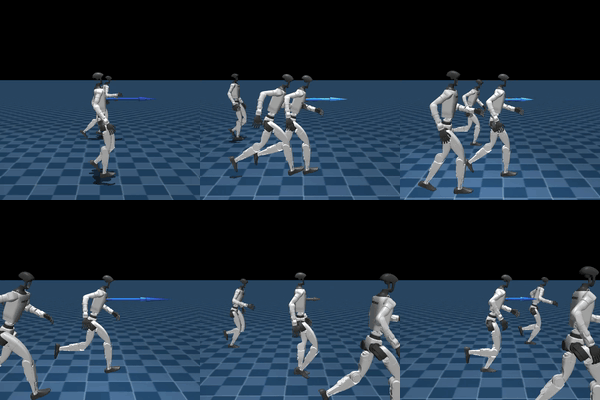 |
walk / jog / run at a commanded +x speed |
Smp-Steering-G1 |
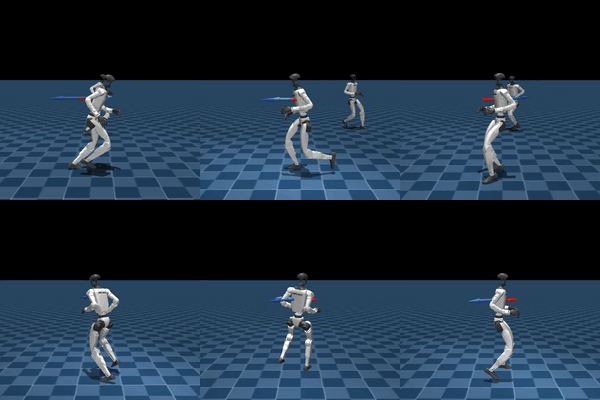 |
track a commanded velocity + facing direction |
Smp-Location-G1 |
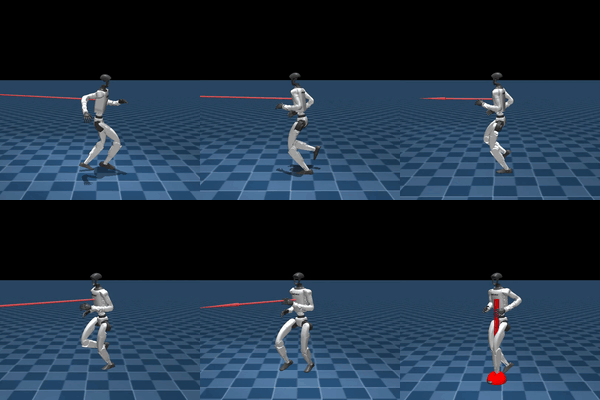 |
walk to a world-frame xy goal |
Smp-Getup-G1 |
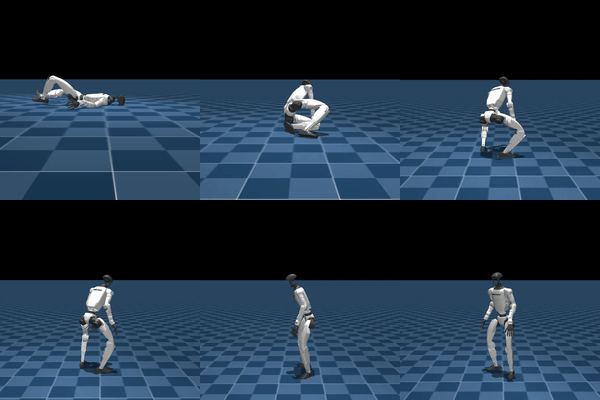 |
stand up from a fallen pose |
# Train (checkpoints land under logs/)
uv run scripts/train.py Smp-Forward-G1 --env.scene.num-envs=4096

# Play a trained policy from a W&B run
uv run scripts/play.py Smp-Forward-G1 --wandb-run-path <org>/<project>/<run> --num-envs 4
Swap the task id for any of the four. Because the priors are shipped and already wired into each env config, no editing is required before training.
Every task uses a single multiplicative reward term, task_smp_product:
r = ( Σᵢ wᵢ · taskᵢ(s) ) × r_smp(s)
where r_smp = exp(−wₛ/|K| · Σ_{i∈K} ‖ε̂_i − ε_i‖²) is the SDS guidance reward
(the frozen denoiser's ε-prediction error at a fixed set of diffusion timesteps
K, per-timestep normalized).
This is the key divergence from the original SMP / MimicKit, which combines
the two additively and balances them with separate weights
(task_reward_weight, smp_reward_weight):
# original (additive):     r = task_reward_weight · task  +  smp_reward_weight · r_smp
# here     (multiplicative): r = task · r_smp
We want the policy to complete the task while keeping the SMP reward high — which is exactly what a product expresses: it is large only when both factors are large, and collapses toward 0 if either drops. This makes reward tuning easier and more robust:
- No task-vs-prior weight to balance. The additive form needs a
task_reward_weight : smp_reward_weightratio whose sweet spot shifts per task (and per training stage); the product removes that knob entirely. - Neither term can be farmed alone. Additively, a policy can max one term and ignore the other — e.g. stand still looking natural (high prior, no task progress) or lunge at the goal off-manifold (high task, low prior). With the product both failure modes score ≈ 0, so the only way to earn reward is to do the task and stay on the motion manifold.
Per-task taskᵢ components (each weighted, summed, then gated by r_smp):
- Forward — velocity tracking only:
exp(−s·‖v_cmd − v_xy‖²), zeroed when the velocity projects backwards onto the target direction. Fixed+xheading, commanded speed 0.5–5 m/s. - Steering —
0.5·velocity tracking+ 0.5·facing alignmentmax(face_dir · heading, 0); randomized target direction + facing, speed 0.5–2 m/s. - Location — position tracking only:
exp(−s·‖xy_goal − xy_robot‖)toward a periodically resampled world-frame goal (usesws=4). - Get-up —
0.7·upward head velocity+ 0.3·head-height tracking, eachexp(−s·max(target − ·, 0)²), from a fallen GSI start.
On every reset, an init state is drawn from a pool of windows pre-sampled from the
frozen prior; its last frame seeds the sim state and the whole window primes the
online feature buffer, so r_smp is meaningful from step 0. Each env is reset to
its own scene origin while the feature buffer is kept env-origin-relative, so
the guidance reward is invariant to where the env sits in the world grid.
The guidance reward scores a rolling window of motion features rebuilt online by
smp.rl.utils.MotionFeatureBuffer, matching the pretraining layout (59-dim/frame
for G1), anchored to the last frame's yaw-only local frame:
[root_pos(3), root_rot(6), joint_pos(29), ee_pos(15), root_lin_vel(3), root_ang_vel(3)]
This repository reproduces SMP; please cite the original work and credit the reference implementation:
- SMP — Mu et al., Reusable Score-Matching Motion Priors for Physics-Based Character Control, 2025. arXiv:2512.03028
- MimicKit — the original SMP implementation: https://github.com/xbpeng/MimicKit
- mjlab — RL environment backbone: https://github.com/mujocolab/mjlab