A Multi-Layer Perceptron from scratch in pure C++ — no libraries, no magic, just math and memory management.




Synapse.cpp is a hand-rolled implementation of a Multi-Layer Perceptron (MLP) written in raw C++17. Every single operation — matrix multiplication, backpropagation, the Adam optimizer — is implemented from first principles. The only things used are <cmath> for exp, log, sqrt, and raw heap-allocated arrays for storage.
This is an educational reference implementation designed to be read and understood, not just used.
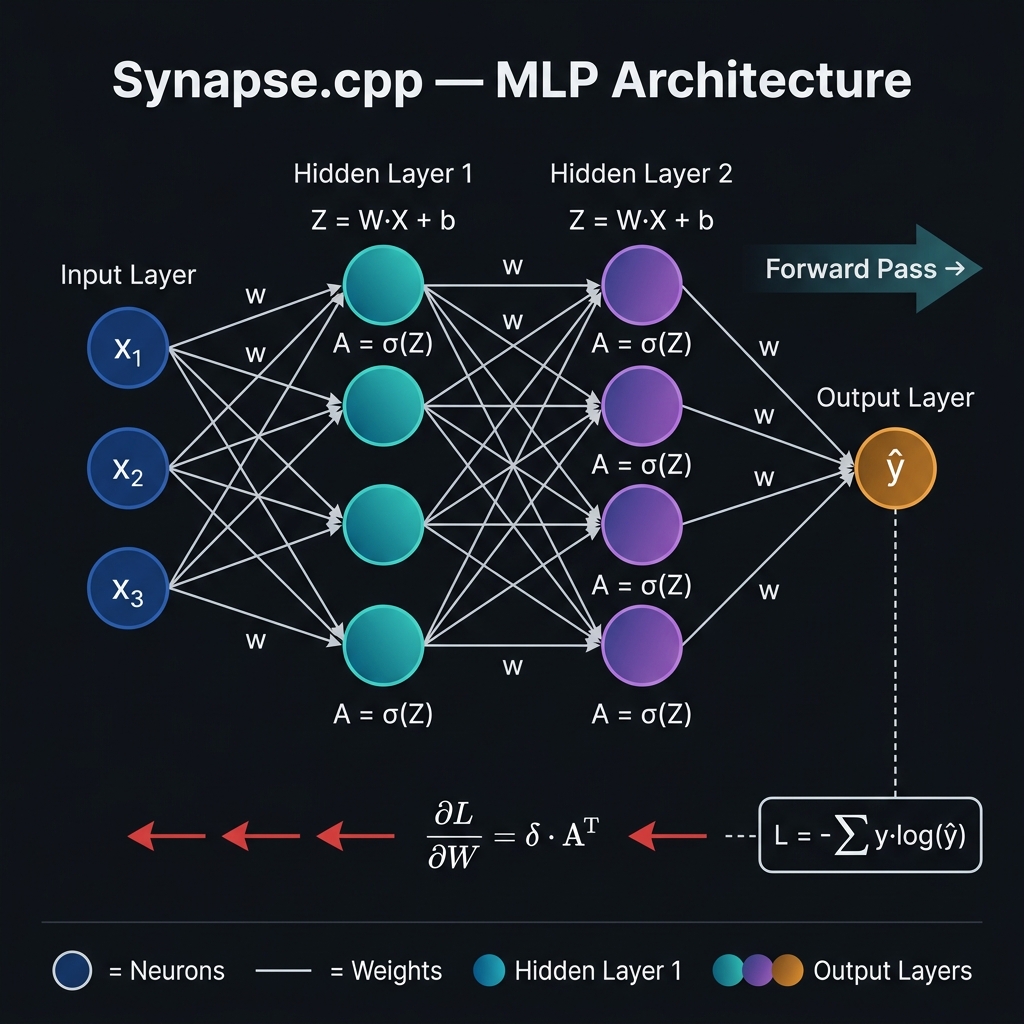
A single neuron receives inputs, multiplies each by a weight, sums them up, adds a bias, and passes the result through an activation function:
z = w₁x₁ + w₂x₂ + ... + wₙxₙ + b    (linear combination)
a = σ(z)                               (activation)
In matrix form for a whole layer processing a whole batch:
Z = X · W + b     (batch_size × units)
A = σ(Z)
An MLP chains multiple layers. Each layer's output A becomes the next layer's input X:
Layer 1:  Z¹ = X  · W¹ + b¹  →  A¹ = σ(Z¹)
Layer 2:  Z² = A¹ · W² + b²  →  A² = σ(Z²)
   ...
Output:   Ẑ  = Aᴸ⁻¹ · Wᴸ + bᴸ →  Ŷ = σ(Ẑ)
We measure how wrong the predictions are:
| Loss | Formula | Used For |
|---|---|---|
| MSE | L = (1/2n) Σ (ŷ - y)² |
Regression |
| Binary Cross-Entropy | L = -(1/n) Σ [y·log(p) + (1-y)·log(1-p)] |
Binary classification |
| Categorical Cross-Entropy | L = -(1/n) Σ Σ yᵢⱼ·log(p̂ᵢⱼ) |
Multi-class classification |
This is where the magic happens. We compute how much each weight contributed to the error using the chain rule of calculus — propagating gradients backward through the network.
Output layer gradient:
∂L/∂Z^L = Ŷ - Y (combined loss + activation gradient for BCE/CCE)
Hidden layer gradient (chain rule):
∂L/∂A^l   = ∂L/∂Z^(l+1) · (W^(l+1))ᵀ
∂L/∂Z^l   = ∂L/∂A^l  ⊙  σ'(Z^l)      (⊙ = element-wise)
∂L/∂W^l   = (A^(l-1))ᵀ · ∂L/∂Z^l
∂L/∂b^l   = Σ ∂L/∂Z^l   (sum over batch)
SGD with Momentum:
velocity = β·velocity - α·∇W
W        = W + velocity
Adam (Adaptive Moment Estimation):
m = β₁·m + (1-β₁)·∇W        (1st moment — mean)
v = β₂·v + (1-β₂)·∇W²       (2nd moment — variance)
m̂ = m/(1-β₁ᵗ)               (bias correction)
v̂ = v/(1-β₂ᵗ)
W = W - α · m̂/(√v̂ + ε)
flowchart TD
    A["🔢 Raw Input Data\n(batch_size × input_features)"]
    B["📊 Mini-Batch Sampler\nShuffle + slice indices"]
    C["⚡ Layer 1: Linear Transform\nZ¹ = X·W¹ + b¹"]
    D["🔀 Layer 1: Activation\nA¹ = ReLU(Z¹)"]
    E["🎲 Dropout Mask\nA¹ *= mask / keep_prob"]
    F["⚡ Layer 2: Linear Transform\nZ² = A¹·W² + b²"]
    G["🔀 Layer 2: Activation\nA² = ReLU(Z²)"]
    H["⚡ Output Layer\nẐ = A²·Wᴸ + bᴸ"]
    I["📤 Output Activation\nŶ = Sigmoid / Softmax / Linear"]
    J["📉 Loss Function\nL = BCE / MSE / CCE"]
    K["🔴 Backward Pass\n∂L/∂Ẑ = Ŷ - Y"]
    L["🔴 Propagate to Layer 2\n∂L/∂Z² = δ·W^T ⊙ σ'(Z²)"]
    M["📐 Compute Gradients\n∂L/∂W = Aᵀ·δ\n∂L/∂b = Σδ"]
    N["⚙️ Adam / SGD Update\nW -= α · m̂/√v̂"]
    O["✅ Convergence Check\nLoss below threshold?"]

    A --> B --> C --> D --> E --> F --> G --> H --> I --> J
    J --> K --> L --> M --> N --> O
    O -->|No — next epoch| B
    O -->|Yes| P["🎉 Trained Model\nReady for inference"]

    style A fill:#1e3a5f,color:#fff
    style J fill:#5f1e1e,color:#fff
    style K fill:#5f1e1e,color:#fff
    style L fill:#5f1e1e,color:#fff
    style M fill:#5f1e1e,color:#fff
    style P fill:#1e5f2a,color:#fff
    style N fill:#4a1e5f,color:#fff
graph LR
    subgraph Activations["Activation Functions"]
        R["🟦 ReLU\nmax(0, z)\nHidden layers"]
        LR["🟪 Leaky ReLU\nmax(0.01z, z)\nAvoids dying ReLU"]
        S["🟨 Sigmoid\n1/(1+e⁻ᶻ)\nBinary output"]
        T["🟩 Tanh\n(eᶻ-e⁻ᶻ)/(eᶻ+e⁻ᶻ)\nRegression hidden"]
        SM["🟥 Softmax\neᶻⁱ/Σeᶻʲ\nMulti-class output"]
        LN["⬜ Linear\nz\nRegression output"]
    end
| Method | Formula | Best For |
|---|---|---|
| Xavier Uniform | U[-√(6/(fᵢₙ+fₒᵤₜ)), +√(6/(fᵢₙ+fₒᵤₜ))] |
Sigmoid / Tanh |
| He Normal | N(0, √(2/fᵢₙ)) |
ReLU layers |
| Random Uniform | U[-0.5, 0.5] |
Quick experiments |
| Random Normal | N(0, 0.01) |
Small-scale nets |
Synapse.cpp/
├── Matrix.hpp      ← Matrix class declaration (all operations)
├── Matrix.cpp      ← Matrix implementation (dot, broadcast, init...)
├── MLP.hpp         ← MLP class: layers, configs, enums
├── MLP.cpp         ← Full forward pass, backprop, Adam, SGD, training loop
├── main.cpp        ← 4 live demos: XOR, Circle, Sine, Blobs
└── README.md       ← You are here
Requirements: Any C++17-compatible compiler (GCC, Clang, MSVC).
# Compile
g++ -O2 -std=c++17 main.cpp Matrix.cpp MLP.cpp -o synapse

# Run all 4 demos
./synapse

# Windows
g++ -O2 -std=c++17 main.cpp Matrix.cpp MLP.cpp -o synapse.exe
.\synapse.exeThe XOR function is not linearly separable (no single line can divide the classes). A two-layer MLP solves it perfectly.
| Input | Expected | Predicted |
|---|---|---|
| (0, 0) | 0 | ≈ 0.01 |
| (0, 1) | 1 | ≈ 0.99 |
| (1, 0) | 1 | ≈ 0.99 |
| (1, 1) | 0 | ≈ 0.02 |
- Architecture:
2 → 8 → 1 - Loss: Binary Cross-Entropy
- Optimizer: Adam
Points inside radius 0.6 → class 1. Non-linear boundary requires multiple layers.
- Architecture:
2 → 16 → 8 → 1 - Expected accuracy: ~98%
Approximate f(x) = sin(2πx) + noise from 300 noisy samples.
- Architecture:
1 → 64 → 64 → 1(Tanh hidden, Linear output) - Expected MSE:
< 5×10⁻⁴
Three overlapping Gaussian clusters. Tests Softmax + Categorical Cross-Entropy.
- Architecture:
2 → 32 → 16 → 3 - Expected accuracy: ~99%
| Feature | Status |
|---|---|
| Arbitrary depth & width | ✅ |
| ReLU, Leaky-ReLU, Sigmoid, Tanh, Softmax | ✅ |
| Linear activation (regression) | ✅ |
| MSE loss | ✅ |
| Binary Cross-Entropy loss | ✅ |
| Categorical Cross-Entropy loss | ✅ |
| SGD with momentum | ✅ |
| Adam optimizer | ✅ |
| Xavier weight init | ✅ |
| He weight init | ✅ |
| Dropout regularisation | ✅ |
| Gradient clipping | ✅ |
| Mini-batch training | ✅ |
| Numerically stable softmax | ✅ |
| Bias-corrected Adam | ✅ |
| Training / eval mode | ✅ |
| Accuracy metric | ✅ |
| Loss history tracking | ✅ |
| Model summary printer | ✅ |
| Zero external dependencies | ✅ |
The Matrix class at the heart of Synapse.cpp implements:
- Storage: flat
double*array (row-major), allocated withnew[] - Ownership: RAII — destructor calls
delete[], copy constructor deep-copies - Move semantics:
Matrix(Matrix&&)transfers ownership without copying - Operations:
+,-,*(element-wise),dot()(matmul),transpose(),broadcastAdd(),sum(axis),mean(axis),exp(),log(),clip(),argmax() - Init: Xavier uniform, He normal, random uniform, random normal (Box-Muller)
L = (1/2n) ||Ŷ - Y||²

∂L/∂Ŷ  = (Ŷ - Y)/n                    ← output gradient

For layer l (going backwards):
∂L/∂Zˡ = ∂L/∂Aˡ ⊙ σ'(Zˡ)            ← activation gradient
∂L/∂Wˡ = (Aˡ⁻¹)ᵀ · ∂L/∂Zˡ           ← weight gradient
∂L/∂bˡ = Σᵢ ∂L/∂Zˡᵢ                  ← bias gradient (sum over batch)
∂L/∂Aˡ⁻¹ = ∂L/∂Zˡ · (Wˡ)ᵀ           ← propagate to previous layer
t ← t + 1
mᵥᵥ ← β₁·mᵥᵥ + (1-β₁)·∇W
vᵥᵥ ← β₂·vᵥᵥ + (1-β₂)·∇W²
m̂   ← mᵥᵥ / (1 - β₁ᵗ)
v̂   ← vᵥᵥ / (1 - β₂ᵗ)
W   ← W - α · m̂ / (√v̂ + ε)

Defaults: β₁=0.9, β₂=0.999, ε=1e-8
MIT — see LICENSE.
Built entirely from scratch. No PyTorch. No TensorFlow. No Eigen. Just C++.