
- Mines parameters from web archives (Wayback Machine) without touching the target host
- Discovers parameters from subdomains by default
- Supports JSON output for tool chaining (
--json) - Pipes results directly to stdout (
--stdout) for use withhttpx,nuclei,grep, etc. - Excludes URLs by file extension (
--exclude) - Finds nested parameters (
--level high) - Custom placeholder string (
--placeholder) - Connection pooling for faster retries
- Retry logic with configurable attempts
Requires: Python 3.8+

$ git clone https://github.com/viphacker100/ParamSpider
$ cd ParamSpider
$ pip install -r requirements.txt
$ python paramspider.py --domain hackerone.com
1 - Simple scan (includes subdomains by default)
$ python paramspider.py --domain hackerone.com
-> Output: https://hackerone.com/test.php?q=FUZZ

2 - Exclude URLs with specific extensions
$ python paramspider.py --domain hackerone.com --exclude php,jpg,svg

3 - Find nested parameters
$ python paramspider.py --domain hackerone.com --level high
-> Output: https://hackerone.com/test.php?p=test&q=FUZZ

4 - Save results to a file
$ python paramspider.py --domain hackerone.com --exclude php,jpg --output hackerone.txt

5 - Custom placeholder (default is FUZZ)
$ python paramspider.py --domain hackerone.com --placeholder CUSTOM

6 - Quiet mode (suppress console output)
$ python paramspider.py --domain hackerone.com --quiet

7 - Exclude subdomains
$ python paramspider.py --domain hackerone.com --subs false

8 - Retry failed requests
$ python paramspider.py --domain hackerone.com --retries 5

9 - JSON output (for tool chaining)
$ python paramspider.py --domain hackerone.com --json
-> Output: {"domain": "hackerone.com", "parameters": [...], "count": 123}

10 - Pipe to stdout only (no file saved)
$ python paramspider.py --domain hackerone.com --stdout

11 - Pipe JSON to stdout (for httpx, nuclei, etc.)
$ python paramspider.py --domain hackerone.com --json --stdout | httpx -silent
$ python paramspider.py --domain hackerone.com --json --stdout | nuclei -t params.yaml

12 - Version check
$ python paramspider.py --version
| Flag | Description | Default |
|---|---|---|
-d, --domain |
Target domain (required) | — |
-s, --subs |
Include subdomains (true/false) |
true |
-l, --level |
high for nested parameters |
— |
-e, --exclude |
Comma-separated extensions to skip | — |
-o, --output |
Output filename | output/{domain}.txt |
-p, --placeholder |
Placeholder string for parameter values | FUZZ |
-q, --quiet |
Suppress console output | false |
-r, --retries |
Number of retries on error | 3 |
--json |
Output in JSON format | false |
--stdout |
Print to stdout only (no file) | false |
--version |
Show version | — |
Let's say you have already installed ParamSpider and now you want to filter out the juicy parameters from plethora of parameters. No worries you can easily do it using GF(by tomnomnom).
Note: Make sure you have go properly installed on your machine.
Follow along this:
$ go get -u github.com/tomnomnom/gf
$ cp -r $GOPATH/src/github.com/tomnomnom/gf/examples ~/.gf

Note: Replace '/User/levi/go/bin/gf' with the path where gf binary is located in your system.

$ alias gf='/User/levi/go/bin/gf'
$ cd ~/.gf/

Note: Paste JSON files(https://github.com/0xKayala/ParamSpider/tree/master/gf_profiles) in ~/.gf/ folder

Now run ParamSpider and navigate to the output directory

$ gf redirect domain.txt   # for potential open redirect/SSRF parameters
$ gf xss domain.txt        # for potential xss vulnerable parameters
$ gf potential domain.txt  # for xss + ssrf + open redirect parameters
$ gf wordpress domain.txt  # for wordpress urls
$ python paramspider.py --domain bugcrowd.com --exclude woff,css,js,png,svg,php,jpg --output bugcrowd.txt
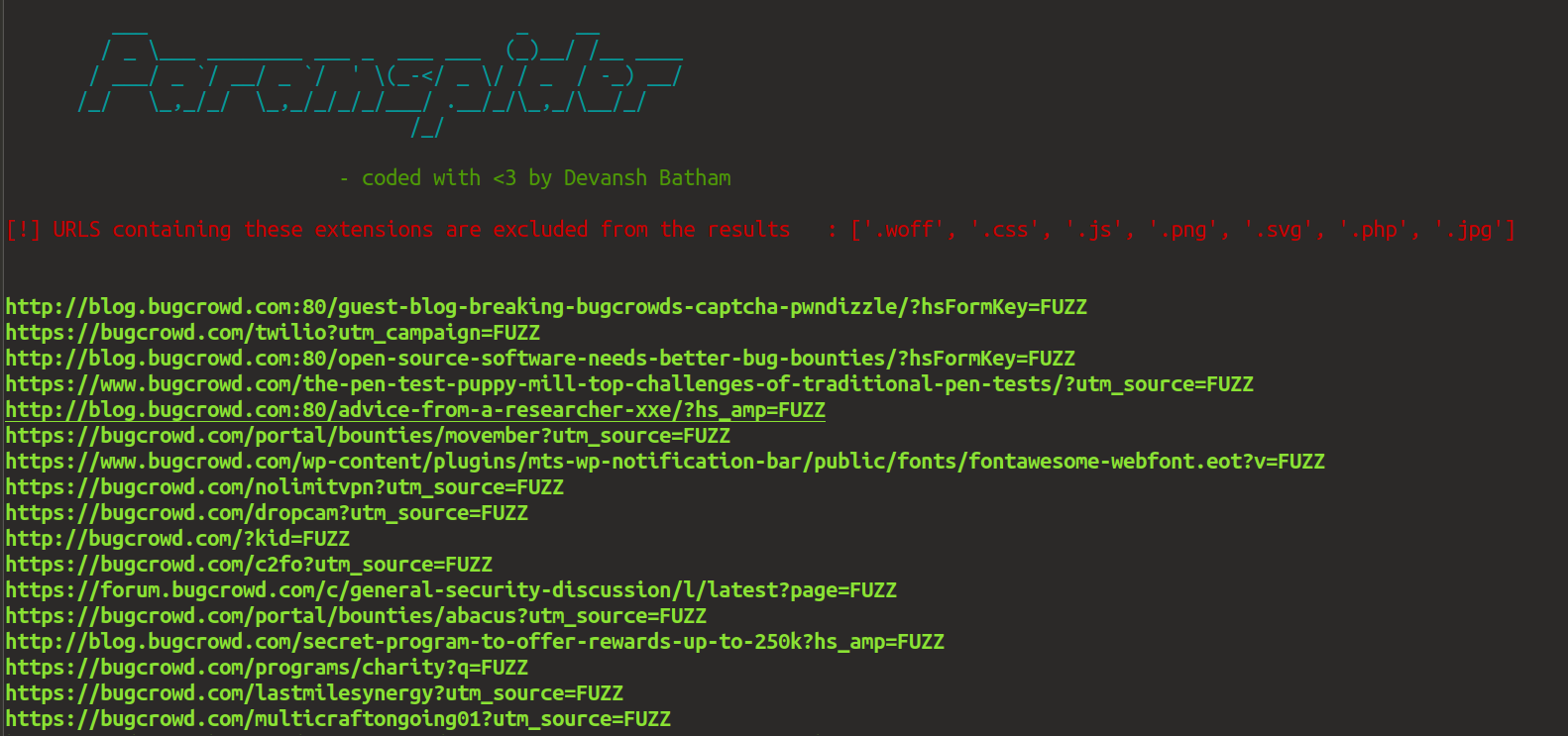
As it fetches the parameters from web archive data,
so chances of false positives are high.
- Report bugs, missing best practices
- Shoot my DM with new ideas
- Make more GF profiles (.json files)
- Help in Fixing bugs
- Submit Pull requests
Say hello: 0xAsm0d3us