
Network-aware payment-abuse detection, with evidence an analyst can inspect.
Coordinated abuse can hide inside individually ordinary payments. RiskWeave connects transactions through shared infrastructure and activity patterns, ranks suspicious candidate rings, and makes the relationships, timeline, and financial exposure reviewable.
Evidence, not verdicts. This is a working local analyst product with a synthetic-trained detector—not a real-payment-validated fraud service. No GNN or paid API key is required.
Previously branded RingSentinel. The internal ringsentinel package, CLI commands,
configuration names, API paths, and historical benchmark artifacts are unchanged.

Quick start · Screenshots · Validation · Watch demo
- Find coordinated activity: combines transaction, infrastructure-sharing, temporal, and structural graph features in a histogram-gradient-boosting model.
- Keep investigations reproducible: upload a validated dataset, run asynchronous analysis, and revisit saved findings with input/result checksums and run history.
- Inspect evidence: explore explicit network links, shared resources, merchant relationships, event timelines, and candidate-associated exposure.
- Ask grounded questions: the investigator cites computed facts. An optional LLM can select/order those facts; it cannot invent evidence or change detection decisions.
- Compare simpler approaches: a separate demo/replay workspace includes measured transaction and graph baselines, feature ablations, and legitimate hard-negative communities.
This helps an analyst move from a suspicious score to a reviewable case, while making the limits of the evidence visible.
Create investigation → upload DatasetBundle → run analysis → review candidate rings → inspect graph/evidence → read grounded investigator summary.
The main workspace analyzes an uploaded dataset retrospectively. The separate /demo route
replays synthetic events chronologically; it is not a live payment integration.

flowchart TB
    UI[Analyst frontend] --> API[FastAPI: owner-scoped API]
    API --> RUN[Investigation and run lifecycle]
    RUN --> DET[Causal features and network-aware detector]
    DET --> EV[Candidate rings and computed evidence]
    RUN <--> DB[(Database: cases and run metadata)]
    EV <--> STORE[(Local storage: inputs and results)]
    EV --> API
    API --> INV[Grounded investigator]
    INV -. optional fact selection .-> LLM[LLM provider]
    INV --> ANSWER[Cited deterministic statements]
    ANSWER --> UI
The detector scores events and groups candidates. The evidence service exposes only computed graph/event information. The investigator explains that evidence using cited, server-rendered statements—not free-form model-written findings.
Stack: Python, FastAPI, Pydantic, scikit-learn, NetworkX, SQLAlchemy/Alembic; React/TypeScript, Vinext, Tailwind/shadcn, Cytoscape; pytest, Playwright, Ruff, Oxlint. Local startup uses SQLite and filesystem storage. PostgreSQL support exists, but live PostgreSQL/container verification remains outstanding. See architecture.
Prerequisites: a repository checkout, Python 3.11+, uv, and Node.js 22.13+ with npm. The latest local verification used Python 3.14.6 and Node.js 24.19. Run from the repository root.
Terminal 1 — install, migrate, and start the backend:
uv sync --locked --extra dev
uv run --locked ringsentinel-migrate
uv run --locked ringsentinel-api
Terminal 2 — install and start the frontend:
cd frontend
npm ci
npm run dev
Open the analyst workspace. API documentation is available in development mode.
Terminal 3 — generate a reproducible upload from the repository root:
uv run --locked python scripts/make_upload_sample.py --output work/sample.json --transactions 1000 --seed 105Create an investigation, select work/sample.json, click Upload dataset, then Start
analysis. Wait for Completed, open a candidate, and try Network, Evidence, Timeline,
and Investigator. Sample creation refuses to overwrite an existing file; reuse it or
choose another output filename. First analysis may take tens of seconds on a laptop.
No .env or API key is needed. Defaults use local development identity, SQLite at
work/ringsentinel.db, and objects at work/storage. Keep both servers on loopback.
.env.example documents settings but is not automatically loaded; pre-existing shell
overrides still apply. Ingestion accepts a complete DatasetBundle JSON, not arbitrary CSV
or a single exported table. See data contract.
For build/preview commands, browser dependencies, and troubleshooting, see local setup. Do not expose development identity to a network.
Phase 3 used five held-out synthetic ecosystems (seeds 101–105; 5,000 payments each, plus refunds). Each fold trained on three seeds, selected its threshold on another, and tested on the fifth. These are preserved experiment results, not a new Phase 6 benchmark run.
| Model | Precision | Recall | F1 | PR-AUC |
|---|---|---|---|---|
| Transaction rules | 0.126 | 0.058 | 0.080 | 0.056 |
| Transaction-only HGB | 0.627 | 0.154 | 0.243 | 0.199 |
| Static graph heuristic | 0.331 | 0.287 | 0.307 | 0.321 |
| Network-aware HGB | 0.964 | 0.939 | 0.951 | 0.971 |
Values are fold means. Network PR-AUC was 0.971 ± 0.005; ring detection was 50/50 under the benchmark's matching definition—not perfect member recovery. Exposure mean relative error was 8.14%, with 4.44% aggregate underestimation. Detection and exposure accuracy are separate measures.
The leakage audit found and corrected an unrealistic merchant-history shortcut; PR-AUC fell from 0.979 to 0.971. Held-out merchant collusion was weaker and variable (0.803 ± 0.143 PR-AUC). Full ablations, false-positive rates, distributions, and weak results remain in the measured report, JSON artifact, and methodology.
Submission checks: 94 Python tests, 27 frontend tests, Ruff, frontend lint, TypeScript, and production build passed. Verification details record the date, warnings, preserved SHA-256, and separately dated dependency audits.
From the root:
uv run --locked --extra dev pytest -q
uv run --locked --extra dev ruff check .
With both local servers running in the default deterministic investigator mode,
run in frontend:
npx playwright install chromium
npm test
npm run lint
npm run typecheck
npm run build
Browser tests create local test investigations; use a separate local database/storage pair to keep your presentation worklist uncluttered. See setup details.
- Synthetic-trained and synthetic-evaluated only. Distribution shift and real-payment performance are unknown; model scores are not calibrated fraud probabilities.
- Shared infrastructure can be legitimate. Candidates need human review; the application does not establish guilt or recommend automatic blocking.
- Exposure is candidate-associated value, not confirmed loss. Refund value replaces purchase value for the same original payment; synthetic expected-loss rates are assumptions.
- The investigator cannot establish model causality from an observed link. Default mode is visibly deterministic; optional paid-provider integration has not been live-verified.
- This is a single-host/local-storage foundation, not production approval. JWT verification is implemented, but real identity-gateway/TLS integration and live infrastructure checks remain unverified. Vinext is beta. See Phase 5C verification and gates.
src/ringsentinel/  Generation, features, detection, evaluation, evidence,
                  simulation, API, and persisted investigation lifecycle
frontend/         Analyst workspace and browser tests
tests/            Python unit and integration tests
scripts/          Validated upload sample and local API smoke test
results/phase3/   Frozen measured benchmark JSON and report
docs/             Setup, architecture, methodology, security history, screenshots
docs/demo-script.md  2–4 minute recording plan
Start with local setup, screenshot gallery, or the documentation index. Historical reports and Phase 2 artifacts are retained.
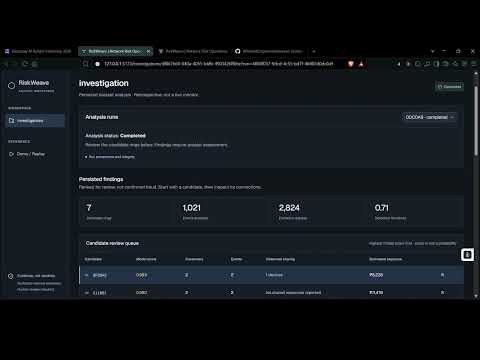
Watch the RiskWeave demo on YouTube. The recording script is also available for reference. No hosted application deployment is claimed.
Suggested GitHub description and topics are in submission metadata. Licensed under the existing MIT License, credited to RingSentinel contributors.