PDO API foundations #291
PDO API foundations #291
Conversation


 JanJakes
force-pushed
the
pdo-api
branch
8 times, most recently
from
JanJakes
force-pushed
the
pdo-api
branch
8 times, most recently
from
fd4cc59 to
c02c987
Compare
JanJakes
force-pushed
the
pdo-api
branch
9 times, most recently
from
12df654 to
9e8e453
Compare

Extracting smaller chunks from
#291 so we
can review and merge them independently.

This PR includes the following changes:
- Removed support for nested transactions. MySQL doesn't support them.
- Implemented PDO-like APIs for start transaction, commit, and rollback.
- The PDO-like APIs differ from an equivalent SQL command in that they
always throw an exception in scenarios when a transaction was already
started or not yet started (depending on the method), irrespective of
the `ATTR_ERRMODE` setting.
- Polyfill `PDO::inTransaction()` on PHP < 8.4, where it is not reliable
([issue](https://bugs.php.net/bug.php?id=81227),
[PR](php/php-src#14268)).

Extracting smaller chunks from
#291 so we
can review and merge them independently.

This PR adds `Table` column to `SHOW CREATE TABLE` statements, [as per
MySQL behavior](https://onecompiler.com/mysql/447x6gea7).
Extracting smaller chunks from
#291 so we
can review and merge them independently.

This PR renames the current `WP_SQLite_Driver` to
`WP_PDO_MySQL_On_SQLite` and reintroduces the `WP_SQLite_Driver` as a
simple proxy over the new renamed class. It's done in these two steps
(first rename, then reintroduce) so that Git understands the rename and
presents history (hopefully) accurately.

The changes are better understood in a commit-by-commit view.

#### `WP_PDO_MySQL_On_SQLite` vs `WP_SQLite_Driver`
The "reintroduced" `WP_SQLite_Driver` is not meant to be permanent. It
is a temporary proxy so we can gradually modify `WP_PDO_MySQL_On_SQLite`
to support PDO APIs while not touching the driver API just yet. Once the
basics of PDO API are in place, we can make all dependencies use the new
class directly and then remove the `WP_SQLite_Driver`.

That is, in the future, the `WP_SQLite_DB extends wpdb` will use
directly the new `WP_PDO_MySQL_On_SQLite` class.
JanJakes
force-pushed
the
pdo-api
branch
2 times, most recently
from
5fe6619 to
4aadd4e
Compare
There was a problem hiding this comment.
This implies we're always loading the full result set into memory. Do we have to do that? I worry we could blow up memory on some large queries.
There was a problem hiding this comment.
Do we have to do that?
@adamziel In most cases, fortunately not. But in some, when we construct the result in PHP (things like SHOW GRANTS, etc.), we need to have a "synthetic" statement that is implementing the PDO API on top of PHP arrays.
For all statements where a MySQL statement corresponds to an SQLite statement, it will be better to use a "proxy" statement. We can't use the SQLite statement directly because some things like column metadata formats differ, but we can use a proxy to avoid loading all results into memory. I actually have a class-wp-pdo-proxy-statement.php in a WIP commit, but I'll probably extract it to a follow-up PR. Here's why I think it's fine:
In the first step, we can use the synthetic statement for everything because 1) the current driver already stores everything in memory ($this->last_result, etc.), and 2) $wpdb loads everything in memory as well. So I think I can complete this PR with the "synthetic" statement, and then in the next PR, I would replace all the $this->last_something props with a single $this->last_result_statement that we would use as the proxy target.
There was a problem hiding this comment.
(things like SHOW GRANTS, etc.),
I don't suppose we would ever see a 100 megabyte result set in those so that seems fine.
In the first step, we can use the synthetic statement for everything because 1) the current driver already stores everything in memory ($this->last_result, etc.), and 2) $wpdb loads everything in memory as well. So I think I can complete this PR with the "synthetic" statement, and then in the next PR, I would replace all the $this->last_something props with a single $this->last_result_statement that we would use as the proxy target.
That sounds good. For Playground, the database is in memory anyway so it's not a big deal. It will matter when a larger site wants to adapt this driver, and perhaps we're reasonably close to having a technical ability to do it with all the MySQL queries we support. Not a huge priority, but it would be nice to briefly document in a docstring that yes, this is possible and here's what needs to happen technically.
|
@adamziel I think this one is ready for a final round. In the end, it only needs a I left many methods with |
| $this->assertInstanceOf( PDO::class, $driver ); | ||
| } | ||
|
|
||
| public function test_dsn_parsing(): void { |
There was a problem hiding this comment.
thank you for these tests!
|
|
||
| // Create a new SQLite connection. | ||
| if ( isset( $options['pdo'] ) ) { | ||
| $this->connection = new WP_SQLite_Connection( array( 'pdo' => $options['pdo'] ) ); |
There was a problem hiding this comment.
Hm, so we can pass both the dsn and $options['pdo']? And the dsn is still validated and parsed in that case? Shouldn't we throw an error when both are passed here?
There was a problem hiding this comment.
@adamziel This allows passing the underlying PDO SQLite instance, not the one we're parsing the options for.
While in theory, it can make some sense to support it (new WP_PDO_MySQL_On_SQLite( 'mysql-on-sqlite:dbname=test', [ 'pdo' => $my_pdo ] )), I'm not sure if we should keep it, and if we do, a better name for that option would probably make sense.
| return $type; | ||
| }; | ||
|
|
||
| if ( null === $fetch_mode ) { |
There was a problem hiding this comment.
Sooo, now that we delegate the logic to PDO, do we need to validate all of that here? Or could we also rely on PDO validation?
There was a problem hiding this comment.
@adamziel Unfortunately, not here. We delegate the PDOStatement API to SQLite PDO, but not the PDO::query(), where we need more granular control over what queries and how many (if any) we execute.
| * | ||
| * From MySQL documentation: | ||
| * | ||
| * In the absence of the SQL_CALC_FOUND_ROWS option in the most |
There was a problem hiding this comment.
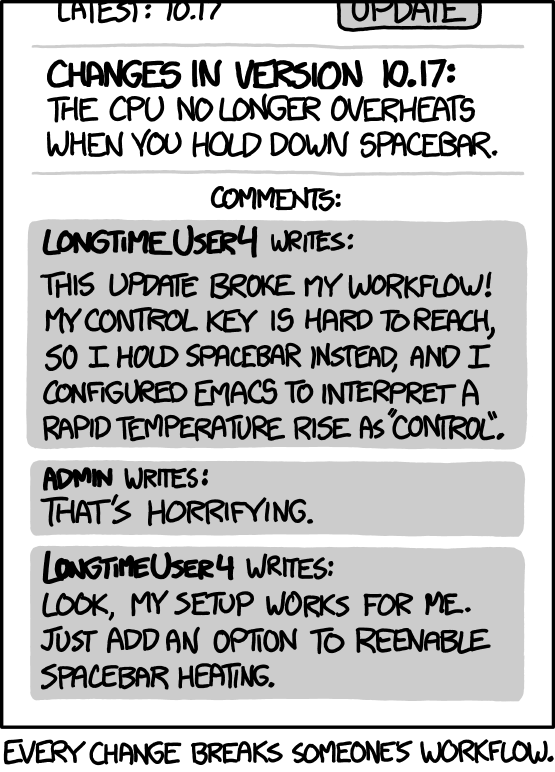
I hope noone out there actually relies on that behavior, but some plugins probably do. Obligatory xkcd:
There was a problem hiding this comment.
@adamziel True true 😬😂 I took a stab at it here: 3c8543b
I think that implementation does the > 99% case.
It's not 100%, because calling FOUND_ROWS() multiple times in a row will not necessarily give correct results. And then I also discovered this:
I also found this strange nuance:

But we never supported these edge cases anyway.
 adamziel
left a comment
adamziel
left a comment
adamziel
left a comment
There was a problem hiding this comment.
I only have nitpicks. Really good work here, it's exciting to see how this is coming together. If you asked me a few years ago, I would have never guessed we'd be doing anything like this and yet here we are ❤️

Co-authored-by: Adam Zieliński <adam@adamziel.com>
|
@adamziel Thanks for the great review, as always. Another round should be ready now ✅ |
| $this->quote_sqlite_identifier( $statistics_table ), | ||
| $this->connection->quote( $this->get_saved_db_name( $database ) ), |
There was a problem hiding this comment.
interesting, why do we need two quoting functions?
There was a problem hiding this comment.
aha, one is for identifiers and another is for string values, and also this is no longer a prepared statement? Why ditch prepared statements here?
There was a problem hiding this comment.
This would communicate the data flow right away:
$this->quote_sqlite_identifier( $statistics_table ),
$this->quote_sqlite_value( $this->get_saved_db_name( $database ) );

This PR implements foundational PDO APIs and uses them in the existing
WP_SQLite_Driverclass.The changes are best understood commit-by-commit, and they include the following:
WP_PDO_MySQL_On_SQLiteextendPDO.PDO::exec()API.PDO::query()API.PDOStatementAPI for in-memory data (operating on PHP arrays) asWP_PDO_Synthetic_Statement. This is required forPDO::query()that must return aPDOStatementinstance.PDOStatement::fetch()andPDOStatement::fetchAll()with the most common PDO fetch modes.PDOandPDOStatementgetAttribute()andsetAttribute()methods.PDOStatement::setFetchMode().Synthetic vs. proxy PDO statement
This initial work implements only a
WP_PDO_Synthetic_Statementthat requires the full PDO statement result set to be loaded in memory. This makes it easier to implement a gradual transition to the PDO API (the current driver loads all result sets in memory as well) and it can support all statement types, including those that are composed on the PHP side.In a follow-up work, it should be possible to transition most statement types to a proxy-like PDO statement that would internally use PDO SQLite statements directly, without eagerly fetching all data. The proxy will be required to address incompatibilities between SQLite and MySQL statements.
Next steps
Subsequent PRs will focus on the following:
PDOandPDOStatementAPIs.WP_PDO_Proxy_Statementas described above.