Deterministic audit of the numbers in your LaTeX manuscript against the experiment artifacts that produced them.


English · 简体中文

- Reads the
.texyou already have. No rewriting, no new build system. - Deterministic. No model in the loop; the same input always gives the same verdict.
- Fails closed. A number nobody accounted for is an error, not silence.
- Made for CI. Stable exit codes, machine-readable output, one runtime dependency.
Contents · Quickstart · How it works · Adopting it · The three commands · Tolerance · Fail-closed · CI · Agents · Comparison · Reference
Someone reruns the experiment and updates Section V:
  \section{Evaluation}
- FastCache improves end-to-end throughput by 12.7\% over the tuned baseline.
+ FastCache improves end-to-end throughput by 13.7\% over the tuned baseline.
The abstract still says 12.7. Nothing else in a LaTeX toolchain will tell you:
$ texclaims check
PASS     headline-improvement paper.tex:6 claimed=12.7 expected=12.73421 tol=0.05
FAIL     headline-improvement paper.tex:10 claimed=13.7 expected=12.73421 tol=0.05 :: |claimed - expected| = 0.96579 exceeds display-precision tolerance
== 8 PASS, 1 FAIL, 0 MISS, 0 UNMAPPED, 1 WAIVED — FAIL ==
$ echo $?
1
One claim, two places, one of them now wrong. It knows the number should be
12.73421 because the ledger says where it comes from:
sources:
  summary: results/summary.json                    # an experiment artifact

claims:
  - name: headline-improvement
    file: paper.tex
    anchor: { template: 'throughput by {num}\%' }  # the sentence in the manuscript
    expect: 2                                      # it appears twice; both must agree
    value: 'summary:.improvement.throughput_pct'   # -> 12.73421
Everything above is examples/demo. The alternatives all ask
for something you may not want to give:
| Existing answer | What it asks of you |
|---|---|
| Literate programming (knitr, Quarto, showyourwork) | Rewrite the paper in its format, adopt its build system |
| LLM auditors | Trust a probabilistic reviewer as a gate — SciCoQA puts the best evaluated models under half on real-world discrepancies in the neighbouring paper-vs-code task |
| Artifact evaluation (ACM/IEEE, CODECHECK) | Only that the code runs; guidelines tolerate numeric drift |
$ git clone https://github.com/YYYJH1/texclaims && cd texclaims
$ pip install -e .          # not on PyPI yet; CI should pin a tag, see below
$ cd examples/demo
$ texclaims check --ledger claims.yaml
PASS     headline-improvement paper.tex:6 claimed=12.7 expected=12.73421 tol=0.05
PASS     headline-improvement paper.tex:10 claimed=12.7 expected=12.73421 tol=0.05
PASS     latency-row#g1 paper.tex:11 claimed=4.87 expected=4.8659 tol=0.005
PASS     latency-row#g2 paper.tex:11 claimed=0.51 expected=0.5121 tol=0.005
PASS     latency-row#g3 paper.tex:11 claimed=3.21 expected=3.2114 tol=0.005
PASS     latency-row#g4 paper.tex:11 claimed=0.44 expected=0.4432 tol=0.005
PASS     hit-rate paper.tex:12 claimed=94.2 expected=94.218 tol=0.05
PASS     seed-count paper.tex:6 claimed=5 expected=5 tol=0.5
PASS     seed-count paper.tex:12 claimed=5 expected=5 tol=0.5
== 9 PASS, 0 FAIL, 0 MISS, 0 UNMAPPED, 1 WAIVED — OK ==
Python 3.10+, one runtime dependency (PyYAML). Start your own ledger with
texclaims init --doc main.tex.
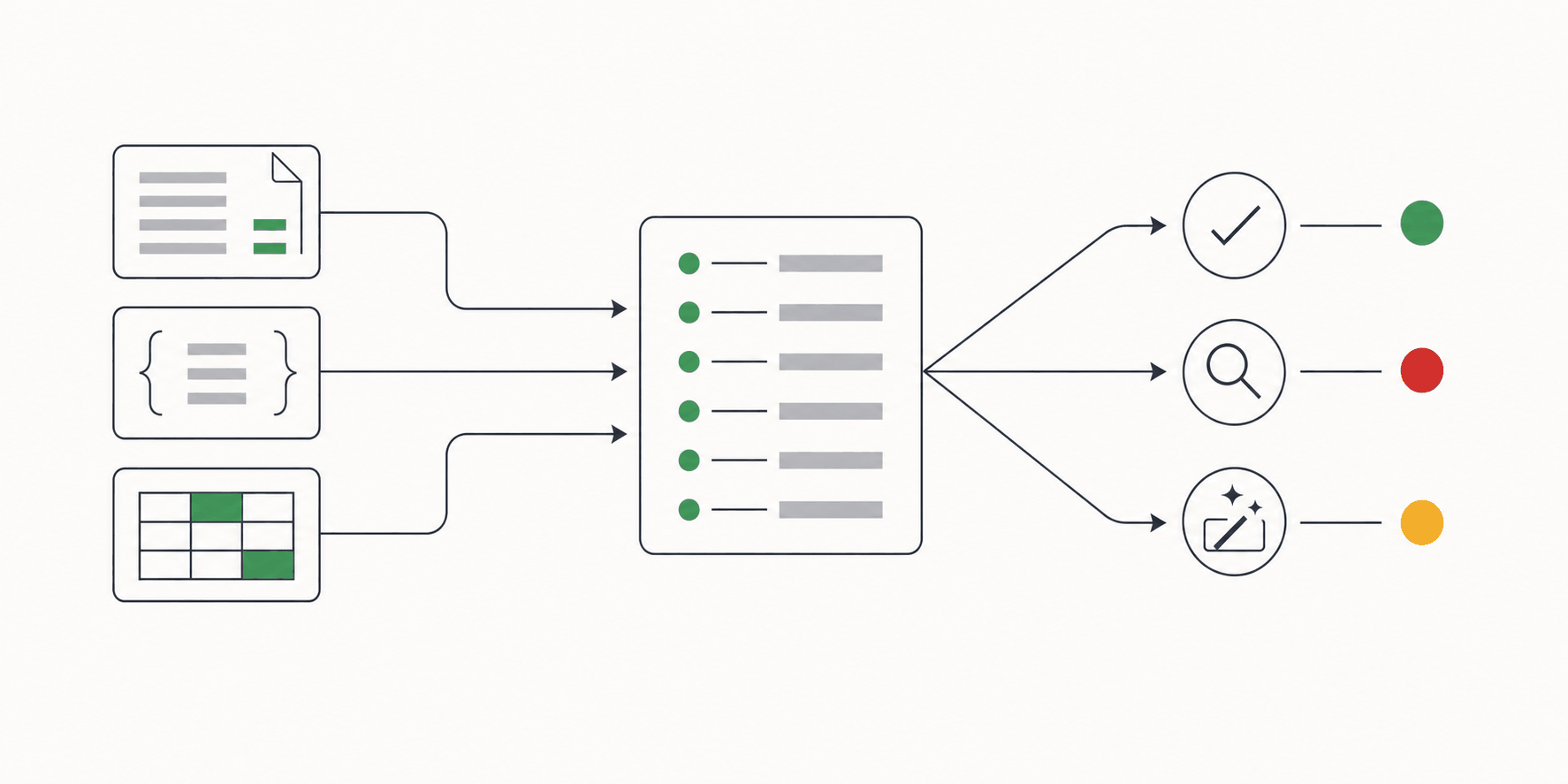
Your manuscript and your result files meet in one place: a YAML ledger that binds each reported number to the exact artifact field it came from. Three commands read that ledger, and each answers a different question.
| Command | What it establishes |
|---|---|
texclaims check |
Every number the ledger claims agrees with its artifact. |
texclaims scan --strict |
Every number in the declared regions is claimed by the ledger. |
texclaims generate |
New prose never hand-copies a number in the first place. |
check proves the mapped numbers are right. scan proves you did not forget
to map one. Either alone leaves a gap; together they close the loop.
Exit codes are the interface: 0 clean, 1 a number or the prose is wrong, 2 the ledger is wrong. CI can tell those apart.
Records use PASS, FAIL, MISS, or UNMAPPED and go to stdout; warnings
and the summary go to stderr. The summary's WAIVED counter counts number
occurrences covered by exemptions. It adds no per-number records and does not
affect the exit code. For completed audits, JSON includes the same total under
summary.WAIVED and counts by exemption name under waived, so a broad waiver
is visible.
With --json, summary.verdict is OK for exit 0 and FAIL for exit 1.
Ledger or artifact errors return CONFIG_ERROR with exit 2, empty records
and warnings, and an error.message diagnostic; the human-readable error
still goes to stderr. That error object has no audit counts because no audit
completed.
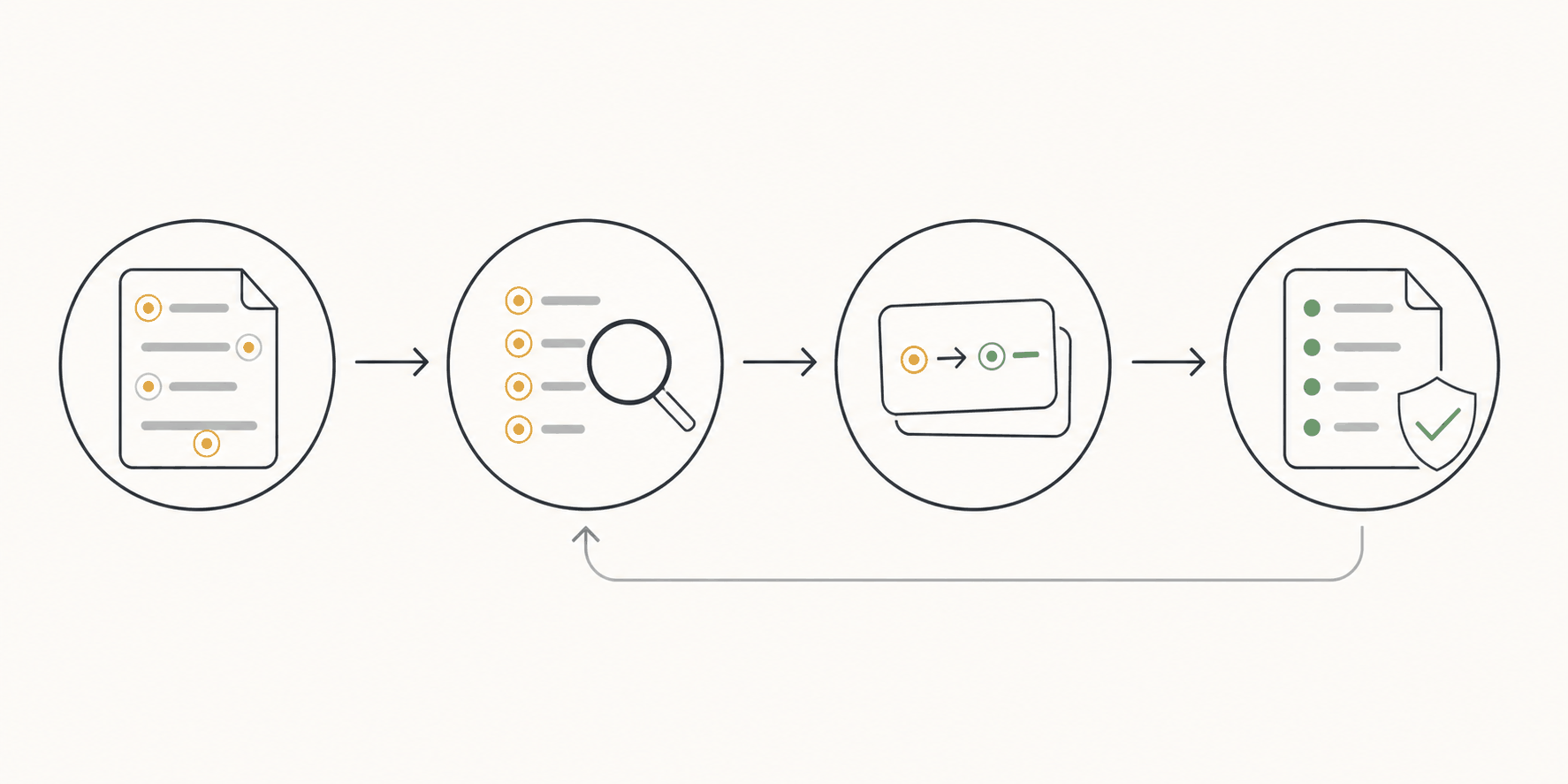
You do not write the ledger up front. You let the scan tell you what is missing, and work the list down in batches:
texclaims init --doc main.tex, then pointsources:at your result files.- Run
texclaims scanwithout--strict. Every number in the region comes backUNMAPPED— that list is the worklist. - Add claims a few at a time, re-running as you go.
- When
scan --strictexits 0, add it to CI.
A paper split across files needs each one listed, with its own region —
claims are file-local, and texclaims does not follow includes such as
\input, \include, \subfile, or \import:
documents: [main.tex, sections/results.tex, sections/discussion.tex]
scan:
  regions:
    - { file: main.tex, start: '\section{Introduction}' }
    - { file: sections/results.tex }
scan warns about an included name missing from documents:. Under --strict,
an unlisted name resolving to a real .tex section inside the project is a
configuration error; an unresolved package name or macro-built path only warns.
check alone reports nothing about coverage, so run non-strict scan alongside
it while adopting the ledger.
Important
Two things worth knowing before you start. An evaluation section in a
two-column paper typically hands you a few hundred UNMAPPED entries on the
first run, most of which collapse into one claim per table row (each covering
that row's cells) and one exemption for protocol constants. And a claim binds
a number to a field that already exists in your artifact: a derived figure
like "improves by 12.7%" has to be a field your analysis script writes, because the selector
deliberately cannot compute — a gate that evaluates expressions is a gate
that can be wrong in a second, independent way.
$ texclaims check --json | jq -c '.summary'
{"FAIL":0,"MISS":0,"PASS":9,"UNMAPPED":0,"WAIVED":1,"verdict":"OK"}
skills/texclaims/SKILL.md is a ready-made agent
skill — copy the skills/texclaims/ directory into .claude/skills/ and the
agent knows how to bootstrap a ledger, read the four record statuses and the
WAIVED counter, and re-anchor a claim after an edit.
The division of labour: the agent proposes ledger entries, texclaims rules on
them. Good at reading sentences, bad at being a gate — this keeps the judgement
deterministic and re-runnable.
Each claim anchors a number and binds it to one artifact field. expect is
exact, not a minimum: a number quoted in both the abstract and a results table
is declared once with expect: 2, interlocking the copies.
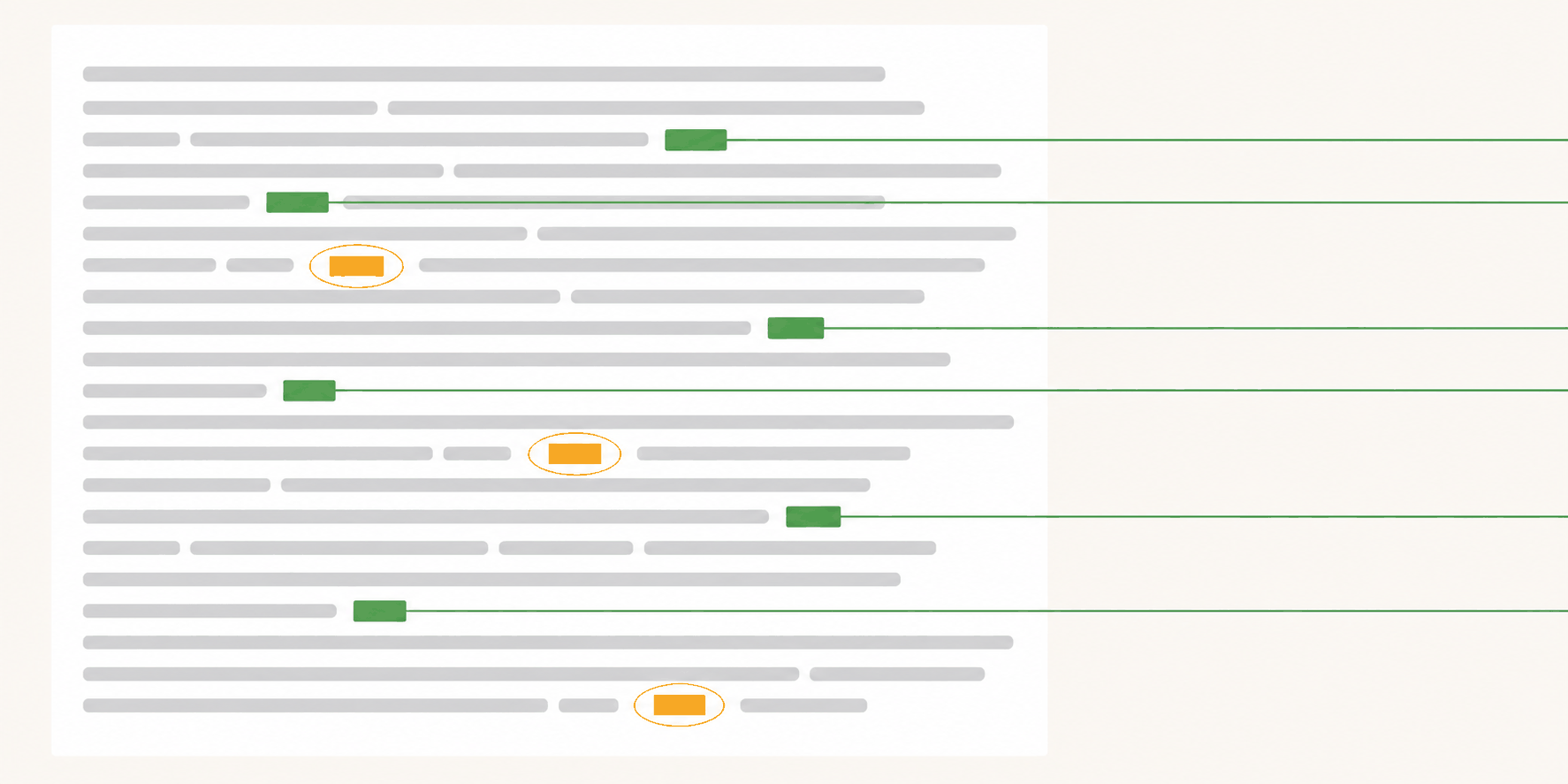
check only vouches for numbers you remembered to write down. The scan
inverts the question — in each declared region, every number must be claimed,
or waived by an exemption that states a reason:
exemptions:
  - name: confidence-level
    file: paper.tex
    anchor: { template: 'the {num}\% confidence level' }
    expect: 1
    reason: "Statistical protocol constant chosen a priori, not a result."

scan:
  regions:
    - file: paper.tex
      start: '\section{Evaluation}'
Anything else in that region is reported with its line and surrounding text.
In examples/demo/paper.tex, insert Throughput reached 8123 QPS. immediately
before All intervals use in the Evaluation section. The scan then reports
the following, after the nine passing claims, and exits 1:
$ texclaims scan --ledger claims.yaml --strict
UNMAPPED - paper.tex:13 claimed=8123 :: .2\% across 5 seeds. Throughput reached 8123 QPS. All intervals use the 95\% confide
== 9 PASS, 0 FAIL, 0 MISS, 1 UNMAPPED, 1 WAIVED — FAIL ==
Citation keys, labels, filenames and typesetting dimensions (\hspace{12pt},
[width=0.5]) are masked out first; a bare 9.9mm in prose stays visible. The
scan would rather ask about a measurement than go quiet about a result. It
always runs the full check first — coverage a stale ledger could vouch for
would be worthless.
emit:
  output: numbers.tex
  macros:
    - name: HeadlineImprovement
      value: 'summary:.improvement.throughput_pct'
      format: '.1f'
% HeadlineImprovement <- summary:.improvement.throughput_pct = 12.73421
\newcommand{\HeadlineImprovement}{12.7}\input{numbers} once, then write \HeadlineImprovement\%. Each macro carries
its provenance comment. In CI, generate --check verifies the committed file
still matches the ledger instead of rewriting it.
The default tolerance is half a unit in the last displayed decimal place — the only claim a printed number actually makes.
| In the paper | Accepts | Rejects |
|---|---|---|
12.7 |
12.73421, 12.65 |
12.8, 13.7 |
12.73 |
12.7342 |
12.74 |
5 |
5.4 |
5.6 |
Precision is read from the token, so a claim tightens automatically when you
print more digits. abs_tol and rel_tol are there for the rest, and
satisfying either passes. Floating-point slack is proportional to the
tolerance, never a fixed addend — a fixed addend would dominate at the
magnitudes where p-values and learning rates live.
Every rule here exists because the alternative fails silently.
| Rule | Without it |
|---|---|
| Unknown ledger field is an error | scal: instead of scale: passes with the wrong value |
| Duplicate YAML keys are an error | A second claims: block deletes the first, run stays green |
Anchor not found is MISS, never a skip |
Editing the sentence quietly removes the check |
expect is exact |
A copy-pasted paragraph doubles a number unnoticed |
| Each number occurrence is claimed once | One loose regex vouches for several numbers |
| A capture must be the whole number | 88 out of 88.9 audits a number nobody printed |
| Integers keep their exactness | Above 2^53 two different counts become one float |
| Exemptions require a written reason | The waiver list becomes a place to hide things |
| Claims are file-local | An identical number elsewhere satisfies the check |
scan --strict needs a region |
An empty gate that reports success is worse than no gate |
scan re-runs check first |
A stale ledger certifies coverage it no longer has |
| Any unexpected error exits 2 | A traceback exiting 1 reads as "a number is wrong" |
- run: pip install "texclaims @ git+https://github.com/YYYJH1/texclaims@v0.1.0"
- run: texclaims check    --ledger paper/claims.yaml
- run: texclaims scan     --ledger paper/claims.yaml --strict
- run: texclaims generate --ledger paper/claims.yaml --check
Note
Turn it on before you have full coverage: run check as the gate and scan
without --strict while you work through the backlog, then flip --strict
on once the region is clean.
| Tool | Position |
|---|---|
| texclaims | Audits hand-written numbers · no rewrite · deterministic |
| statcheck | Recomputes p-values · no rewrite · deterministic |
| showyourwork, Quarto, PythonTeX | Numbers become build products · changes authoring · deterministic |
| LLM audit skills | Model reads the manuscript · no rewrite · nondeterministic |
| CODECHECK, artifact evaluation | Human reruns the code · manual |
statcheck is the closest relative and they do not overlap: it asks whether the
reported statistics are internally consistent, texclaims whether the reported
numbers match the files that produced them. The literate-programming tools
solve the problem more thoroughly — if you will author in their format, use
them. This is for the manuscript that already exists.
The survey behind this table — 40+ tools across five categories, with
maintenance status and citations — is in docs/prior-art.md.
Prior art: jtoman/claims (2016) paired
LaTeX claim markers with a YAML verifier — the earliest version of this shape I
know of. K-Veritas (arXiv:2605.08586) argues the cryptographic form of the same
requirement.
A claim binds one number in one document to one artifact field:
- name: headline-improvement
  file: paper.tex
  anchor: { template: 'throughput by {num}\%' }
  expect: 2
  value: 'summary:.improvement.throughput_pct'
docs/ledger.md has the rest: the three anchor kinds, the
selector grammar, transforms and tolerances, and every field of the schema.
- Inequality claims ("more than 40%") are out of scope; a ledger entry binds a number to a value, not to a predicate.
- Numbers inside figures are not audited. Generate the figure and its caption numbers from the same artifact instead.
- Markdown is never masked, since it has no TeX grammar: a
%in a.mdfile is literal and dimensions are not recognised. - Lengths are masked in recognised commands such as
\hspace{12pt}and\setlength{\parskip}{12pt}, as well as options such as[width=0.5]. Bare or text-formatted measurements (12pt,\textbf{9.9mm}) stay visible; unfamiliar length commands may need an exemption. \iffalsemasking preserves its live\elsebranch and tracks nested primitive conditionals. Unclosed blocks or unknown nested conditional commands are configuration errors because their coverage cannot be established safely.- A sign detached from its number (
$- 5$) is read as positive. Write$-5$. - Include commands (
\input,\include,\subfile,\importand their supported variants) are detected but not followed. List each manuscript file indocuments:.scanreports an unlisted included name asWARN;scan --strictrefuses to run when it resolves to a real.texsection inside the project. Unresolved package names and macro-built paths only warn.checkalone does not report these coverage gaps. - A percent is treated as literal inside
\verb,\url,\path,\href,\lstinlineand verbatim-like environments. A custom verbatim macro of your own is not known to it. - The scan finds unclaimed numbers, not wrong ones. It tells you where you have not looked.
$ pip install -e ".[dev]"
$ pytest                 # 661 tests
Mostly adversarial: each test in tests/test_failclosed.py describes a way an
earlier version reported success while a number was wrong, missing, or
unaccounted for. CI runs texclaims against its own example. Tests reproduce
the documented edits and compare console output in both READMEs, including
failures and the JSON summary, against what the tool actually prints.
Demo · Agent skill · Cite · MIT License