Obsidian Graph View, but for source code. One command scans the project, another opens an interactive relationship map in the browser.
Liquid · JavaScript · TypeScript · Vue/Svelte/Astro · HTML · CSS · Python · Ruby · Rust · Go · PHP · Java/Kotlin · C/C++ · Markdown · Shell · Terraform
npx nervegraph scan     # → .nervegraph/graph.json
npx nervegraph view     # → http://localhost:4210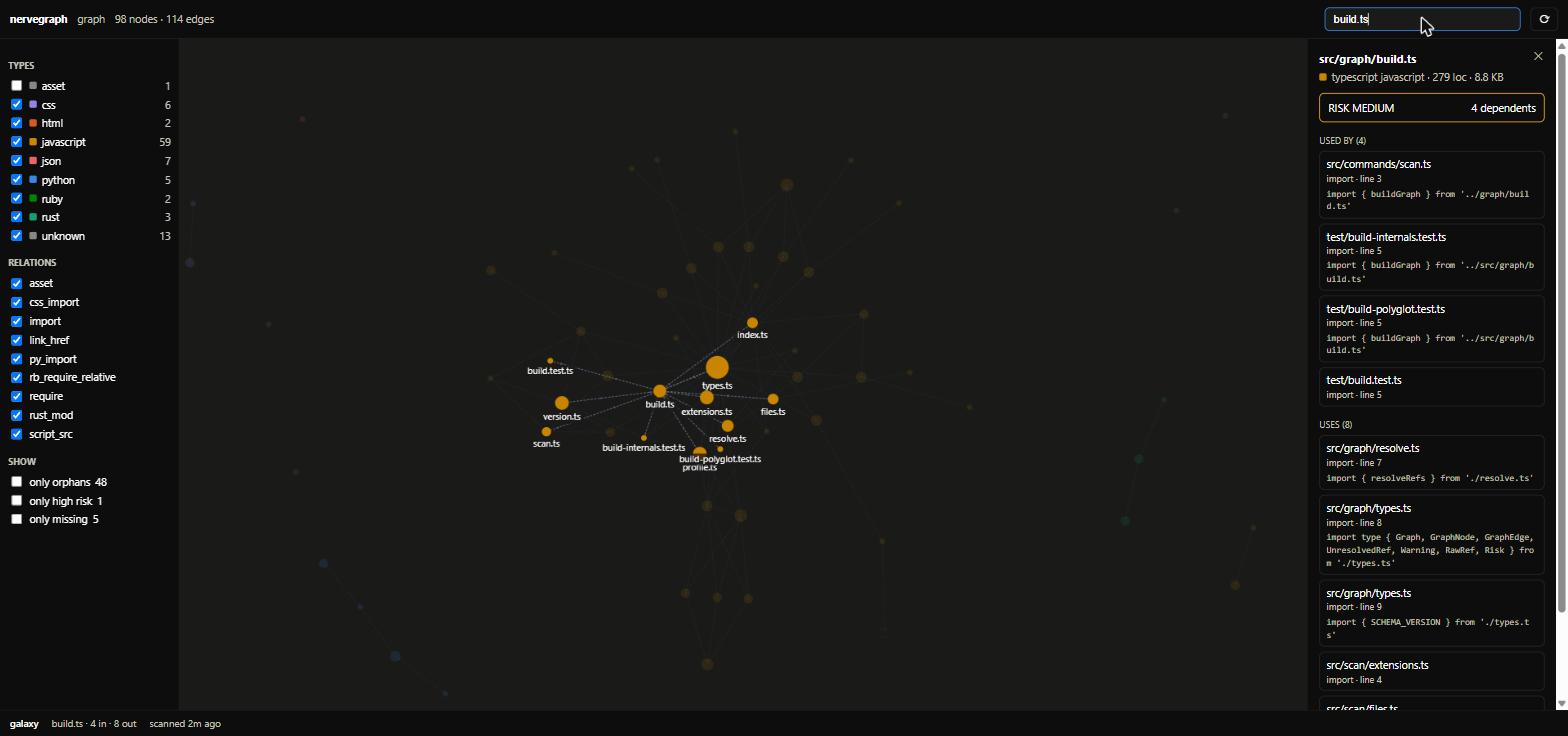
nervegraph scanning its own repo. Selecting src/graph/build.ts shows its 4
dependents and 8 dependencies, each with the exact import line.
Nothing to install — npx runs it straight from npm:
npx nervegraph scan
npx nervegraph view
Or install it properly:
npm install -g nervegraph     # global, gives you the `nerve` binary
nerve scan
nerve view
npm install -D nervegraph # per-project
npx nerve scanRequires Node ≥ 22.6.
nerve scan  [path] [flags]    # writes .nervegraph/graph.json
nerve view         [flags]    # serves the interactive map
nerve query <file> [flags]    # what uses this file, and what it uses
nerve check        [flags]    # fail the build when the graph breaks a budget
nerve diff <a> [b] [flags]    # what changed structurally between two graphs
nerve export       [flags]    # the graph as mermaid or dot text
nerve mcp [flags] # serve the graph to an agent over MCP (stdio)| Flag | Default | What it does |
|---|---|---|
--profile <name> |
auto |
shopify, js, poly, or auto detection |
--watch |
off | re-scan on change; an open viewer reloads itself |
--out <dir> |
.nervegraph |
Where graph.json is written |
--ignore <glob> |
— | Extra ignore pattern; repeatable |
--no-gitignore |
off | Don't read .gitignore |
--classes |
off | Also collect CSS/HTML class names (noisy) |
--pretty |
off | Indent graph.json — bigger, but diffable by hand |
--json |
off | Machine-readable summary on stdout |
--quiet |
off | Suppress the report |
.gitignore and .nervegraphignore are respected by default, and
node_modules, dist, build, vendor, coverage and minified files are
always skipped.
| Flag | Default | What it does |
|---|---|---|
--port <n> |
4210 |
Port to serve on (probes upward if taken) |
--graph <path> |
.nervegraph/graph.json |
Which graph to open |
--no-open |
off | Don't launch a browser |
In the viewer: click a node for its dependents and dependencies, / or
Ctrl+K to search, and use the sidebar to filter by language, relation type,
or to isolate orphans, high-risk files and broken links. ? shows the rest —
colour and size modes, the issues panel (i), shift-click to trace the path
between two files, and the focus controls.
| Flag | Default | What it does |
|---|---|---|
--json |
off | The card as JSON and nothing else — pipe-safe |
--depth <n> |
— | Also list files within n hops |
--orphans |
off | List every file nothing references |
--missing |
off | List referenced files that aren't on disk |
--unresolved |
off | List references static analysis couldn't follow |
--risk <level> |
— | List files at low, medium or high risk |
--dead-exports |
off | List exports nothing imports |
--duplicates |
off | List groups of byte-identical files |
--cycles |
off | List dependency cycles |
--packages |
off | Fold the graph up to one node per package (monorepos) |
--graph <path> |
.nervegraph/graph.json |
Which graph to read |
$ nerve query src/graph/types.ts
src/graph/types.ts
  typescript javascript · 122 loc · risk high
  34 dependents (50 transitive) · 0 dependencies
The same artifact as a gate. Nothing fails unless you ask for it, except a reference to a file that isn't on disk:
nerve scan --quiet && nerve check --max-cycles 0 --no-duplicates
# exit code 7 when a budget is broken, 0 when every budget is met| Flag | What it means |
|---|---|
--max-cycles <n> |
At most n dependency cycles |
--max-unresolved <n> |
At most n references static analysis couldn't follow |
--max-orphans <n> |
At most n files nothing references |
--allow-missing |
Tolerate references to files that aren't on disk |
--no-dead-exports |
Fail if any export is unused |
--no-duplicates |
Fail if any two files are byte-identical |
--rules <file> |
Layer rules; .nervegraph/rules.json is picked up automatically |
Layer rules are yours to write — the tool only checks what you declared:
[
  { "name": "ui must not reach the database", "from": "src/ui/**", "deny": "src/db/**" },
  { "from": "src/core/**", "allow": "src/core/**" }
]
nerve diff old-graph.json # against .nervegraph/graph.json
nerve export --format mermaid --focus src/graph/build.ts --depth 1
nerve export --format dot --out graph.dotdiff names new and removed files and edges, cycles introduced or resolved,
files that became orphans, and files whose risk went up — the structural half
of a code review. export writes the map as text, so a diagram can live in a
README or an ADR and be diffed like code.
cd some-project
npx nervegraph scan          # 98 files · 114 edges
npx nervegraph view # → http://localhost:4210graph.json is plain, sorted, deterministic JSON, so an agent (Claude Code,
Cursor) can read the dependency map instead of grepping the whole repo:
nerve query snippets/product-card.liquid --jsonusedBy lists what breaks if the file changes, transitiveDependents is the
full blast radius, and stale: true means the file changed since the scan —
run nerve scan first. The whole map is also readable directly:
nerve scan --quiet && cat .nervegraph/graph.jsonKeep it fresh while working: nerve scan --watch in one terminal, nerve view
in another — the map reloads itself on every re-scan.
Agents that speak MCP can skip the shell entirely:
{ "mcpServers": { "nervegraph": { "command": "npx", "args": ["nervegraph", "mcp"] } } }It exposes two tools — nervegraph_query (one file's dependents, dependencies,
risk and blast radius) and nervegraph_list (orphans, missing files, high-risk
files, unused exports, duplicates, cycles). The graph is re-read on every call,
so nerve scan --watch keeps the agent current.
| Language | Extensions | What becomes an edge |
|---|---|---|
| Liquid | .liquid |
render, include, section, sections, content_for, asset_url, t |
| JavaScript / TypeScript | .js .mjs .cjs .jsx .ts .tsx .mts .cts |
import, export … from, import(), require() |
| HTML | .html .htm |
<script src>, <link href>, <img>/<source>/<iframe>/… src |
| CSS | .css .scss .sass .less |
@import, @use, url() |
| Python | .py .pyi |
import x, from x import y, relative from .x import y |
| Ruby | .rb .rake .gemspec |
require, require_relative |
| Rust | .rs |
mod x; (the declarations that pull files into the crate) |
| Vue / Svelte / Astro | .vue .svelte .astro |
the <script> imports, <style> @use/url(), and template src attributes |
| Go | .go |
import "…" inside the repo's own module (from go.mod) |
| PHP | .php .phtml |
require/include, and use through composer's PSR-4 map |
| Java / Kotlin | .java .kt .kts |
import a.b.C under the Maven/Gradle source root |
| C / C++ | .c .h .cc .cpp .hpp … |
#include "x.h" (angle-bracket includes are external) |
| Markdown | .md .mdx |
links and images pointing at project files |
| Shell | .sh .bash .zsh |
source x.sh / . x.sh |
| Terraform | .tf .tfvars |
module { source = "./…" } |
| Shopify JSON | templates/*.json, sections/*.json |
sections.*.type |
| Web components | any markup + JS | <product-form> ↔ customElements.define('product-form', …) |
Breadth without measured accuracy is how a dependency graph quietly starts lying, so each language carries a label rather than an implied promise:
| Level | Languages | What it means |
|---|---|---|
| verified | Liquid, JavaScript / TypeScript, HTML, CSS, Shopify JSON | Exercised against real projects; scanner and resolver both covered by tests |
| experimental | Python, Ruby, Rust, Go, PHP, Java / Kotlin, C / C++, Vue / Svelte / Astro, Markdown, Shell, Terraform | Covered by unit tests on fixtures, not yet measured on a large real codebase — expect gaps rather than wrong edges |
A language moves to verified when its unresolved share has been measured on
a real repository, not before.
Third-party references stay out of the graph: import requests, require 'json' and a CDN <script src> are reported as external, not as broken
links. A reference that must be a project file — a relative Python import, a
require_relative, a mod declaration — and isn't there becomes a missing
node, which is the point: that's a broken link in production.
Deliberate, and cheaper to state than to hide:
- Rust
usepaths are not followed.moddeclarations already define the file graph;useis item-level and would need full name resolution for zero extra nodes. - Rails autoloading is invisible. Zeitwerk resolves
User→app/models/user.rbwith norequire, so a Rails app's graph is thinner than its real coupling. - Python docstrings can produce a phantom import if a line inside one
starts with
import x. - ERB
<%= %>inside an HTML attribute is skipped, because the>in%>ends the tag match..html.erbisn't a scanned extension. - A Go import resolves to one file of the package, not to all of them —
the package's own
<name>.goif it exists, otherwise its first source. Nodes are files, and a package is a directory. - Java's same-package references are invisible, because they need no
import; only cross-package coupling shows up. import a.b.*anduse App\{A, B}are skipped rather than expanded to an arbitrary member of the package.- Aliases are resolved from a single root config.
tsconfig.jsonextendschains and per-package tsconfigs in a monorepo are not followed; workspace package names are.
Open someone else's 60,000-line theme and understand its architecture in 10 seconds. See who uses a file before deleting it. See what breaks before editing a snippet.
A useful side effect: graph.json is machine-readable, so an AI agent (Claude Code, Cursor)
can read the map instead of grepping the whole repo.
| Question | Decision | Why |
|---|---|---|
| Package name | nervegraph, binary nerve |
Checked for availability on npm before publishing |
| Runtime | Node ≥ 22.6, TypeScript, ESM | Needs --experimental-strip-types to run TS sources directly |
| Argument parser | node:util → parseArgs |
Stdlib, commander not needed |
| HTTP server | node:http |
3 static files, express not needed |
| Liquid / HTML | Regex over tags, not a full AST | Reference tags are trivially regular |
| JS | es-module-lexer + regex for require |
A full Babel AST is overkill for v0.1 |
| CSS | postcss |
Correctly extracts @import and selectors |
| Python, Ruby, Rust, Go, PHP, Java/Kotlin, C/C++, Markdown, Shell, Terraform | Line-oriented regex, zero dependencies | Import syntax in all of them is regular; a per-language parser would be one more dependency each for the same edges |
| Vue / Svelte / Astro | Split the file, reuse the HTML, JS and style passes | A SFC is three languages in one file, and all three scanners already exist |
| Visualization | force-graph (vasturiano), canvas |
Drag, zoom, highlight, 5k+ nodes out of the box |
| Frontend framework | None. Vanilla JS + one HTML file | The detail panel is 150 lines of DOM |
| Storage | A single graph.json |
SQLite at 100k+ nodes, not before |