Drop-in replacement for ftl-extract 0.12.1 — the
same ftl extract <code> <locales>, with the same options and byte-for-byte the same output —
in which the decision "is this a Fluent key" is made not by a parser but by a simulated
fruit-fly mushroom body: LIF neurons on the real FlyWire FAFB v783 connectome (124 projection
neurons → 2597 Kenyon cells ⇄ 1 APL → 48 MBONs), a readout on the MBONs trained with
"dopamine" (delta rule). The tokenizer only proposes candidates (string literals and
attribute chains before () and encodes their context into an odour; the fly decides which
of them is a key and which kwarg is placeable. This is a joke — but a joke that is literally true.
Switch the fly off and no keys are found: the hot path has neither ast nor rules about
i18n.get; the test tests/test_no_ast_in_hot_path.py checks that a plain ftl extract
loads neither the AST reference nor the audit.
Python file ──tokenize──▶ candidate + window (6 tokens before · focus · 3 after)
                                   │
                                   ▼  feature hashing → 14 puffs × 124 PN (rate coding, tanh)
        ┌─────────────────────────────────────────────────────────────────────┐
        │   PN 124  ──ACh──▶  KC 2597  ──ACh──▶  MBON 48       mushroom body  │
        │  Poisson,          LIF, τm 20 ms,        LIF          of FlyWire    │
        │  ≤ 200 Hz         V_th −45 mV               ▲         FAFB v783,    │
        │                    │       ▲                │   right hemisphere    │
        │                    ▼       │ GABA ×0.5      │         syn_count ≥ 5 │
        │                   APL 1 ───┘                │                       │
        │               (feedback inhibition,         │                       │
        │             8–10 % of KCs active per puff)  │                       │
        │                                             │                       │
        │   DAN 165 — teaching signal only ───────────┘  (sim current = 0)    │
        └─────────────────────────────────────────────────────────────────────┘
                                   │  KC spike counts per puff (14 × 2597)
                                   ▼
        readout  w · [KC spiked, log1p(spikes)] + b  →  margin
        |margin| < θ  →  "sniff again" (up to 5 extra trials with other seeds), vote = Σ margin
        margin > 0  →  key  /  kwarg placeable
- Temporal coding. The window = 14 puffs of 40 ms with no silence between them + 10 ms of
silence (570 ms, 5700 steps of 0.1 ms): 6 puffs of context before the candidate, 5 puffs of
focus (
[root][attr1][attr2][attr3][summary]for a chain,[<STR>][silence×3][summary]for a string), 3 puffs after. The membrane is not reset between puffs — that is the memory of the preceding tokens. Every puff is a 124-PN vector: hashed slot features (normalised token, token + distance, type, bracket depth, bigram), 2 buckets per feature, ≈ 10 active PNs per puff. - Normalisation, not rules.
--i18n-keys,-p,--ignore-attributes,--ignore-kwargsaffect only the tokens (i18n→<I18N>,self→<PREFIX>,set_locale→<IGNORE>,when→<IGNORE_KW>), so-k LFsmells the same asi18n. The decision is the sign of the margin. - Resniff. θ is chosen on val so that ≤ 10 % of windows get extra sniffs; trial seed = sha256(file bytes, candidate index, encoder version) — two runs give the same output.
- Details: CLAUDE.md (the contract), docs/CONNECTOME.md (the subgraph), docs/BENCH.md (calibration, speed), docs/ODOR.md (the encoder), docs/METRICS.md (training), docs/FORMAT.md (what exactly the original does and what is reproduced).
Python 3.14 is required (requires-python = ">=3.14,<3.15"). From PyPI:
pip install fly-ftl-extract                              # into a 3.14 venv, or
uv tool install --python 3.14 fly-ftl-extract            # as an isolated tool
The same wheel is attached to every GitHub release;
the repository itself installs too (uv build → dist/):
uv tool install --python 3.14 ./fly_ftl_extract-0.1.0-py3-none-any.whl
uv tool install --python 3.14 git+https://github.com/andrew000/FLY-FTL-Extract
The wheel contains the connectome (fly_ftl_extract/data/mb_fafb783.npz, 106 KB), its
metadata (meta.json) and the trained weights (mbon_weights.npz, 598 KB); runtime
dependencies are numpy, scipy, rich, click and fluent.syntax.
Entry-point conflict. The package installs the scripts ftl and fly-ftl. The original
ftl-extract also installs ftl; in one environment the last one installed wins, so do not
put both into one venv — keep them in separate uv tool environments or call ours as
fly-ftl.
Everything works as in the original 0.12.1 (the FTL-Extract README): ftl extract CODE_PATH LOCALES_PATH, -l/--language, -k/--i18n-keys, -K, -p/--i18n-keys-prefix, -e/-E,
-i/-I, --ignore-kwargs, --default-ftl-file, --comment-keys-mode {comment,warn},
--line-endings, --dry-run, --cache/--cache-path/--clear-cache,
--allow-parse-errors, -v, the global --config, the [tool.ftl-extract.extract] section
in pyproject.toml (CLI > pyproject > defaults), ftl config sample. Output, exit codes and
the .ftl tree match the Rust binary; after its ✅ Done line the block [INFO fly] Fly statistics: is appended (neurons, files, candidates, trials, resniffs, trials/s, brain time).
ftl extract app/bot app/bot/locales -l en -l uk          # drop-in
ftl extract app locales --fly-audit                       # run the AST reference alongside, differences → stderr, exit 1
ftl extract app locales -v --fly-no-tui                   # the margin of every window after ✅ Done
Our options (all prefixed --fly-):
| option | what it does |
|---|---|
--fly-audit |
the AST reference (fly_ftl_extract.reference) runs alongside; every difference is a [WARN fly::audit] … line, exit 1 |
--fly-no-tui |
a plain log even in a terminal (without a tty the TUI switches itself off) |
--fly-workers N |
processes for the brain (spawn; default CPU−2, ≤ 16); below 128 windows always a single process |
--fly-batch N |
trials per brain call (256 in a single process, 64 in a worker, 16 under the TUI) |
--fly-trials N |
base trials per window before the resniff rule (the margins are summed) |
--fly-seed S |
a salt on every trial seed — "another nose"; 0 = the production seeds |
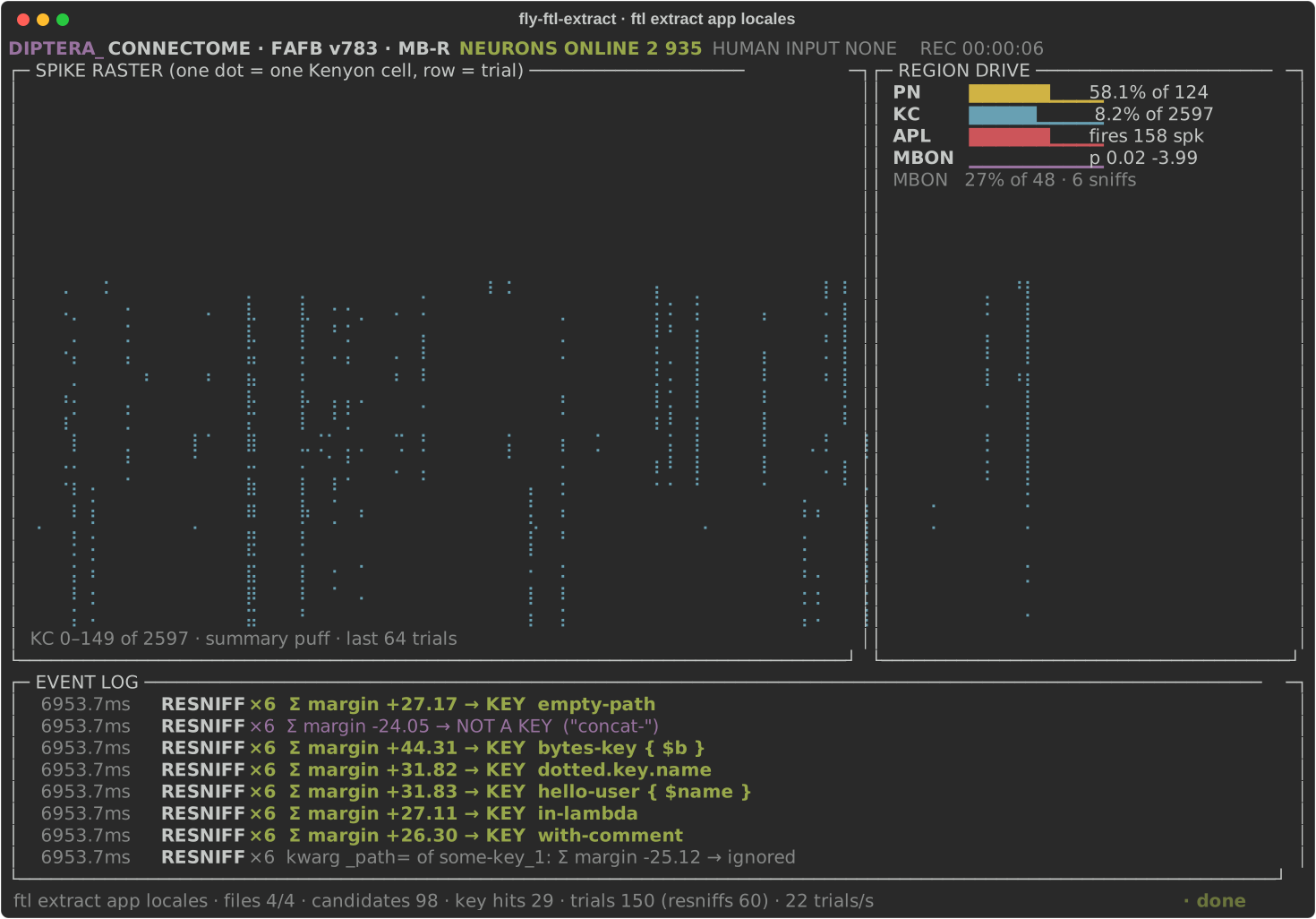
In a terminal ftl extract draws a live panel (rich, ≤ 15 fps): a spike raster of the
Kenyon cells (one dot = one cell that spiked in the trial's summary puff, one row = one
trial), the PN/KC/APL/MBON activity of the last trial, an event log (ODOR → MBON margin →
KEY / NOT A KEY / placeable, RESNIFF) and counters. All numbers are real — from the
connectome, the spikes and the readout; the TUI module never imports random.
Dataset grammar-5: 20 000 synthetic snippets labelled by the AST reference (460 672
candidates, 147 876 kwargs; split 80/10/10 by snippet). The golden fixtures from tests/ and
the real bot's code are not part of the dataset — they are the holdout.
| what | result | source |
|---|---|---|
| keys, test, with resniff (≤ 5 extra trials, 9.8 % of windows) | P 0.9987 · R 1.0000 (tp 11554, fp 15, fn 0, tn 34354) | METRICS.md §1 |
| keys, test, without resniff | P 0.9949 · R 0.9978 | same |
| kwargs (placeable / ignore), test | P 1.0000 · R 1.0000 | same |
| golden fixtures through the whole fly | 24 / 24 files match the reference | tests/test_judge_on_fixtures.py |
the real ftl 0.12.1 against ours on every fixture |
31 / 31 runs byte for byte (exit, stderr, tree), config sample too |
COMPARE.md |
| a real aiogram bot (280 files, 9 992 candidates, 538 keys) | 0 differences from the reference (--fly-audit); the fly trained on the previous corpus (grammar-4) had 13 on the same code (all of them L("…") in dict values, constructor fields and decorator arguments), 15 in the first run |
REAL_PROJECT.md — the honest before/after story |
the old weights (grammar-4) on the grammar-5 test |
keys R 0.870 (1503 misses) — the price of call positions that were not in the corpus | METRICS.md §8 |
- One hemisphere (right: 2597 KCs vs 2580 in the left); the left one is not used.
- 15 GABAergic iPNs per side are excluded from the PNs (three have ≥ 5 synapses onto KCs and would break the rule "PN→KC only positive").
syn_scale = 5.0andapl_scale = 0.5are calibrated on our odours (8–10 % KCs per puff, APL inhibits ≥ 2×), not taken from Shiu et al.; the APL weight is scaled separately.- A 40 ms puff, not 20: at 20 ms the per-puff KC code was not reproducible (same-candidate Jaccard 0.34).
- Synapse threshold
syn_count ≥ 5per neuron pair; DANs carry no current in the forward simulation. - Speed ≈ 50 trials/s per process (one trial = 5700 LIF steps), 290–410 trials/s on 16 processes depending on machine load; a bot with ~10 000 candidates takes 24–34 s versus 0.02 s for the Rust original.
ftl stubandftl checkare not implemented (a message and exit 2).- The
--cachecache is written to the same file as in the original, but the format is ours and not compatible with the original. -vdoes not reproduce the original's debug lines (globset,Saved …); our margin lines are printed instead.i18n.get("dotted.key.name")and other invalid Fluent identifiers are written as is — the original does the same (the next run of either will fail reading the.ftl).- The fly makes mistakes. On the
grammar-5test split (with resniff) 15 false keys among 34 369 negatives and 0 misses among 11 554 positives; all 10 worst false keys areself.get("…")/cls.get("…")with-p self -p cls(margin up to +10.5; for the reference a prefix without an i18n name right after it is not a key). The fly learns only what is in the grammar: the first version (grammar-4) missed on the real bot everyL("…", _path=…)in dict values and in constructor fields (description=L(…)on the line after a recognisedname=L(…), margin −1…−31),LF("…")as the first argument of the decorator@router.message((−8…−32), and flagged a string inside a tuple,("captcha_timeout_task", …), with no call at all, as a key (+7.00). This was fixed not by adding rules to the code but by extending the corpus (grammar-5) with these positions and their negative twins: on the same bot it became 0 differences, and the same 13 windows give +5.7…+40.7 (REAL_PROJECT.md). The next unseen construct will likewise be a miss until it gets into the grammar.
- Connectome: FlyWire FAFB v783, Zenodo 10676866, CC-BY 4.0. Dorkenwald S. et al. Neuronal wiring diagram of an adult brain. Nature 634, 124–138 (2024). Schlegel P. et al. Whole-brain annotation and multi-connectome cell typing of Drosophila. Nature 634, 139–152 (2024) — neuron annotations (flyconnectome/flywire_annotations).
- Neuron model and parameters: Shiu P. K. et al. A Drosophila computational brain model reveals sensorimotor processing. Nature 634, 210–219 (2024) (philshiu/Drosophila_brain_model).
- Inspiration (the mushroom body as a hash function): Dasgupta S., Stevens C. F., Navlakha S. A neural algorithm for a fundamental computing problem. Science 358, 793–796 (2017).
- Fluent: python-fluent (
fluent.syntax, Apache 2.0) — parser and serializer, byte-for-byte compatible with fluent-rs on every golden file. - The original: FTL-Extract © andrew000, MIT. The output format, key order (
FxHashMap), file walk and message texts are reproduced from the behaviour of the 0.12.1 binary. - This package is MIT. The data
fly_ftl_extract/data/mb_fafb783.npzis a derivative work of FlyWire (CC-BY 4.0).
Everything is deterministic (the seeds are fixed); the times are from the author's machine (Ryzen 9 9950X3D, 32 threads) (train.py: 30 processes for the brain; the ftl extract pool: 16).
| step | command | what it does | time |
|---|---|---|---|
| 1 | download proofread_connections_783.feather (852 MB), proofread_root_ids_783.npy, Supplemental_file1_neuron_annotations.tsv into .cache/flywire/ |
raw FlyWire data | — |
| 2 | uv run --extra connectome python scripts/build_connectome.py |
the mushroom-body subgraph → data/mb_fafb783.npz + meta.json, docs/CONNECTOME.md |
≈ 4 s (the feather is read through a memory map in batches, only the needed columns); a repeated run gives byte-for-byte the same npz, only the build date changes in meta.json |
| 3 | uv run python scripts/make_dataset.py |
20 000 snippets of the grammar-5 grammar (14 grammar-4 mutation families + 10 call-position families), labelling by the AST reference, encoding → data/dataset/ |
12 s generation + 212 s labelling and encoding |
| 4 | uv run python scripts/train.py --lr 0.005 --epochs 100 --patience 10 --train-seeds 6 [--baseline-weights old.npz] |
the brain on every window (train × 6 seeds, val, test; state cache in .cache/brain_states/, ≈ 8 GB per corpus), delta rule, θ, fixtures → data/mbon_weights.npz, docs/METRICS.md |
12 260 s (3.4 h) without the state cache, 30 processes: brain keys 4466 s (2.3 M trials, ≈ 665 trials/s), kwargs 1310 s, readout keys 5506 s (86 epochs, early stopping), kwargs 223 s, fixtures 23 s; with the state cache — only the readout |
| 5 | uv run pytest -q |
297 tests (296 passed + 1 diagnostic xfail), among them golden through the fly and --fly-audit on the fixtures |
≈ 3 min |
| 6 | uv run python scripts/compare_with_reference.py |
the real ftl 0.12.1 (via uv tool run) against ours → docs/COMPARE.md |
≈ 45 s |