





Real-time multiplayer web game. One player draws a tech-company logo from memory on a constrained canvas while the rest of the room races to guess the brand. A partida is a fixed sequence of rondas scored against a timed clock. Human-only rooms: 2 to 8 players, host-driven setup, no bots or AI.
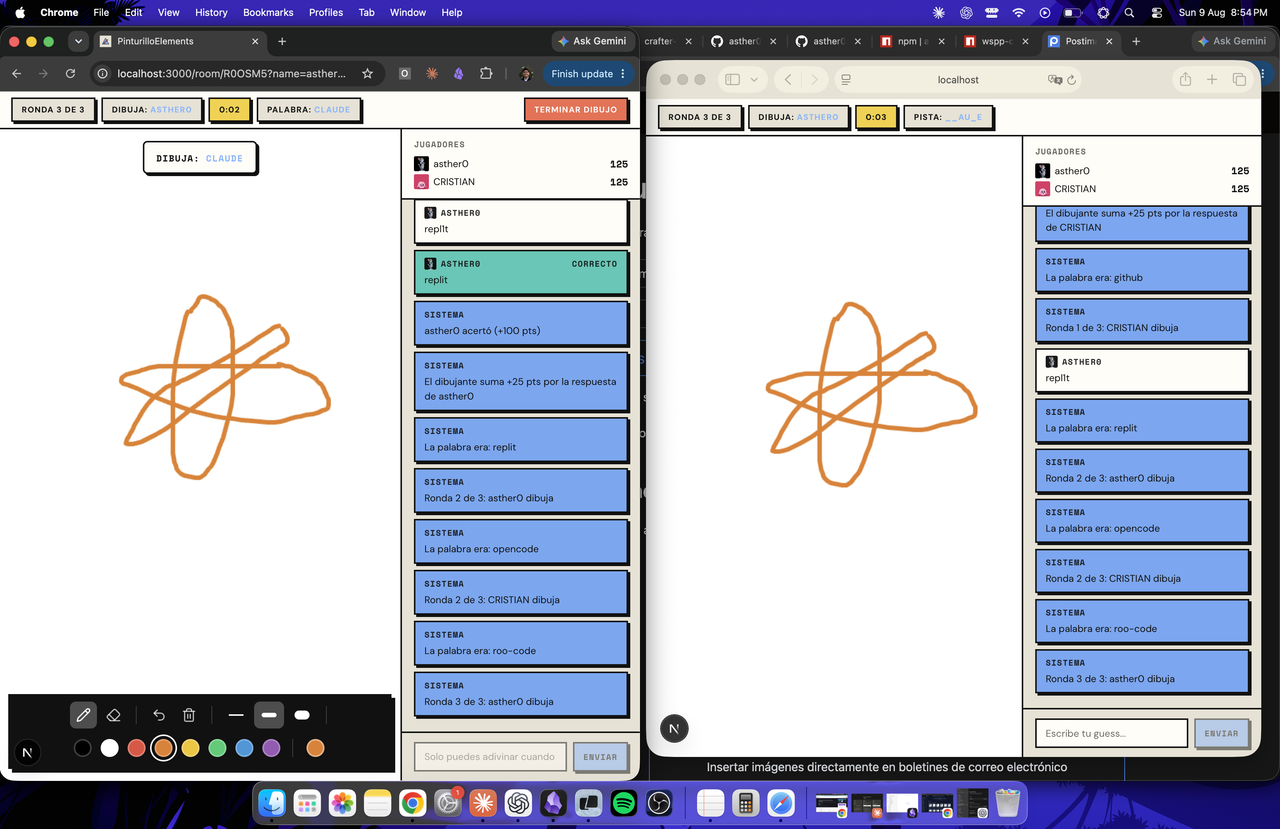
A room runs one partida made of rondas. The default is three rondas.
| Phase | Duration | What happens |
|---|---|---|
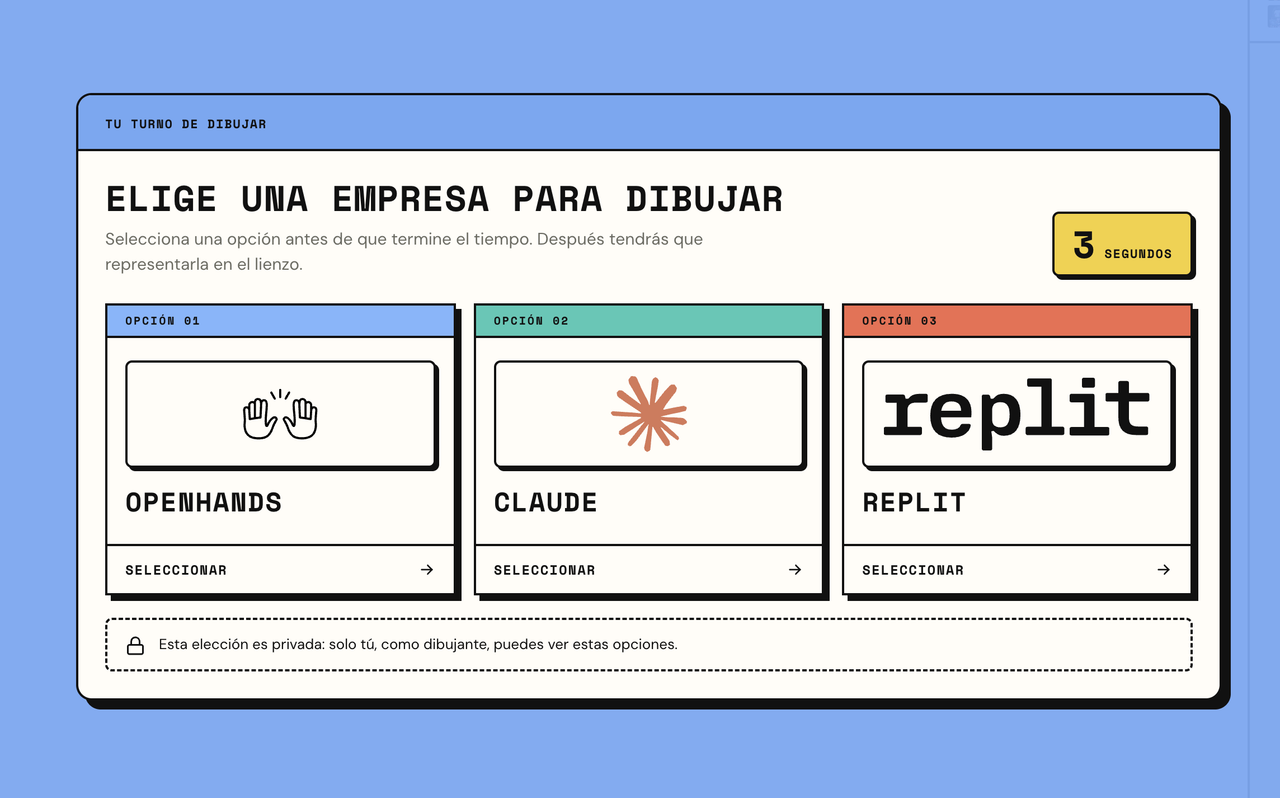
| Choosing | 10s | Drawer picks one of three company names from the TryElements catalog. The pick is private. |
| Drawing | 45-90s | Drawer recreates the chosen logo with strokes only. No text, no shapes, no images, no reference. Guessers see the canvas live and chat. |
| Result | 5s | Target word is revealed. Per-round scores are added to the leaderboard. Drawer rotates. |
After the last ronda the room shows a final leaderboard and a winner.
A Nueva partida button restarts the sequence with the same roster.
- Pen, eraser, three stroke widths (small, medium, large)
- Fixed 7-color palette
- No text, no shapes, no image paste, no reference image
The host creates a public room and configures:
- Human capacity: 2 to 8 players
- Rondas: 3, 4, or 5
- Draw time: 45, 60, or 90 seconds
- Late-join policy: spectator or closed
- Logo source: full TryElements catalog (206 logos) or filtered collections
Guests join via room code. All players are human. No agents, no bots, no AI guessing, no BYOK.
| Kind | Source | Behavior |
|---|---|---|
human |
Joins via room code | Draws with the tool set or types guesses in chat. Guess input is disabled while drawing. |
-
Portal -- realtime transport for rooms. Presence, stroke streaming, chat, round state and timers. Each client holds its own state machine and exchanges events through the Portal channel
room:<roomId>. Integrated via@portalsdk/coreand@portalsdk/react. -
TryElements -- the catalog the word picker draws from. The MVP serves company logos directly from
https://tryelements.dev/r/svg/...for the picker preview. The word picker uses a generated catalog snapshot inlib/logoCollections.ts. -
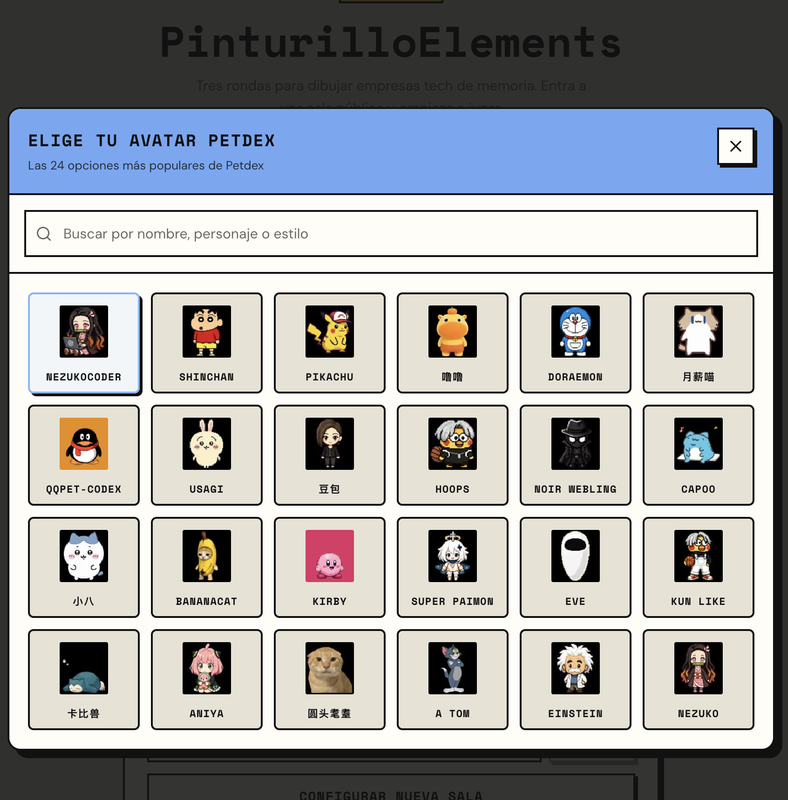
Petdex -- the avatar system. The join screen fetches pets from
/petdex-api/pets/searchand lets each player pick one. The room shows those avatars in the lobby roster and next to chat lines. The MVP ships a fallback list of six pets in case Petdex is unreachable.
When NEXT_PUBLIC_PORTAL_API_KEY is missing, components/PortalBridge.tsx
swaps Portal for an in-memory bus inside the same browser tab. Same
Portal event types, same UI, same timers, no events leave the tab and
no cross-tab multiplayer. With the key set, rooms share state across
tabs and machines through Portal.
- Next.js 15, React 19, App Router
- TypeScript, Tailwind CSS
- Portal SDK for realtime
- Bun as package manager and runner
| Command | Effect |
|---|---|
bun install |
Install dependencies |
bun run dev |
Start next dev on http://localhost:3000 |
bun run build |
Production build |
bun run start |
Start the production server |
bun run lint |
next lint |
Copy .env.example to .env.local and fill in:
| Variable | Scope | Purpose |
|---|---|---|
NEXT_PUBLIC_PORTAL_API_KEY |
Client | Portal SDK publishable key. Without it the app falls back to the local in-memory bus. |
NEXT_PUBLIC_ROOM_ID |
Client | Default room id when none is supplied. Defaults to demo. |
- Landing page that creates or joins a room by id
- Room lobby with copyable room code, host edit modal, and a human roster with Petdex avatars
- Full Skribbl loop: 3 rounds by default, 10s word choice, 60s drawing,
5s result beat, drawer rotation, per-round scoring, end-of-game
leaderboard,
Nueva partida - Drawing canvas with the round's tool set
- Chat panel with player list, live scores, system messages, and a guess input disabled for the drawer
- Local fallback for single-developer play without a Portal key
- No deployed or authenticated backend. The app is a Next.js client. There is no server-side game state, no auth, no persistence beyond the current room session, and no historical leaderboards. Portal (or its local fallback) is the only state carrier.
- The TryElements catalog is imported as a generated snapshot rather than requested live at runtime.
- Optimised for desktop and landscape tablet. Small phones are not a supported target.
- The MVP validation set uses company logos. The vault notes this is for internal testing only and is not approval to redistribute brand assets at scale.
.
+- AGENTS.md            Local agent instructions and vault pointers.
+- opencode.json        Local editor config.
+- package.json         Next.js scripts and Portal SDK dependency.
+- .env.example         Template for NEXT_PUBLIC_PORTAL_API_KEY etc.
+- next.config.ts       Next.js config.
+- tailwind.config.ts   Tailwind config.
+- postcss.config.mjs   PostCSS config.
+- tsconfig.json        TypeScript config.
+- .eslintrc.json       ESLint config.
+- app/                 Next.js App Router entry points.
|  +- layout.tsx        Root layout.
|  +- page.tsx          Landing page (create / join room).
|  +- room/[id]/        Room page (room id route).
|  |  +- page.tsx       Server entry, suspense around the client.
|  |  +- RoomPageInner.tsx Reads ?name and forwards to client.
+- components/          Game UI and the PortalBridge provider.
|  +- PortalBridge.tsx  Provider, local fallback, handler hook.
|  +- RoomPageClient.tsx Room client (game state, phases).
|  +- GameCanvas.tsx    Canvas, pen, eraser, palette, widths.
|  +- GameUI.tsx        Header (round, drawer, timer).
|  +- ChatPanel.tsx     Players, chat, guess input.
|  +- JoinRoomProfile.tsx Name + Petdex avatar picker.
+- lib/                 Game logic and Portal event types.
|  +- gameLogic.ts      Phases, scoring, word picker.
|  +- types.ts          Player, GameState, Stroke, PortalEvent.
+- .vault-context/      Local symlinks to the project vault (gitignored).
The Next.js app under app/ and components/ is the MVP.
- Optional AI-agent players
- Infrastructure optimization