


Transport-neutral, fail-closed protocol contracts for safe AI-to-editor integrations.
Glomancy Protocol is a small Rust library plus versioned JSON Schemas for the boundary between AI systems and editor/tooling runtimes. It defines how integrations negotiate versions and capabilities, submit work, request approvals, report progress, return evidence, surface errors, and stay observable without coupling the protocol to one transport, model provider, or editor implementation.
New here? Read What Glomancy Is and Why the Protocol Exists for the product vision, concrete benefits, example workflows, intended audiences, current maturity, and the public/private boundary.
Integrating it into another project? Read External Adoption Guide for release/commit pinning, Rust Git dependencies, schema/hash verification, non-Rust vendoring, conformance, and upgrade discipline.
The repository includes a dependency-free public demo that computes real protocol decisions from the versioned conformance vectors. It is not a prerecorded success path and it does not call the private Glomancy runtime.
python3 examples/consumers/python/demo_flow.pyRepresentative output:
Glomancy Protocol — runnable public flow
1. handshake       PASS  selected wire version: 0.4.0
2. capabilities    PASS  selected: editor.read@1.0.0, result.evidence@1.0.0
3. task gate       PASS  accepted: true
4. approval        PASS  accepted=true authorized=true
5. evidence        PASS  evidence.record -> urn:glomancy:protocol:evidence.record:1.0.0
The boundary demonstrated is:
advertised version → exact capabilities → task gate → approval correlation/expiry → evidence contract
The dedicated Public protocol demo workflow runs this path on every push and pull request, including a machine-readable --json contract check. Protocol validation and capability selection are prerequisites for a safe integration; they are not authentication, local authorization, editor execution, or proof that a real Unreal mutation occurred.
See the full runnable walkthrough and sequence diagram →
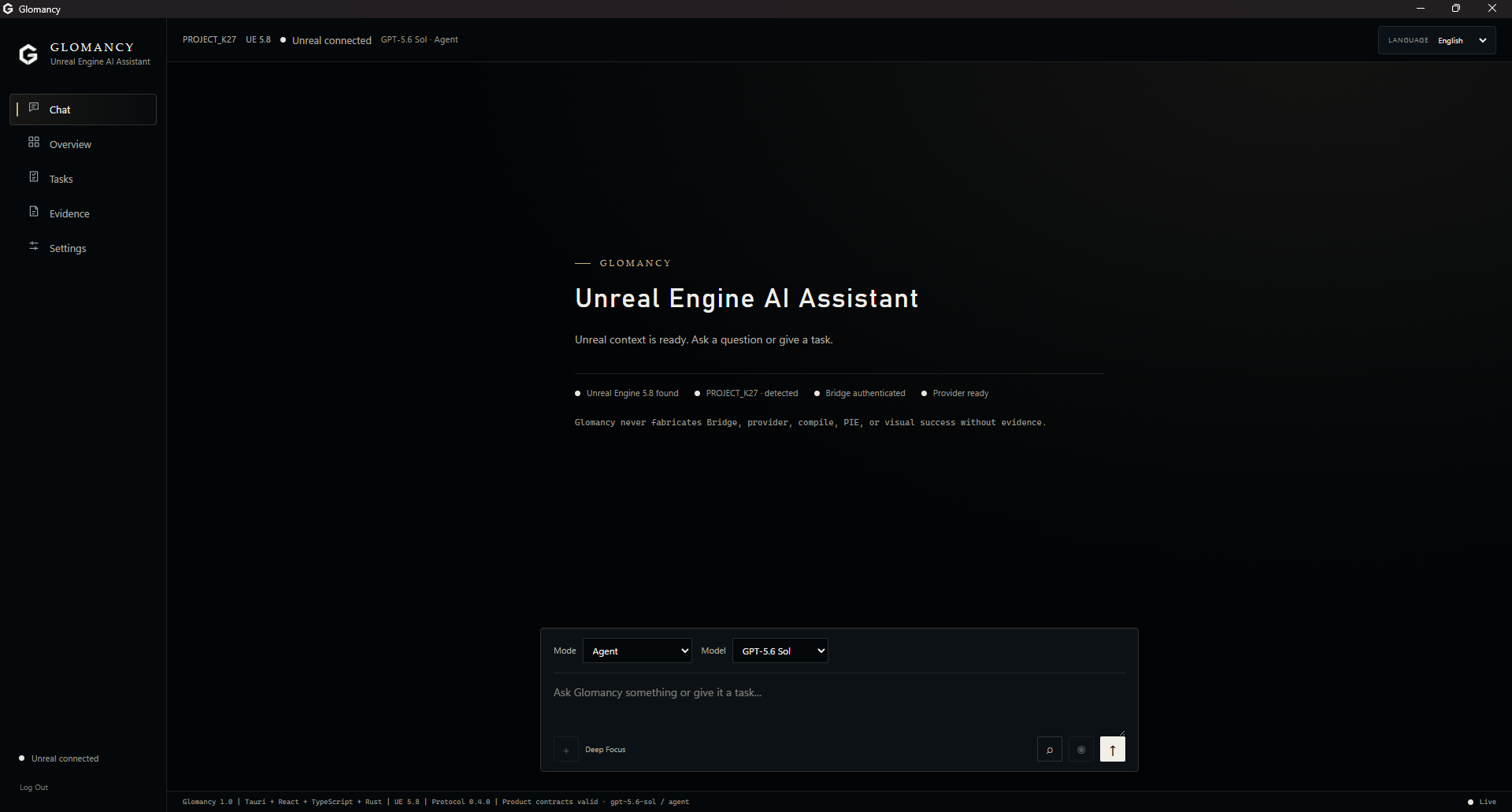
Real development build: an active Unreal Engine project is detected, the Desktop ↔ Unreal Bridge is authenticated, and the AI provider session is ready. Glomancy remains under active development; the current UI and capability surface represent one stage of a broader product roadmap.
The broader Glomancy product is being developed as an AI-native Unreal Engine development environment — not merely a chat interface or code generator. Its direction is to understand the project as a connected technical system, trace relationships across supported Blueprint, C++, asset, animation, AI, and editor contexts, plan multi-step work, execute through explicit editor integrations, and verify what actually happened.
The product thesis is deliberately ambitious: the developer should be able to state the outcome, while Glomancy increasingly gathers the relevant project context, investigates the system, connects dependencies, plans the work, performs supported changes, validates the result, and returns evidence.
The long-term goal is for Glomancy to become a force multiplier for game developers — a persistent technical co-pilot that reduces operational and cognitive overhead while keeping creative and engineering authority with the developer.
Read the full Glomancy product vision →
The broader Glomancy product is currently being developed primarily for Unreal Engine as an AI-assisted editor copilot and automation layer. Its high-level goal is to help turn a natural-language change request into a structured workflow: understand the active project/editor context, plan work, check capabilities and policy, request approval when appropriate, execute through supported Unreal/editor integrations, validate the result, and return status/evidence.
For Unreal Engine, the product direction includes assisting with supported editor workflows around project context, Actors and Components, Blueprints, materials, animation and AI systems, Sequencer-style workflows, and C++-backed editor operations as those integrations mature. The goal is not merely to generate text or code, but to make supported changes through explicit editor/tool interfaces and then verify what actually happened.
Unreal Engine is the first concrete product target, not a limitation of the protocol. Glomancy Protocol remains deliberately editor-agnostic, transport-neutral, and provider-neutral so the same public contract can be implemented by other editor/tool integrations without depending on the private commercial Glomancy runtime.
See Unreal Engine Product Focus for the concrete product context and why Unreal Engine is a useful proving ground for this protocol design.
Glomancy Protocol is the public OSS contract layer for that boundary. It does not contain the commercial Glomancy runtime or editor implementation. Instead, it makes AI-originated work easier to validate, test, audit, negotiate, and integrate safely.
| Problem | Protocol response |
|---|---|
| Two components may support different versions | Explicit wire-version negotiation |
| A peer may not support a requested behavior | Exact, fail-closed capability negotiation |
| Free-form AI text is ambiguous | Typed, versioned message schemas |
| Higher-risk work may need review | Explicit approval request/decision messages |
| Long-running work needs status | Progress and cancellation semantics |
| "It worked" is not enough | Result and evidence contracts |
| Integrations drift over time | Registry hashes, compatibility rules, fixtures, snapshots, and CI |
| External tools need structured diagnostics | Versioned conformance CLI JSON output with a published JSON Schema contract |
| Unknown input can be dangerous | Conservative fail-closed validation |
AI-assisted developer tools increasingly need to cross a high-trust boundary: an AI proposes work and another process may execute it. Ad-hoc JSON messages and direct text-to-tool execution make compatibility, auditing, approval gates, capability checks, and failure behavior difficult to reason about.
Glomancy Protocol makes that boundary explicit with:
- versioned handshake and compatibility rules;
- machine-readable capability negotiation with required/optional semantics;
- stable task lifecycle messages (
submit,progress,result,error,cancel); - explicit approval request/decision messages for risk-aware workflows;
- evidence records for verifiable outcomes;
- strict identifiers, trace/span metadata, and bounded protocol limits;
- a SHA-256-backed schema registry;
- fail-closed handling for unknown message kinds, schemas, incompatible versions, and unsupported required capabilities;
- valid and intentionally invalid fixtures for conformance testing;
- language-neutral consumer vectors for deterministic protocol decisions;
- published compatibility snapshots for released public contracts;
- a public conformance CLI with human-readable and versioned machine-readable JSON output;
- a Draft 2020-12 JSON Schema for the CLI JSON-output contract;
- executable Rust, independent Python, and independent JavaScript consumer examples.
Validation, compatibility, capabilities, approvals, and errors are explicit protocol concepts rather than hidden assumptions. The protocol does not replace authorization or sandboxing, but it gives those systems a predictable contract.
Structured messages make it easier to answer what was requested, which component sent it, which version/capability was selected, whether approval was involved, what result was reported, and what evidence was returned.
The public contract is transport-neutral and provider-neutral. An outside implementation can speak the protocol without adopting the private commercial Glomancy runtime. Language-neutral vectors and independently implemented Python and JavaScript examples demonstrate how the same published decisions can be consumed outside the Rust crate.
Schemas, registry hashes, compatibility cases, capability cases, language-neutral vectors, published snapshots, Rust tests, valid/invalid fixtures, repository validators, the public conformance CLI, its JSON-output schema, and independent consumer examples can all run in CI.
Wire versions, schema IDs, compatibility rules, snapshot regression checks, changelog discipline, and conformance checks make contract changes visible instead of silently changing behavior underneath consumers. The Pre-1.0 Deprecation and Schema Evolution Policy defines how public contracts are proposed, deprecated, migrated, and removed while the project is still evolving.
User request
    |
    v
AI / planning layer
    |
    v
Policy + capability checks
    |
    |  Glomancy Protocol
    v
Editor / tooling integration
    |
    v
Progress / result / error / evidence
    |
    v
Validation and user-visible outcome
For consequential work, an implementation can insert an explicit approval step before execution. Passing protocol validation or capability negotiation is not authorization by itself.
Requirements: Rust 1.85 or newer. Python is used for the public repository/conformance tooling. Node.js is optional and is only needed for the independent JavaScript consumer example.
git clone https://github.com/charman-07/glomancy-protocol.git
cd glomancy-protocol
cargo test --all-targets
cargo run --example quick_start
cargo run --example reference_consumer
python3 scripts/validate_repository.py
quick_start shows basic version and message-kind handling. The Rust reference_consumer demonstrates a fuller consumer boundary: version compatibility, exact capability negotiation, task capability gating, schema resolution, fail-closed required-capability rejection, and the explicit fact that authorization is still required. See Reference Consumer for the annotated walkthrough.
The repository validator checks JSON integrity, schema-registry hashes, fixture references, and protocol-version consistency.
For an integration that should survive repository changes, do not copy commands from mutable main without pinning a baseline first. See the External Adoption Guide.
The repository also contains independent, dependency-free consumer examples that implement selected public decisions without importing the Rust crate or the repository vector validator:
python3 examples/consumers/python/reference_consumer.py
node examples/consumers/javascript/reference_consumer.mjs
Both consumers load the same public registry and vectors/v1/ cases and independently exercise advertised-version selection, exact capability negotiation, task-time capability gating, and approval correlation/expiry behavior. CI runs both examples and fails if either disagrees with the published expected outcomes.
Run the language-neutral repository consistency suite directly with:
python3 scripts/validate_consumer_vectors.py
python3 scripts/validate_compatibility_snapshots.py
These maintained examples demonstrate implementability across languages; they are not claims of third-party adoption or production deployment.
Install the public conformance validator:
python3 -m pip install -r requirements-conformance.txtValidate a message using its embedded schema_id / kind:
python3 scripts/glomancy_conformance.py validate examples/v1/valid/task.submit.jsonExecute the entire public fixture corpus:
python3 scripts/glomancy_conformance.py fixturesList the registered message schemas:
python3 scripts/glomancy_conformance.py list-schemasFor automation, add --json:
python3 scripts/glomancy_conformance.py validate examples/v1/valid/task.submit.json --json
python3 scripts/glomancy_conformance.py list-schemas --json
The JSON interface carries output_version: "1.0.0". Its Draft 2020-12 machine-readable contract is published at conformance/v1/cli-output.schema.json, and repository CI checks representative real CLI outputs against it with:
python3 scripts/validate_cli_output_contract.pySee Protocol Conformance for exit codes, explicit schema selection, JSON-output fields, CI usage, and fail-closed expectations.
Current wire protocol: 0.4.0. Published Rust baseline: v0.1.0. Current unreleased Rust package line: 0.2.0.
The v1 schema set covers:
| Area | Message kinds / contract |
|---|---|
| Negotiation | handshake.request, handshake.response, capability profile |
| Task lifecycle | task.submit, task.progress, task.result, task.error, task.cancel |
| Human/policy approval | approval.request, approval.decision |
| Verification | evidence.record |
| Liveness | heartbeat |
See the External Adoption Guide for pinned consumption and upgrade guidance, the Consumer Integration Guide for an end-to-end language-neutral flow, and Consumer Conformance Vectors for independent implementation guidance. Capability Negotiation, Protocol Conformance, Architecture, Compatibility, Snapshot Compatibility, Pre-1.0 Deprecation Policy, Public Rust API Compatibility, and Security Model document the executable contract, design rationale, evolution rules, and trust boundaries.
The initial public capability profile intentionally starts conservative:
- matching is exact
name + version; - unsupported required capabilities reject the handshake;
- unsupported optional capabilities are omitted;
- duplicate capability names are rejected by the profile helper;
- a task may request only capability names selected for that session;
- capability negotiation never grants authorization by itself.
This behavior is backed by a machine-readable profile, conformance cases, Rust helpers/tests, language-neutral vectors, independent consumer examples, and CI validation.
Glomancy Protocol treats the message boundary as untrusted input.
- Fail closed. Unknown kinds, unknown schemas, unsupported protocol combinations, and unsupported required capabilities are rejected.
- Validate before execution. Protocol validation is a prerequisite, not authorization to perform an action.
- Keep policy explicit. Risk level and approval state belong in explicit contracts rather than hidden implementation behavior.
- Preserve evidence. Results can reference evidence so consumers can distinguish claims from verifiable artifacts.
- Bound inputs. Public constants define message, nesting, extension, and artifact limits.
- Keep secrets out of the protocol. Credentials and provider-specific authentication are out of scope.
- Keep capabilities narrow. Negotiated support does not imply trust, permission, or successful execution.
For vulnerability reporting, read SECURITY.md. Please do not disclose sensitive vulnerabilities in public issues.
| Broader Glomancy product | Glomancy Protocol |
|---|---|
| Commercial/private AI editor experience, currently focused primarily on Unreal Engine | Public MIT-licensed contract layer that remains editor-agnostic |
| Natural-language Unreal/editor workflow | Structured machine-readable messages |
| Private planning/orchestration implementation | Public task lifecycle semantics |
| Private Unreal/editor integrations and mutation implementations | Transport-neutral boundary contracts |
| Private model/provider/runtime choices | Provider-neutral schemas and types |
| Product policy and UX | Approval/capability/error primitives |
This repository intentionally contains no provider credentials, billing logic, private agent runtime, desktop application, proprietary planner/orchestrator, Unreal Engine mutation implementation, installer/updater, or signing infrastructure.
- Unreal Engine plugin/editor-tooling developers interested in structured AI-to-editor boundaries;
- AI editor/tool developers building structured AI-to-tool boundaries in other environments;
- plugin and integration authors that need versioned schemas and compatibility rules;
- security/platform engineers reviewing validation, approval, capability, and evidence flows;
- test/infrastructure engineers that want executable conformance in CI;
- researchers and OSS maintainers exploring typed alternatives to direct text-to-execution pipelines.
The protocol is not presented as a broadly adopted industry standard today. It is a pre-1.0 public project intended to become more useful through real integrations, independent implementations, review, and feedback.
src/                         Rust protocol types and validation helpers
schemas/v1/                  Wire-message JSON Schema contracts
registry/v1/                 Canonical schema registry and SHA-256 metadata
conformance/v1/              Versioned contracts for public conformance tooling output
vectors/v1/                  Language-neutral expected-outcome vectors
examples/                    Runnable Rust examples plus public protocol fixtures
examples/v1/                 Valid and invalid protocol fixtures
examples/consumers/python/   Independent dependency-free Python consumer
examples/consumers/javascript/ Independent dependency-free JavaScript consumer
compatibility/v1/            Version compatibility rules and cases
compatibility/snapshots/     Pinned real public-release compatibility baselines
capabilities/v1/             Machine-readable capability profile and cases
downstream/rust-consumer/    Standalone crate that consumes only the public Rust API
docs/                        Product context, adoption, architecture, conformance, compatibility, evolution, security, integration guides
scripts/                     Repository integrity, boundary, interoperability, fixture, and conformance tools
tests/                       Public contract regression tests
.github/                     CI and contribution / feedback workflow templates
Before 1.0, a patch change within the same protocol minor line is compatible; a different minor line is treated as incompatible. At 1.0 and later, versions with the same major version are considered protocol-compatible. Exact rules and negotiation behavior live in compatibility/v1/compatibility-matrix.json and are documented in docs/COMPATIBILITY.md.
Schema versions and wire-protocol versions are separate on purpose: a schema can evolve independently while negotiation remains explicit. CLI JSON-output versions and consumer-vector versions are separate again. Changes that deprecate or remove public behavior must follow docs/DEPRECATION_POLICY.md rather than silently mutating the contract.
Rust package SemVer is also tracked separately. The published v0.1.0 baseline remains the comparison point for the current unreleased 0.2.0 package line, and CI runs a pinned, checksum-verified cargo-semver-checks job so public Rust API breaks are explicit rather than accidental. See Public Rust API Compatibility.
This public repository is newly open-sourced, but the underlying protocol work had already been under active development, testing, debugging, and repeated validation before the public repository was opened. The current public focus is a small, auditable protocol core with executable conformance behavior rather than a large framework.
The broader private Glomancy product is being developed with Unreal Engine as its first primary editor target. That concrete product work gives the protocol a real high-trust editor environment to design against, while the public protocol intentionally avoids depending on Unreal-specific implementation details.
The repository includes cross-platform Rust tests, JSON Schema validation, public/private boundary checks, capability-negotiation validation, language-neutral expected-outcome vectors, independent Python and JavaScript consumer examples, published compatibility snapshots, registry hash checks, supply-chain maintenance rules, a public conformance CLI, versioned machine-readable CLI output, a published schema for that output, a standalone downstream Rust consumer, an executable public demo, package-boundary validation, and public Rust API SemVer regression checks. It is still pre-1.0; genuine external integration feedback and independent usage remain important before stronger stability or adoption claims are appropriate.
If you have actually implemented or evaluated the public protocol independently, use the dedicated Integration feedback issue form. Maintainer-derived implementation notes live separately in Integration Pitfalls and Implementation Notes; the project does not treat those notes as external adoption evidence.
Planned work is tracked in ROADMAP.md and GitHub Issues. Roadmap items are direction, not promises or fabricated adoption claims.
Contributions are welcome. Read CONTRIBUTING.md and CODE_OF_CONDUCT.md before opening a pull request. Good first contributions include additional fixtures, validation tests, documentation, interoperability examples, and edge cases that remain inside the public protocol boundary.
If you built an independent consumer, proof of concept, editor/tool integration, or conformance implementation, genuine test results are also useful through the Integration feedback issue form. Do not include credentials, customer data, private source code, or sensitive infrastructure details.
Project decisions and maintainer responsibilities are described in GOVERNANCE.md. Support guidance is in SUPPORT.md.
Every release should pass formatting, Clippy, tests, documentation checks, cross-platform test jobs, repository integrity validation, capability-profile validation, independent consumer examples, compatibility-snapshot checks, executable examples, executable conformance checks, package-boundary/MSRV checks, the runnable public demo, and public Rust API SemVer review. Public deprecations/removals must also carry explicit migration notes under docs/DEPRECATION_POLICY.md. The release checklist is documented in RELEASING.md, and notable changes are recorded in CHANGELOG.md.
Glomancy Protocol is licensed under the MIT License.
The separate commercial Glomancy product and its private implementation are not licensed under this repository's MIT license.