




Your dependency tree has 300 crates. You have time for three.
cargo-depcheck is a dependency-health report for Rust projects. It combines
RustSec advisories, version lag, maintenance activity, and dependency-graph
impact into one ranked list.
cargo audit answers “is this vulnerable?” and cargo outdated answers “is
this old?”. cargo depcheck answers the follow-up question:
Which dependency deserves attention first?
Documentation · How scoring works · Compared to cargo-audit, cargo-outdated, and cargo-deny
cargo install cargo-depcheck
cd your-rust-project
cargo depcheck
The first run downloads registry metadata and the RustSec advisory database. Later runs reuse Cargo's caches.
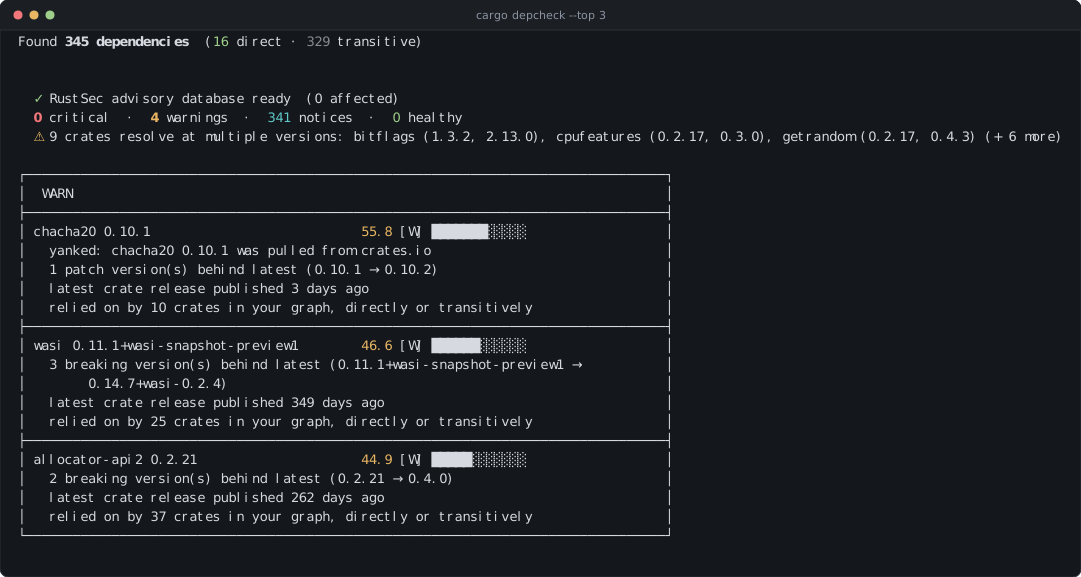
The report is a ranked list. Direct dependencies are bold, and every row carries the score, a severity tag, and the reasons behind it:
┌─────────────────────────────────────────────────────────────────────────────┐
│  WARN                                                                       │
├─────────────────────────────────────────────────────────────────────────────┤
│ wasi 0.11.1+wasi-snapshot-preview1        46.4 [W] ██████░░░░░░             │
│   3 breaking version(s) behind latest (0.11.1+wasi-snapshot-preview1 →      │
│        0.14.7+wasi-0.2.4)                                                   │
│   latest crate release published 342 days ago                               │
│   relied on by 25 crates in your graph, directly or transitively            │
└─────────────────────────────────────────────────────────────────────────────┘
The score is not a vulnerability severity score. It is a prioritization score: a stale crate deep in the graph can rank above a stale leaf because more of the project depends on it.
| Level | Score | Suggested response |
|---|---|---|
| CRITICAL | > 70 | Investigate promptly |
| WARN | 40–70 | Plan an upgrade or document why it can wait |
| NOTICE | < 40 | Low-priority signal; hidden by default |
Direct dependencies are bold. Severity is never color-only — each row
also carries a [C] / [W] / [N] tag, so it stays readable in
grayscale, piped through a color stripper, or with --color never. Bold
identifies ownership; it does not add points to the score.
notice means “below the warning boundary”, not “broken”. Because even a
small amount of publish age produces a non-zero score, a mature project may
have many notices and few score-zero healthy crates. The default report
hides those notices so the actionable items remain short.
cargo depcheck                          # the default report
cargo depcheck --top 5                  # only the five worst
cargo depcheck --threshold 30           # show lower-scoring issues too
cargo depcheck --threshold 0            # enumerate the complete checked graph
cargo depcheck --ignore libc            # hide a crate you've already triaged
cargo depcheck --quiet                  # summary counts only
cargo depcheck --json > report.json     # machine-readable
cargo depcheck --format markdown        # for a PR comment or job summary
cargo depcheck explain wasi             # why does this crate score that?
--threshold and --top control what is printed, not what CI evaluates. A
warning hidden by --threshold 80 still makes --fail-on warn exit non-zero.
Summary buckets are also threshold-independent: notice means a non-zero
score below WARN, healthy means a checked score of zero, unknown means
registry metadata was unavailable, and path/git dependencies are
not_applicable.
explain shows the whole derivation — each signal against its cap with the
evidence behind it, the graph multiplier and the count it came from, and the
arithmetic that produces the total:
cargo depcheck explain wasi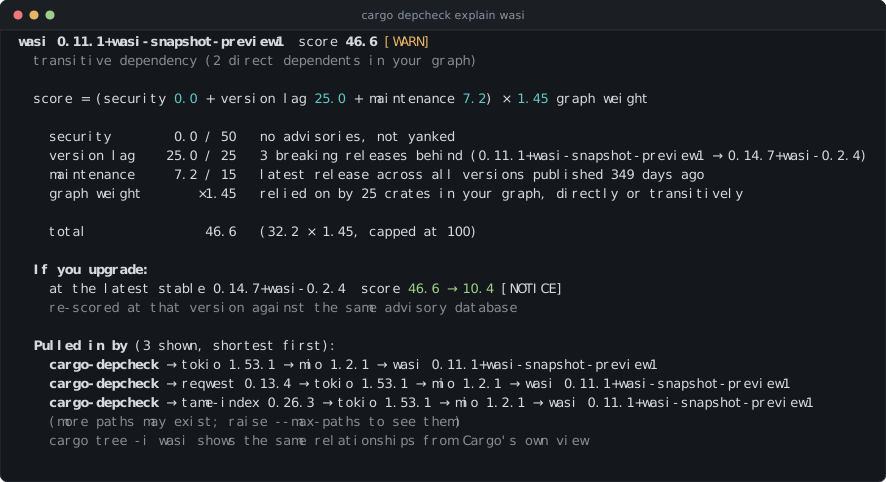
Three things it answers that the ranked report can't:
- Which of your own dependencies pulled this in. A transitive finding is
only actionable once you know the direct dependency behind it, so the paths
are printed shortest-first, with
[build]or[dev]marking the hop where a path crosses a build-script or dev-only edge. (cargo tree -i wasishows the same relationships from Cargo's own view.) - Whether upgrading would actually help. The crate is re-scored at each upgrade target — within its Cargo compatibility line, and at the latest stable — against the same advisory database, rather than assuming an upgrade only cancels version lag.
- Why a crate you expected isn't listed. Being below your threshold, suppressed by an ignore rule, or excluded as a dev/build dependency is stated outright.
Add --format json for the same breakdown as data, or --max-paths N to see
more paths. explain is a diagnostic: it never fails a build, whatever it
finds.
A project with an existing backlog fails --fail-on warn on day one, for
reasons nobody in this PR introduced. A baseline separates the two:
cargo depcheck --write-baseline depcheck-baseline.json   # once, then commit it
cargo depcheck --baseline depcheck-baseline.json --fail-on warn
The full report is still shown, with each finding marked known or new, and
only the new ones can fail the build. A finding is new if the baseline has no
entry for that crate at that version, if it carries an advisory the
baseline didn't, or if it has crossed into a higher severity.
Score drift alone never counts as new: maintenance points grow every day a crate isn't republished, so matching on exact scores would report every untouched dependency as new on the next run.
The baseline file is an ordinary JSON report, so any report you've already
archived works as one. Write it at the same --threshold you gate on — a
mismatch is warned about, since a baseline can only contain what its own run
reported. --top is refused with --write-baseline, because a truncated
baseline would report everything it omitted as new next time.
After reviewing the report, ask Cargo to apply only upgrades that stay on each resolved crate's current compatibility line:
cargo depcheck upgrade --compatible --dry-run
cargo depcheck upgrade --compatible
The dry run asks Cargo to validate every exact name@current → target update
and does not write Cargo.lock. A real run:
- considers non-ignored registry findings visible at the configured threshold;
- allows compatible security and yanked-version fixes, regardless of severity;
- changes
Cargo.lockonly — neverCargo.toml; - runs
cargo check --workspace; and - restores the original lockfile if an update or verification fails.
Cargo's compatibility rules are followed exactly: 1.x stays on the same
major, 0.y stays on the same minor, and 0.0.z does not move automatically.
Breaking-only and manifest-blocked updates are skipped with guidance. Use
--no-verify only when you intend to verify the workspace yourself.
--locked, --frozen, --offline, JSON, and SARIF are intentionally
rejected for this mutating workflow.
Let the exit code enforce policy; there is no need to parse terminal output:
cargo depcheck --fail-on critical| Exit code | Meaning |
|---|---|
0 |
Clean, or nothing reached your --fail-on level |
1 |
Something at or above --fail-on was found |
2 |
Usage error (bad flag, bad config) |
3 |
Registry or advisory data was incomplete (--allow-incomplete to allow) |
First run needs network (the crates.io sparse index and the RustSec
advisory DB). Both land in the caches cargo already uses, so later runs
are fast — and --offline skips the network entirely, using whatever
both caches already hold. Any registry dependency not yet cached is reported
as unknown and marks the run incomplete rather than being quietly assumed
healthy. Path and git dependencies are counted separately as not applicable.
Downloads a prebuilt binary — no source build in your CI:
- uses: debrajrout/cargo-depcheck@v1
  with:
    fail-on: critical    # none | warn | critical
It writes the report to the job summary, and exposes critical,
warnings, notices, unknown, not_applicable, ignored, and healthy
as step outputs:
- uses: debrajrout/cargo-depcheck@v1
  id: depcheck
  with:
    fail-on: none    # don't fail here — decide from the outputs instead
- run: echo "found ${{ steps.depcheck.outputs.critical }} critical issues"
Send findings to the Security tab with SARIF:
permissions:
  security-events: write

steps:
  - uses: debrajrout/cargo-depcheck@v1
    with:
      sarif: true
      fail-on: none
The upload runs before fail-on can fail the job, so findings reach the
Security tab either way. Every finding gets a sortable security-severity
— including the ~65% of RustSec advisories that have no CVSS score.
Comment the report on pull requests, updating one comment instead of adding a new one on every push:
permissions:
  pull-requests: write

steps:
  - uses: debrajrout/cargo-depcheck@v1
    with:
      comment: true
      top: 10
      baseline: depcheck-baseline.json   # optional: mark what's new in this PR
Like the SARIF upload, the comment is posted before fail-on can fail the
job — a failing check is exactly when the reviewer needs the report. If the
job lacks pull-requests: write (the default for a pull request from a fork),
the comment is skipped with a warning rather than failing the build. Set
comment-key when one workflow runs the action more than once, so each run
updates its own comment instead of overwriting a sibling's.
Other inputs: version, manifest-path, threshold, top, baseline,
ignore, allow-incomplete, summary, sarif-category, comment-key.
Outputs also include report-path, markdown-path, and comment-url.
See action.yml.
version: local skips the download and runs a cargo-depcheck already on
PATH — for a job that installed it with cargo install, a vendored binary,
or a runner with no access to GitHub releases.
Commit your policy so every developer and CI job uses the same settings:
[package.metadata.depcheck]
threshold = 30
fail_on = "critical"

[[package.metadata.depcheck.ignore]]
crate = "openssl"
reason = "vendored, patched internally"
expires = "2027-01-01" # optional — omit for a permanent ignore- CLI flags beat the config file.
CARGO_DEPCHECK_THRESHOLDandCARGO_DEPCHECK_FAIL_ONwork too. --ignoreadds to the config's ignore list rather than replacing it.- Once
expirespasses, the ignore stops applying and the crate is reported again, with a warning pointing at the stale entry — so muting something can't silently become permanent. - A workspace can use
[workspace.metadata.depcheck]as a fallback for members that don't define their own.
Every crate scores 0–100:
score = (security + version_lag + maintenance) × graph_weight
| Signal | Max | Source |
|---|---|---|
| Security | 50 | RustSec advisories, or a yanked version |
| Version lag | 25 | Releases behind the latest stable |
| Maintenance | 15 | Days since last publish (caps at 2 years) |
| × Graph weight | 1.0–2.0 | How many crates depend on this one |
That multiplier is the point. A stale leaf crate nobody imports scores lower than the same staleness in a crate holding up 30 others.
Three things worth knowing:
- Version lag follows Cargo's compatibility rule. Below 1.0,
0.3.1→0.4.0is a breaking gap, scored like1.0.0→2.0.0— not a routine minor bump. - Advisories without a CVSS score still get ranked, by category rather than a flat guess. That's 65% of the RustSec database.
- Graph weight is absolute, not relative to your project — so a threshold you tune once means the same thing everywhere.
See the full scoring reference for exact point values and design rationale.
Run cargo depcheck --help for the version installed on your machine.
| Flag | What it does |
|---|---|
--threshold N |
Display crates scoring ≥ N (default: 40); does not weaken --fail-on |
--top N |
Display only the N highest-scoring crates; does not weaken --fail-on |
--ignore CRATE |
Skip a crate — repeat for multiple |
--fail-on LEVEL |
Exit non-zero at none | warn | critical (default: none) |
--baseline PATH |
Compare against a stored report; --fail-on sees only new findings |
--write-baseline PATH |
Write this run's report for a later --baseline to compare against |
--format FORMAT |
human | json | sarif | markdown |
--json |
Alias for --format json |
--quiet |
Summary line only |
--manifest-path PATH |
Point at another project |
--color WHEN |
auto | always | never (respects NO_COLOR) |
--offline |
Local caches only, no network at all (implies the cached advisory DB) |
--locked / --frozen |
Require an up-to-date Cargo.lock |
--no-advisories |
Skip RustSec — version and maintenance only |
--no-fetch |
Use the cached advisory DB, no git pull |
--allow-incomplete |
Exit 0 even if some crates couldn't be checked |
--include-build |
Also check build-script (build.rs) dependencies |
--include-dev |
Also check dev-dependencies |
Run cargo depcheck explain --help and cargo depcheck upgrade --help for
the per-command options. The upgrade command is intentionally local and
human-focused; the GitHub Action continues to analyze without modifying a
checkout.
--json output carries schema_version (currently 4) plus
tool_version, generated_at, project, and advisory_db_commit, so a
stored report still makes sense when you read it back later. Schema 3
introduced exclusive notices, not_applicable, and ignored summary
buckets and reserved healthy for checked dependencies whose score is zero;
schema 4 adds an optional per-finding baseline field ("new" or "known")
that appears only when a run compared against --baseline, so a report
produced without one is byte-identical to schema 3.
Shell completions and man page
cargo depcheck completions bash > /usr/local/etc/bash_completion.d/cargo-depcheck
cargo depcheck completions zsh  > "${fpath[1]}/_cargo-depcheck"
cargo depcheck completions fish > ~/.config/fish/completions/cargo-depcheck.fish

cargo depcheck mangen > /usr/local/share/man/man1/cargo-depcheck.1
elvish and powershell work too. Every release archive also
ships pre-generated copies of all five, alongside the man page.
Building from source
git clone https://github.com/debrajrout/cargo-depcheck
cd cargo-depcheck
cargo install --path .
Needs Rust 1.91+.
| depcheck | audit | outdated | deny | |
|---|---|---|---|---|
| Security advisories | ✓ | ✓ | ✓ | |
| Version lag | ✓ | ✓ | ||
| Maintenance age | ✓ | |||
| Ranked by graph impact | ✓ | |||
| Per-crate score breakdown | ✓ | |||
| Baseline / fail only on new | ✓ | |||
| JSON output | ✓ | ✓ | ✓ | |
| SARIF / Security tab | ✓ | |||
| License / policy enforcement | ✓ |
They are complementary: use audit to block known vulnerabilities, deny for license and policy enforcement, and depcheck to prioritize dependency maintenance.
Whether you fix a typo, add a test, or redesign scoring — there's a place for your work.
| I want to… | Start here |
|---|---|
| Report a bug | Bug report |
| Suggest a feature | Feature request |
| Write code | CONTRIBUTING.md |
| Find an easy task | good first issue |
| Ask a question | Discussions |
Scoring feedback is especially welcome — if a ranking feels wrong for your project, that's a bug report worth filing.
Code of Conduct · Security policy
Dual-licensed under MIT or Apache-2.0.