
⚠ Warning: Running the solution require nodejs 20.0.0 or above.
https://www.tomdalling.com/toms-data-onion/
Tom's Data Onion is a series of layers of obfuscated data along with instructions on how do deobfuscate it.
As Tom puts it:
There are many puzzles wrapped inside each other, like a matryoshka doll, or the layers of an onion.
I have had this website bookmarked for years and no longer know where I originally found it, but have wanted to solve it for a long time. I believe I started solving it a couple of years ago, but got stuck on layer 3 and gave up.
For a while now I've primarily been working in JavaScript (yes, not even TypeScript) so I decided to stick with that. I tried keeping the layers separate but using the same format and having main.js being mostly just scaffolding.
For each layer I save the full layer along with just the payload to make it easier for me to see if my solution was correct and the ASCII85 encoded string has the correct start and end delimiters.
The following sections assume you have read the instructions for the that layer before reading my solution comments.
Beware, possible spoilers ahead!
I decided to implement the ASCII85 decoder myself using the description and examples I was able to find on Wikipedia. Doing this turned layer 0 into something much harder than layers 1 and to.
A thing I noticed is that the Wikipedia article does not mention the <~ delimiter used to mark the start of the ASCII85 encoded string.
Pretty easy. Shift the bytes while replacing the most significant bit with the least significant bit from the original byte.
I didn't check the hints until after I had gotten this working and was delighted to find that they pencilled out exactly what I had done myself.
Nothing much to say here, still pretty simple. I feel like I'm kind of cheating a bit by converting numbers to strings containing the binary representation, but I don't want to try and do it in another way.
In between solving layers 2 and 3 I refactored my ASCII85 decoder from returning a string to an array of numbers, which I think made working with it a lot cleaner.
This layer has a secret key that we will need to crack. I can see that each of the layers has started with a message like:
==[ Layer 3/6: XOR Encryption ]=============================

Lorem Ipsum
I'm assuming the next layer will also start similar to this. Knowing some decoded characters along with their position in the rotating secret key we can start to fill out the positions in the key by xor'ing the encrypted message with the guessed parts of the message.
I'm guessing that the first 15 bytes of the payload is going to be ==[ Layer 4/6: and skipping ahead to the next part of the message with an unknown byte in the key I can see that they are mostly "=" along with 2 new-lines.
I know have 30/32 bytes in the secret key and from here I'm just going to guess; So I take 2 random bytes as the remainder of the key and decode the whole payload and then look for the payload marker which I know is going to be somewhere in the message. Since the payload marker is longer than the key we can be sure that we do indeed have the correct key. Cracking the last 2 bytes of the secret key took just a couple of minutes on my ~4 year old laptop.
At one point during implementing I actually did notice that I had gotten most of the title of the next layer as something like ==[ Layer 4/6: Network Traffi*2, from which I deduced that the first 32 bytes of the payload was ==[ Layer 4/6: Network Traffic ], however I wanted to find the secret key programmatically without me guessing some it.
Networks like Tom's Data Onion are made up of layers, in this case some data wrapped in a UDP layer which then is wrapped in a IPv4 layer.
The instructions mention the officials specifications for the IPv4 and UDP protocols, but those are hard to understand, so I instead go straight to wikipedia where I find this image showing the structure of an IPv4 packet.

From this I recognize that I will need to extract 4 pieces of information: "Total length", "Header checksum", "Source address" and "Destination address". Luckily none of these fractions of bytes, so extraction is easy enough. Calculating the IPv4 checksum was a bit confusing to me because of JavaScript's use of 32-bit SIGNED integers in bitwise operations, so had to lookup1 what I was missing and turns out I needed to mask the one's complement to only keep the 16 LSB's.
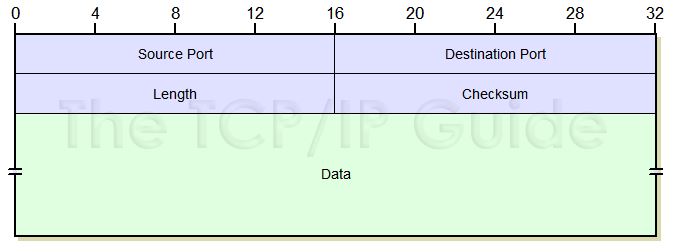
Next up is the UDP header which only contains 4 fields, "Source port", "Destination port", "Length" and "Checksum", of which I need everything but the source port.
I got caught on the checksum calculation initially because it seemed from both the specification and Wikipedia that the checksum was needed to calculate the checksum turning it into some kind of grandfather paradox. I quickly though found a UDP checksum calculation example2 that helped me figure it out. Shortly after I got confused about the wording of how to calculate the checksum used in the specification and instead went back to the example I found and used the method for calculating it found there.
Instructions says not to try and implement the AES decryption myself and after just having finished layer 4 I'm going to comply with that suggestion.
For the library I decided to go with Node.js built-in crypto api and I started out trying to identify what cipher to use, so I wrote a small utility script for displaying the different options 3, for deciphering the KEK that seems to be id-aes256-wrap and for the payload itself it seems to be aes-256-ctr.
For testing purposes I initially tried to decrypt the KEK using OpenSSL only to find that OpenSSL v1.1, which is widely used, doesn't actually support decrypting wrapped keys or maybe it does and it's only using the enc command that doesn't allow it, anyway I wasn't able to do it before abandoning the idea.
My goal with the testing was to have the correct answer so I would know if my code was working as intended. I instead took the "Wrap 128 bits of Key Data with a 256-bit KEK" example values from RFC 3394 4 taking care to note that this document uses the default initialization vector (0xA6A6A6A6A6A6A6A6).
Since I decided not to implement the decryption myself once I had decrypted the key it was just a matter of plugging in the correct cipher for the payload and I had the next layer.
After having finished this layer and looked at the AES Key Wrap Algorithm specification it doesn't actually look too hard to decrypt the KEK myself, but still I can't be bothered to implement both this and the actual AES decryption, so I will just go on to the next layer.
As the instructions suggested I was indeed quite intimidated by writing an emulated which was not made any better by the instructions being 500 lines long compared to the second longest instruction (layer 1) being only about 100 lines.
I had a pretty good idea of how I wanted to structure the code and actually started writing it while reading the instructions (I had skimmed through already). Instructions need to be pretty simple for a computer to understand them and so were these. I was actually surprised how easy it was to implement this and how few bugs I needed to sort out as the only thing I missed really was the (ptr+c) pseudo-register which I had initially handled like a normal register that could be read from and written to instead of it pointing to memory addresses. Once I had added that bit of logic and ran the example code provided in the instructions I saw "Hello, world!" and my VM was working.
Yay! I reached the core of Tom's Data Onion!
There is indeed a secret hidden at the core of the onion, but not to me as I have learned this secret many years ago while traveling in the orient. It might sound like some silly flavour text, but I actually did.
I would suggest you don't run my code at all and instead write your own, as it's true when they say that it's not about the destination, it's about the journey.
I had a lot of fun and have stayed up a bit later than I should have a couple of nights trying to solve this. Good luck trying to get to The Core yourself!