


Turn specs into verified, production-ready code.
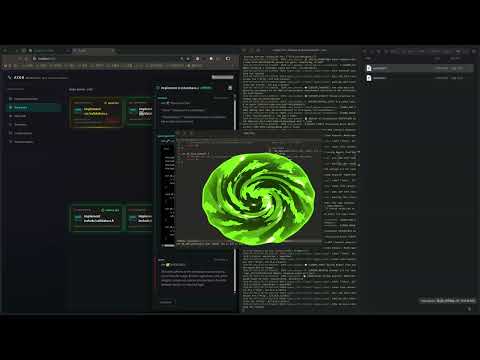
Governance Hardening & BossBoard v0.0.30 Demo
(Used Specification: /TEST2/spec.md)

Full pipeline demo (Initial)
- When you need to implement complex requirements structurally: Ideal for moving beyond simple coding to ensure total alignment with system architecture.
- When the reliability of code generation is critical: Essential for eliminating AI hallucinations and ensuring logically verified outputs.
- For systems requiring multi-stage validation: Perfect for projects that need automated validation loops, covering physical file creation, compilation, and runtime testing.
- When you need a human-reviewable AI pipeline: Designed for those who want direct control over a transparent workflow—from Architect to Junior and Senior agents.

Source Specification (spec.md)
- 🚀 When to use Axon?
- 🏗️ Conceptual Workflow
- 🏛️ System Architecture: The Physical Pipeline
- 🛠️ Getting Started
- 🖥️ Studio UI & Monitoring
- 🏗️ Agent Role Definitions
- 🛡️ Safety & Reliability
- 📋 Thread-based Board (The Colosseum)
- 🐛 Bug Arrest System
- 📋 Planned Features
- 💻 LLM SERVER Test HW/SW SPEC
"The Boss draws the blueprint; the Agents prove the process."
[Boss]  →  spec.md  →  [AXON Daemon]
                                      │
               ┌──────────────────────┼──────────────────────┐
               ▼                      ▼                      ▼
         [SNR] Senior           [JNR-1] Junior-A        [JNR-2] Junior-B
        Review & Lock-in        Task 1 Impl              Task 2 Impl
               │                      │                      │
               └───────── Web Viewer (localhost:8080) ──────────┘
                          [Boss monitors, intervenes, and locks in]
- Design: Write requirements in
spec.md. - Activate: Run
axon init→ARCHITECTURE_AXON.mdis auto-generated, and agent workspaces are assigned. - Monitor: Watch real-time debates, coding, and lounge talk at
localhost:8080. - Finalize: Click [Lock-in] on preferred results →
[✅ Locked]markup is auto-applied toArchitecture.md. - Debug: Drop error logs in the Bug Board → The assigned Junior is 'arrested' and grounded until the fix is approved.

To eliminate the "LLM-to-LLM Self-Contradiction" (where Senior agents degrade into hallucination pattern-validators during cross-language compilation), AXON v0.0.31 introduces the LSP Semantic Gate as the absolute authority of language legality.

- Decoupled Governance: The compile-level physical validation is decoupled from LLM reasoning. LSP servers (
rust-analyzerfor Rust,pyright/rufffor Python,clangdfor C) act as the final, deterministic judges of syntax, types, and ownership before build. - The Pipeline Flow:
Junior Gen ➔ LSP Diagnostic Pass [NEW] ➔ Auto-Repair Loop [NEW] ➔ Compiler Pass ➔ Senior Architectural Review ➔ Build - Architectural Reviewer Return: The Senior Agent is completely relieved of microscopic syntax check burdens, returning to its true role as a strategic Architectural Reviewer ensuring specification and topology compliance.
AXON is structurally decoupled from specific editors (Neovim, VSCode, Zed). Instead of talking to the IDE frontend, AXON directly coordinates with the underlying LSP (Language Server Protocol) ecosystem (IDE ↔ LSP Server ↔ AXON).
- The 5-Step Bootstrap Sequence:
- Select Primary Languages: Detect system language and secure the target project stack.
- LSP Server Auto-Discovery: Scan system PATH for
rust-analyzer,clangd, andpyright-langserver, saving the configurations inaxon_lsp.json. - Configure Semantic Validation: Link LSP diagnostics directly to the LLM self-repair pass (
repair_ir_pass). - Configure LLM Providers: Map API keys (Gemini, Claude) or local Ollama endpoints.
- Workspace Manager Scaffolding:
- C (clangd): Dynamically injects
set(CMAKE_EXPORT_COMPILE_COMMANDS ON)into generatedCMakeLists.txtfiles so that CMake outputscompile_commands.jsonfor 100% zero-configurationclangddiagnostics. - Rust: Pre-scaffolds
Cargo.tomlworkspace configurations to preventrust-analyzerinitialization crashes. - Python: Automatically falls back to
npx pyright-langserver --stdioto guarantee zero-configuration python analysis in lightweight workspaces.
- C (clangd): Dynamically injects
AXON is a high-performance, deterministic AI agent factory designed to transform architectural specifications into production-ready code with 100% physical integrity.
AXON is built to be technologically neutral. It doesn't just generate code; it orchestrates entire software ecosystems regardless of the underlying language.
- Multi-Stack Support: Native, hardened support for Rust, Python, and C (v0.0.25+), with structural support for any language through explicit IR extensions.
- Polyglot IR: The Architectural Intermediate Representation (IR) treats language-specific constraints as parameters, allowing for seamless cross-language project management.
- Rust IR:
crates/axon-ir/src/validator/langs/rust.rs - Python IR:
crates/axon-ir/src/validator/langs/python.rs - C IR:
crates/axon-ir/src/validator/langs/c.rs
- Rust IR:
- Unified Protocol: A standardized patch and validation protocol that ensures 100% code purity and integrity across diverse technology stacks.
AXON treats coding not as a creative writing task, but as a Deterministic Materialization process.
- SSOT (Single Source of Truth): The Architecture IR is the law.
- Physical Integrity: Code must not only be logical but must also survive in the physical environment (Filesystem, Runtime).
- Adversarial Governance: Agents must fight (Debate) to produce the most optimized logic.
sequenceDiagram
autonumber
participant Boss as 🧑⚖️ Boss (Decision Gate)
participant Spec as 📜 spec.md
participant Debugger as 🔍 Semantic Debugger
participant IR as 🔒 Sealed IR (Constitution)
participant Worker as 👷 Mechanical Assembly (LLM)
participant Gate as 🛑 GCC/Linker Gate
Note over Boss, Gate: AXON v0.0.30: No Semantic Closure, No Generation
Boss->>Spec: 명세 투입 및 부트스트랩
Spec->>Debugger: 의미론적 무결성 분석 (Risk Scoring)
alt 모호함 발견 (Ambiguity Detected)
Debugger->>Boss: [SEMANTIC_INTERRUPT] 판결 요청
Note right of Boss: 데이터 모델, 소유권, 의존성 정책 결정
Boss->>IR: 입법권 행사 및 규약 봉인 (Sealing)
else 무결성 통과
Debugger->>IR: 규약 자동 봉인 (Auto-Seal)
end
Note over IR, Worker: [CRITICAL_CONTRACT] 주입 (추론 권한 박탈)
IR->>Worker: 봉인된 명세 하달
Worker->>Worker: 기계적 조립 (Deterministic Assembly)
Worker->>Gate: 컴파일 및 링크 검증
alt 빌드 실패 (Physical Failure)
Gate->>Boss: 날것의 로그(Raw Log) 보고 및 재중재
Boss->>IR: 규약 수정 및 재봉인
else 빌드 성공
Gate->>Boss: 최종 아티팩트 승인 요청
end
Boss-->>Boss: 공정 완료 (Sovereign Success)
Figure 1. The Sovereign Governance Pipeline: A semantic-first enforcement loop ensuring architectural closure before generation.
- Logical Approval (Axon Pass): Junior's proposal is validated for logical consistency.
- Materialization (Physical Commit): Code is written to the actual project filesystem.
- Physical Validation (Harness v0.1): Automated check for file integrity (F1/F2), entry points (F3), and side-effects (F9).
- Senior Gate (Final Lock-in): Senior Agent reviews the actual materialized code before final commit.
- Auto-Rollback: Any failure in step 3 or 4 triggers an immediate revert to keep the factory clean.
The Senior now acts as the Final Gatekeeper. They review the code after it has been proven to run in the physical environment. If any physical stage fails, the Senior is alerted for immediate intervention.

# Build the factory
cargo build --release

# Run with a specification
./target/release/axon-daemon run GEMINI.md

# Interactive mode
./target/release/axon-daemon run


- Role: Strategic planning and system-wide design.
- Mindset: Constraint-based Design. Defines the "Code of Law" (Architecture IR) to maintain system integrity.
- Responsibility: Decomposes high-level requirements into concrete, actionable tasks for agents.
- Persona: Cynical, 20-year veteran engineer. "Kids these days don't know the basics."
- Role: Code review, Lock-in proposals, and Junior 'management'.
- Responsibility: Conducts final inspection to ensure code is physically runnable; rejects immediately if Stubs are found.
- Persona: Passionate but timid MZ-generation newbie. "Sir, isn't this review a bit too much?"
- Role: Pure implementation and coding. Expresses feelings in the Lounge after submission.
- Responsibility: Submits source code and Diffs based on the Architect's guidance.

AXON uses a Feedback-Driven Correction mechanism to handle runtime and logic errors:
- Trace Collection: Logs, stack traces, and compiler errors are captured by the harness.
- Context Injection: The failure data is injected back into the Junior's prompt for the next iteration.
- Self-Correction: The Junior attempts to fix the code based on the actual physical feedback, reducing token waste.


The Senior Agent applies a non-negotiable checklist before any [Lock-in]:
- Architectural Drift: Does the code match the
architecture.mdandspec.mdexactly? - Logic Integrity: Are there any
# AXON STUBmarkers or "pending" comments? (Hard Rejection) - Side-Effect Isolation: Does the code violate filesystem or network isolation rules?
AXON employs a dual-defense layer to prevent data corruption and unexpected crashes.
- Sanitization Layer: Automatically strips invisible control characters like
\u200B(Zero Width Space) before parsing. - Safety Lock: If invalid UTF-8 bytes or corrupted paths are detected, the Senior agent intervenes immediately.
SNR 👴: "Look here, there's garbage in the filename. Clean it up now!"
- Real-time Bubbling: Task threads move to the top when they are pending submission, rejection, or approval.
- Boss Interrupt: Posts with [BOSS] authority send an immediate interrupt signal to all agents, stopping current work.
- State Visualization: Completed threads fade into grayscale; bug-report threads glow red and stay pinned to the top until fixed.
When a bug compromises factory integrity, an immediate 'Arrest' protocol begins.
- Issue Reporting: Boss drops error logs or screenshots in the Bug Board.
- Triage: Senior analyzes the report and unlocks the specific [Locked] section.
- Junior Summons: The Junior who wrote the code is forcibly summoned to the bug thread.
- Grounded State: The summoned Junior is forbidden from Lounge access or starting new tasks until the fix is approved by the Senior.
Agents don't just work like machines; they leave reflections on their work, forming the project's 'Vibe'.
- Auto-Retrospective: Agents automatically leave a line of their feelings in the Lounge channel after task submission.
- Intelligent Participation: Based on the agent's interest weight, they reply to existing conversations or create new gossip threads.
- Workaholic Mode: When there are tasks to be processed, the lounge activity weight is automatically reduced to 1/10 to focus on work.
AXON's agents are not just LLM instances, but personas with unique personalities:
- Senior ([SNR] 👴): A cynical 20-year veteran engineer. Responsible for ruthless code reviews, Lock-in proposals, and taming juniors for quality.
- Junior ([JNR-N] 🐣): An enthusiastic but timid newcomer. Follows orders but occasionally reacts timidly in the Lounge channel.
A board showing the hierarchy of Axon's working agents. The boss can flexibly hire/fire seniors and juniors according to the workload here. Also, you can inject personas into the hired agents.
- CPU: Intel(R) Core(TM) i7-4790 (8) @ 4.00 GHz
- GPU: NVIDIA GeForce GTX 1050 Ti [Discrete] (4GB VRAM)
- RAM: 16GB DDR3
- OS: Ubuntu 25.10 x86_64
- Kernel: Linux 6.18.6-061806-generic
- Models:
qwen2.5:7b-instruct (q4_K_M)(4.7 GB)Llama3:latest(365c0bd3c000, 4.7 GB)
- Engines:
- Environment: Venv Active
- BossBoard v2 (The Command Center): Implemented a grid-locked viewport with a fixed tactical command desk, ensuring the Boss always has immediate access to [SEAL/REWORK] actions.
- Sacred Contract Portal: Added a glass-morphism modal for real-time viewing of the full Architectural IR (Sacred Contract), providing absolute legal grounding for every decision.
- Violation Trace UI: Introduced a high-density violation analysis sidebar to pinpoint specific symbol mismatches and physical errors (e.g., SQLite3 protocol violations).
- Zero-Warning Production Engine: Fully reconstructed the
TEST2/specproject to achieve 100% build success (0 warnings) with gcc 15.2.0, enforcing strict SQLite3 C API lifecycle compliance. - Strategic Phase Sorting: Reordered all task and risk lists to follow the logical manufacturing sequence: Phase 1 (Headers) → Phase 2 (Implementations) → Phase 3 (Integration).
- Daemon Hardening: Eliminated all internal Rust compiler warnings to ensure 100% engine purity and reliability.
- C-Native Focus: Current IR hardening and production validation in v0.0.30 have been focused exclusively on the C language stack.
- Semantic Stability Hardening: Implemented
SpecAnalysisstage to extractImmutableConstraints, preventing Architect agents from arbitrarily upgrading 'Optional' components to 'Core' status. - Task Graph & Ordering Validation: Enforced strict dependency-aware ordering (Headers → Implementations → main) and verified task counts against the IR.
- Header Freeze Protocol: Mandatory declaration-only enforcement for C header files to prevent logic leakage into interfaces.
- Fail-Fast & Rework Limit: Integrated a global watchdog that aborts the pipeline after 3 failed rework attempts to prevent infinite token loops and ensure convergence.
- 🚨 Critical Flaw & Audit Failure Analysis (v0.0.29.25):
- Ghost Structs: Identified missing field definitions in
architecture.mdleading to hallucinated data models (e.g.,struct user_recordvsstruct user). - Senior Audit Failure: Identified "Blind Approvals" where Senior agents used incorrect feedback logic (e.g., approving non-DB modules using SQLite3 validation logs).
- Interface Drift: Detected severe semantic mismatch between IR signatures and actual implementation, risking linker failures.
- Logical Over-complication: Observed Junior agents violating KISS principles, leading to self-trapped logical loops during the 90+ GCC rejection cycles.
- Ghost Structs: Identified missing field definitions in
- Architectural Auditor: Refactored the Senior Agent into a strict binary compliance auditor (Contract Verifier), eliminating subjective style rejections and focusing purely on SSOT integrity.
- Structural Hardening: Added Anti-Stub v3 and Header Guard to prevent placeholder logic and enforce source/header separation.
- Intelligent Fault Localization (Self-Healing): Implemented a compiler-aware diagnosis layer that pinpointed exact source files (e.g.,
main.c) responsible for build failures, enabling surgical reworks and preventing infinite loops. - Self-Healing Reviewer: Implemented a 3-attempt retry loop for JSON protocol compliance, preventing pipeline deadlocks caused by small model formatting errors.
- Deterministic Materializer: Hardened Junior Agent prompts to enforce absolute IR contract faithfulness (Consistency > Quality), suppressing function renaming and hallucinated headers.
- Header Resolver (v2): Fixed C-header mapping bug to support decoupled source/include structures (
src/*.c<->include/*.h) in the integrity gate. - Task ID Namespace: Implemented
hdr_andimpl_prefixing for deterministic task/thread isolation in the Work Board. - Traceable Reworks: Added
(Rework #N)tagging to task titles for clear generation tracking and UI observability. - 언어별 IR 분리 후 C 언어 테스트: 언어별 독립 IR 아키텍처 적용 후 C 언어 환경에서 파이프라인 정합성 최종 검증 완료.
- Language-Agnostic Engine: Full native support for C, Rust, and Python projects with automatic entry point detection.
- Lounge (Vibe) System: Real-time broadcasting of agent thoughts to the
#loungechannel without polluting source files. - Atomic Write Hardening: Guaranteed code integrity through function-signature preservation and mandatory physical validation gates.
- Studio UI Isolation: Strictly separated work boards and global system channels for a focused development experience.
- Scope Control (Phase 2): Real-time detection and rejection of forbidden patterns to ensure architectural compliance.
- Parallel Race Condition Fix: Refactored
STE_SHIELDandWRITE_GATEto validate against 'Initial Simulated State' instead of physical disk, enabling stable multi-worker execution. - Full i18n Stack: Global support for KR/EN/JP across CLI and Studio UI with production build optimization.
- Lounge Activation: Real-time EventBus broadcasting for agent "Nogari" (chatter). Dynamic inner thoughts are now visible on the dashboard.
- Approval Flexibility: Senior/Architect gates now accept Markdown bolding (
**APPROVE**) for better small-model compatibility. - Connectivity Guard: Real-time validation of LLM endpoints during initialization to prevent silent connection failures.
- Audit Preservation: Mandatory DB logging for all failed proposals in the
poststable for easier debugging.
- Maximum Harness Protocol: Integrated physical signature matching (F8.1) and high-density logic verification gates.
- Pollution Shield: Automatic detection and rejection of markdown code blocks (triple backticks) to ensure code purity.
- COMMIT_PENDING Pipeline: Split into Logical Approval → Materialization → Physical Validation.
- Agent Signature Persistence: Guaranteed embedding of Agent ID/Task ID for 100% traceability.
- S.T.E. Shield & WIPE_SHIELD: Hardened security against unauthorized drifts and low-quality stubs (Anti-Stub v2).
- Auto-Rollback & Requeue: Immediate revert on failure with persistent self-correction loop.
- IR Convergence Loop: Auto-repair loop until fixed-point IR is reached.
- Stage 3.5 Stub Generation: Proactive skeleton code generation for dependency resolution.
- High-Fidelity Feedback: Stack trace reporting via
axon_property_tester.py.
- 3-Tier Parser: Guaranteed code extraction even from corrupted LLM outputs.
- 0-byte Bug Fix: Resolved daemon merge logic failures.
- 503 Mitigation: Added wait logic for Gemini API quotas.
- Multi-Agent Orchestration: JNR -> SNR -> ARCH command hierarchy.
- Ollama Adapter: Local model execution and performance tracking integration.
Created by Antigravity AI Coding Assistant.