


LIMMA (Language Interface Model for Machine Automation) is an open framework to build AI-integrated, automation-ready applications with minimal code and infrastructure.
This repository — limma-applications — showcases real-world templates and example projects that demonstrate how LIMMA can be used to create innovative, scalable, and cost-efficient solutions across multiple domains.
LIMMA connects natural language understanding with programmable logic — allowing anyone to build, customize, and deploy automation and AI-driven apps without deep coding expertise.
Each application in this repo (like HomeGPT, RoboticsCar, AutoHub, etc.) demonstrates:
- How to connect LIMMA to real-world actions (IoT, devices, chat, or APIs)
- How to design modular low-code systems
- How to integrate AI reasoning and automation logic for intelligent control
LIMMA acts as the “brain” — interpreting natural language and generating structured actions or responses.
Each application acts as the “body” — executing those actions in a specific domain.
Architecture:
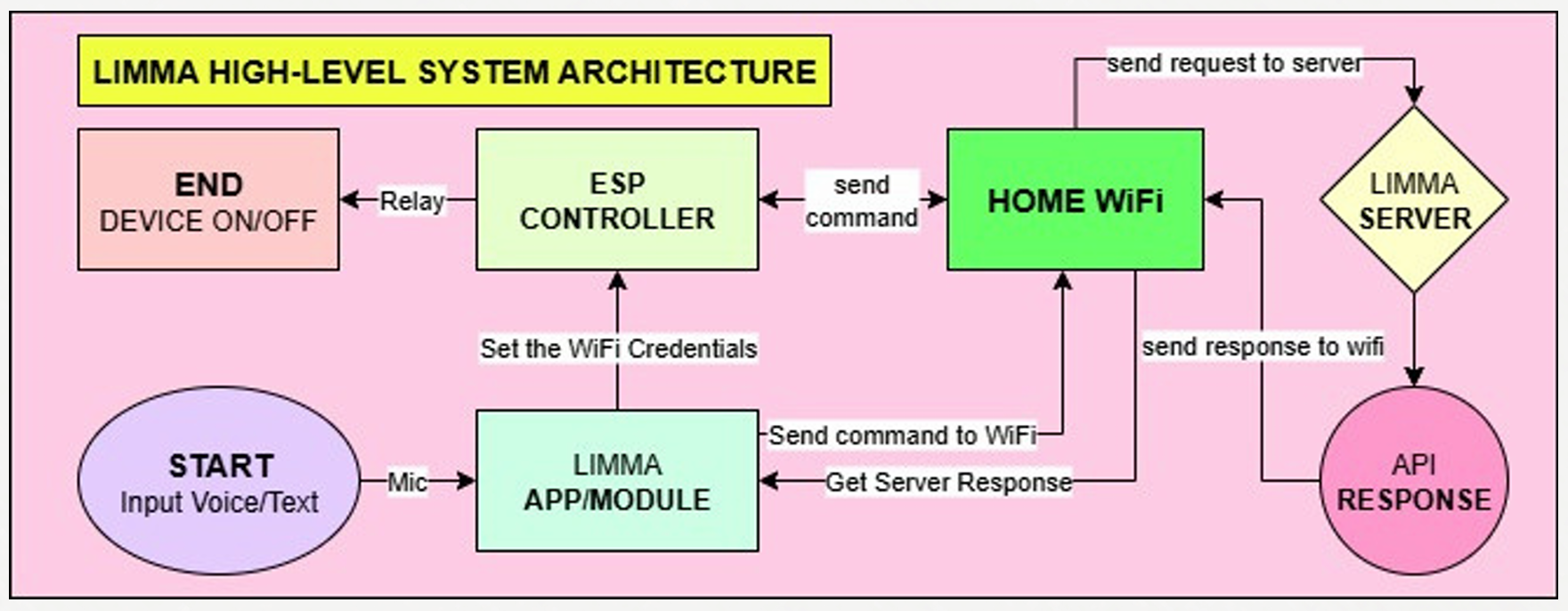
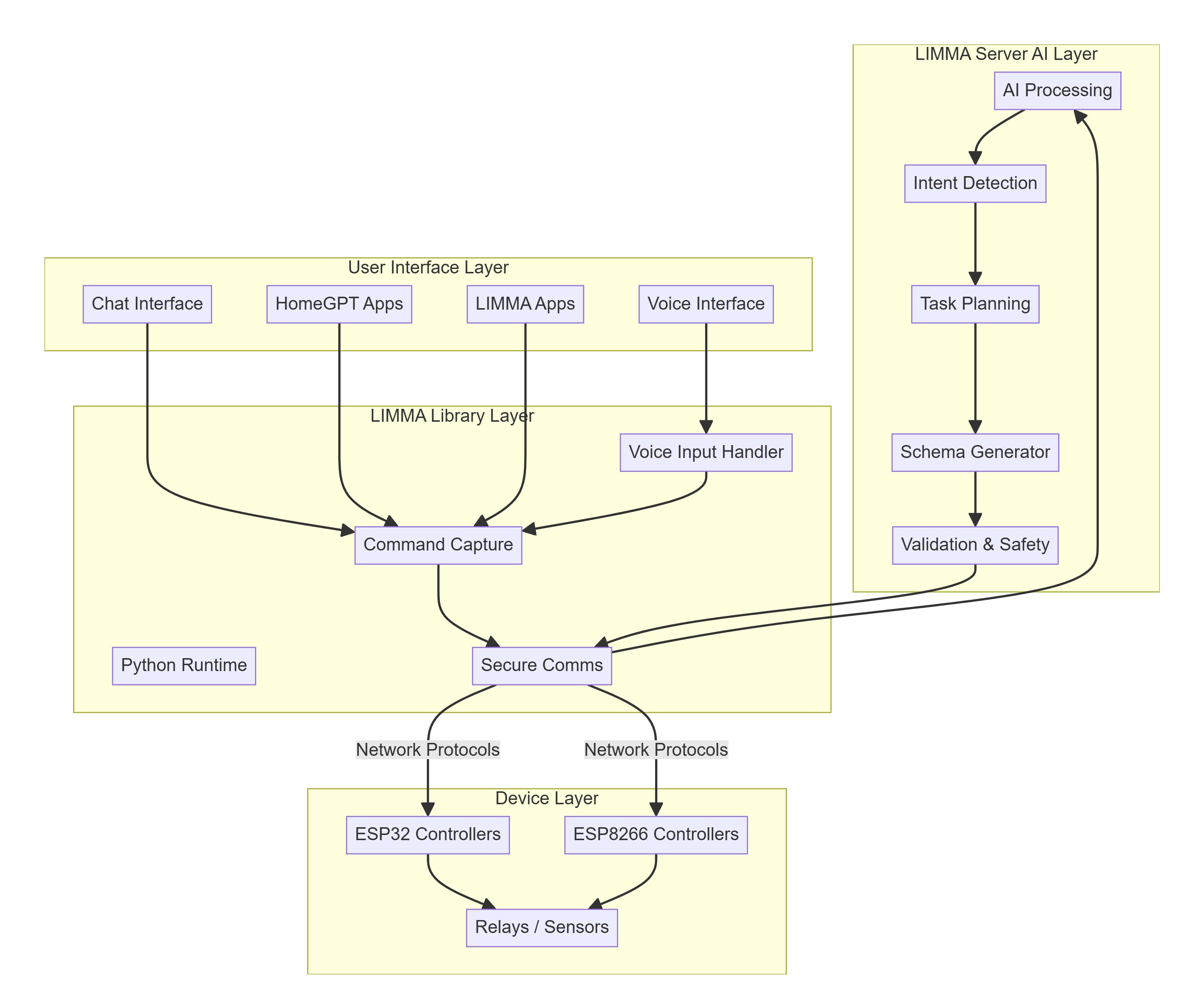
[User Interface] ⇄ [LIMMA AI Engine / Model] ⇄ [Application Logic] ⇄ [Device / API / Database]
- Language Input: Natural text/voice from user
- LIMMA Engine: Interprets, decides, and returns structured tasks
- Connector Layer: Executes commands or fetches data
- UI Layer: Displays results in real time, mobile/desktop responsive
Modern automation and AI projects suffer from:
- Complex code and infrastructure setup
- High development and maintenance costs
- Slow prototyping cycles
- Difficulty connecting AI models to devices, APIs, or workflows
LIMMA bridges this gap through a low-code, low-cost, and modular approach.
- 🧠 Natural Language Interface: Control systems, apps, or devices via text or speech.
- ⚙️ Plug-and-Play Modules: Quickly connect AI, IoT, or custom APIs.
- 💸 Low Cost: Minimal infrastructure — runs on lightweight servers or edge devices.
- 💻 Low Code: Configuration-driven logic and visual UI blocks instead of heavy scripting.
- 🌐 Scalable: Works with any LLM, API, or local AI model (OpenAI, HuggingFace, custom).
limma-applications/
│
├── HomeGPT/           # Smart Home automation dashboard + chat UI
├── RoboticsCar/       # Control robotics car using LIMMA commands
├── AutoHub/           # Multi-device automation and integration hub
├── 4-Line-ChatBot/    # Minimal chatbot integration example
│
├── docs/              # Documentation and architecture diagrams
└── README.md          # You are here 🚀
git clone https://github.com/firoziya/limma-applications.git
cd limma-applicationscd HomeGPTCreate or edit a config.json:
{
  "LIMMA_URL": "https://api.limma.live",
  "API_KEY": "your-api-key-here",
  "APP_NAME": "HomeGPT"
}For simple HTML UI:
python -m http.server 8080For Node or Python backend apps:
npm install
npm start
# or
pip install -r requirements.txt
uvicorn app:app --reloadLIMMA abstracts the complexity of AI-driven systems into three reusable layers:
| Layer | Function | Example |
|---|---|---|
| Intent & Logic | Define what user wants | “Turn on the living room lights” → {"action": "turn_on", "device": "light", "location": "living_room"} |
| Connector Layer | Executes the task | Calls device API or IoT command |
| UI Layer | Displays and interacts | Chat UI, Dashboard, Voice control |
This architecture allows anyone to build complex AI applications by editing just a few configuration files — not thousands of lines of code.
- LIMMA core and applications are functional across multiple demos (
limma.livehosts working endpoints). - Example applications (
HomeGPT,AutoHub,ChatBot) run locally or on the cloud. - Tested modules: intent detection, response generation, IoT command mapping, and chat-based control.
Demo: https://limma.live
- Built around AI-driven intent understanding and task automation.
- Supports multiple AI models (OpenAI, HuggingFace, local models).
- Innovative in bridging language models → real device actions.
- Enables “Natural Language Programming” for devices, web, or automation tasks.
-
Problem: Traditional AI/IoT apps need heavy code, infra, and expertise.
-
Solution: LIMMA allows modular, prompt-based configurations for AI workflows.
-
Value Proposition:
- 10× faster prototyping
- 70% cost reduction
- Minimal engineering skill required
- AI + Automation integration in a few lines of config
- Simple, clean, and minimal UI across all apps.
- User-friendly chat-based interface.
- Built using HTML/CSS (and optionally React/Tailwind in advanced UIs).
- Easy navigation and quick access to LIMMA-powered features.
- All interfaces designed for mobile and desktop using flexbox/grid layouts.
- Automatic scaling of buttons, fonts, and chat cards.
- Tested on Chrome, Edge, and Android browsers.
- Uses lightweight storage for low-cost scalability.
- Configurable: JSON / SQLite for small setups, PostgreSQL or Firebase for production.
- Logs, user sessions, and conversation history persist across restarts.
- Supports offline caching where applicable.
- Supports token-based authentication (JWT) for connectors.
- Secure backend APIs — no secrets stored in frontend.
- HTTPS enforced for cloud deployments.
- Role-based permissions and validation of LIMMA actions before execution.
- Configurable access levels for admin, user, and device layers.
┌──────────────────┐
│   User Interface  │
│ (Chat / Dashboard)│
└───────┬───────────┘
        │
        ▼
┌──────────────────┐
│   LIMMA Core AI  │
│ (Intent Parser,  │
│  Action Mapper)  │
└───────┬───────────┘
        │
        ▼
┌──────────────────┐
│ Connector Layer  │──► IoT / API / DB
│ (Executes Tasks) │
└──────────────────┘
| Application | Description | Example |
|---|---|---|
| 🏠 HomeGPT | Smart home control via chat | “Turn on bedroom light” |
| 🤖 RoboticsCar | AI-based robot control | “Move forward and take a turn” |
| 🌐 AutoHub | Connect multiple devices | “Check all sensors and report” |
| 💬 ChatBot | Lightweight conversational UI | “Tell me today’s weather” |
- Frontend: HTML, CSS, JS, React (for some apps)
- Backend: Python (Flask)
- AI Model: LLMs (openai/gpt-oss-120b, llama-3.3-70b-versatile, gemini-2.5-flash), ML Models, DL Models
- Database: Firebase
- Auth: API Keys
- Deployment: Vercel & Render
Contributions are welcome! If you have built an app using LIMMA, please:
- Fork this repository
- Add your app under
/applications/ - Include a
README.mdandconfig.example.json - Submit a pull request
Apache License 2.0 — open for learning, research, and innovation. For commercial use, please check limma.live.
Developed and maintained by the LIMMA Project Team. For more information or partnership inquiries, visit https://limma.live.
- 🌐 Website: https://limma.live
- 🤖 Chatbot: https://chat.limma.live
- 💬 GitHub: https://github.com/firoziya/limma
- 📧 Email: ykfiroziya@gmail.com