



Catches the slop that AI produces — before it reaches production.
The problem isn't that AI writes code.
The problem is the specific class of defects AI reliably introduces:
unimplemented stubs, disconnected pipelines, phantom imports, and buzzword-heavy noise.
The code speaks for itself.
Navigation: What Is It? • Quick Start • How It Works • What It Detects • Scoring • Key Features • Security • CI/CD • Config • VS Code • Changelog • Release Notes
AI-SLOP Detector is an evidence-based static analyzer purpose-built to catch the specific class of defects that AI code generation reliably introduces — before they reach production.
Unlike general linters that flag style and convention, it targets AI slop: structurally plausible code that is functionally empty, disconnected, or misleading.
- 27 adversarial pattern checks — stubs, phantom imports, disconnected pipelines, buzzword inflation, clone clusters
- 4D scoring model — LDR (logic density), ICR (inflation), DDC (dependency coupling), Purity (critical severity) combined via geometric mean
- Self-calibrating — every scan is recorded per-project; after 10 files have been re-scanned the tool automatically tunes its weights using project-scoped, domain-anchored grid search (no manual command required)
- Git-aware noise filter — uses commit SHA to distinguish real improvements from measurement noise
- Domain-aware bootstrap —
--initauto-detects project domain (8 profiles:web_frontend,data_science,ml_research,backend_api, …) and pre-seeds weights accordingly; override with--domain - JS/TS analysis — optional
[js]extra activates JSAnalyzer v2.8.0 with tree-sitter AST + regex fallback for.js/.jsx/.ts/.tsxfiles - Go analysis — optional
[go]extra activates GoAnalyzer v1.0.0 with regex-based detection for.gofiles; detects empty funcs, panic-as-error, fmt.Print debug, ignored errors - CI/CD gates — soft / hard / quarantine modes; GitHub Actions ready
- VS Code extension — real-time inline diagnostics, debounced lint-on-type, ML score in status bar
pip install ai-slop-detector

slop-detector --init                       # bootstrap .slopconfig.yaml + .gitignore
slop-detector mycode.py                    # single file
slop-detector --project ./src             # entire project
slop-detector mycode.py --json            # machine-readable output
slop-detector --project . --ci-mode hard --ci-report  # CI gate

# Optional extras
pip install "ai-slop-detector[js]"       # JS/TS tree-sitter analysis
pip install "ai-slop-detector[ml]"       # ML secondary signal

# No install required
uvx ai-slop-detector mycode.py

flowchart LR
    A[📄 Source File] --> R[FileRole\nClassifier]
    R --> B[AST Parser]
    B --> C[27 Pattern Checks]
    B --> D[LDR · ICR · DDC\n+ Purity Metrics]
    C --> E[GQG Scorer\nWeighted Geometric Mean]
    D --> E
    E --> F{deficit_score}
    F -->|< 30| G[✅ CLEAN]
    F -->|30–50| H[⚠️ SUSPICIOUS]
    F -->|50–70| I[🔶 INFLATED_SIGNAL]
    F -->|≥ 70| J[🚨 CRITICAL_DEFICIT]
    E --> H2[history.db]
    H2 --> K[Self-Calibrator\nauto-tune weights]
Every file goes through four independent measurement axes (LDR, ICR, DDC, Purity) and 27 pattern checks. Results are combined via a weighted geometric mean — a near-zero in any single dimension pulls the overall score down regardless of other dimensions. Every scan is recorded to history (per project); weights auto-tune when 10 files have been re-scanned in the same project.
Full specification: docs/HOW_IT_WORKS.md · docs/MATH_MODELS.md
27 patterns across 5 categories. Full catalog: docs/PATTERNS.md
| Category | Patterns | Signal |
|---|---|---|
| Placeholder | empty_except, not_implemented, pass_placeholder, ellipsis_placeholder, return_none_placeholder, return_constant_stub, todo_comment, fixme_comment, hack_comment, xxx_comment, interface_only_class |
Unfinished / scaffolded code |
| Structural | bare_except, mutable_default_arg, star_import, global_statement |
Anti-patterns |
| Cross-Language | js_push, java_equals, ruby_each, go_print, csharp_length, php_strlen |
Wrong-language syntax |
| Python Advanced | god_function, dead_code, deep_nesting, lint_escape, function_clone_cluster, placeholder_variable_naming |
Structural complexity + evasion |
| Phantom | phantom_import |
Hallucinated packages |
Three metric axes per file:
| Metric | What it measures |
|---|---|
| LDR (Logic Density Ratio) | logic_lines / total_lines — code vs. whitespace/comments |
| ICR (Inflation Check) | jargon_density × complexity_modifier — buzzword weight |
| DDC (Dependency Check) | used_imports / total_imports — import utilization |
purity        = exp(-0.5 × n_critical_patterns)
quality (GQG) = exp( Σ wᵢ·ln(dimᵢ) / Σ wᵢ )   — weighted geometric mean
deficit_score = 100 × (1 − quality) + pattern_penalty
| Score | Status |
|---|---|
| ≥ 70 | CRITICAL_DEFICIT |
| ≥ 50 | INFLATED_SIGNAL |
| ≥ 30 | SUSPICIOUS |
| < 30 | CLEAN |
Default weights: ldr=0.40 · inflation=0.30 · ddc=0.30 · purity=0.10 (all four calibrated via --self-calibrate in v3.2.0+)
Project aggregation uses SR9 conservative weighting: 0.6 × min + 0.4 × mean
Full specification: docs/MATH_MODELS.md
Bootstrap — domain-aware, one command to start
slop-detector --init                   # auto-detect domain, generate .slopconfig.yaml
slop-detector --init --domain web_frontend  # explicit domain override
--init detects your project domain from file patterns (8 built-in profiles:
general, web_frontend, data_science, cli_tool, library,
ml_research, backend_api, scientific) and pre-seeds the weight profile
accordingly. Also secures .slopconfig.yaml in .gitignore by default.
JS/TS Analysis — optional tree-sitter path
pip install "ai-slop-detector[js]"
slop-detector --project ./src         # now includes .js/.jsx/.ts/.tsx files
Activates JSAnalyzer v2.8.0 with tree-sitter AST (regex fallback when not installed).
Results appear under js_file_results in ProjectAnalysis and JSON output.
Go Analysis — regex-based, optional tree-sitter-go path
pip install "ai-slop-detector[go]"
slop-detector --project ./src         # now includes .go files
Activates GoAnalyzer v1.0.0. Detects: empty function stubs, panic() as error handling,
fmt.Println/Printf debug prints, _ = ignored errors, TODO/FIXME comments, god functions
(> 60 lines). Results appear under go_file_results in JSON output.
Self-Calibration — the tool learns your codebase
slop-detector . --self-calibrate               # see what your history recommends
slop-detector . --self-calibrate --apply-calibration  # write to .slopconfig.yaml
4D grid-search (ldr / inflation / ddc / purity) over your run history. Optimizes all four weight dimensions simultaneously.
- Project-scoped —
history.dbtags every record with aproject_id(sha256 of cwd); calibration signal never mixes across different projects - Domain-anchored — grid search is constrained to ±0.15 around the current domain weights, preventing drift outside the domain's meaningful weight region
- Drift warnings —
CalibrationResult.warningsflags any dimension that shifted > 0.25 from the anchor - Only applies when confidence gap between top two candidates exceeds 0.10
- Milestone is triggered by files re-scanned (not raw record count), avoiding false triggers on first-time project scans
History Tracking — longitudinal quality analysis
slop-detector mycode.py --show-history   # per-file trend
slop-detector --history-trends           # 7-day project aggregate
slop-detector --export-history data.jsonl
Every run auto-recorded to ~/.slop-detector/history.db. The history database is
the training signal for ML self-calibration.
docs/HISTORY_TRACKING.md →
Your .slopconfig.yaml contains domain_overrides — a precise map of which functions
are exempt from complexity rules. This is effectively a codebase weakness surface:
it reveals which areas are too complex to refactor right now.
Best practice:
- Run
slop-detector --initto generate.slopconfig.yamland auto-add it to.gitignore - To share governance config with your team, explicitly remove
.slopconfig.yamlfrom.gitignore - Open-source repos committing it is fine (transparency over obscurity — see this project's own
.slopconfig.yaml)
History is stored at ~/.slop-detector/history.db (your home directory, outside all repos).
It is never committed and accumulates across all projects you scan.
Adversarial Validation (SPAR-Code) — ground-truth regression guard
fhval spar          # 3-layer adversarial check
fhval spar --layer a   # known-pattern anchors
fhval spar --layer c   # existence probes
Verifies each metric is measuring what it claims. Catches calibration drift before it reaches production.
Structural Coherence — project-level signal
project = detector.analyze_project("./src")
print(project.structural_coherence)  # 0.0 – 1.0
Experimental. Use for longitudinal comparison within a project, not as an absolute gate. docs/ARCHITECTURE.md →
pre-commit (runs on every commit):
# .pre-commit-config.yaml
repos:
  - repo: https://github.com/flamehaven01/AI-SLOP-Detector
    rev: v3.5.0
    hooks:
      - id: slop-detector
GitHub Actions (runs on every PR):
# .github/workflows/quality-gate.yml
- name: AI-SLOP Gate
  run: |
    pip install ai-slop-detector
    slop-detector --project . --ci-mode hard --ci-report
Enforcement modes:
--ci-mode soft        # informational, never fails build
--ci-mode hard        # fails at deficit_score >= 70 or critical_patterns >= 3
--ci-mode quarantine  # escalates repeat offenders after 3 violations
Full CI/CD Integration Guide →
# .slopconfig.yaml
weights:
  ldr: 0.40
  inflation: 0.30
  ddc: 0.30
  purity: 0.10

patterns:
  god_function:
    domain_overrides:
      - function_pattern: "check_node"   # AST walker — complex by design
        complexity_threshold: 30
        lines_threshold: 200

ignore:
  - "tests/**"
  - "**/__init__.py"
Full Configuration Guide → · Config Examples →
Real-time inline diagnostics, debounced lint-on-type, ML score and Clone Detection in status bar.
Commands: Analyze File · Analyze Workspace · Auto-Fix · Show Gate Decision · History Trends
Install from the VS Code Marketplace or build locally:
cd vscode-extension && npm install && npx vsce package| Version | Highlights |
|---|---|
| v3.5.0 | Domain-aware --init (8 profiles, --domain flag); JS/TS analysis via JSAnalyzer v2.8.0 + [js]; Go analysis via GoAnalyzer v1.0.0 + [go]; self-calibration patches: project-scoped history (project_id), re-scan milestone trigger, domain-anchored grid search (±0.15), CalibrationResult.warnings (drift > 0.25); 308 tests GREEN |
| v3.4.1 | FileRole.STUB (Protocol/ABC stubs skip ldr+patterns); auto-discover .slopconfig.yaml; Python 3.8 CI compat; mypy attr-defined fix |
| v3.4.0 | Per-rule FP rate tracking (LEDA Phase 2A); purity weight ceiling MAX_PURITY_WEIGHT=0.25 (Phase 2B) |
| v3.3.0 | File role classifier (SOURCE/INIT/RE_EXPORT/TEST/MODEL/CORPUS); DDC annotation-only import fix; # noqa: F401 + __all__ re-export recognition |
| v3.2.1 | Auto-calibration at every 10-scan milestone (no manual cmd); P2 git noise filter; P3 per-class thresholds (5+5); calibrate() min_events bugfix; 11/11 e2e GREEN |
| v3.2.0 | 4D calibration (purity dimension); --init bootstrap; auto-calibration hints; 44/44 self-scan CLEAN |
| v3.1.2 | data_collector refactor; slopconfig gap fill; 43/43 self-scan CLEAN |
| v3.1.1 | Clone Detection in Core Metrics table; table style unification; VS Code UX |
| v3.1.0 | 3 new adversarial patterns (function_clone_cluster, placeholder_variable_naming, return_constant_stub); GQG calibrator alignment; fhval SPAR-Code |
| v3.0.2 | Phantom import 3-tier classification; __init__.py LDR fix; god_function LOW demotion |
| v3.0.0 | Geometric mean scorer (GQG); purity dimension; DCF per-file; structural coherence |
| v2.9.3 | Self-calibration engine; weight grid-search from usage history |
| v2.9.0 | phantom_import CRITICAL detection; history auto-tracking |
Full Release Notes → · Changelog →
git clone https://github.com/flamehaven01/AI-SLOP-Detector.git
cd AI-SLOP-Detector
pip install -e ".[dev]"
pytest tests/ -v --cov
black src/ tests/
ruff check src/ tests/
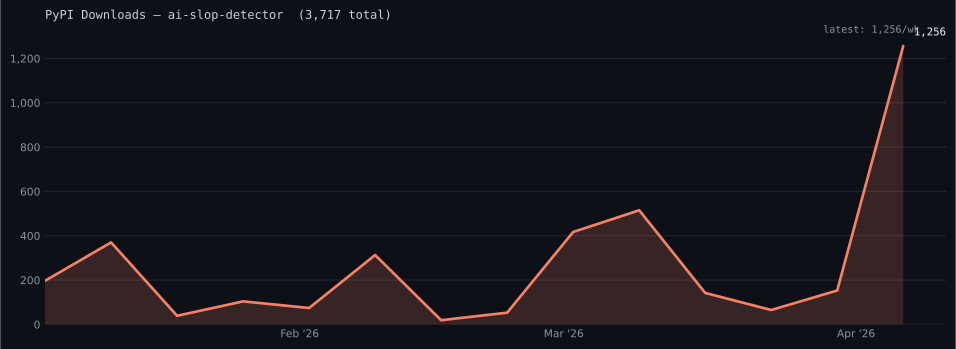

Chart updated weekly via GitHub Actions. Monthly installs: pypistats.org (mirrors excluded). Total: pepy.tech (incl. mirrors)
MIT — see LICENSE.
Flamehaven Labs • Issues • Discussions • Docs