
Los Angeles County Department of Health Services
Are public health services available to all individuals living in Los Angeles regardless of their income?
Our project is aimed to create a visual narrative of the accessibility to health services depending on an income-based distribution within Los Angeles County. We will explore the existing records of all certified and licensed medical clinics in the County and how the number of health establishments or types of services offered are potentially affected by the median household income of the zip code they are located in. By utilizing census and quantitative data we will be able to visualize how the distribution of health services is affected by the income of the population they are being offered to. Our project will also provide insight as to how the Federal and State funds for health services are being allocated and if there are improvements needed to increase accessibility. Furthermore, it is important to understand how discrepancies in health accessibility have influenced the spread and deaths caused by the Coronavirus

Venice Family Clinic in Santa Monica, California
Accessibility to medical services is an important topic to us because it is a service that everyone needs and thus should be widely available. According to the American Medical Association, the United States is experiencing a health crisis as a result of insufficient allocation of low-cost and free primary care services and preventative programs within communities. According to the New York Times, there are more than 1 million cases of coronavirus 19 in just Los Angeles County. Such large numbers have had catastrophic consequences on the death rates for the disease. One of the issues major problems with the pandemic is the lack of medical services and equipment, including ventilators, that have become increasingly difficult to find available. Health promotion and disease prevention is vital to improve the quality of life of all individuals, especially in low-income areas that experience resource limitations and have less accessibility to hospitals and other care. It is important to allocate Federal and State funds to the communities that are in true need to then increase the quality of life of those who live in these areas. Large numbers of preventable deaths are at stake, it is a human necessity to receive medical care in order to detect and treat diseases in a safe and timely manner.
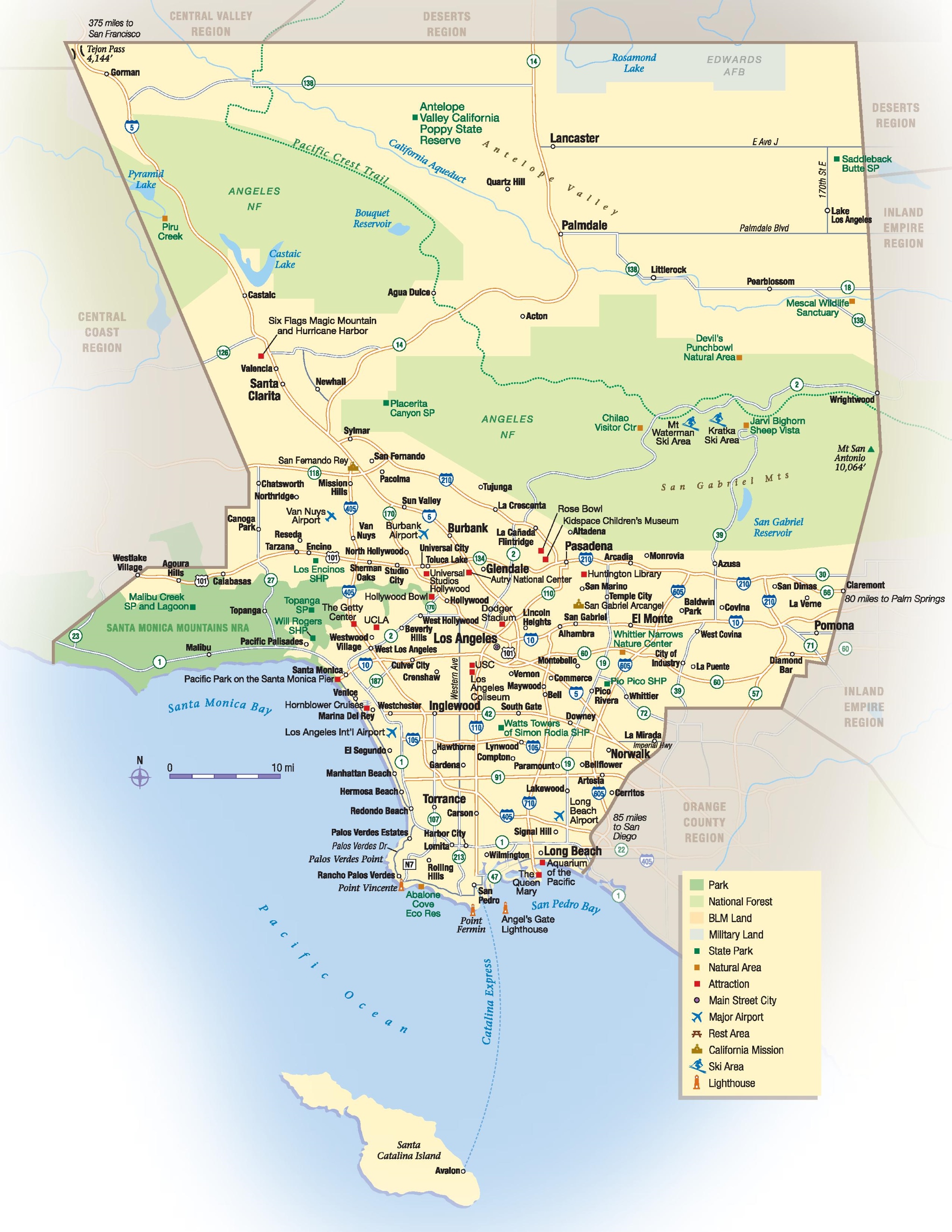
Los Angeles County Map
The spatial scope for our project is the United States, more specifically, Los Angeles County in California. The quantitative and census data we will use includes the location of all the certified clinics and the median household income of each zip code within Los Angeles County. The data we will be using is relatively recent, from 2019 for the median household income and 2021 (modified monthly) for the certified Healthcare facility listing. Our aim is to use data as updated as possible to create a project that reflects the current resource allocation of the healthcare sector in Los Angeles.
For our project, we will be reviewing data sources centered on health care facilities and population income in the region. Provided by Healthdata.gov, the "Licensed and Certified Healthcare Listings" dataset will allow us to view existing facilities in the state of California (https://healthdata.gov/dataset/licensed-and-certified-healthcare-facility-listing). Using this we can analyze the number of healthcare facilities in different neighborhoods of Los Angeles. Similarly, we have data that focuses on a variety of healthcare programs within the county of Los Angeles, which is provided by the Los Angeles County office of Enterprise Geographical Information Systems (https://egis-lacounty.hub.arcgis.com/datasets/public-health-programs). We will also view data provided by the Census Reporter which gives details on the amount of income by zip code in Los Angeles County (https://censusreporter.org/data/map/?table=B19013&geo_ids=05000US06037,860|05000US06037&primary_geo_id=05000US06037).
Using these three data sources, we intend to create a map of Los Angeles County which visually shows areas where public healthcare facilities are located. We will also provide details that explain the income per zip code in each area within the County. By developing this map, we intend to analyze which regions in the County are in need of more funding for healthcare facilities/programs. We also intend to visually show the economic disparities that exist between wealthier and lower income communities within the County. This will allow us to explain how federal and state funding should prioritize certain communities that are most underrepresented.
We hope to gain insights on where households within the County are most economically disadvantaged compared to their counterparts in certain communities. Through our visualizations, we hope to gain stronger insights on the availability and accessibility of health care facilities and programs and whether certain income levels have greater access to these resources. In addition, as we look through more data on programs offered in the region, we hope to identify health programs that are most used in the region that could potentially be prioritized for funding.