


Turn any GitHub issue into a structured, verifiable report. Reporters fill a native GitHub form — no install, no account beyond GitHub. One workflow file gives maintainers automatic scoring, labeling, and tamper-evident receipts.
| Complete report | Incomplete report | |
|---|---|---|
| Demo repo | gietsmaximiliano-pixel/reprogate-demo | gietsmaximiliano-pixel/reprogate-demo |
| Issue | #2 - widget title truncation | #1 - missing reproduction details |
| Score | 93 / 100 | 0 / 100 |
| Label | reprogate:complete |
reprogate:needs-info |
| What the Action does | Validates evidence, comments with scorecard, applies label | Lists missing actualBehavior, environment, expectedBehavior, and stepsToReproduce, then applies the needs-info label |
Both issues above were validated automatically by the ReproGate Action in a separate public demo repository. No tool was installed by either reporter; they filled in a form on GitHub.
Short walkthrough video: MP4
# Reporter pastes this into the GitHub issue form — nothing to install
schemaVersion: "0.1"
reportType: bug
projectName: my-library
affectedVersion: 2.4.1
environment:
  os: Ubuntu 24.04
  runtime: Node.js 20.20.2
  dependencies:
    my-library: 2.4.1
summary: "parseConfig throws TypeError on an empty object instead of returning defaults"
expectedBehavior: parseConfig({}) should return the default configuration.
actualBehavior: parseConfig({}) throws TypeError — Cannot read properties of undefined.
stepsToReproduce:
  - npm install my-library@2.4.1
  - node -e "require('my-library').parseConfig({})"
  - Observe the TypeError
commands:
  - node -e "require('my-library').parseConfig({})"
redactionNotes: No secrets included.
aiAssisted: false
humanReviewed: true
createdAt: "2026-06-01T00:00:00.000Z"
Action comment the maintainer sees:
ReproGate validation: valid
Actionability score: 93/100

Evidence files: none

Score breakdown:
+5  Supported schema version
+4  Report type is bug
+6  Project name and version
+6  OS described
+5  Runtime included
+6  Dependency versions listed
+10 Summary is specific
+8  Expected behavior stated
+8  Actual behavior stated
+16 Reproduction steps are detailed
+8  Commands supplied
+4  Redaction notes provided
+7  Reporter manually reviewed

Label applied: reprogate:complete
ReproGate evidence check: valid
Actionability score: 54/100
Suggested label: reprogate:needs-info

Missing information: None.
Invalid fields: None.
All required fields were present but too vague to score above the threshold (default: 70/100).
The label reprogate:needs-info prompts the reporter to improve their report.
Create .github/ISSUE_TEMPLATE/bug-report.yml in your repository.
Copy the ready-to-use template from setup/reprogate-bug-report.yml
or download it:
mkdir -p .github/ISSUE_TEMPLATE
curl -fsSL \
  https://raw.githubusercontent.com/gietsmaximiliano-pixel/reprogate/main/setup/reprogate-bug-report.yml \
-o .github/ISSUE_TEMPLATE/bug-report.ymlCreate .github/workflows/reprogate.yml:
name: ReproGate

on:
  issues:
    types: [opened, edited]

permissions:
  contents: read
  issues: write

jobs:
  validate-issue:
    runs-on: ubuntu-latest
    steps:
      - name: Validate ReproGate evidence
        uses: gietsmaximiliano-pixel/reprogate/packages/github-action@v0.1.0
        with:
          github-token: ${{ github.token }}
Or download it:
mkdir -p .github/workflows
curl -fsSL \
  https://raw.githubusercontent.com/gietsmaximiliano-pixel/reprogate/main/setup/reprogate-workflow.yml \
  -o .github/workflows/reprogate.yml
Commit both files to your default branch. The Action runs automatically on every new or edited issue that contains a fenced ```reprogate block.
npx reprogate@latest initThe CLI writes both files, the security report form, a configuration file, and a maintainer guide.
Run reprogate --help for the full command list.
flowchart TD
  Reporter["Reporter\n(no install needed)"]:::accent0
  Form["Native GitHub\nIssue Form"]:::accent1
  Action["ReproGate\nGitHub Action"]:::accent2
  Score["Actionability\nScore 0–100"]:::accent3
  Label["Issue label\n+ comment"]:::accent4
  CLI["reprogate CLI\n(maintainer, optional)"]:::accent5
  Receipt["Tamper-evident\nReceipt JSON"]:::accent5
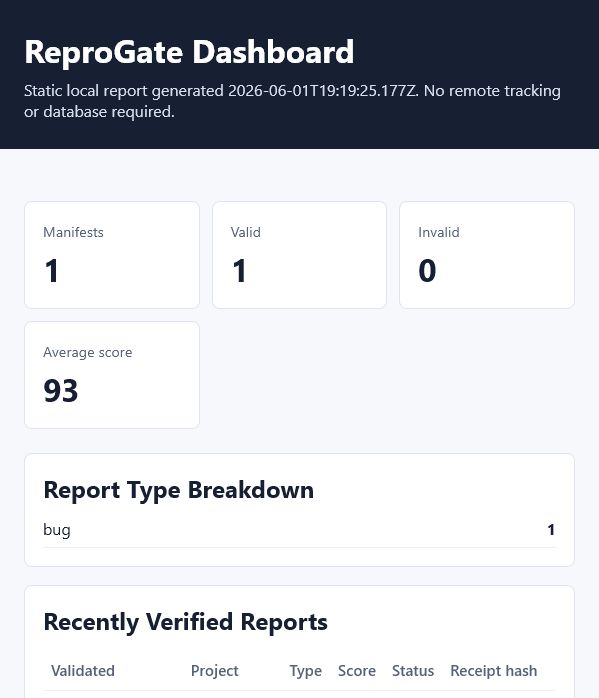
  Dashboard["Static\nDashboard"]:::accent5

  Reporter --> Form
  Form --> Action
  Action --> Score
  Score --> Label
  Score --> CLI
  CLI --> Receipt
  Receipt --> Dashboard
- Reporter opens a GitHub issue and fills in the native form — no account beyond GitHub, no tool to install.
- The form pre-fills a structured YAML block that the reporter edits in place.
- The Action runs on every new or edited issue, parses the YAML, validates all fields, and posts one comment with the actionability score and missing-field list.
- Labels route the issue:
reprogate:completefor reports above the score threshold,reprogate:needs-infofor those below it. - Maintainers can optionally use the CLI to generate receipts and dashboards for their own audit trail.
| Capability | GitHub Issue Forms | IssueOps Validator | ReproGate |
|---|---|---|---|
| Native form UI for reporters | ✅ | ✅ | ✅ |
| No install required for reporters | ✅ | ✅ | ✅ |
| Required-field enforcement at submit | ✅ UI only | ✅ | ✅ |
| Validation re-runs on issue edits | ❌ | ✅ | ✅ |
| Structured data preserved after submit | ❌ plain Markdown | ❌ re-parsed | ✅ YAML |
| Actionability score (0–100) | ❌ | ❌ | ✅ |
| Evidence file SHA-256 verification | ❌ | ❌ | ✅ |
| Tamper-evident receipt artifact | ❌ | ❌ | ✅ |
| Security-report form + guidance | ❌ | ❌ | ✅ |
| Automated reporter support (CI bots) | ❌ | ❌ | ✅ |
| Custom domain validation rules | ❌ | ✅ custom JS | ✅ schema-driven |
| Self-contained — no AI, no SaaS | ✅ | ✅ | ✅ |
GitHub Issue Forms provides a guided UI and enforces required fields at submission time, but the structure is flattened to plain Markdown immediately after. There is no post-submission validation, no scoring, and no audit trail.
IssueOps Validator closes the post-submission gap by running on issue events and re-parsing the Markdown body. It supports custom JavaScript validators for domain-specific rules but requires those scripts to be written and deployed per project. It has no scoring, no evidence hashing, and no security-report workflow.
ReproGate adds an evidence-quality layer on top of GitHub Issue Forms: structured YAML that survives edits, a 0–100 actionability score, evidence file hashing, tamper-evident receipts, and first-class support for security and automated reports.
ReproGate ships a second issue form for security disclosures.
reprogate init writes .github/ISSUE_TEMPLATE/security-report.yml.
The security form:
- Sets
reportType: securityin the YAML block. - Requires reporters to confirm no credentials, tokens, or exploit payloads are included.
- Adds a prominent notice pointing to GitHub Security Advisories for high-severity issues that should stay private.
- Validates the same evidence fields as the bug form.
For high-severity vulnerabilities that must not be public, instruct reporters to use the Security Advisories tab ("Report a vulnerability") rather than the public issue form. Configure this in your repository's SECURITY.md.
ReproGate is designed for CI-generated bug reports, not just human reporters.
A CI system that detects a regression can generate and submit a manifest programmatically:
# Generate manifest from CI context
cat > reprogate.yml << EOF
schemaVersion: "0.1"
reportType: regression
projectName: my-library
affectedVersion: $(git describe --tags)
environment:
  os: ubuntu-24.04
  runtime: node-$(node --version)
  dependencies:
    my-library: $(node -p "require('./package.json').version")
summary: "Test suite regression detected in CI on commit $(git rev-parse --short HEAD)"
expectedBehavior: All tests pass on the main branch.
actualBehavior: $(cat test-failure-summary.txt)
stepsToReproduce:
  - git checkout $(git rev-parse HEAD)
  - npm test
commands:
  - npm test
aiAssisted: false
humanReviewed: false
createdAt: "$(date -u +%Y-%m-%dT%H:%M:%SZ)"
EOF

# Submit as a GitHub issue
gh issue create \
  --title "CI regression: $(git describe --tags)" \
  --body "$(cat reprogate.yml | awk '{print "```reprogate\n" $0 "\n```"}')"
The Action then scores the automated report just like a human one.
humanReviewed: false is valid — the score reflects the evidence quality, not whether a human wrote it.
Maintainers who want local workflows can install the CLI separately. The CLI is not required for the core reporter → Action → label flow.
| Command | Description |
|---|---|
reprogate init |
Scaffold issue templates, workflow, config, and guide |
reprogate create |
Interactively build a manifest |
reprogate validate <path> |
Validate a manifest and print the score |
reprogate receipt <path> |
Generate a tamper-evident receipt JSON |
reprogate render <path> |
Render a Markdown issue summary |
reprogate dashboard <dir> |
Generate a static receipt dashboard |
reprogate verify-safe-run <path> |
Opt-in Docker verification (manual review required) |
| Package | Role |
|---|---|
packages/spec |
Evidence Manifest types, Zod schema, normalization, hashing, scoring, receipts, Markdown rendering |
packages/cli |
reprogate command-line interface |
packages/github-action |
Issue-body parser, validator, label selection, marker-comment logic |
packages/dashboard |
Static receipt dashboard generator |
packages/ai-adapters |
Optional mock AI interface (advisory only, not in the validation path) |
- Public issue automation parses untrusted text as data only — no execution.
- The core validation path is deterministic and requires no AI or external APIs.
- Evidence paths are restricted to safe relative paths.
- Receipts hash normalized manifests and local evidence files using SHA-256.
- The workflow uses minimal permissions:
contents: read,issues: write. pull_request_targetis never used.- Safe-run is Docker-only, opt-in, network-disabled, resource-limited, and requires explicit confirmation.
See docs/THREAT_MODEL.md for details.
Read CONTRIBUTING.md, SECURITY.md, and AGENTS.md.
Apache-2.0. See LICENSE.