

"The geometry measures, the AI teaches, the student grows." (ADR-001)




A student drops a photograph of a plate into a folder and closes the laptop. Nobody presses anything. Cloud Storage finalises the object, Eventarc fires, and the agent measures the drawing, writes a critique and appends the result to that student's history — while nobody is watching. On Monday morning, Cloud Scheduler synthesises the week into a practice plan the student never asked for.
That is the shape of the thing: the interactive studio is one way in, not the product. The same pipeline runs when the browser is closed.
Around that loop sit four verbs, which are the collaborative partnership rather than a request/response API:
| ASK | before critiquing | "What were you practicing today? Which part felt hardest?" — intent the pixels do not carry |
| GUIDE | after measuring | an exercise chosen from the deviation that keeps recurring, not from the last plate |
| CAPTURE | after teaching | helpful: bool plus a note, stored as an immutable event |
| ADAPT | across sessions | the tone moves from technical to encouraging on its own, derived from the history |
Atelier verifies technical drawings in descriptive geometry — sistemas de representación, the Monge tradition taught as a first-year subject in architecture, engineering and animation degrees.
That discipline has a property most drawing subjects do not: correctness is objective. An
isometric axis is at 30° or it is not; a point's plan lies on the reference line dropped from its
elevation or it does not. And yet across eighteen published syllabi and rubrics
(docs/PEDAGOGY.md) not one states a numerical tolerance. The discipline
defines correctness exactly and then hands the checking to a person with a set square at the end of
a stack of plates — which is slow, and which is why a student working remotely waits days to learn
that one edge missed by eight degrees.
Atelier pairs deterministic OpenCV computer vision — vanishing points, axis angles, ground-line correspondence, per-line angular error in degrees — with Gemini 3.5 Flash on Vertex AI, which teaches but is forbidden from producing a number. A validator enforces it.
It automates the objective verification the discipline already defines. It does not invent a new criterion.
| Requirement | How Atelier satisfies it | Where |
|---|---|---|
| Gemini 3.5+ via Gemini API or Vertex AI | gemini-3.5-flash on Vertex AI, europe-west3 (critique, dialogue and the vision gate) · config.py:16 |
atelier-agent/src/tools/critique.py |
| ≥1 Google Agent Framework | Google GenAI SDK — google-genai 2.18.1, genai.Client(vertexai=True, …), every model call |
atelier-agent/requirements.txt · src/tools/ |
| ≥1 Google Cloud infrastructure service | Cloud Run and Firestore (both on the rules' enumerated list) · plus Cloud Storage, Eventarc and Cloud Scheduler | infra/ · src/tools/ |
- Demo video (3:41): https://youtu.be/uIwx3I5ZpeI — the measurement, the refusal, and the Google Cloud backend serving it, recorded against this deployment
- Studio Web Client (Blazor / .NET 10):
https://atelier-web-773993294789.europe-west1.run.app - Agent Backend API (Google GenAI SDK + FastAPI / Cloud Run):
https://atelier-agent-773993294789.europe-west1.run.app - Interactive Swagger API Docs:
https://atelier-agent-773993294789.europe-west1.run.app/docs
💡 Note on Cold Starts: To conserve hackathon credits, Cloud Run services scale to 0 instances when idle. The initial load request may take ~5-10 seconds to spin up containers.
Every figure in these screenshots was measured by the deployed system, and every screenshot was taken against it rather than assembled. Nothing here is a mockup.
Three of the four systems of representation are measured, and the useful thing about having them together is that they differ in where the reference comes from — which sets a ceiling on how far each result can be trusted:
| System | Where the reference comes from | How far it can be trusted |
|---|---|---|
| Conic | Inferred. RANSAC estimates a vanishing point from the student's own lines | Weakest. A consistently wrong drawing yields a vanishing point that agrees with it, and the reported error shrinks — there is a worked example of exactly that below |
| Orthographic (sistema diédrico) | Read off the page. The ground line is a line the student drew | Middle. Nothing is guessed, but a crooked ground line skews everything, so its tilt is reported as a figure in its own right |
| Axonometric | Given. The axes are constants of the projection system | Strongest. Nothing is estimated at all; an error injected at 6.00° comes back at 6.00° |
The fourth, contoured planes (sistema de planos acotados), needs the numeric annotations read off the page — OCR rather than line geometry — and is documented as not implemented.

The drawing on the left is 03_1point_error_9deg.png, built with a deliberate nine-degree error
on one receding edge. The engine reports 4.5° average, 20.3° worst line — and selecting the
perfect sample instead reports 0.8° / 2.5°. The number moves with the drawing, which is the
only interesting property a measurement can have.
The green Anti-Hallucination: Validated badge appears only when Gemini actually answered.
When the model is unreachable the same panel shows an amber "Deterministic fallback — no model
answered" instead, with the real model_version beneath it. The badge is earned per critique,
not painted on.

A shopping list, uploaded by mistake. Before any measurement, Gemini 3.5 Flash looks at the page and answers two questions: is this an exercise at all, and which system of representation is it? Here the first answer is no, and it says why in its own words — "The image is a plain text shopping list and does not contain any technical drawing or geometric construction."
Nothing is measured, and nothing is critiqued. Without this gate the page would go through RANSAC, find a vanishing point among whatever edges exist, and spend real tokens telling a student their line weight is confident. Measuring the wrong thing carefully is worse than declining to measure it.
The refusal appears on step one, where the upload happened. That is worth saying because it did not always: the three status messages lived only in the results panel, which step one does not render, so a rejected upload looked like nothing at all had happened. The strongest argument the project has was invisible for a day.

Eleven synthetic drawings across all three systems, each carrying an error of a known size — and each labelled with the system it belongs to, because that decides what it is measured against. They are the benchmark the golden tests assert against: the conic detector must recover the vanishing point to within one pixel of where it was drawn and must rank 0° below 4° below 9°; the axonometric and orthographic cases must return their injected error to within 0.05° and 1 px.

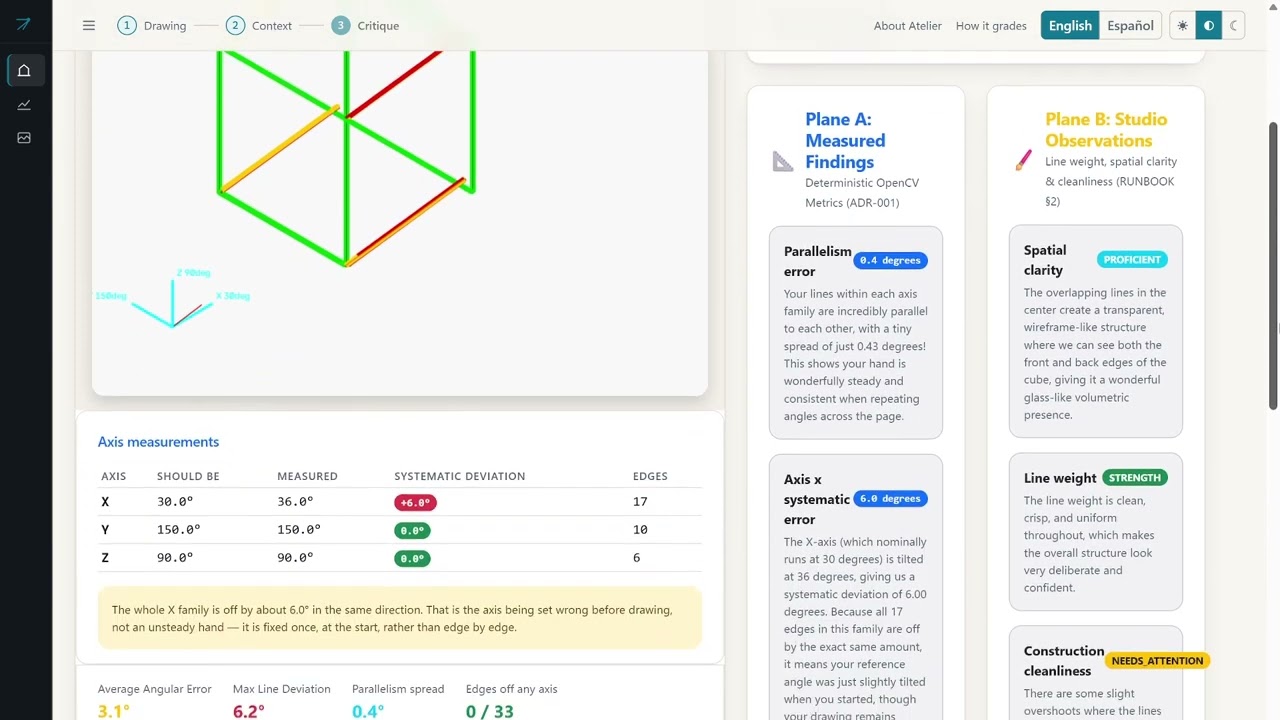
The same page, a different drawing, and a different reference. 07_isometric_error_6deg.png has
every edge of the X family drawn at 36° instead of 30° — a set square placed wrong, not an unsteady
hand — and the table names exactly that: nominal 30.0°, measured 36.0°, systematic +6.0°, while
Y and Z come back at 0.0°.
That split is the point. A single average of 3.1° would say "slightly inaccurate" and leave the student sanding every edge. Separating systematic from per-line deviation says something a published rubric cannot: the hand was steady, the axis was set wrong, and the fix happens once before drawing rather than edge by edge. Gemini reaches that conclusion from the payload on its own — "Because all 17 edges share this same tilt, it means your set square or guide was just slightly rotated, rather than your hand wavering" — and the critique contains no mention of a vanishing point, because there is no vanishing point in this drawing and the rubric forbids inventing one. The parallelism spread is 0.4°, and 0 of 33 edges fall off any axis: nothing was dropped to make the average look better.

Three steps — drawing → context → critique — with the indicator in the top bar and a rail that collapses to icons. Step one is choosing: the page analyses nothing until a drawing is picked, because a three-step flow that starts on step two is not a flow.
Each sample carries the projection system it belongs to, because that decides what it is measured against. The history beside them is the reader's own: every past exercise with its system, the one figure worth showing, and the headline of the critique that was written at the time. A figure that was not measurable renders as a dash — never as zero.
The profile is a difficulty level, not a person. It sets the register of the rubric and the tone of the critique, and nothing downstream interpolates a name into anything.

Not a picture of a solid at all — an orthographic plate (sistema diédrico): an elevation above the ground line, a plan below it, and reference lines carrying each vertex across. What is measured here is neither convergence nor parallelism but correspondence: a point in one view must have its counterpart directly below it in the other.
The plan in this plate is drawn correctly and placed 18 px to the right. Every vertex inherits that, so a naive reading reports a broken corner at each one. Atelier reports one fact — the plan sits 18 px sideways from the elevation, 2.2% of the page — removes it, and then checks what is left: 1.8 px of residual, 2 of 2 vertices agreed, no orphans. The two mistakes it separates need different corrections:
| Reading | What went wrong | What the student does |
|---|---|---|
| Systematic offset, no orphans | The plan was placed wrong on the page | Move it once, before anything else |
| Orphan vertex | A corner was never carried across the ground line | Redraw the construction |
The hard part of correspondence, in principle, is knowing which mark in the plan belongs to which vertex in the elevation. The engine never solves it and does not need to: in orthographic projection corresponding points share an abscissa, so comparing the two views' sets of vertex abscissae answers the question without pairing a single feature.
Heights and depths are not measured — cotas and alejamientos. Those need a third view and real feature correspondence, and claiming them from two views would be inventing.

A two-point plate, in Spanish and in the dark theme. Everything below the headline was written by
Gemini in Spanish because the interface language travels with the request — the critique is not
translated afterwards, and the numbers are the same ones OpenCV produced. Note 0,4° rather than
0.4°: the culture drives number formatting too, so the measurement reads the way the student
writes it.
Metric names, unit words and the strength/needs-attention statuses are identifiers the validator matches on, so they stay in English on the wire and are looked up for display. An identifier with no translation falls through to itself, which is readable English rather than a blank.
This screenshot also shows the weakest link in the system, and it is worth reading carefully.
The drawing is 05_2point_error_6deg.png — a plate whose F1 was deliberately drifted by six
degrees. The panel reports an average convergence error of 0,4° (0.42° off the API). The
perfect two-point plate, 04_2point_perfect.png, reports 0.48°. The drawing with the injected
fault scores better than the one without it.
That is not a defect in the arithmetic. It is what inferred reference means: RANSAC estimates the vanishing points from the lines the student actually drew, so a consistently drifted drawing yields a pair of vanishing points that agree with it, and the residual against them is small. The fault does surface — as 2.08° of horizon tilt, against −0.51° for the correct plate — because two vanishing points estimated from a drifted construction no longer sit on a level horizon.
This is exactly why the three systems are ranked in the table above, and why the ranking is in the documentation rather than buried. An axonometric drawing cannot do this: its axes are constants of the projection, so there is nothing for a wrong drawing to bend.

Read from Firestore, not from a fixture. 16 drawings, 5.5° overall average, tone adapted to encouraging from the feedback events, helpful ratio 100%. The counts are low because they are real — every exercise on this page was produced by analysing an actual drawing through the deployed agent, and the curve is jagged for the same reason.
The curve plots conic exercises only. An average axis deviation and an average convergence error are both measured in degrees and are not the same quantity; one line through both would show progress or regression nobody made. The weekly practice plan appears on this page when a Cloud Scheduler digest exists for the student — absent rather than faked when it does not.

Generated by docs/make_architecture_diagram.py — every
region, model id, bucket and trigger on it is a value read out of the code, so it cannot drift from
the system it describes.
docs/COMPONENTS.md answers what a diagram cannot: why each component is
here rather than the obvious alternative, and which requirement it satisfies — including the ones
that were rejected, and why. ADK, Cloud SQL, Pub/Sub, one service instead of two, and asking the
model for the measurements.
The same architecture as text, for reading at a terminal
┌───────────────────────────────────────────────────────────────────────────────────────────┐
│                                   ATELIER STUDIO SYSTEM                                   │
└───────────────────────────────────────────────────────────────────────────────────────────┘
                                              │
                    ┌─────────────────────────┴─────────────────────────┐
                    ▼                                                   ▼
 ┌─────────────────────────────────────┐             ┌─────────────────────────────────────┐
 │       STUDENT WEB CLIENT            │             │      BACKGROUND GCS INGESTION       │
 │  Atelier.Web (Blazor Server .NET10) │             │  gs://atelier-hack-inbox/{studentId}/    │
 │  - Multimodal Overlay (Original/AI) │             │  - Private Inbox Bucket (ADR-006)   │
 │  - Two-Plane Level-Aware Critique   │             │  - Eventarc Object Finalized        │
 │  - Progress Curve (Native SVG)      │             │  - Cloud Scheduler Weekly Digest    │
 └─────────────────────────────────────┘             └─────────────────────────────────────┘
                    │                                                   │
                    └─────────────────────────┬─────────────────────────┘
                                              ▼
 ┌─────────────────────────────────────────────────────────────────────────────────────────┐
 │            ATELIER AGENT BACKEND (Google GenAI SDK + FastAPI / Cloud Run)               │
 │                                                                                         │
 │   ┌───────────────────────────┐                     ┌───────────────────────────────┐   │
 │   │    Intent Pre-Router      │ ──(Chooses k)─────> │   OpenCV Deterministic Engine │   │
 │   │    (Gemma 4, Vertex)      │                     │   - Deskew & Hough Lines      │   │
 │   │    - Exercise Classification                    │   - RANSAC Vanishing Points   │   │
 │   │    - Canny Threshold Tuning                     │   - Horizon Line & Error (°)  │   │
 │   └───────────────────────────┘                     │   - Base64 Annotated Overlay  │   │
 │                                                     └───────────────────────────────┘   │
 │                                                                     │                   │
 │                                                                     ▼                   │
 │   ┌───────────────────────────┐                     ┌───────────────────────────────┐   │
 │   │ Anti-Hallucination Gate   │ <──(Validates)───── │   Gemini 3.5 Flash Studio     │   │
 │   │ (ADR-001 Validator)       │                     │   (Google Vertex AI)          │   │
 │   │ - Rejects invented metrics│                     │   - Level-Aware Rubric        │   │
 │   │ - Retries with feedback   │                     │   - Two-Plane Structured JSON │   │
 │   └───────────────────────────┘                     └───────────────────────────────┘   │
 └─────────────────────────────────────────────────────────────────────────────────────────┘
                                              │
                                              ▼
 ┌─────────────────────────────────────────────────────────────────────────────────────────┐
 │                 APPEND-ONLY MEMORY & EVENT STORE (Cloud Firestore)                      │
 │   - students/{studentId}/exercises/{id}      (Immutable geometry & critique)            │
 │   - students/{studentId}/exercises/{id}/feedback/{id} (Helpful bool + note: CAPTURE)    │
 │   - Dynamic Profile Derivation               (Tone adaptation & progress curve: ADAPT)  │
 └─────────────────────────────────────────────────────────────────────────────────────────┘
- Numbers come from OpenCV, never from the model (ADR-001): vanishing points, horizon line, axis angles and per-line error in degrees are computed deterministically. The critique is then checked against that set — a figure the geometry did not produce sends the model back for another pass. It is a gate with a retry, not a guarantee; where it can still be fooled is written down below.
- Interactive overlay: toggle between the original sketch and the measured overlay, colour-coded by deviation (green under 2.5°, amber 2.5° to 6.0°, red above 6.0°), side by side, with the per-line table underneath.
- Two-stage pre-router, two models: Gemma 4 (
gemma-4-26b-a4b-it, Gemini API) reads the student's own description and picks 1-point or 2-point — a beginner who writes "the corner of a building" is measured as two-point because they said so, not as one-point because of a field in their profile. Gemini 3.5 Flash (Vertex AI) then looks at the photograph and answers the question that saves the most work: is this a descriptive-geometry exercise at all, and which system? A page of text or a blank sheet is refused before the geometry engine runs and before a critique spends tokens describing nothing. Both label their own provenance (source: gemma | vertex | fallback). - Three projection systems, and three kinds of reference — conic perspective, axonometric (
tools/axonometry.py) and orthographic Monge plates (tools/dihedral.py). The vision gate looks at the photograph and decides which one it is before anything is measured. What makes them worth having together is that they are not the same tool three times: conic infers its reference (RANSAC estimates a vanishing point from the student's own lines, so a consistently wrong drawing yields one that agrees with it), orthographic reads its reference off the page (the ground line is a line the student actually drew — nothing is guessed, but a crooked one skews everything, so its tilt is reported as a measurement in its own right), and axonometric is handed its reference as a constant of the system. An error injected at 6.00° in an isometric plate comes back as 6.00°; a plan displaced by 18 px comes back as 18 px. - Taught in the student's own language: The interface and the critique are both available in English and Spanish, chosen with one control and remembered in a cookie. This is not a translation layer bolted on top — the language is sent to the agent, so Gemini writes the critique itself in Spanish, and the anti-hallucination gate that forbids a number in Plane B recognises
4,2 gradosas well as4.2 degrees. A gate that only reads English would have stopped being a gate the moment the interface was translated. - Light and dark, decided before first paint: Three states — light, dark, and follow-the-system, which is the default because a person who has already told their operating system how they want screens to look has answered the question once. The choice is applied by an inline script before the page renders, so there is no flash of the wrong theme.
- Append-Only Memory & Weekly Digests: Event-sourced progression tracking in Google Cloud Firestore with automated weekly practice plans synthesized via Cloud Scheduler.
- Async-First & Privacy-Preserving (ADR-004, ADR-006): Private Google Cloud Storage inbox (
gs://atelier-hack-inbox/{studentId}/), Eventarc triggers, signed URLs, and profiles that are difficulty levels rather than named people — there is no personal identifier to leak.
What is measured, what is deliberately not, and what is simply missing. A judge who reads one row of this table has seen the project's whole posture: the difference is stated rather than hidden.
| Feature / Domain Area | Current Implementation Status | Notes & Roadmap |
|---|---|---|
| One-point conical (k=1) | ✅ Complete & benchmarked | Golden-case dataset with deliberately injected errors; the detector recovers the vanishing point to within one pixel of where it was drawn. The five calibration images are synthetic, generated by demo/generate_calibration_dataset.py — there are no photographs of real drawings in this repository. |
| Two-point oblique perspective | Measured — and the one to read with care | RANSAC clusters two vanishing points, F1 and F2, and reports horizon tilt and per-line error. On this system a consistent drift lowers the convergence error instead of raising it; the row A drifted two-point plate scores better than a clean one below has the numbers. |
| Two-plane critique model | Separation enforced in code, test_critique.py |
Plane A (OpenCV measured) + Plane B (qualitative rubric) strictly separated. Calibrated against published descriptive-geometry curricula — the Monge tradition taught in architecture, engineering and animation degrees — across eighteen sources. See docs/PEDAGOGY.md for the assessment-criteria comparison, the bilingual canonical vocabulary, and the sourced exercise progression. |
| Anti-hallucination validator | In code, with a retry loop — see its blind spot below | Every number in the critique must appear in the set OpenCV produced, or the model is asked again. measured_values() builds that whitelist from the analysis itself, so a new measurement cannot silently escape the gate. |
| The four verbs | Implemented, test_memory_collaborative.py |
Ask, Guide, Capture and Adapt, with tone derived from history and every event appended to Firestore rather than overwritten. |
| Two-stage pre-router | Both stages live, test_pre_router.py |
Its job is to spend the cheap model first: /api/router/classify on Gemma 4 reads the student's own words and picks the projection system, which sets the Canny and Hough parameters before any image is processed; /api/router/gate on Gemini 3.5 Flash then looks at the page and can refuse it outright. Both decisions happen before the large model is asked for a critique. Gemma's vision path was measured and rejected: it spends its whole output budget reasoning and returns empty. |
| Async GCS Ingestion (Eventarc + Scheduler) | ✅ Verified on GCP (2026-08-18) | Object finalize triggers Cloud Run pipeline and persists immutable events in Firestore. |
| Blazor studio UI | Working, Atelier.Web.Tests covers the client contract |
Overlay viewer with original/measured toggle, side-by-side comparison, line table and an SVG progress curve drawn without a charting library. |
| Cylinders & ellipses | ⏳ Not measured | BYU-Idaho's published rubric scores ellipse shape and major/minor axis; Atelier has no ellipse detection. A documented rung of the curriculum ladder (PEDAGOGY §5) that the engine cannot yet assess, so the agent should not prescribe it. |
| Interior & exterior scenes | ⏳ Untested | Measurable in principle — an interior is one-point with more orthogonals — but never tested against a real room drawing. Exterior depth is largely atmospheric, which is tonal rather than geometric. |
| Vertical-line accuracy | ⏳ Not scored | Verticals are correctly excluded from the convergence average, and their deviation from true vertical is not measured. BYU scores it; Atelier does not. |
| Axonometric projection (isometric, dimetric, cavalier) | ✅ Complete & benchmarked | POST /api/analyze/axonometric. Measured against the fixed axes of the system rather than an estimated vanishing point, so the golden case recovers an injected 6° as 6° to within 0.05°. Selected by the vision gate, which distinguishes converging edges from parallel ones before anything is measured. Taught before conic perspective in the Spanish public syllabi (PEDAGOGY §5). |
| Axonometric exercises in the progression curve | ⏳ Deliberately excluded | Axonometric exercises are stored, critiqued and counted towards tone adaptation, but they do not join the progress curve. An average axis deviation and an average convergence error are both measured in degrees and are not the same quantity; one line through both would show progress or regression nobody made. |
| Orthographic projection (sistema diédrico, the Monge method) | ✅ Complete & benchmarked | POST /api/analyze/dihedral. Ground-line detection, reference-line squareness, and correspondence between the two views by shared abscissa. A plan displaced by 18 px is recovered as 18 px and reported as one systematic offset rather than one broken vertex per corner. Taught inside the same subject as conic perspective, and before it, in the Spanish public syllabi (PEDAGOGY §5). |
| Heights and depths across three views (cotas and alejamientos) | ⏳ Not measured | Checking that a height in the elevation equals the height in the profile needs a third view and real feature correspondence. Two views cannot support the claim, so it is not made. |
| 3-Point Curvilinear Perspective (k=3) | ⏳ Planned for Phase 2 | 3-point worm/bird's-eye perspective is planned for high-level architectural rendering. Taught as inclined-picture-plane perspective — perspectiva de plano inclinado — alongside one- and two-point in a Spanish public fine-arts syllabus (PEDAGOGY §5), so it is the very next documented rung rather than a distant one. |
| Cast shadows & reflections | ⏳ Not measured | Universidad de Granada devotes a whole block to "Proyección Caballera. Proyección Militar. Sombras". Shadow construction converges on its own points and is geometric, so it is measurable in principle — the engine does not look for it (PEDAGOGY §3). |
| Contoured planes (sistema de planos acotados) | ⏳ Not measured | The fourth system of representation: one view plus numeric heights, used for terrain, roofs and earthworks. Reading it needs the annotations off the page — OCR rather than line geometry — so it is the one system of the four Atelier does not cover (PEDAGOGY §1). |
| True magnitudes: rabatment, rotation, change of plane (abatimientos, giros, cambios de plano) | ⏳ Not measured | Named in the first block of two published Spanish syllabi. A rabatment either recovers the true length or it does not, so the result is checkable — the engine does not check it (PEDAGOGY §3). |
| Measuring points & distance points | ⏳ Not measured | The construction that carries true dimensions into a perspective. A documented rung above where Atelier stops, so the agent must not prescribe it (PEDAGOGY §5). |
| Whole-scene layout | ⏳ Out of current scope | Sheridan runs six consecutive semesters of layout and The Animation Workshop teaches Environment Design and Construction; Atelier measures one construction at a time (PEDAGOGY §5). |
| Live camera stream | ⏳ Not built | Uploads and inbox drops only. |
| A drifted two-point plate scores better than a clean one | Measured 2026-08-26 on the calibration set: 04_2point_perfect.png reports avg 0.480°, max 1.590°, while 05_2point_error_6deg.png — the same plate with 6° of drift injected — reports avg 0.420°, max 0.970°. Lower on both. RANSAC fits the vanishing points to the student's own lines, so a consistent rotation moves the target rather than scattering the shots. The signal that does move is horizon tilt: −0.51° clean against +2.08° drifted. Read the tilt, not the average. This is a property of inferring the reference, so axonometric cannot fail this way — its axes are constants of the system, not estimates. |
|
| One-point conic does not have that problem | ✅ Measured the same day | Same experiment, k=1: perfect 0.820°, 4° injected 1.360°, 9° injected 4.470°. Monotonic, as it should be. The weakness above is specific to the two-vanishing-point fit, not to conic perspective as a family. |
| The ±0.05° figure belongs to axonometry only | The golden case recovers an injected 6° as 6° to within 0.05° because the axes are fixed by the system. No conic measurement in this repository supports a bound that tight, and the two rows above are why. Do not carry the number across systems. | |
The three fallbacks now agree about validated |
✅ Fixed 2026-08-26 | The conic template used to return validated=true while the orthographic and axonometric ones returned false. No validator passes any of them, so all three now say false. Three existing tests failed when this was corrected: they asserted validated is True while running without credentials, which meant they were pinning the fault. They now assert validated is (source == "vertex"), which is true with credentials and without. |
| The critique cache outlives the rules that filled it | .cache/critiques/ is keyed on the request, not on the code version, and nothing invalidates it when the critique logic changes. It still holds entries stamped source=fallback with validated=true from before the provenance work. The directory is gitignored, so this affects a developer's machine and not a deployment. |
|
| The Quickstart runs on a clean machine; the browser flow does not | ✅ Steps 1–4, 2026-08-26 | Two containers, clone from GitHub, commands exactly as written. python:3.12-slim: venv, pip install, 11 calibration plates, and /api/health answering "memory_backend":"memory". dotnet/sdk:10.0: build 0 warnings, 0 errors, 8 tests. Step 5 is not covered — nobody has started the Blazor app and clicked through it on a machine that never had the repository. |
| One tester, not a cohort | ⏳ Not validated | Every drawing this has been exercised on is either synthetic, from demo/generate_calibration_dataset.py, or from a single 9-year-old beginner. Handwriting, paper, lighting and camera angle all vary between people, and none of that variation has been sampled. |
| Where the validator can still be fooled | Two ways, both read out of validator.py. It compares values and never what they are predicated of (validator.py:67), so a correct 6.0° attached to the wrong edge passes. And the match is not exact: the tolerance defaults to ±0.5°, so any invented figure landing within half a degree of any measured value is accepted. That one is now an operator setting — VALIDATOR_TOLERANCE_DEG, where 0.0 demands an exact match — so a stricter deployment does not need a code change. A third hole, Plane B blocking degrees but not pixels, was closed on 2026-08-26. |
|
| If a model does not answer | ✅ Handled three different ways, each labelled | They are not the same failure and the screen does not pretend they are. The gate refuses the page — amber panel, "This does not look like a perspective exercise", nothing measured. Gemini fails but OpenCV succeeded — measurements and overlay render normally and the critique carries an amber pill reading "Deterministic fallback — no model answered", with source=fallback and model_version=deterministic-template. Pinned by test_a_server_error_from_vertex_serves_the_template_and_says_so. The agent is unreachable — red panel, "Nothing is shown rather than something invented", and no figures at all, because the geometry is computed in the agent and there is nothing to show. A figure that could not be measured renders as a dash, never a zero. |
A gaps table that only lists roadmap items is a marketing table. These are the things a reviewer would otherwise have to find:
infra/setup.shhas not been run against a fresh project. It now creates the service accounts, IAM bindings, Eventarc trigger and Scheduler job that previously existed only because somebody typed them once — reproducing, step by step, what the live project contains. But the only honest proof is a clean-room run on an empty project, and there has not been one.- No application-level authentication, and therefore no accounts. Both Cloud Run services are
--allow-unauthenticatedand the agent has no authorization at all: anyone with the URL can register a student or trigger a digest.CurrentStudentIdis one of two compile-time constants, so every visitor reads and writes the same two level profiles — an exercise uploaded by one person is counted in the history the next person sees. The history panel shows the date, the system, one figure and a critique headline; it does not re-display the uploaded image, and no name, email or address is ever collected because there is nowhere to put one. Proportionate for a judged demo, wrong for anything else, andADR-006now records what real accounts would take rather than leaving it implied. - No signed URLs. ADR-006 called for them. The current data flow never hands a browser a stored object — images travel as base64 over TLS and the bucket is private with uniform access — so the control it describes is not needed yet. It becomes required the moment a gallery serves stored drawings directly. The ADR is amended rather than quietly dropped.
- No deskewing.
preprocess_and_detect_linesis greyscale, blur, Canny, Hough. A drawing photographed at an angle is measured as drawn. Three documents claimed otherwise for a fortnight; they no longer do. - Gemma does not look at drawings. Its vision path was measured and rejected: with an image
attached it returns empty text at 80 and 300 output tokens and does not return at all at 800,
and
thinking_budgetis unsupported on Gemma. Gemma reads the student's words; Gemini 3.5 Flash looks at the page. - The two-point case is diagnosed differently from the one-point case. A consistent rotation of every receding edge does not scatter convergence — it lifts one vanishing point off the horizon. The measurement that moves is horizon tilt, not average error. This is correct perspective, and worth knowing before reading the numbers.
Written assuming a stranger will follow it, on a machine with nothing installed and no Google Cloud account. What that gets you is described at the end — it is not everything, and the difference is stated rather than left to be discovered.
Nothing else. No gcloud, no credentials, no API key.
git clone https://github.com/hvaler/atelier.git
cd ateliercd atelier-agent
python -m venv .venv
source .venv/bin/activate # Linux / macOS
# .venv\Scripts\activate # Windows
pip install -r requirements.txt
cd ..This step used to come after the one below, which could not work: the next step runs the virtual environment's interpreter, and it does not exist until this step has created it. The dataset generator needs OpenCV, which arrives with
requirements.txt.Steps 1 to 4 were run verbatim in a clean
python:3.12-slimcontainer on 2026-08-26, cloning from GitHub with nothing else installed. Eleven plates were generated and/api/healthanswered"memory_backend":"memory".dotnet buildanddotnet testwere verified the same way inmcr.microsoft.com/dotnet/sdk:10.0.Step 5 was exercised on 2026-08-31, from a fresh
git cloneof this repository: the studio opened on 5246, the eleven plates from step 3 were on screen, and choosing one measured it —cónica frontalat 100% confidence, the vanishing point at 0.8°, the overlay drawn — with no credentials of any kind present. That run is also what found the port paragraph above wrong.
Eleven benchmark drawings across the three projection systems, each carrying an error of a known size. They are what the golden tests assert against and what the studio offers on step one.
atelier-agent/.venv/bin/python demo/generate_calibration_dataset.py          # Linux / macOS
# atelier-agent\.venv\Scripts\python demo/generate_calibration_dataset.py # Windowscd atelier-agent
# with the virtual environment from step 2 still active:
python -m uvicorn src.main:app --reload --port 8000Interactive API docs at http://localhost:8000/docs, and http://localhost:8000/api/health
should report "memory_backend":"memory" — see below.
cd Atelier.Web
dotnet run
Open http://localhost:5246. That is the http profile in
Properties/launchSettings.json, and dotnet run with no arguments starts the first profile in
that file — so it is the port you get. There is an https profile on 7140 as well, but reaching it
takes dotnet run --launch-profile https and a trusted development certificate, which is why these
instructions do not go that way. An earlier version of this section said port 5000, which is not in
the file at all, and then offered 7140 as though dotnet run served it.
No configuration is needed to connect the two. The web app reads Agent:BaseUrl and falls back
to http://localhost:8000, which is exactly what step 4 starts.
This matters more than the steps, because two of these look like faults and are not:
| Without credentials | Why | |
|---|---|---|
| Measurement — all three engines, the overlays, every figure | ✅ Works fully | It is OpenCV. There is no model in the measuring path, which is the whole premise |
| The eleven calibration samples | ✅ Work | Generated in step 3 |
| The vision gate | It cannot reach Gemini, so it lets the drawing through labelled source: fallback rather than refusing everything. A gate that closes when it cannot see would stop a student's work from being marked |
|
| The critique | The green Anti-Hallucination: Validated badge is gated on a real model having answered. Amber with "no model answered" is the honest state, not a bug | |
| The intent router | Gemma needs an API key | |
| History and progression | MEMORY_BACKEND defaults to memory outside production. An empty history on a fresh machine is correct |
To get the green badge and a real critique you need Google Cloud: application-default credentials
for Vertex AI, and a GEMINI_API_KEY for the Gemma router. The hosted demo has both —
atelier-web-3hacbhowpq-ew.a.run.app — which is the
faster way to see the part that needs them.
110 tests, none skipped — 102 Python and 8 .NET, measured on 2026-08-26 and broken down per
suite in docs/FACTS.md, which also lists what each one does and does not cover.
CI runs both on ubuntu-latest on every push.
# Python agent — 102 tests
cd atelier-agent
.venv/bin/python -m pytest tests -v          # Linux / macOS
# .venv\Scripts\python -m pytest tests -v    # Windows

# Blazor web — 8 tests
cd .. && dotnet test Atelier.slnxNo pre-existing code or prior work was incorporated into this project; the first commit is dated 18 August 2026, inside the submission period. AI coding assistants were used during development, which the hackathon rules explicitly permit as standard development tools. Every AI capability the product itself uses at runtime is Google's: Gemini 3.5 Flash on Vertex AI and Gemma 4 through the Gemini API, both called via the Google GenAI SDK.
Third-party dependencies are used under their own licences: google-genai (Apache-2.0), OpenCV
(Apache-2.0), Bootstrap (MIT). No third-party pedagogical material is redistributed — see
docs/references/README.md for the licence check on the eighteen
sources cited in docs/PEDAGOGY.md.
This project is licensed under the Apache 2.0 License.