


Experimental study of PostgreSQL B-tree indexing and its impact on database and web application performance.




This repository contains the code, experimental results, figures, and reproducibility materials for:
Impact of Database Indexing on Web Application Performance: An Experimental Study Using PostgreSQL and FastAPI
The experiment evaluates how workload-specific B-tree indexes affect:
- SQL query performance
- API response time
- Concurrent throughput
- Performance as the database grows
- Storage and write overhead
For the complete methodology and analysis, see the full research paper linked below.
At 420,000 total rows:
| Metric | Without Indexes | With Indexes | Result |
|---|---|---|---|
| Database execution — Q1–Q5 | 67.55 ms | 0.76 ms | 98.9% lower |
| API latency — Q1–Q4 | 17.42 ms | 2.28 ms | 86.9% lower |
| Q1 throughput | 255.4 req/s | 1,241.5 req/s | 4.86× |
| Q2 throughput | 67.3 req/s | 406.1 req/s | 6.04× |
| Q3 throughput | 34.3 req/s | 1,042.5 req/s | 30.39× |
| Q4 throughput | 87.3 req/s | 1,167.7 req/s | 13.37× |
| Secondary-index storage | — | 23.2 MB | +72.5% |
| Bulk insert time | 26.28 ms | 96.49 ms | +267.1% |
Main finding: appropriate indexes can dramatically improve read performance, while introducing measurable storage and write costs.
The benchmark uses a simple web-application database:
users
products
orders
Five representative queries were tested:
| Query | Workload |
|---|---|
| Q1 | Email lookup |
| Q2 | Status + date filtering |
| Q3 | Latest orders |
| Q4 | Three-table join |
| Q5 | Primary-key lookup |
The indexed configuration adds four B-tree indexes:
CREATE INDEX idx_users_email
    ON users (email);

CREATE INDEX idx_orders_status_date
    ON orders (status, order_date);

CREATE INDEX idx_orders_order_date
    ON orders (order_date);

CREATE INDEX idx_orders_user_date
ON orders (user_id, order_date DESC);The experiment was repeated from 160K to 4.1M rows:
| Scale | Users | Products | Orders | Total |
|---|---|---|---|---|
| S1 | 50K | 10K | 100K | 160K |
| S2 | 100K | 20K | 300K | 420K |
| S3 | 300K | 50K | 1M | 1.35M |
| S4 | 1M | 100K | 3M | 4.10M |
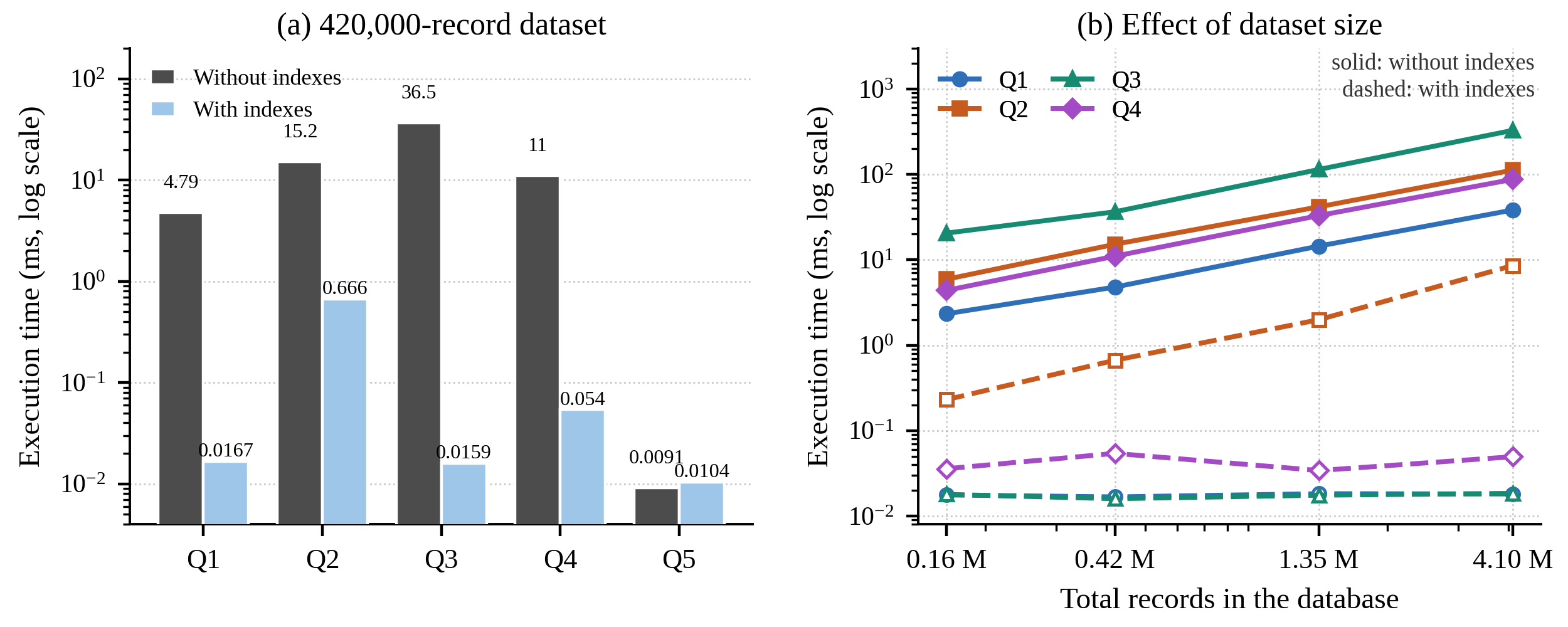
At the reference scale:
| Query | Without Index | With Index | Reduction |
|---|---|---|---|
| Q1 | 4.793 ms | 0.0167 ms | 99.65% |
| Q2 | 15.204 ms | 0.666 ms | 95.62% |
| Q3 | 36.514 ms | 0.0159 ms | 99.96% |
| Q4 | 11.028 ms | 0.054 ms | 99.51% |
| Q5 | 0.0091 ms | 0.0104 ms | — |
Q5 is the control query because its primary key is already indexed.
| Dataset | Without Index | With Index |
|---|---|---|
| 160K | 2.333 ms | 0.0176 ms |
| 420K | 4.793 ms | 0.0167 ms |
| 1.35M | 14.466 ms | 0.0182 ms |
| 4.10M | 38.302 ms | 0.0181 ms |
| Dataset | Without Index | With Index |
|---|---|---|
| 160K | 20.549 ms | 0.0179 ms |
| 420K | 36.514 ms | 0.0159 ms |
| 1.35M | 114.305 ms | 0.0175 ms |
| 4.10M | 328.351 ms | 0.0184 ms |
The indexed workloads remained comparatively stable while scan-heavy workloads increased with dataset size.
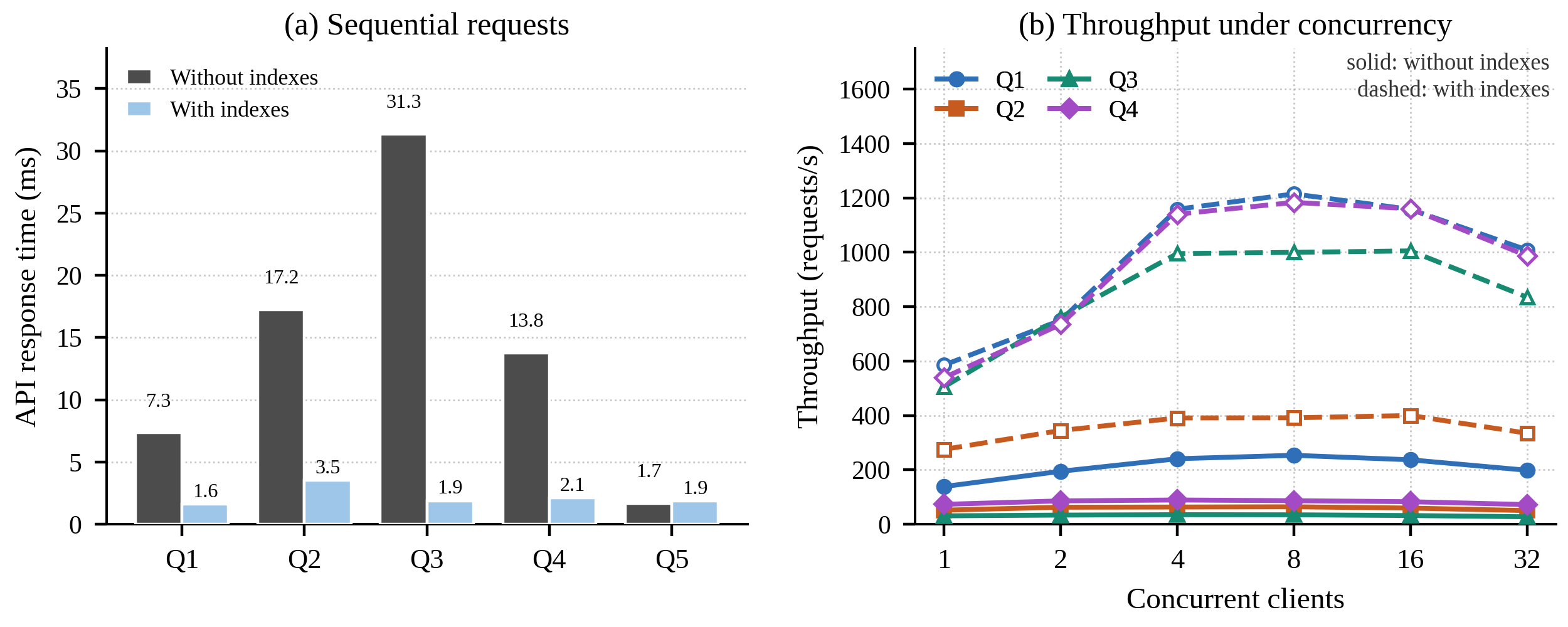
At 8 concurrent clients:
| Endpoint | Latency A | Latency B | Throughput A | Throughput B |
|---|---|---|---|---|
| Q1 | 7.34 ms | 1.61 ms | 255.4 | 1,241.5 |
| Q2 | 17.24 ms | 3.53 ms | 67.3 | 406.1 |
| Q3 | 31.35 ms | 1.88 ms | 34.3 | 1,042.5 |
| Q4 | 13.76 ms | 2.09 ms | 87.3 | 1,167.7 |
Average Q1–Q4 latency:
17.42 ms → 2.28 ms
86.9% lower.
The benchmark also evaluates:
1 → 2 → 4 → 8 → 16 → 32 clients
For Q3 at 32 clients:
| Metric | Without Index | With Index |
|---|---|---|
| Mean latency | 973 ms | 33 ms |
| P95 latency | 1,354 ms | 43.8 ms |
| Throughput | 27.2 req/s | 835 req/s |
Indexes also introduce overhead.
Secondary indexes: ~23.2 MB
Without indexes : 26.28 ms
With indexes    : 96.49 ms
Write overhead: +267.1%
This highlights the read/write trade-off of indexing.
| Component | Version |
|---|---|
| Ubuntu | 24.04.4 LTS |
| PostgreSQL | 16.13 |
| Python | 3.11.15 |
| FastAPI | 0.141.1 |
| Uvicorn | 0.46.0 |
| CPU | 2 × Xeon vCPU @ 2.80 GHz |
| RAM | 7.8 GiB |
Install dependencies:
pip install "psycopg[binary]" psycopg_pool fastapi uvicorn httpx matplotlib python-docxRun the main experiments:
python3 bench_db.py
python3 scale_bench.py
Run the API benchmark:
python3 -m uvicorn app:app --host 127.0.0.1 --port 8100 --workers 1

python3 bench_api.py A
python3 bench_conc.py A
Then run Configuration B after creating the indexes:
python3 bench_api.py B
python3 bench_conc.py B
Generate figures and the paper:
python3 figures.py
python3 build_paper.py| File | Purpose |
|---|---|
gen.sql |
Schema and data generation |
queries.py |
Queries and index definitions |
bench_db.py |
Database benchmark |
scale_bench.py |
Scaling benchmark |
app.py |
FastAPI service |
bench_api.py |
API benchmark |
bench_conc.py |
Concurrency benchmark |
figures.py |
Figure generation |
build_paper.py |
Paper generation |
results_*.json |
Raw measurements |
fig*.png |
Benchmark figures |
The experiment demonstrates that carefully selected B-tree indexes can significantly improve database-backed web applications:
Database execution
67.55 ms → 0.76 ms

API latency
17.42 ms → 2.28 ms

Measured throughput improvement
up to 30.4×
At the same time:
Storage overhead  ≈ +72.5%
Write overhead    ≈ +267.1%
Index for the workload, measure the result, and consider both read performance and maintenance cost.
For the complete methodology, analysis, scaling study, discussion, limitations, and conclusions, read the full research paper:
Impact of Database Indexing on Web Application Performance: An Experimental Study Using PostgreSQL and FastAPI
📄 Read the full paper on Academia.edu
Alaa Mahdi, Ahmed.

"Impact of Database Indexing on Web Application Performance:
An Experimental Study Using PostgreSQL and FastAPI."

2026.
No open-source license has currently been declared for this repository.