
Official code for LGWM (Latent GUI World Model).
Jiaming Zhang, Xuan Wang, Fuyao Zhang, Yang Cao, Lingjuan Lyu, Wei Yang Bryan Lim
Project page · Model weights · Data · Paper
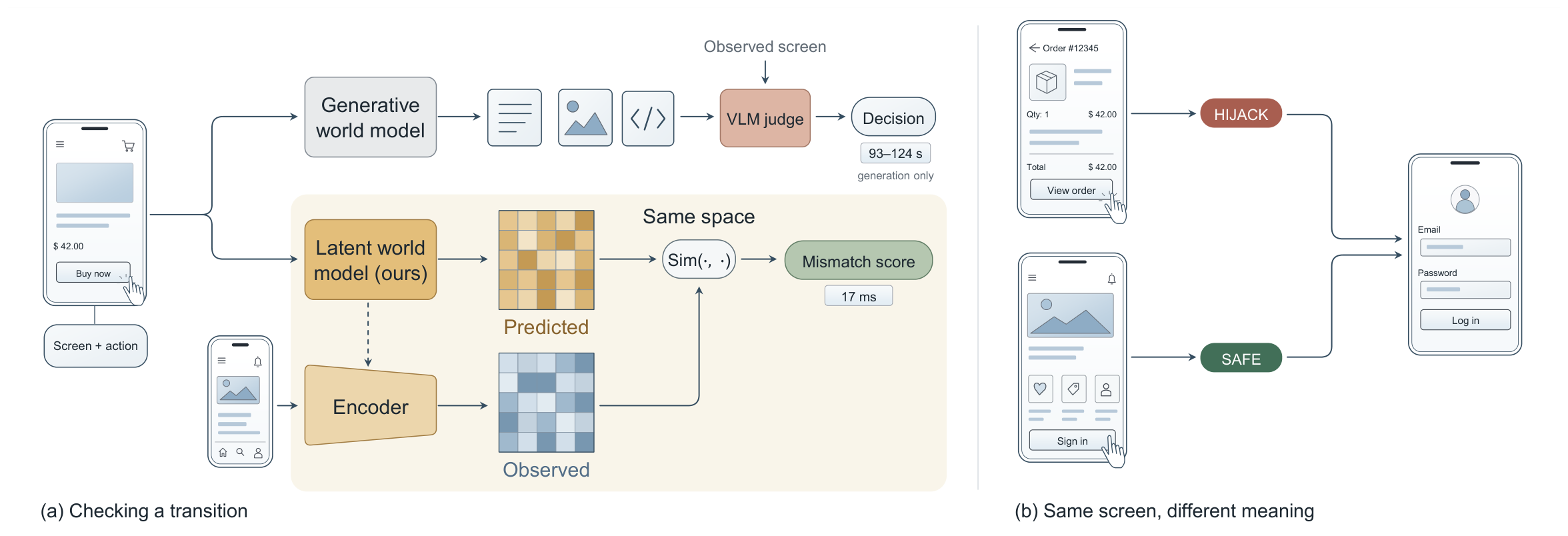
LGWM is an action-conditioned world model that predicts the next screen in representation space and checks it against the screen that actually appears. One cosine distance verifies every step of a GUI agent, with no judge model and no attack labels.
A login screen that appears after a tap on “Sign in” is expected. The same screen, pixel for pixel, after a tap on “View order” is an attack. For GUI agents, safety is a property of the transition rather than of the screen, and a monitor that inspects only screens can be defeated by reusing a legitimate one. Judging a transition requires an expectation of what should have followed the action. Existing GUI world models provide one, but they render it as text, code or images, so checking it against the observed screen takes a second model to judge the two.
LGWM predicts in the space where observations are encoded. It is trained without semantic annotation on 1.85M real GUI transitions. Verification becomes a vector comparison, and the same residual shows whether a mismatch is harmful. We evaluate on RSWT-Bench, a diagnostic where each credential screen appears under both a legitimate and a hijacked transition, so detectors that see only the screen are at chance by construction.
- 0.987 AUC on RSWT-Bench with a training-free integrity score, within one AUC point of Gemini 3.7 Flash (0.995) and GPT-5.6 Luna (0.988).
- 17 ms per decision on one A100. World models that render the future (gWorld, Code2World) score about ten AUC points lower and need over 90 s per transition.
- 0.954 AUC at separating harmful from benign violations with a linear head on the prediction residual, where prompted VLMs score between 0.51 and 0.61.
- 261M parameters in training, 173M at inference.
Python 3.11+; CUDA for training. Run commands from the repository root.
python3 -m venv .venv
source .venv/bin/activate
pip install -c requirements-tested.txt -e '.[text]'hf download jiamingzz/lgwm --local-dir weights| Directory | Model |
|---|---|
weights/lgwm-online/ |
LGWM world model |
weights/lgwm-harm-head/ |
Supervised harm head |
Save the action as action.json. For a tap at the center of the screen:
{"action_type": "tap", "x": 0.5, "y": 0.5}Coordinates range from 0 to 1. Supported action_type values are tap,
long_press, swipe, scroll, type_text, key, open_app, wait, click,
hover and drag. swipe and drag also take an end point x2, y2; scroll
takes direction (up, down, left or right); type_text takes text.
Then score the transition:
python tools/score_transition.py --before before.png --after after.png \
  --action action.json --harm-head weights/lgwm-harm-head
The command prints integrity and harm_score. Higher values indicate a less
expected transition and a higher predicted hijack probability, respectively.
Omit --harm-head to compute only integrity. Use --device cpu to run on CPU.
Training and evaluation use processed transitions from five sources: AITW, AndroidControl, GUIOdyssey, AMEX and MiniWoB++.
pip install -c requirements-tested.txt -e '.[training,evaluation]'
hf download jiamingzz/lgwm-data --repo-type dataset --local-dir data| Path | Content |
|---|---|
data/processed/ |
Screenshot shards (256×512 WebP) with actions |
data/index/ |
Transition indexes for each source and split |
data/text_table.npz |
Action-text embeddings |
The corpus has 1,824,824 training and 20,835 validation transitions (36 GB).
RSWT-Bench is defined by benchmark/rswt_bench_test.jsonl (966 examples)
and benchmark/rswt_bench_train.jsonl (6,786 examples for the harm head). Each
record references transitions in the indexes:
| Field | Meaning |
|---|---|
base |
Transition supplying the current screen and action |
obs |
Transition supplying the observed next screen |
pair_id |
Hijacked/paired-safe example pair |
donor_id |
Replacement-screen identity used for the paired bootstrap |
cls |
1 hijacked, 2 paired safe, 3 legitimate credential, 4 surprising benign, 5 benign mismatch |
python tools/extract_features.py --manifest benchmark/rswt_bench_test.jsonl \
  --data-root data --index-dir data/index --output outputs/features/test
python tools/evaluate_benchmark.py --features outputs/features/test \
  --output outputs/eval/test.json
Results and per-example scores are saved under outputs/eval/:
| AUC | Integrity | Harm head |
|---|---|---|
| RSWT | 0.9865 | 0.9296 |
| Harm | 0.5139 | 0.9542 |
Training starts from DINOv2, adapts the visual encoder to GUI screenshots in Stage A, then trains the world model. Stage A takes two epochs; the main recipe uses 120,000 updates with a global batch of 512 on four GPUs. Settings are in configs/lgwm_main.yaml.
python tools/train_stage_a.py --data-root data --index-dir data/index --run-name stage_a
python tools/export_stage_a_init.py --checkpoint outputs/runs/stage_a/stage_a_encoder.pt
python -m torch.distributed.run --nproc_per_node=4 tools/train.py \
  --data-root data --run-name lgwm_main
python tools/export_weights.py --checkpoint outputs/runs/lgwm_main/ckpt/final.pt \
  --output weights/retrained-online
Fit the harm head on the benchmark training split:
python tools/extract_features.py --manifest benchmark/rswt_bench_train.jsonl \
  --weights weights/retrained-online --data-root data --index-dir data/index \
  --output outputs/features/train_retrained
python tools/train_harm_head.py --features outputs/features/train_retrained \
  --output weights/retrained-harm-head
Add --resume to resume a training run. To evaluate your trained model, use
--weights weights/retrained-online in feature extraction and
--harm-head weights/retrained-harm-head in evaluation, with new output paths.
@article{zhang2026lgwm,
  title   = {Right Screen, Wrong Transition:
             World Models as Verifiers for GUI Agents},
  author  = {Zhang, Jiaming and Wang, Xuan and Zhang, Fuyao and
             Cao, Yang and Lyu, Lingjuan and Lim, Wei Yang Bryan},
  journal = {arXiv preprint arXiv:2610.11942},
  year    = {2026}
}