






A plug-and-play Docker image that turns the official OpenCloud server into a genuine
one-click Unraid app: it runs the required first-boot init for you, heals the
appdata permissions and honours Unraid's PUID/PGID — no console,
no chown, no config-file editing required.
Maintained solo, in whatever spare time there is. Questions via the support thread, bugs, ideas and feature requests via GitHub issues. If it's useful to you, a coffee is always welcome.

- Overview
- Quick Start
- Configuration
- Production vs Rolling
- How the Wrapper Works
- Reverse Proxy
- Building Locally
- Updating
- Troubleshooting
- Architecture
- Contributing / License
- License
- Support this project
OpenCloud is a modern, self-hosted file sync-and-share platform (an actively developed member of the ownCloud/Infinite-Scale family). The official opencloudeu/opencloud image is excellent, but it is not built for a one-click NAS install:
- it runs its binary as a fixed UID with no
PUID/PGIDsupport, so on a fresh Unraid box the root-owned bind mounts make the very first boot fail with "permission denied" writing/etc/opencloud/opencloud.yamland/var/lib/opencloud/nats; - it requires a one-time
opencloud initto be run by hand beforeopencloud serverwill start.
This image is a thin wrapper around the official one that fixes exactly those two things and nothing else:
- Auto-init — runs
opencloud initonce on first boot (idempotent on later boots). - Permission heal — creates the config/data dirs and hands them to your
PUID:PGID, and repairs a previously root-owned tree once (sentinel-guarded, so it never recursively re-chowns your whole data set on every start). - PUID / PGID — drops privileges to Unraid's
nobody:users(99:100) by default via a staticgosu. - Two channels —
:latest(stable, default) and:rolling(newest builds), from the same wrapper. - Multi-arch — amd64 and arm64.
The wrapper does not fork, patch or repackage OpenCloud itself — it layers a tiny entrypoint on top of the unmodified upstream image, so you always run real, current OpenCloud.
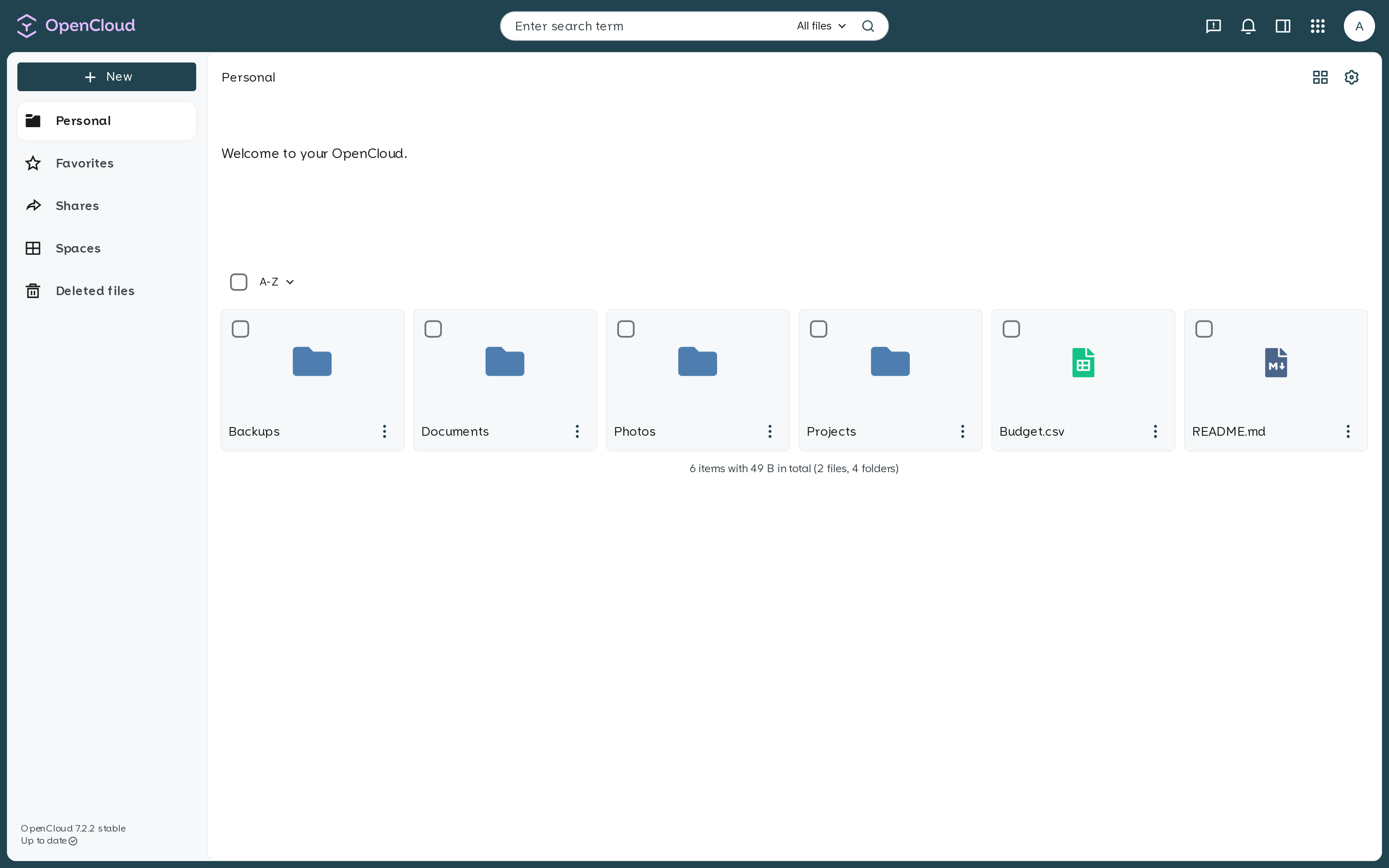
The OpenCloud web UI: your personal space with files, folders and spaces.
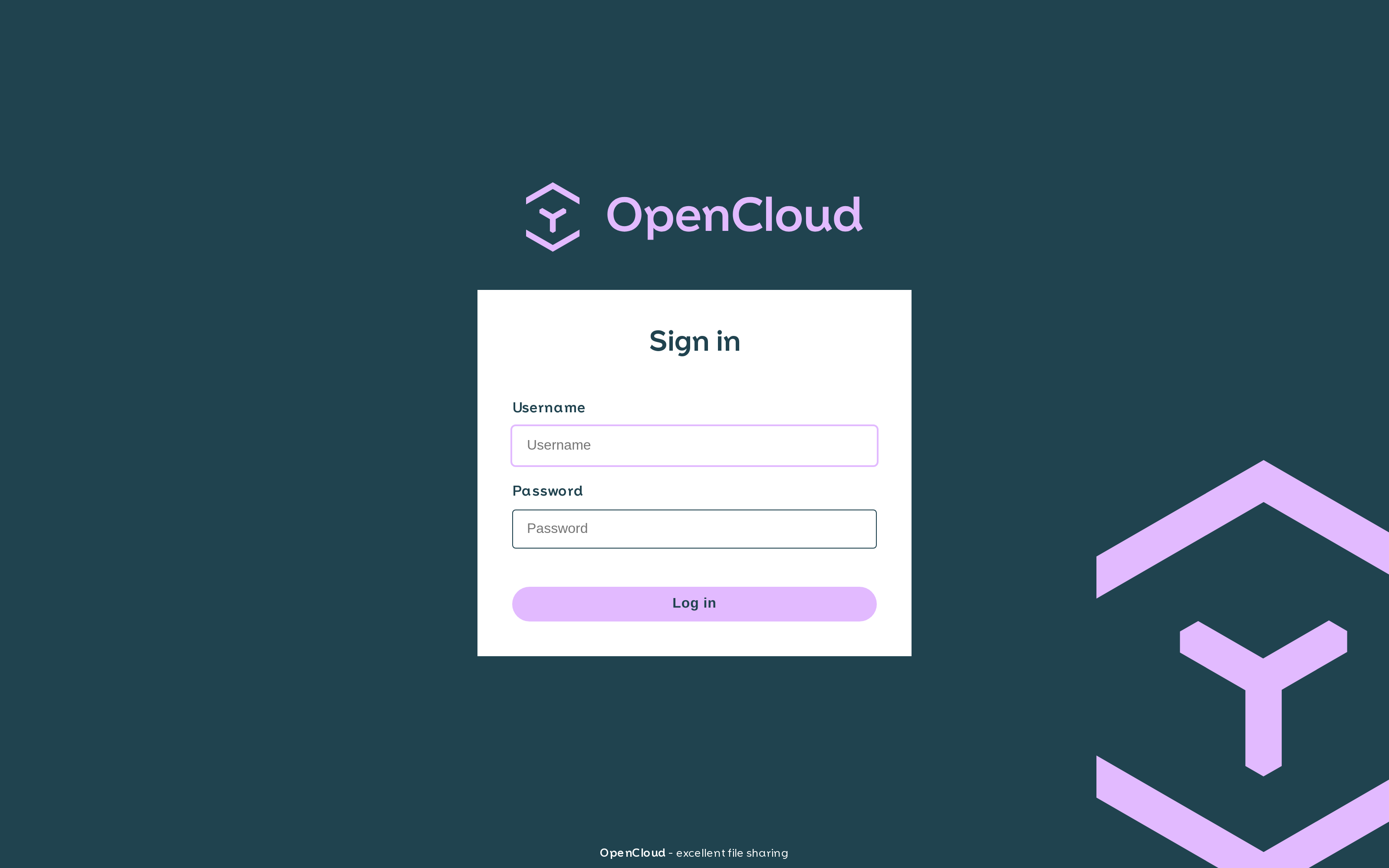
Sign in as admin with the password you set in the Unraid template.
On Unraid: Apps → search for OpenCloud → Install. The Community Applications template is published from the unraid-apps feed.
To load it by hand:
mkdir -p /boot/config/plugins/dockerMan/templates-user && \
curl -fsSL -o /boot/config/plugins/dockerMan/templates-user/my-OpenCloud.xml \
https://raw.githubusercontent.com/junkerderprovinz/unraid-apps/main/opencloud/opencloud.xmlIn the template, the only field you must set is Admin Password (IDM_ADMIN_PASSWORD) — it becomes the password for the built-in admin user on first start. The two volumes default to /mnt/user/appdata/opencloud/{config,data}; adjust the data path to a share with room to grow.
Hit Apply. The first start takes a moment while the container generates its config and a self-signed certificate. Watch the container log for:
  OpenCloud
  OPENCLOUD IS READY
Open https://<unraid-ip>:9200/ and accept the self-signed certificate once. Log in as admin with the password you set.
Plain Docker (no Unraid)
docker run -d \
  --name opencloud \
  --restart unless-stopped \
  -p 9200:9200 \
  -e PUID=99 -e PGID=100 \
  -e IDM_ADMIN_PASSWORD='change-me-please' \
  -e OC_URL='https://192.168.1.10:9200' \
  -e OC_INSECURE=true \
  -v /mnt/user/appdata/opencloud/config:/etc/opencloud \
  -v /mnt/user/appdata/opencloud/data:/var/lib/opencloud \
  junkerderprovinz/opencloud:latest
Set OC_URL to how clients reach the server (its IP:port, or your proxied hostname).
| Variable | Default | Description |
|---|---|---|
IDM_ADMIN_PASSWORD |
(required) | Password for the built-in admin user — applied on first init. Set this. |
OC_URL |
https://192.168.1.10:9200 |
Required. Public URL clients use to reach OpenCloud, and the OIDC login issuer — must be https. Set your server's real LAN IP:9200, or your external hostname behind a reverse proxy. Unraid does not auto-fill this. |
OC_INSECURE |
true |
Accept the container's self-signed cert. Set false when a proxy provides a valid cert. |
OC_LOG_LEVEL |
info |
Log verbosity — info, warn, error, debug. |
IDM_CREATE_DEMO_USERS |
false |
Seed demo users (test only — unsafe for real use). |
PROXY_TLS |
true |
OpenCloud terminates TLS itself on 9200. Set false behind a TLS-terminating proxy (see §6). |
PUID |
99 |
User ID OpenCloud runs as — Unraid's nobody. |
PGID |
100 |
Group ID — Unraid's users. |
| Port | Purpose | Volume | Purpose | |
|---|---|---|---|---|
9200 |
HTTPS WebUI / API (self-signed by default) | /etc/opencloud |
Config (opencloud.yaml + secrets) |
|
/var/lib/opencloud |
Data — user files, index, nats bus |
No database. OpenCloud is not Nextcloud — it has no MySQL/Postgres and needs none. State lives in the local storage tree on the
/var/lib/opencloudvolume plus an embedded NATS bus. Don't add a database container; there's nothing to point it at.
Files show up but are greyed out / won't open? The storage driver is wrong. Keep
STORAGE_USERS_DRIVER=posix(the default) — never leave it blank and never uselocal; both leave files visible but unreadable. Also make sure the Data volume is on a filesystem with extended-attribute support (the Unraid array and cache/pool disks have it). The driver is fixed at first init — to change it, start with a fresh Data folder.
OpenCloud can keep file blobs in any S3-compatible bucket while the metadata stays local. Set the storage driver to decomposeds3 and add the connection variables. Keep the driver on posix (the default) for normal local storage — do not leave it blank.
For self-hosted, two genuine, actively-maintained S3-compatible stores work well here: SeaweedFS (recommended for a single node) and Garage (built for geo-distributed multi-node clusters, but runs single-node here too). AWS S3, Backblaze B2 and Wasabi work the same way against their own endpoints.
| Variable | Example | Description |
|---|---|---|
STORAGE_USERS_DRIVER |
decomposeds3 |
Set to decomposeds3 for S3 blob storage. Default is posix (local) — never leave it blank or use local, both grey out files. |
STORAGE_USERS_DECOMPOSEDS3_ENDPOINT |
http://192.168.1.10:8333 |
S3 endpoint. Internal http:// URL for self-hosted SeaweedFS/Garage; the provider's https:// endpoint for AWS/B2/Wasabi. |
STORAGE_USERS_DECOMPOSEDS3_REGION |
default |
default for SeaweedFS, garage for Garage (its default region), or the provider region (us-east-1, …) otherwise. |
STORAGE_USERS_DECOMPOSEDS3_ACCESS_KEY |
… |
Access key ID. |
STORAGE_USERS_DECOMPOSEDS3_SECRET_KEY |
… |
Secret access key. |
STORAGE_USERS_DECOMPOSEDS3_BUCKET |
opencloud |
Bucket name — create it first, the container does not. |
Where those values come from:
- SeaweedFS (self-hosted). In that template, set an Access Key and Secret Key (see its README's Security note) and optionally a Pre-create Bucket name — those become your access key, secret key and bucket directly, no separate service-account step. Point the endpoint at its S3 port,
http://<seaweedfs-ip>:8333, with regiondefault. - Garage (self-hosted). In that template, set an Access Key and Secret Key (and optionally a Bucket) — they are pre-seeded on first boot, no separate CLI step. Point the endpoint at its S3 API port,
http://<garage-ip>:3900, with regiongarage. - AWS S3 / Backblaze B2 / Wasabi. Create a bucket in the provider console, then create an access key (AWS: an IAM access key; B2/Wasabi: an application/API key). Use the provider's
https://endpoint and the bucket's region.
The metadata always stays local.
decomposeds3puts only the blob bytes in S3; the file tree, xattrs and the blob→object mapping live on/var/lib/opencloud. That volume is therefore required and must be backed up even with S3 — losing it orphans your S3 objects (they are opaque IDs with no folder structure). There is no all-on-S3 mode. OpenCloud's system/metadata store (STORAGE_SYSTEM_DRIVER) staysdecomposed(local) and needs no change.
If uploads fail with a checksum error on a non-AWS endpoint, add STORAGE_USERS_DECOMPOSEDS3_PUT_OBJECT_DISABLE_CONTENT_SHA256=true. Both the SeaweedFS and Garage paths use the same generic decomposeds3 driver this wrapper's S3 support was originally built and verified against. SeaweedFS has since been re-verified live against a real OpenCloud instance after the switch away from MinIO (connectivity, boot health and unauthenticated bucket reachability all confirmed; a fully authenticated file-read round-trip is the one check still outstanding). Garage has not yet been separately re-verified end-to-end.
OpenCloud can edit documents in the browser, but it ships no office engine: it speaks the WOPI protocol to a separate document-server container. This wrapper wires that up from three template fields (all advanced, default off).
- Run a document server (its own container):
- Euro Office (
euro-office) — the sovereign OnlyOffice fork, imageghcr.io/euro-office/documentserver, port 80. SetWOPI_ENABLED=true. There is a one-click Unraid template for it in the junkerderprovinz feed (search Euro Office in Community Applications). OpenCloud itself makes Euro Office the default editor for MS formats (docx/xlsx/pptx). - Collabora Online (CODE) (
collabora) — imagecollabora/code, port 9980. A maintained community CA template exists (search Collabora in Community Applications); set its WOPI host allowlist (aliasgroup1/domain) to your OpenCloud URL. Best for ODF (odt/ods/odp). - OnlyOffice Document Server (
onlyoffice) — imageonlyoffice/documentserver, port 80; setWOPI_ENABLED=true. A community CA template exists.
- Euro Office (
- Point OpenCloud at it: set Web office suite to
euro-office,collaboraoronlyoffice, Office document server URL to the server's browser-reachable URL, and an Office WOPI secret. For OnlyOffice and Euro Office that secret must equal the document server's JWT secret (JWT_SECRET/EURO_OFFICE_JWT_SECRET); for Collabora it is not required. - Reverse proxy: forward
/wopiand/collaborationto OpenCloud on port 9200, and make sure OpenCloud and the document server can reach each other over the network.
Under the hood the wrapper turns on OpenCloud's built-in collaboration service (OC_ADD_RUN_SERVICES=collaboration), sets the COLLABORATION_* variables, registers it as the secure-view/edit handler and exposes the secure-view role. It also writes a small csp.yaml adding the document server's origin to OpenCloud's Content-Security-Policy frame-src/img-src and points PROXY_CSP_CONFIG_FILE_LOCATION at it, so the editor iframe isn't CSP-blocked by the browser — a step OpenCloud's own reference deployment requires wiring by hand. Already set PROXY_CSP_CONFIG_FILE_LOCATION yourself? The wrapper leaves it alone; add the document server's origin to your own file's frame-src/img-src. Leave Web office suite on off (the default) if you do not need document editing.
OpenCloud already has a built-in search: out of the box it matches file and folder names and metadata (tags, media type, …). It does not look inside file contents on its own. Apache Tika is not a second search engine, it is a text-extractor that OpenCloud's search service uses to read the text out of documents (PDF, Word, Excel, PowerPoint, ODF, …) so a search word inside a file is found too. (The TIKA=:tika.yml / TIKA_IMAGE lines you may have seen belong to OpenCloud's official docker-compose deployment — this Unraid wrapper has no .env; the two template fields below do the wiring instead.)
- Run Apache Tika (its own container). Ready-made Tika templates exist in Community Applications (search Tika) — install one (image
apache/tika, port9998; a-fulltag additionally does OCR of scanned images). Note its network-reachable address, e.g.http://<TIKA_IP>:9998. - Turn it on: set Full-text search (Tika) to
trueand Tika server URL to that address, then Apply. The wrapper points OpenCloud's search extractor at Tika and switches full-text search on for you.
Under the hood the wrapper sets SEARCH_EXTRACTOR_TYPE=tika, SEARCH_EXTRACTOR_TIKA_TIKA_URL and FRONTEND_FULL_TEXT_SEARCH_ENABLED=true (plus SEARCH_EXTRACTOR_CS3SOURCE_INSECURE=true for the internal LAN cert). Only files uploaded or changed after this are content-indexed; existing files are not re-indexed automatically, so re-upload or edit a file to test. See the OpenCloud search docs.
Two channels are built from this wrapper, differing only in the upstream base image:
| Tag | Base image | For |
|---|---|---|
junkerderprovinz/opencloud:latest |
opencloudeu/opencloud:latest |
Default. OpenCloud's stable release line (currently the 7.2.x train). :production is kept as an alias, same image. |
junkerderprovinz/opencloud:rolling |
opencloudeu/opencloud-rolling:latest |
Newest OpenCloud releases (currently 7.4.x). Recommended for large-folder sync. |
Which channel? The stable/default train moves slowly and, as of 7.2.x, does not yet carry the incremental-fsync fix (reva#720) for the large-folder sync abort on slow storage (issue #3027). That fix ships from 7.3.0, which OpenCloud publishes only on the rolling image. So on array/FUSE-backed appdata, or if you push large folders (tens of GB) from a desktop client, run :rolling. Placing the data volume on a fast SSD/NVMe pool also avoids the stall.
Switch by changing the Repository tag in the Unraid template (:latest -> :rolling). Back up your appdata before switching channels. Both channels track OpenCloud's own upstream :latest tag directly, and the weekly rebuild picks it up automatically alongside Alpine security patches — no waiting on a version-bump PR to get merged.
The entrypoint runs as root only long enough to prepare the volumes, then drops to your user:
- Permission heal. Creates
/etc/opencloud+/var/lib/opencloudif missing andchowns them toPUID:PGID. The config dir is small and always fully healed; the data dir is onlychown -R'd once (or after aPUID/PGIDchange), tracked by a.uid-healsentinel — so a large data set is never recursively re-owned on every boot. Thenatsbus dir is always re-asserted (small, must stay writable). - Init. Runs
opencloud initas the target user (writesopencloud.yaml, consumingIDM_ADMIN_PASSWORD). Idempotent — it harmlessly errors once the config exists. - Hand-off. Prints the ready banner, then
execsopencloud serverdropped toPUID:PGIDvia a staticgosu(copied from the upstreamtianon/gosuimage — no package manager needed in the base).
By default OpenCloud serves HTTPS itself on 9200 with a self-signed certificate — ideal for a direct LAN install. To put it behind a reverse proxy that terminates TLS (Traefik, NGINX Proxy Manager, SWAG, …):
- set
PROXY_TLS=false(OpenCloud then serves plain HTTP for the proxy to wrap), - set
OC_URLto your external URL, e.g.https://cloud.example.com, - set
OC_INSECURE=false(your proxy presents a valid certificate), - point the proxy upstream at the container's port
9200.
Desktop or mobile client login returns 403 Forbidden while the browser works? The native clients sign in through a loopback OIDC redirect (redirect_uri=http://127.0.0.1:<port>, per RFC 8252). Many reverse-proxy "block exploits" filters reject a literal http:// inside a query string. In NGINX Proxy Manager this is the "Block Common Exploits" toggle: its block-exploits.conf contains if ($query_string ~ "[a-zA-Z0-9_]=http://") { return 403; }. The web UI avoids it (its redirect is URL-encoded), the desktop client trips it (plain http:// loopback). Switch that toggle off for the OpenCloud host and the client login succeeds. OpenCloud brings its own auth and CSRF protection, so the crude regex filter is redundant here.
git clone https://github.com/junkerderprovinz/opencloud.git
cd opencloud

# production/latest channel (default base)
docker build -t opencloud:dev .

# rolling channel (reads the BASE_ROLLING pin from the Dockerfile)
docker build --build-arg BASE="$(grep -oE 'ARG BASE_ROLLING=[^[:space:]]+' Dockerfile | cut -d= -f2)" -t opencloud:rolling .

# multi-arch (amd64 + arm64) — needs buildx
docker buildx build --platform linux/amd64,linux/arm64 -t opencloud:dev --load .
just recipes mirror the CI flows — just build, just build-rolling, just smoke, just lint.
docker pull junkerderprovinz/opencloud:latest
docker stop opencloud && docker rm opencloud
# re-create with the same template / docker run args
On Unraid: Docker tab → the container → Force Update. Your /etc/opencloud and /var/lib/opencloud are untouched. The image is rebuilt weekly for upstream OpenCloud and Alpine patches.
The container starts, heals ownership, then crash-loops and the WebUI never comes up. This means the Data volume is pointing at a non-fresh OpenCloud/oCIS data directory — an old install, or a data set created with a different storage backend (local vs S3). The layouts are not interchangeable and there is no in-place migration between backends, so the search service can't open its index and takes the whole server down.
Fix: give it a fresh, empty Data folder. Move the old directory aside (mv /mnt/user/opencloud /mnt/user/opencloud.old) and let a new empty one be created, then restart. To keep old files, start fresh and re-upload them through the web UI. This is not a bug in the wrapper or the image — a clean data dir boots normally, S3 included.
Syncing a large folder (tens of GB) from the desktop client stalls partway and the client connection just drops. The cause is slow fsync on the Data volume, not the network. The Data volume holds the embedded NATS message bus, the file-tree metadata and the transient upload staging, all of them fsync-heavy. On slow storage (the Unraid array, or any /mnt/user share through the shfs FUSE union) the fsync storm freezes, postprocessing fails and the server drops the client (upstream issue #3027).
Fix: put the Data volume on a fast SSD/NVMe pool, not the array. With a decomposeds3/S3 backend only this small metadata volume needs fast storage (the file blobs go to your S3 bucket, so it stays small and grows with file count, not size). The reva incremental-fsync change (reva#720) also helps and ships from OpenCloud 7.3.0, which is on the :rolling channel (§4).
First start seems stuck / WebUI not reachable yet
The first boot runs opencloud init and generates a self-signed certificate — give it a moment. Watch the log for the OPENCLOUD IS READY banner, then open https://<ip>:9200/.
Browser warns about the certificate
That is expected with the default self-signed certificate (OC_INSECURE=true). Accept it once, or put OpenCloud behind a reverse proxy with a real certificate (see §6).
"permission denied" in the log
The wrapper heals ownership on start, but a data set created earlier as a different user can need a one-time repair. Stop the container, delete /var/lib/opencloud/.uid-heal, and start again to force a full re-chown to your PUID:PGID.
I forgot / want to change the admin password
IDM_ADMIN_PASSWORD is read on every start and overrides the stored admin password, so just set it in the template and restart.
Login loops or "redirect URI" errors behind a proxy
OC_URL must exactly match the URL in your browser (scheme + host + port). Set OC_URL to your external https URL and PROXY_TLS=false (see §6).
┌──────────────────────────────────────────────────────────────┐
│  opencloudeu/opencloud[:latest] | opencloud-rolling           │
│  (Alpine base + the OpenCloud binary, unmodified)             │
│  ┌────────────────────────────────────────────────────────┐  │
│  │  entrypoint.sh  (runs as root)                          │  │
│  │   ↓ mkdir + chown /etc/opencloud, /var/lib/opencloud    │  │
│  │   ↓ one-time data heal (sentinel-guarded)               │  │
│  │   ↓ gosu PUID:PGID  opencloud init  (|| true)           │  │
│  │   ↓ print "OPENCLOUD IS READY" banner                   │  │
│  │   ↓ exec gosu PUID:PGID  opencloud server               │  │
│  └────────────────────────────────────────────────────────┘  │
│      static gosu  ← COPY --from=tianon/gosu (multi-stage)     │
└──────────────────────────────────────────────────────────────┘
Pull requests welcome. Issues: https://github.com/junkerderprovinz/opencloud/issues.
Licensing — dual:
- This wrapper repository (Dockerfile,
entrypoint.sh,print-banner.sh, Unraid template, README and banner/icon artwork) is licensed under the GNU Affero General Public License v3.0 (AGPL-3.0). - OpenCloud itself and the bundled
gosubinary are Apache-2.0; the Alpine base and its packages keep their own licenses. When you run, redistribute or rebuild the resulting image you must comply with all of those, not only this wrapper's AGPL-3.0 license. SeeNOTICE.
The OpenCloud logo and wordmark are the property of OpenCloud GmbH, used unmodified to identify the upstream project. This is an independent, community-maintained packaging and is not affiliated with or endorsed by OpenCloud GmbH.
- OpenCloud — the file sync-and-share platform this image wraps
- gosu — clean, static privilege-drop for the entrypoint
Copyright (C) 2026 Junker der Provinz.
This repository packages OpenCloud as a container for Unraid. The packaging in this repository (Dockerfile, scripts, theme, web assets and everything else original here) is free software under the GNU Affero General Public License v3.0 (AGPL-3.0); see LICENSE. If you distribute it, or run a modified version as a network service, you must release your source under the same AGPL-3.0 terms and keep the existing copyright and attribution notices intact.
Scope. The AGPL applies to this repository's own code and assets. OpenCloud itself is a separate project under its own license and name; this repository does not claim it. The banner, logo, theme and other branding original to this repository remain reserved: a fork must use its own branding and may not present itself as this project.
Questions? Check the support thread. Bugs, ideas or feature requests? Please open a GitHub issue.
This is a one-person project. I put a lot of time and effort into building and maintaining it, in whatever free time I have. If it's helped you, I'd genuinely appreciate the support: you're welcome to buy me a coffee.