
CoinMarketCap publishes one price per asset. Consensus shows how that price is made across perpetual-futures venues, how concentrated it is, and where the venues disagree.
Live: https://consensus-cmc.vercel.app · Track: Data and Visualisation · Built for Build with CMC: API Hackathon · #BuildwithCMC
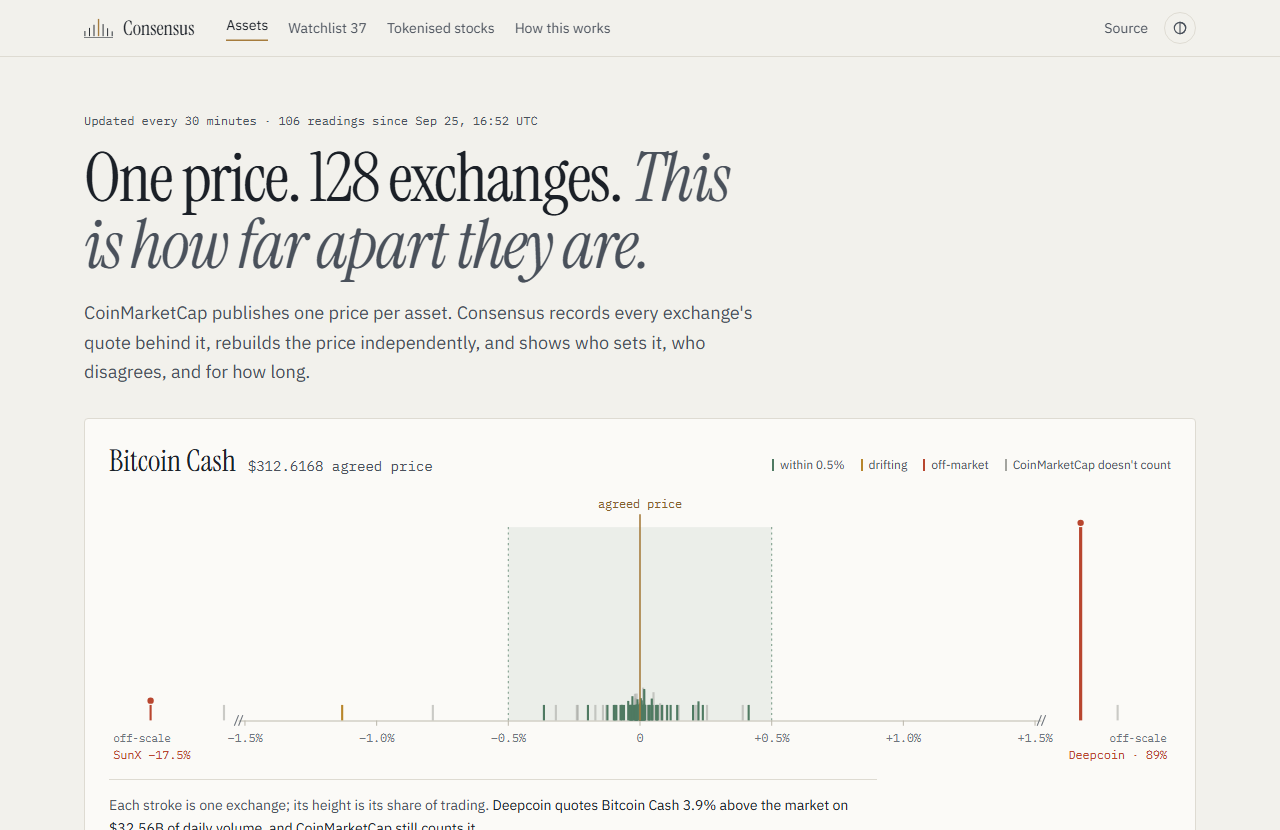
A recorder captures per-venue price, volume, open interest, funding and basis for 38 assets (about 3,700 venue rows per capture), plus liquidations and Uniswap v3 pools, on a fixed schedule. The site scores each asset and shows who sets the price. Started at 15 assets on the free CMC Basic tier (15k credits/month); widened to 38 after the CMC team upgraded the key to the Startup tier (450k credits/month) for the event window — two assets (PEPE, SHIB) are deliberately excluded because their perpetual contracts are quoted in two different denominations across exchanges, a unit mismatch this project's scoring doesn't yet detect for crypto (it already does for tokenised gold — see /methodology).
Event API access reverts to the Basic tier when submissions close (30 Sep), before judging (1-16 Oct) begins, so the live site's actual capture cadence will widen from 30 minutes to a few hours during judging — lib/budget.ts throttles automatically rather than exhausting the key. The home page always states the real, current cadence from recent capture gaps, not a fixed claim.
| Live | https://consensus-cmc.vercel.app |
| For judges | https://consensus-cmc.vercel.app/judge — a 90-second click path through the strongest evidence, live |
| Repo | https://github.com/ketutezraugm/consensus-cmc (MIT) |
| Demo video | https://youtu.be/wqvrUpC_c4M |
| Verify it yourself | node --no-warnings --env-file=.env.local scripts/report.mjs — reproduces every finding below from the live recorded data, no CMC credits spent |
| Tests | 105, node --no-warnings --test (~6s, offline — nothing above depends on a live key) |
| Raw API evidence | scripts/out/ — real, saved responses, not paraphrased |
| API feedback | 24 items from real calls: docs/api-feedback.md. Strongest: the market_id duplicate below; no unit field on tokenised assets (a 97% "disagreement" that's actually gold priced per gram vs per troy ounce); tier docs don't say which endpoints each plan actually gets |
The headline finding: CoinMarketCap's own API returns Kraken's BTC perpetual market twice, under the same market_id (47233), with two conflicting prices in the same response — and flags neither row. Consensus catches this because it checks every market for duplicates on every capture; CMC's own exclusions field never does, on this or 6 other duplicated markets in the latest capture alone. And it isn't just an alarm system: built only from venue-level data, with no knowledge of CMC's own published number, it independently reconstructs that number to within a median of 5 bps across 37 assets — checked against ground truth, not just flagged as a risk.
This submission is the web app above. The same recorder and analysis engine also power a Telegram bot (docs/submission-trading-alerts.md) and a remote MCP server (claude mcp add --transport http consensus https://consensus-cmc.vercel.app/api/mcp, docs/submission-mcp.md) — not submitted as separate entries, included here for completeness.
Recorded 2026-09-25 onward, 199 captures and counting. Reproduce every number below with node --no-warnings --env-file=.env.local scripts/report.mjs (fast — it's the exact code the home page runs). Ordered by how defensible the claim is, strongest first.
| Finding | Evidence |
|---|---|
| We independently reconstructed CMC's own published price to within a median of 5 bps across 37 assets — a volume-weighted composite built only from venue-level data, with no knowledge of CMC's published number, computed after the fact. Widest: BCH diverges by 161 bps. | Every capture |
The API returns some markets twice with conflicting prices, on a reputable venue. Kraken's BTC perp (market_id 47233) appears as $83,896 and $66,959 in the same response; neither row is flagged. Same for Kraken ETH/LTC/XRP and DigiFinex ETH, plus MemeMax's XLM market since the watchlist widened — a data-return defect, not a thin-venue quirk. |
7 duplicated markets in the latest capture, present every capture since duplicates were kept |
| BCH perp volume is one venue. Deepcoin holds 90%+ of BCH's 24h perp volume. CMC excludes only a few percent of BCH's volume from its own aggregation. | 90%+ in 153 of 199 captures |
| SunX quotes off-market on 29 of 37 tracked assets and is never flagged. Typically 14% below the median. | 199 of 199 captures. Its volume is small, so it barely moves an aggregate |
| CMC excludes a median 47% of perp volume from its own aggregation (1%-80% by asset). | Every capture |
| Tokenised assets mostly agree, with one large exception. Median weighted disagreement between issuers of the same asset is 4.4 bps across 80 scored assets (82 tracked; a couple have no usable price data yet). SpaceX (SPCX) is the exception: 11 tokens from different issuers, 10 liquid, disagreeing by 40.3% — and it moves: this figure was 14.6% a few hours earlier in the same day. The API does not say why. | Latest capture; history accumulating |
| Gold tokens priced per gram look like a 97% disagreement unless units are handled. Consensus detects and excludes them. | Every capture |
| DEX and exchange prices mostly track each other, loosely. Liquidity-weighted Uniswap v3 prices sit within a few tens of basis points of the exchange reference for BTC (+5 bps) and ETH (-16 bps); LINK, on thinner on-chain liquidity, currently gaps further at +30 bps. | A consistency check, not an anomaly claim |
What these do not show: whether CMC's headline price actually uses the flagged rows, or whether Deepcoin's volume is real. They are observations about what the API returns.
Supabase pg_cron ──POST──> /api/ingest ──> CMC API ──> Supabase (observations, liquidations)
                                                                              │
                                   browser <── Next.js server components <────┘  scoring in lib/consensus.ts
lib/consensus.tsis pure scoring code with no I/O.test/consensus.test.mjscovers it, including the degenerate cases (single venue, zero volume, zero open interest, negative funding, dead pools).- Confidence (0-100) blends volume spread across venues (40%), share of volume within 50 bps of the median (30%), freshness (15%) and share of volume CMC excludes (15%). The weights are a judgement call, not a fitted model. Every asset page shows the four components broken out with their point contributions — a surprising ranking (e.g. one asset outscoring a less-concentrated one) is explained by the numbers right there, not hidden behind a single score. Full breakdown, including what's been checked against real data versus stated as a judgement call, is on /methodology.
- Each asset page also checks the recorded venue composite against CMC's own single published price for that asset — never used as an input, only as an independent check.
- Price statistics use only venues CMC itself trusts for price (
exclusionsdoes not containprice). - The on-chain layer covers BTC (via WBTC), ETH (via WETH) and LINK only. Wrapped tokens are not the underlying, so part of any gap can be wrapper risk.
| Endpoint | Used for | Credits |
|---|---|---|
GET /v5/cryptocurrency/derivatives/market-pairs/list/latest (crypto_id, category=perpetual, limit=250) |
Per-venue price, volume, open interest, index price, basis, funding, outlier_detected, exclusions. 38 calls per capture. |
1 per 250 pairs |
GET /v5/derivatives/liquidations/cryptocurrency/list/latest |
Long/short liquidations, 1h/4h/24h, per asset | 1 |
GET /v5/derivatives/liquidations/quotes/latest |
Market-wide liquidations | 1 |
GET /v4/dex/spot-pairs/latest (dex_slug=uniswap-v3, network_slug=ethereum) |
Pool price, liquidity, volume for WBTC/WETH/LINK vs stablecoins | 1 |
GET /v5/real-world-assets/assets/list (limit=100) |
The 100 highest-ranked tokenised assets | 1 |
GET /v5/real-world-assets/quotes/latest (rwa_id= up to 100 ids in one call) |
Every issuer's token for each asset: price, market cap, 24h volume | 1 |
GET /v1/cryptocurrency/quotes/latest (id= 38 ids in one call) |
CMC's own single published price per asset, checked against our composite — never fed into it | 1 |
About 44-46 credits per capture. Started on the free Basic tier (15k credits/month, ~21-23 credits/capture at 15 assets); the CMC team upgraded the key to the Startup tier (450k credits/month) on 2026-09-28 for the event window, which is what made widening to 38 assets and 100 tokenised assets possible at a 30-minute cadence. That access reverts to Basic at submission close, so the cadence widens automatically during judging — see the note above.
Also probed during development, not used by the product: /v5/exchange/derivatives/list, /v5/real-world-assets/{map,issuers/list} (200 on Basic), /v5/real-world-assets/market-pairs/list, /v2/cryptocurrency/market-pairs/latest (spot markets) and /v1/exchange/listings/latest — all three 403 on Basic, rechecked 403 on Startup too, so this isn't a scope we could add without a further tier upgrade. Raw responses are in scripts/out/.
Code: scripts/probe.mjs and app/api/ingest/route.ts. Responses: scripts/out/. A trimmed real response from derivatives/liquidations/quotes/latest:
{ "data": { "quotes": [ { "symbol": "USD", "total_liquidations_24h": 271450100.5357326,
    "long_liquidations_24h": 140387785.74551252, "short_liquidations_24h": 131062314.79022013,
    "last_updated": "2026-09-25T16:31:00.000Z" } ] },
  "status": { "timestamp": "2026-09-25T16:33:18.280Z", "error_code": "0", "credit_count": 1 } }
And the duplicate-market response (scripts/out/deriv-pairs.json, Kraken, same market_id, same last_updated):
market_id 47233  XBT/USD perpetual  price 84012.0   reported 84027   exclusions []
market_id 47233  XBT/USD perpetual  price 66959.0   reported 66922   exclusions []
Full list with 24 items in docs/api-feedback.md. The short version:
- Made possible: one call returns per-venue price, volume, open interest, index price, basis and funding, plus CMC's own
outlier_detectedandexclusions. Exposing the exclusions is what makes an analysis of how the headline price is made possible at all. Separately, the same API's single published-price endpoint let us check our own reconstruction against it — a validation loop the API supports without meaning to. - In the way: the docs do not say which tier each endpoint needs (derivatives and RWA answered on Basic, spot market-pairs did not);
market_idis not a unique key; the endpoint mixes base-side and quote-side pairs;/v4/dex/networks/listreturned a 500;limit=200silently returns 100; RWA data has no underlying price, so tokenised-vs-underlying comparison is not possible yet.
cp .env.example .env.local        # CMC_API_KEY, INGEST_SECRET, SUPABASE_URL, SUPABASE_SERVICE_KEY
# run every file in supabase/migrations/ (0001-0007, in order) in your Supabase SQL editor
npm install && npm run dev
node --no-warnings --test         # scoring tests
node --env-file=.env.local scripts/probe.mjs   # call every endpoint family once
curl -X POST -H "Authorization: Bearer $INGEST_SECRET" localhost:3000/api/ingest   # one capture (?dry=1 to skip the write)
Scheduling: Supabase pg_cron calls the ingest endpoint every 30 minutes (supabase/cron.example.sql); lib/budget.ts then skips a call when the key's remaining credit budget for the reset period requires it, which is what widens the effective cadence past 30 minutes on the Basic tier. .github/workflows/ingest.yml is a manual trigger only: GitHub throttled its cron to one run every 3-5 hours, too coarse for the history. Keys live only in environment variables and are never committed.