

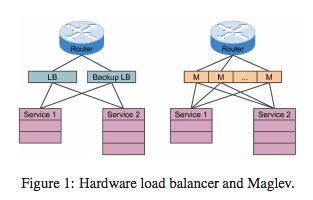
Maglev is Google’s network load balancer. It is a large distributed software system that runs on commodity Linux servers. Unlike traditional hardware network load balancers, it does not require a specialized physical rack deployment, and its capacity can be easily adjusted by adding or removing servers. (cite from paper)
Here is a Chinese reading note about Maglev: [論文中文導讀] Maglev : A Fast and Reliable Software Network Load Balancer (using Consistent Hashing)
The package keeps a lookup table of M slots (M must be prime) and assigns
every slot to one of the N backends:
- Preference lists — each backend gets two independent hashes of its name,
an
offsetand askip(xxhash, salted two different ways so the two values stay independent). Its preference list is(offset + j*skip) mod Mforj = 0..M-1. BecauseMis prime and1 <= skip < M, every list is a full permutation of the table. - Populate — backends take turns claiming the most preferred slot they have not lost yet, until every slot is owned. Turn-taking is what keeps the table balanced.
- Lookup —
Get(key)is one hash plus one table read, so it is O(1) and allocation free.
Because the backend list is sorted before the table is built, the result
depends only on the set of backends, never on the order they were added in.
Removing one backend out of N moves the ~1/N of keys it owned and leaves
almost every other key in place (see TestMinimalDisruption).
Pick M much larger than N — the paper suggests at least 100x — otherwise
the slots do not spread evenly. BigM (65537) is provided as a sane default.
Requires Go 1.24 or newer.
go get github.com/kkdai/maglev
package main

import (
	"errors"
	"fmt"
	"log"

	"github.com/kkdai/maglev"
)

func main() {
	names := make([]string, 5)
	for i := range names {
		names[i] = fmt.Sprintf("backend-%d", i)
	}
	// backend-0 ~ backend-4

	// The lookup table size must be a prime number and >= len(names).
	mm, err := maglev.NewMaglev(names, 13)
	if err != nil {
		log.Fatal("NewMaglev failed: ", err)
	}

	a, err := mm.Get("10.0.0.1")
	if err != nil {
		log.Fatal("Get failed: ", err)
	}
	b, _ := mm.Get("10.0.0.3")
	fmt.Println("10.0.0.1 ->", a) // 10.0.0.1 -> backend-4
	fmt.Println("10.0.0.3 ->", b) // 10.0.0.3 -> backend-0

	// Take backend-0 out. Only the keys it owned are reassigned.
	if err := mm.Remove("backend-0"); err != nil {
		log.Fatal("Remove failed: ", err)
	}

	a, _ = mm.Get("10.0.0.1")
	b, _ = mm.Get("10.0.0.3")
	fmt.Println("10.0.0.1 ->", a) // 10.0.0.1 -> backend-4 (unchanged)
	fmt.Println("10.0.0.3 ->", b) // 10.0.0.3 -> backend-4 (moved off backend-0)

	// Errors are sentinel values, match them with errors.Is.
	if err := mm.Remove("backend-0"); errors.Is(err, maglev.ErrBackendNotFound) {
		fmt.Println("already gone")
	}
}| Function | Description |
|---|---|
NewMaglev(backends []string, m uint64) (*Maglev, error) |
Build a ring with an m-slot lookup table. m must be prime. |
(*Maglev) Get(obj string) (string, error) |
Resolve a key to a backend. |
(*Maglev) Set(backends []string) error |
Replace the whole backend list. |
(*Maglev) Add(backend string) error |
Add one backend. |
(*Maglev) Remove(backend string) error |
Remove one backend. |
(*Maglev) Backends() []string |
Copy of the current backend list, sorted. |
(*Maglev) Clear() |
Drop every backend, keep the table size. |
Errors: ErrTableSizeNotPrime, ErrTooManyBackends, ErrBackendExists,
ErrBackendNotFound, ErrNoBackends. They are wrapped with context, so test
them with errors.Is instead of comparing strings.
All methods are safe for concurrent use.
The core algorithm is complete and stable. What is done, what is open, and how to pick up a task is documented in ROADMAP.md.
| Done | Open |
|---|---|
| Maglev hashing (permutation + populate) | Fuzz test for table invariants |
Thread-safe Add / Remove / Set / Get |
Runnable godoc examples |
| Order-independent, deterministic tables | []byte lookup API |
Sentinel errors with errors.Is support |
Pluggable hash function |
| Benchmarks and race-enabled CI | Incremental rebuild on Add / Remove |
| Weighted backends | |
| Backend health / draining | |
| Disruption metrics helper |
Contributions are welcome, from humans and from AI agents alike. ROADMAP.md is written to be picked up directly: every open task lists why it matters, what "done" looks like, which files to touch, and the traps to avoid. It also documents the invariants of this package — most notably that the key-to-backend mapping is a compatibility promise, so a change that silently remaps traffic will not be merged.
Before opening a PR:
go build ./...
go vet ./...
go test -race ./...
gofmt -l . # must print nothing- Wiki Consistent_hashing
- Go implementation of maglev hashing
- 每天进步一点点——五分钟理解一致性哈希算法(consistent hashing)
- Distributed Systems Part-1: A peek into consistent hashing!
It is one of my project 52.
This is under the Apache 2.0 license. See the LICENSE file for details.