prediction-error temporal adaptation · hidden rupture · fail-closed evidence


error → update → prediction → action → next-state estimate
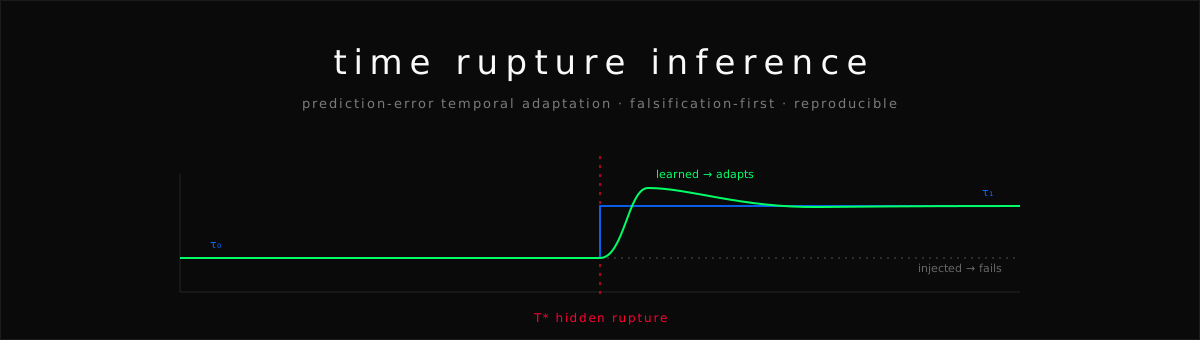
A hidden inter-event interval τ₀ ruptures to τ₁ at an unseen step T*.
The agent never sees τ₀, τ₁, T*, or the noise — only the realised
interval. It must infer the change from its own prediction error and
re-adapt. Nothing is handed to the learner.
S(t) → O(t) → B(t) → P(S(t+Δ)) → E(t) → U(t) → S(t+1)
state   obs    belief  prediction  error   update
Allowed claim. The learned agent adapts to hidden temporal regime shifts better than fixed and naive baselines under preregistered metrics, deterministic replay, no-leakage constraints, and ablation controls.
Forbidden claim. The agent has intelligence, consciousness, biological neuroplasticity, or understanding of time.
This release is prediction-error temporal adaptation — frozen and
scoped. Causal action (do(A) → S(t+Δ)) is the next pre-registered
lineage, deliberately not begun here.
| dimension | this system | explicitly NOT |
|---|---|---|
| learner | one scalar estimate m += gain·error + Page-Hinkley drift trigger |
a neural network / backprop / gradients |
| representation | a single inter-event interval scalar | a representational hierarchy or world model |
| "adaptation" | online error-driven parameter + gain update | cognition, understanding, or sentience |
| "neuroplastic-like" markers | 4 measured operational quantities, ablation-gated | biological neuroplasticity or brain fidelity |
| scope | one hidden-regime temporal-rupture benchmark | general intelligence / AGI |
| claim status | narrow, gate-enforced, falsifiable | an ontological claim about mind |
A machine-checkable lexicon (claims.yaml) plus scripts/claims_lint.py
is enforced in CI and pytest: external-facing text cannot assert cognition / neural-equivalence / AGI outside an explicit disclaimer block (all such terms are forbidden unless negated).
The risk this kills is interpretation-layer inflation, not a code defect.
| agent | post-shift MAE | role |
|---|---|---|
| oracle (knows the schedule) | 0.793 | irreducible noise floor |
| learned | 0.883 | the claim |
| exp_smoothing / moving_avg / last | 0.94 – 1.14 | naive baselines |
| injected (τ₀ hard-wired) | 8.003 | strawman, must fail |
Win-rate vs injected 1.000 · vs best naive 1.000 · on every shift. Ablation proves the drift mechanism necessary. Four neuroplasticity-like markers (synaptic / homeostatic / neuromodulation / extinction) are measured, never asserted.
| tag | verdict | what it records |
|---|---|---|
cti-os-v1-RED |
🔴 | drift detector poisoned by cold-start |
cti-os-v2-GREEN |
🟢 | base proof of life |
cti-os-v3-RED |
🔴 | two new controls mis-specified |
cti-os-v4-GREEN |
🟢 | doctoral critique closed → v0.1.0 |
| v5 (PR #1) | 🟢 | minimal causal-action: gain 0.868, action_null 0.000 |
| v6 | 🔴 | precision-weighting (Kalman) RED — principled ≠ better, kept |
| v7 | 🔴 | learned reservoir/SSM ≤ heuristic — NO_HEADROOM (boundary = task) |
| v8 | 🔴 | scalar-inexpressible env: trigger too rare, decorative |
| v8.1 | 🔴 | frequency fixed; inexpressibility real but carrier-masked |
| v8.2 | 🟠 | trigger-scoped+carrier-controlled: signal confirmed & carrier-robust; history-oracle under-specified (PARTIAL_RED) |
git checkout cti-os-v1-RED reproduces the failure. Scientific
thresholds are byte-identical v2→v4. No threshold was ever tuned to
green; every RED (v1, v3, v6, v7, v8, v8.1) and PARTIAL_RED (v8.2) is a
preserved artifact. Full state: docs/reports/LINEAGE_STATE.md.
pip install -e ".[dev]"
python scripts_prereg.py        # pin the falsifier, then commit it
PYTHONPATH=src pytest tests -q
PYTHONPATH=src python -m ctios.runner --mode full   # fail-closed gate
PYTHONPATH=src python -m ctios.automation            # full chain → runs/ UTC ledger
Exit 0 ⇔ GREEN. Evidence regenerated every run:
evidence/release_gate.md, evidence_ledger.jsonl,
NEGATIVE_RESULT_*.md, metrics_summary.csv, plots/.
src/ctios/   env · agents · drift · metrics · gates · ledger · runner · automation
prereg/      preregistration.yaml · falsifier_contract.yaml · sha_pin.txt
configs/     env · agents · metrics · experiment (the 30×3 grid)
evidence/    ledger · negatives · v4 baseline lock · release gate
tests/       CI-verified tests incl. no-leakage, shuffle kill-control, contract
invariants.yaml  machine-readable invariant register (enforced refs)
Formal specification (claim → falsifier → evidence → boundary):
docs/SPEC.md. Reproducible demonstration:
docs/DEMO.md.
- Trust architecture:
docs/TRUST_LAYER.md - Reproduction contract:
docs/REPRODUCIBILITY_CONTRACT.md - Claim/source matrix:
docs/CLAIM_SOURCE_MATRIX.md - References (claim-mapped):
docs/REFERENCES.md - Prior-art boundary map:
docs/PRIOR_ART_BOUNDARY_MAP.md - Review paths:
docs/REVIEW_PATH.md - Value positioning:
docs/VALUE_POSITIONING.md - Open structural gaps:
docs/OPEN_STRUCTURAL_GAPS.md
Citations do not expand scientific claims; they only map boundaries, prior art, and reviewer context.
TRI-Falsify is a falsification-first temporal inference and hypothesis-auditing apparatus. A pinned, hashed hypothesis runs through an adversarial battery into a sealed, reproducible verdict; on failure it auto-proposes a human-gated next experiment and never runs anything itself. Reviewer entry points:
docs/REVIEWER_ONE_PAGER.md— 60-second system identity.docs/SYSTEM_CARD.md— abstraction, inputs/outputs, boundaries.docs/CONFERENCE_ABSTRACT.md— workshop abstract.docs/CONTRIBUTION_CLAIMS.md— original vs prior art.docs/REPRODUCIBILITY_CONTRACT.md— clean-clone contract + frozen outputs.docs/FAILURE_TAXONOMY.md— defenses + residual risk.docs/ARCHITECTURE.md— pipeline + module map.
PR21 adds adversarial portability stress tests: eight deterministic degenerate probes run fail-closed against the battery over a seven-family synthetic portfolio plus a data-sensitivity scan, with a sealed evidence artifact and a CI gate. It improves battery coverage against degenerate probes; it does not assert real-world validity, and an external collaborator run of the private layer remains open.
One command for a reviewer: bash scripts/conference_smoke.sh.
One command for the adversarial gate: bash scripts/external_adversarial_demo.sh.
Start here if you are reviewing the private-safe redacted-hypothesis
R&D package: docs/INDI_README.md. One-command
check: bash scripts/indi_demo.sh. A redacted private hypothesis runs
through the apparatus with no proprietary mechanism, dataset, or
theorem content entering this repository.
docs/INDI_README.md— read this first.docs/INDI_EXECUTIVE_SUMMARY.md— 3-minute summary.docs/PRIVATE_RND_PROTOCOL.md— redacted hypothesis interface + IP boundary table.docs/INDI_REVIEWER_CHECKLIST.md— fastest useful path, then graded tiers.
v7 tests whether a learned sequence model (small GRU / linear state-space) beats the frozen v4 heuristic and a from-scratch conventional baseline on a harder multi-regime, partially-observable environment. The repo is prepared as a deterministic, cost-guarded, reproducible cloud-run artifact — Google is only an execution surface.
# local readiness gates (no cloud, no spend)
make test
make v7-prereg-check
make v7-cpu-smoke
make v7-artifact-check
make gcp-doctor          # actionable PASS/FAIL (install gcloud + auth)
make gcp-dry-run         # non-destructive plan, creates nothing
# only if all green AND operator-reviewed cost guardrails:
PROJECT_ID=cti-os-v7 ZONE=europe-west4-a APPLY=1 make gcp-cpu-run
APPLY=1 PROJECT_ID=cti-os-v7 make gcp-cleanup
Phase 1 is CPU-only; GPU is a documented, manually-unlocked future
phase. No command creates cloud resources unless APPLY=1 is explicit.
Budgets are alerts, not hard caps — see
docs/cloud/gcp_cost_guardrails.md.
Pre-registration: docs/prereg/cti_os_v7_preregistration.md.
Claim boundary: a learned sequence model with a representational advantage on a harder task — NOT intelligence, NOT AGI, NOT cognition.