English · 简体中文
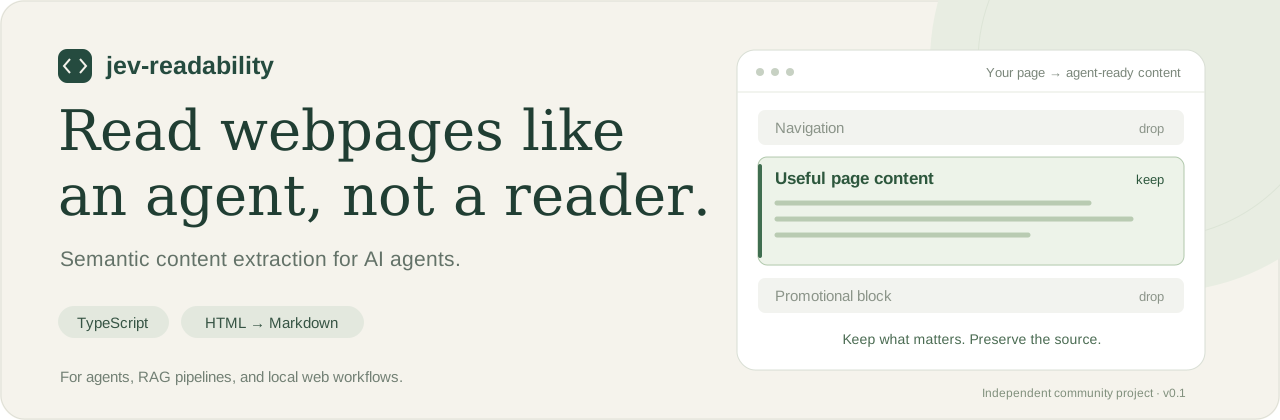
Read webpages like an agent, not a reader.
A semantic content extractor for AI agents. Mozilla Readability is optimized for turning articles into clean reader views; jev-readability is optimized for not missing information an agent may need across documentation, forums, products, listings and long pages. It partitions the DOM, lets TypeSafe JEV decide what belongs, and reconstructs Markdown, text and HTML from the original source — the model selects content, it does not rewrite it.


Benchmark · Quick start · Readability migration · Full evaluation · Large pages
Experimental development version. Independent community project, not an official Mozilla or TypeSafe product. The latest 140-page WCXB comparison includes real JEV calls and a recorded timeout. Results are specific to this public, previously examined cohort; they are not universal accuracy guarantees.
OpenJEV support: Jev is built by TypeSafe. This fork keeps TypeSafe as the default and adds optional support for OpenJEV, a free community gateway to the same Jev model — set
OPENJEV_API_KEY(orJEV_PROVIDER=openjev) to use it. Original project: https://github.com/hifizz/jev-readability by @hifizz.
140 real-world WCXB pages · 7 page types · real JEV API calls
| Engine | Word precision | Word recall | Word F1 | Anchor F1 |
|---|---|---|---|---|
Mozilla Readability 0.6.0 |
80.62% | 74.01% | 72.68% | 79.13% |
| JEV Typed | 72.86% | 94.93% | 79.90% | 92.99% |
JEV Generic agent |
74.08% | 94.76% | 80.64% | 93.01% |
How to read this: Readability is more precise and remains excellent on article pages. JEV is much more recall-oriented: it keeps more of the information that appears in the benchmark ground truth, which is useful when missing a warning, forum reply, spec table, code block or listing item is more costly than retaining a little extra text.
The Generic JEV run receives no supplied page-type label; every page uses the same agent mode. On this fixed cohort, Generic JEV's Word F1 is +7.95 percentage points over Readability. A paired, page-type-stratified bootstrap gives a 95% interval of +3.49 to +12.50 pp for that observed difference.
This is not a claim that JEV is universally better. The dataset is public and previously inspected, page types are equally weighted rather than web-prevalence weighted, one Typed run timed out, and model/API cost and latency are materially higher than local Readability. Article-only pages still favor Readability in this run: 97.12% vs 94.92% Word F1.
Read the full benchmark report · 140 per-page scores · Summary JSON · GitHub Actions run
Requires Node.js 22+, npm and Git. The demo interface is currently Chinese; documentation is available in English and Chinese.
git clone https://github.com/hifizz/jev-readability.git
cd jev-readability
npm install
npm run demo
Open http://127.0.0.1:4317. Load a fixture, paste HTML or open a local HTML file. Inspect extracted content, Markdown, HTML, JSON, block decisions and request statistics.
The default local heuristic is offline and makes no model calls. It is a development baseline, not free JEV inference. For real JEV, copy .env.example to .env, set TYPESAFE_API_KEY, restart and select JEV · 真实 API. The key stays on the server; candidate content is sent to TypeSafe and may incur charges. Failures are explicit, not silently relabeled as successful model results.
Install the current development code from GitHub:
npm install github:hifizz/jev-readability linkedomThe package is ESM with TypeScript declarations. linkedom is required by the Node HTML-string entry point, not by the browser core. GitHub installs compile through prepare; do not disable lifecycle scripts for this path. Registry release instructions are in the publishing guide; these benchmark commits do not themselves publish an npm version.
import { readFile } from 'node:fs/promises';
import { extract } from 'jev-readability/node';

const html = await readFile('./page.html', 'utf8');
const result = await extract(html, {
  url: 'https://example.org/page',
  mode: 'agent',
  apiKey: process.env.TYPESAFE_API_KEY,
});

console.log(result.markdown);
console.log(result.usage);
Save as extract.mjs, configure .env and run node --env-file=.env extract.mjs. Use { strategy: 'heuristic' } for an offline baseline; its model probabilities remain null.
The modes are article, documentation, forum, product and agent. Use agent when no page-type hint is available. The default library mode remains article; the example's explicit mode does not change that default.
If you already use @mozilla/readability, the easiest mental model is:
Keep your browser/fetch layer. Replace the article-only selection step with an agent-oriented semantic selection step.
Readability is still an excellent default for clean article reading. jev-readability is aimed at the cases where "main article" is too narrow: API docs, forum answers, product specifications, listings, collections, warnings, code blocks and other information an agent may need.
import { Readability } from '@mozilla/readability';

const article = new Readability(document.cloneNode(true)).parse();
console.log(article.textContent);import { extract } from 'jev-readability';
const page = await extract(document, {
mode: 'agent',
classifier,
});
console.log(page.markdown);The surrounding architecture can stay the same:
fetch / Playwright / browser
        ↓
     rendered DOM
        ↓
Readability.parse()        → clean article
        or
jev-readability.extract()  → agent-ready semantic Markdown
Use Readability when: you want a local, zero-inference-cost article reader with high precision.
Try jev-readability when: missing a warning, reply, spec table, code example, product field or listing item is more costly than retaining a little extra text.
Migration is incremental: run both extractors side-by-side, compare their output on your own pages, then route article-only workloads to Readability and agent ingestion workloads to jev-readability.
Both approaches extract existing content rather than generate prose. Selection policy and operational tradeoffs differ; neither is universally better.
| Dimension | Mozilla Readability | jev-readability |
|---|---|---|
| Selection | Local DOM/text heuristics | DOM partitioning + JEV block decisions; optional local baseline |
| Main workflow | Article extraction for reader view | Five content-selection criteria, including a generic agent mode |
| Execution | Local, no model API | JEV requires an API key/network; heuristic mode stays local |
| Output | Article HTML/text and metadata | Text/HTML/Markdown, metadata, block keep/role decisions |
| Inspection | Options and debug logging | Original blocks, probabilities, needsReview, usage and warnings |
| Metadata | Includes JSON-LD support | Basic HTML/meta fields; not equivalent coverage |
| Tradeoffs | No inference bill; Firefox integration | Extra latency/cost; higher recall but lower overall precision in the measured cohort |
| HTML safety | Separate sanitizer at display time | Narrow reconstruction allowlist; still use sanitizer/CSP at display time |
Readability can succeed on documentation, forums and product pages too; it is not limited to articles by a hard capability boundary. Neither library fetches pages or replaces browser rendering.
Sources: Mozilla API and security notes, TypeSafe API, our extraction spec and measured results.
140 WCXB pages, seven types × 20, fixed dataset commit and sample. All three engines were run together. Both JEV variants used jev-1.13.0, identical large-page settings and unchanged thresholds. Typed receives the supplied page-type label; Generic always uses agent without that label. This is the same previously examined cohort, not a new untouched test set.
| Engine | Word precision | Word recall | Word F1 | Anchor F1 | Without exception |
|---|---|---|---|---|---|
Mozilla Readability 0.6.0 |
80.62% | 74.01% | 72.68% | 79.13% | 140 / 140 |
| JEV Typed | 72.86% | 94.93% | 79.90% | 92.99% | 139 / 140 |
| JEV Generic | 74.08% | 94.76% | 80.64% | 93.01% | 140 / 140 |
Word metrics are per-page bag-of-words scores, macro-averaged across all scheduled pages, with failed extractions scoring zero. They do not measure whole-document correctness, order or formatting. Completion without exceptions is not an accuracy measure.
| Page type | Readability Word F1 | Typed Word F1 | Generic Word F1 |
|---|---|---|---|
| Article | 97.12% | 95.04% | 94.92% |
| Documentation | 86.44% | 93.95% | 93.73% |
| Forum | 62.16% | 77.20% | 81.60% |
| Product | 62.23% | 69.51% | 69.36% |
| Service | 78.79% | 78.73% | 79.18% |
| Listing | 60.28% | 77.46% | 77.68% |
| Collection | 61.77% | 67.39% | 67.97% |
What this supports: removing the supplied page-type hint did not eliminate the observed advantage over Readability in this cohort. Generic − Readability is +7.95 percentage points, with a 95% paired, type-stratified page-bootstrap interval of +3.49 to +12.50. Generic − Typed is +0.74 pp, interval −1.11 to +2.51: this does not establish Generic superiority. Intervals are not domain-clustered and do not cover repeated-model variability. Readability retains higher overall precision and higher article F1.
What failed: Typed page 4035 hit a request timeout and is scored zero. The Actions job is therefore red, while all 420 result rows and the report were saved. The old >500-block failure, page 4351, succeeded in both variants with 507 blocks → 2 regions → 27 requests per variant. It was not a perfect content extraction.
Two SPA references are empty/null. Keeping the historical empty-target convention gives the all-140 table; the separate 138 nonempty-reference Word F1 values are 72.29% / 79.61% / 80.36% for Readability / Typed / Generic. Empty anchor lists are not counted as perfect annotations.
Correction: the earlier 140-page JEV Word F1 was overstated as 79.97% because its failed page was excluded from the Word mean. The corrected prior score is 79.40%. The latest table is a separate run, not a relabeling of that old result. See the report for all corrected metrics and usage distinctions.
Full methodology and report · Summary JSON · All per-page F1 scores · Actual run · Corrected prior summary
The latest comparison made 1,842 HTTP attempts. Successful responses reported 22,356,322 input + 3,490,889 output tokens; the failed timeout attempt's accounting is unknown. These are usage subtotals, not an invoice. The existing TYPESAFE_API_KEY repository secret is sufficient: Actions → WCXB Typed vs Generic → Run workflow. Paid WCXB workflows are now manual-only and globally request/byte-bounded. The earlier 8-page synthetic suite remains a development smoke test, not a web benchmark.
HTML / rendered Document
  → clean and partition the DOM
  → batch keep/drop and role questions to JEV
  → validate typed decisions
  → reconstruct original text / HTML / Markdown
Headings, paragraphs, code, lists, quotes, tables and captions remain candidate content. The pipeline supports bounded requests/concurrency/retries, cancellation, usage reporting and explicit uncertainty handling. By default, uncertain blocks are kept and flagged; a classifier failure throws. Set fallback: 'heuristic' only for a deliberately labeled fallback.
JEV uses native state + questions, not Chat Completions. noul is a model probability, not a calibrated extraction-correctness guarantee. prepare() → custom Classifier → finalize() lets you replace the decision layer without replacing DOM processing.
Large-page support is opt-in; default guards remain unchanged.
const result = await extract(html, {
  apiKey: process.env.TYPESAFE_API_KEY,
  mode: 'agent',
  jev: {
    model: 'jev-1.13.0',
    largePage: { maxBlocks: 5000, regionBlocks: 500 },
    maxRequests: 128,
    totalTimeoutMs: 120_000,
  },
});
The Node entry point derives the DOM cap from largePage.maxBlocks. Structural heading/layout boundaries form regions of at most 500 candidates; IDs/order are preserved and all regions share one page-level request/deadline budget. This is not learned semantic segmentation or streaming HTML ingestion. The demo/proxy retains its original 500-candidate guard. Full limits and browser/server integration.
import { extract, createRemoteClassifier } from 'jev-readability';

const result = await extract(document, {
  mode: 'agent',
  classifier: createRemoteClassifier({
    endpoint: '/api/classify-content',
    headers: { 'X-CSRF-Token': csrfToken },
  }),
});
extract(document) clones the DOM. Supply csrfToken from your own authentication flow. Never embed a TypeSafe key in browser code. Your backend handles authentication, quotas and createJevClassifier. The demo server is loopback-only, not a production multi-tenant API. Large browser/core inputs require explicit bounded DOM and server-side classifier settings.
# Installed package + linkedom; local HTML, no model calls
npx --no-install jev-readability page.html --heuristic

# Set TYPESAFE_API_KEY in the shell first
# (or set OPENJEV_API_KEY / JEV_PROVIDER=openjev to use OpenJEV)
npx --no-install jev-readability page.html --mode documentation --out result.md
The CLI reads local HTML, not URLs. --url supplies metadata and resolves relative links. Formats: markdown, text, html, json. Results include title, metadata, text, html, markdown, method, blocks, warnings, usage and stats. Default guards include 2,000,000 HTML characters and 500 blocks. Long blocks may be sampled for classification; retained output still uses the complete original block.
Configuration guide (中文) · Types · JEV options
Not a crawler, browser renderer, general sanitizer or paywall bypass. It does not expand Shadow DOM/iframes or infer external-CSS visibility. Provide rendered DOM for SPAs. Obtain authorization before sending candidate content to TypeSafe. Prompt-injection defenses are limited; use a sanitizer, CSP and external-image policy when rendering results. Debug blocks include rejected content; normally pass only text or markdown to downstream agents.
npm install
npm run check
npm test
npm run test:node
npm pack --dry-run
The live evaluation job passed 60 Node tests before calling JEV. Node 22/24 CI, historical browser checks, the recorded live timeout and remaining validation gaps are separated in the test report. Contributions of legally shareable fixtures and independent labels are welcome via Issues. Larger untouched datasets, repeated trials and latency/billing audits remain further validation work.
MIT. Mozilla Readability and TypeSafe JEV are referenced descriptively; no affiliation or endorsement is implied.