


A fast, in-process reverse proxy for AWS S3 and IBM Cloud Object Storage, built on Cloudflare's pingora. It exposes a Python interface so you can plug in your own credential fetching, request signing, and authorization logic without touching the Rust core.
Note: This project is under active development. APIs are likely to change before 1.0.
- High-Level Documentation
- Detailed Documentation
- Code Documentation (cargo doc)
- Changelog
- Contributing
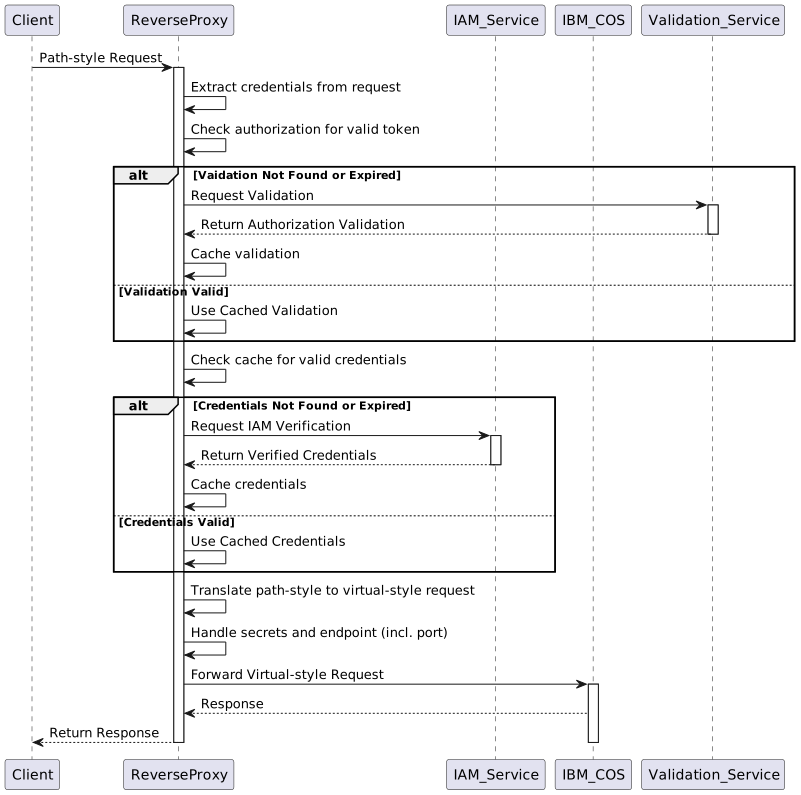
Object storage backends like IBM COS assign one endpoint and one set of credentials per storage instance, which may contain many buckets. Managing credentials and endpoints across instances becomes cumbersome, especially when clients expect a single uniform endpoint.
This proxy solves that by:
- Translating path-style requests (
http://proxy/bucket/key) to virtual-hosted-style (https://bucket.s3.region.host/key) on the way out. - Re-signing requests with the correct backend credentials, so clients only need one keypair pointed at the proxy.
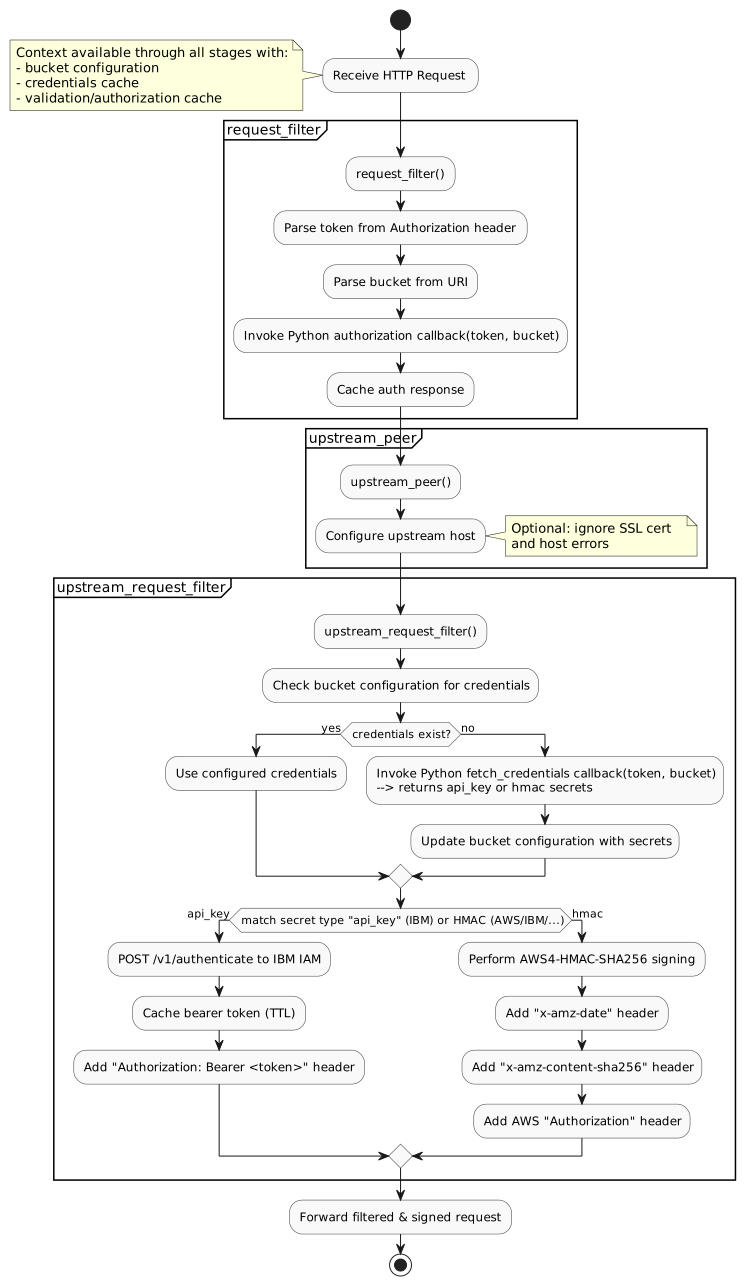
- Calling your Python functions for credential lookup and request authorization, with TTL-based caching.
- Compatible with any AWS S3-compatible client: aws-cli, boto3, polars, spark, datafusion, presto, trino, ...
- Normalises differences between S3-compatible backends so clients work regardless of whether the backend is AWS S3, MinIO, Garage, or IBM COS (see Backend compatibility below).
- Decouples frontend authentication (what the client sends) from backend authentication (what the storage expects).
- Python callables for credential fetching, HMAC key lookup, and per-request authorization.
- TTL-based credential and authorization caching.
- HTTP and HTTPS frontends (HTTPS supports HTTP/2).
- Configurable thread count and per-URL request counting.
- Presigned URL support with configurable max-usage limiting.
- Built-in Prometheus metrics endpoint (
/metrics) — on by default, opt-out via--no-default-features.
pip install object-storage-proxyOr install from source (requires Rust stable and uv):
git clone https://github.com/opensourceworks-org/object-storage-proxy.git
cd object-storage-proxy
uv run maturin develop --release
See DEVELOP.md for full develop/build instructions including Nix and Taskfile usage.
~/.aws/config:
[profile osp]
region = eu-west-3
output = json
services = osp-services
s3 =
    addressing_style = path

[services osp-services]
s3 =
endpoint_url = http://localhost:6190~/.aws/credentials:
[osp]
aws_access_key_id = MYCLIENTID
aws_secret_access_key = myclientsecret
The aws_access_key_id is passed as the token argument to your Python callables. It can be any identifier meaningful to your auth system: an internal client ID, an OAuth2 subject, etc.
import json
import os
from object_storage_proxy import ProxyServerConfig, start_server

def fetch_credentials(token: str, bucket: str) -> str:
    # Return either an IBM COS API key string, or a JSON string:
    # '{"access_key": "...", "secret_key": "..."}'
    return json.dumps({
        "access_key": os.environ["BACKEND_ACCESS_KEY"],
        "secret_key": os.environ["BACKEND_SECRET_KEY"],
    })

def lookup_secret(access_key: str) -> str | None:
    # Called to verify incoming HMAC signatures.
    return os.getenv("MYCLIENTSECRET") if access_key == "MYCLIENTID" else None

def authorize(token: str, bucket: str, request: dict) -> bool:
    # Return True to allow, False to deny.
    return True

cos_map = {
    "my-bucket": {
        "host": "s3.eu-de.cloud-object-storage.appdomain.cloud",
        "region": "eu-de",
        "port": 443,
        "ttl": 300,
    },
}

config = ProxyServerConfig(
    cos_map=cos_map,
    bucket_creds_fetcher=fetch_credentials,
    hmac_fetcher=lookup_secret,
    validator=authorize,
    http_port=6190,
)

start_server(config)uv run python my_server.pyaws s3 ls s3://my-bucket/ --profile osp
aws s3 cp file.txt s3://my-bucket/file.txt --profile ospA fuller example with HTTPS, HMAC keystores, and IBM COS is in examples/minimal_server.py.
| Parameter | Type | Required | Default | Description |
|---|---|---|---|---|
cos_map |
dict |
yes | Bucket-to-backend mapping. See below. | |
hmac_keystore |
list[dict] |
no | [] |
Static HMAC keypairs accepted on the frontend. |
bucket_creds_fetcher |
callable(token, bucket) -> str |
no | Called once per bucket to fetch backend credentials. Return an IBM COS API key string or {"access_key":...,"secret_key":...} JSON. |
|
hmac_fetcher |
callable(access_key) -> str | None |
no | Called per request to resolve a secret key from an access key, used to verify incoming signatures. | |
validator |
callable(token, bucket[, request]) -> bool |
no | Called per request to authorize access. Cached by (token, bucket) for the bucket TTL. | |
http_port |
int |
one of http/https required | HTTP listener port. | |
https_port |
int |
one of http/https required | HTTPS listener port (HTTP/2 supported). | |
threads |
int |
no | 1 |
Number of worker threads. |
verify |
bool |
no | None |
Disable TLS verification on upstream connections. Development only. |
skip_signature_validation |
bool |
no | False |
Skip verification of incoming request signatures. Development only. |
max_presign_url_usage_attempts |
int |
no | 3 |
Max times a presigned URL may be used before being rejected. |
server_name |
str |
no | "osp" |
Server name included in log output. |
metrics_port |
int |
no | None |
Port to expose the Prometheus /metrics scrape endpoint. When None no endpoint is started. |
Each key is the bucket name as the client addresses it. The value is a dict:
| Field | Required | Description |
|---|---|---|
host |
yes | Backend hostname |
port |
yes | Backend port (typically 443) |
region |
no | AWS/COS region string |
apikey |
no | IBM COS IAM API key (mutually exclusive with access_key/secret_key) |
access_key |
no | Backend HMAC access key |
secret_key |
no | Backend HMAC secret key |
ttl |
no | Credential and auth cache TTL in seconds. Default 300. Set to 0 to disable. |
addressing_style |
no | "path" or "virtual" (default "virtual") |
is_tls_enabled |
no | Defaults to true when port is 443 |
# Fetch backend credentials for a bucket.
# token: the access key from the client's Authorization header.
# Return an IBM COS API key string, or JSON: '{"access_key":"...","secret_key":"..."}'
def fetch_credentials(token: str, bucket: str) -> str: ...

# Resolve the secret key for an access key (used to verify incoming signatures).
def lookup_secret(access_key: str) -> str | None: ...

# Authorize a request. request dict contains: method, path, query, headers.
def authorize(token: str, bucket: str, request: dict | None = None) -> bool: ...S3-compatible backends differ in how strictly they follow the AWS S3 specification. OSP irons out these differences so clients don't need to care which backend is underneath.
| Behaviour | AWS S3 spec | Garage | MinIO | OSP handling |
|---|---|---|---|---|
Content-MD5 on DeleteObjects |
Required | Accepted without it (lenient) | Enforced (400 if missing) |
Forwarded when present; test suite injects it because botocore ≥ 1.43 no longer sends it by default |
x-amz-tagging-directive on CopyObject |
COPY or REPLACE |
N/A (tagging not implemented) | ✅ enforced | Header is in OSP's forwarding allowlist — was previously stripped |
PutObjectTagging / GetObjectTagging |
Supported | NotImplemented |
✅ | Forwarded; backend limitation is transparent |
If-Match / If-Unmodified-Since on GET |
Must return 412 |
Returns 200 (header ignored) |
✅ Returns 412 |
Forwarded; backend limitation is transparent |
ListMultipartUploads with Prefix ending in / |
Returns matching uploads | ✅ works | Returns empty list (MinIO bug) | Forwarded; MinIO limitation documented as xfail in the test suite |
botocore ≥ 1.43 note: Recent versions of boto3 switched from
Content-MD5tox-amz-checksum-crc32for body integrity onDeleteObjects, regardless of therequest_checksum_calculationsetting.Content-MD5is still required by MinIO. If you use boto3 ≥ 1.43 directly against MinIO through OSP you may need to injectContent-MD5manually via abefore-signevent hook — see DEVELOP.md for details and example code.
The integration test suite covers all of the above: every test runs parametrized over both Garage and MinIO backends, so regressions surface immediately. See DEVELOP.md for the full compliance table and the internal proxy fixes that enable it.
The proxy ships with a built-in Prometheus scrape endpoint. Set metrics_port to enable it:
config = ProxyServerConfig(
    cos_map=cos_map,
    http_port=6190,
    metrics_port=9090,   # exposes http://localhost:9090/metrics
)
Then scrape it:
curl http://localhost:9090/metricsOr add a Prometheus scrape config:
scrape_configs:
  - job_name: object-storage-proxy
    static_configs:
      - targets: ["localhost:9090"]
Exposed metrics (all prefixed osp_):
| Metric | Type | Labels | Description |
|---|---|---|---|
osp_requests_total |
Counter | method, bucket, status |
Total proxied requests |
osp_request_errors_total |
Counter | method, bucket, error |
4xx / 5xx responses |
osp_transfer_bytes_total |
Counter | direction (rx/tx), bucket |
Bytes transferred |
osp_presigned_url_hits_total |
Counter | bucket |
Presigned URL uses |
osp_presigned_url_rejected_total |
Counter | bucket |
Presigned URLs rejected (over limit) |
osp_active_connections |
Gauge | — | In-flight connections |
osp_memory_bytes |
Gauge | — | Resident set size (Linux only) |
osp_build_info |
Gauge | version, rustc |
Static build metadata |
osp_request_duration_seconds |
Histogram | method, bucket |
End-to-end request latency |
osp_response_size_bytes |
Histogram | method, bucket |
Response body size |
To build without the metrics endpoint:
maturin develop --no-default-featuresGenerate a self-signed certificate for local development:
openssl req -x509 -nodes -days 365 \
  -newkey rsa:4096 \
  -keyout key.pem \
  -out cert.pem \
  -config localhost.cnf

export TLS_CERT_PATH=/path/to/cert.pem
export TLS_KEY_PATH=/path/to/key.pem
Then pass https_port=8443 to ProxyServerConfig.
See .env.example for the full list. Key variables:
| Variable | Description |
|---|---|
COS_API_KEY |
IBM COS IAM API key |
AWS_ACCESS_KEY / AWS_SECRET_KEY |
AWS backend credentials |
TLS_CERT_PATH / TLS_KEY_PATH |
Paths to TLS certificate and key |
OSP_ENABLE_REQUEST_COUNTING |
Set to true to enable per-URL request counting |
AWS_REQUEST_CHECKSUM_CALCULATION |
Set to WHEN_REQUIRED to avoid checksum errors with AWS CLI v2 |
Pre-built wheels are published to PyPI for the following platforms:
| Platform | Architecture | Libc | Python |
|---|---|---|---|
Linux (ubuntu-22.04) |
x86_64 | glibc (manylinux) | 3.x |
Linux (ubuntu-22.04) |
aarch64 | glibc (manylinux) | 3.x |
Linux (alpine 3.18) |
x86_64 | musl (musllinux_1_2) | 3.x |
macOS (macos-14) |
aarch64 (Apple Silicon) | — | 3.x |
| Source distribution | any | any | 3.x |
Windows builds are not currently active in CI. An sdist is always published so you can build from source on any platform with Rust stable installed.
See BUILD.md.
These backlog items are currently not yet implemented:
- Pass path and method to Python callbacks; cache by (token, bucket, path, method)
- Expose pingora server and service configuration directly to Python
- Spark streaming write support
- AWS CLI checksum workaround (aws/aws-cli#9214)
- Allow same bucket name on different providers
- Pluggable distributed cache
See CONTRIBUTING.md. Bug reports and feature requests go through GitHub Issues.